


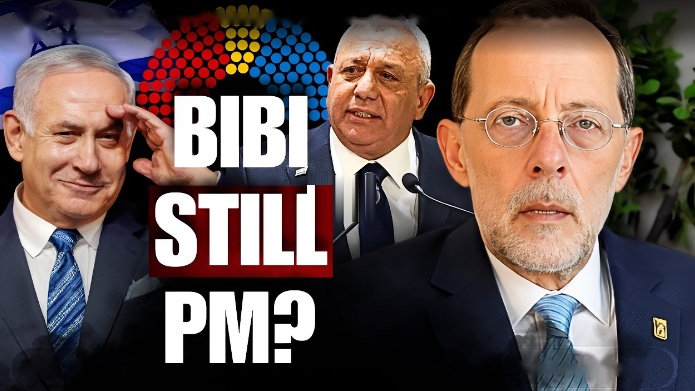
Days after taking his seat in the 26th Knesset, Zehut chairman MK Moshe Feiglin warned that Israel is “at the edge of the cliff” of its existence as a Jewish state, and laid much of the blame on his own national camp.
Speaking with Israel365 founder Rabbi Tuly Weisz on the Universal Zionist podcast, Feiglin said the right has never offered a real ideological alternative to the idea of a “state of all its citizens.” He announced that his first bill will add the words “the State of the Jewish Nation” to Israel’s official name.
Feiglin returns to the Knesset after more than a decade. He was elected as the sole Zehut representative on a joint slate with Finance Minister Bezalel Smotrich’s Religious Zionist Party, which won six seats in the October 27 election.
A right-wing public, a left-leaning Knesset
Weisz opened with the question many on the right are asking. If the country moved right after October 7, why does the new Knesset appear to lean left?
“You’re touching a very sore point,” Feiglin said. “After the 7th of October, all surveys show that the Israeli public moved to the right, and not only to the right, but toward a deeper Jewish identity.” On that basis, he said, Prime Minister Benjamin Netanyahu should have had no trouble forming a government.
Feiglin argued that “left” and “right” no longer describe Israel’s real divide. The true split, he said, is between a Jewish bloc, those who see themselves “first of all as Jews and only then as Israelis,” and a civic bloc.
“If you look under a microscope for the ideological differences between Netanyahu and Eisenkot, you won’t find them,” he said of Gadi Eisenkot. He credited Netanyahu with greater ability, but said that on values, voters seeking a more Jewish-oriented government “could not see the difference.”
He also said responsibility for October 7 rests with the government that was in power. “The buck stops here,” he said, quoting President Truman. In his view, the national camp failed by not winning the war in its first weeks and not showing the public what set it apart from the left.
Feiglin traced the problem back to Menachem Begin’s 1977 victory. Begin, he said, also could not draw a clear line between himself and the left, and went on to give up Sinai and evacuate Yamit.
“A political October 7th”
Feiglin repeated his charge that the election saw a “political jihad” by the Arab parties, which won 19 seats. He called it “the political 7th of October” and alleged it was “financed by Qatar.”
He said the allegations should have led to the election being cancelled and run again. He rejected the argument that the alleged interference did not change the outcome. In his view, Israel’s democracy was violated by Qatar, and a “big black cloud of delegitimization” now hangs over the Knesset.
Still, Feiglin said the Arab seat count is not the core issue. “It doesn’t matter if the Arabs got 19 seats or 15 seats,” he said. “The point is that the blocs remain as they are. Israelis basically did not move from their political positions from before the 7th of October.”
He drew a direct line between the two attacks. On October 7, he said, Hamas attacked Israel as a Jewish state, rejecting Jewish sovereignty “on any square inch of the land of Israel.” On election day, he argued, Arab citizens of Israel “did the same thing politically,” using Israel’s own democracy against it.
Feiglin went further, saying there is no meaningful distinction between radical Islam and Islam. He cited Professor Gad Saad, whom he heard say on Joe Rogan’s podcast that what Israel saw on October 7 “was Islam, not radical Islam.” Feiglin said the Islamist lawmakers in the Knesset share “the same dream” as Hamas in Gaza.
First bill: “Israel, the State of the Jewish Nation”
Feiglin said Zehut’s first bill will add a phrase to the country’s official name: “Israel, the State of the Jewish Nation.”
He compared it to the United States. “You have the United States of America, not just America,” he said. The new name, he said, should appear “on everybody’s ID, on his driving license, on every official paper” issued by the state.
He rejected the “Jewish and democratic” formula adopted in the 1990s. “It is Jewish, period,” he said. “This is who we are, and it has to stay like this.”
Weisz raised a recent claim by Rabbi Rafi Eis, Israel365 News correspondent, that a government ruled by a minority is the beginning of tyranny. Feiglin said a form of tyranny already exists. The Supreme Court and other unelected bodies, he said, “see themselves as above the Knesset and in many ways are running the show.”
He again took aim at the “Jewish and democratic” definition. “I’ve never heard that England is an English and democratic state, or that France is a French and democratic state,” he said. He cited former Supreme Court President Aharon Barak’s vision of Israel as a state of its citizens, and charged that the extreme left wants to erase Israel’s Jewish identity entirely.
He also said the new majority used Arab votes in its first Knesset vote to gain control over the chamber’s organization, including the choice of a Knesset speaker. “I have no problem with the Arabs,” he said. “They are saying the truth. I have a problem with the left who opened the door for them, and with the right that never defined who the enemy is.”
The Third Temple as national identity
Feiglin, long known for calling to rebuild the Third Temple in Jerusalem, pointed to the Temple pin on his jacket. He said Israel forgot the dream its great-grandparents carried for 2,000 years and tried to reinvent itself as “a normal nation, a nation like all the nations.”
The Jewish people, he said, was created “to fix the world in the kingdom of God.” That meant forming a nation through the covenant at Sinai, entering the Land of Israel, and building “a palace to God” on the Temple Mount “to be the light to the nations.”
“It’s not a religious thing,” Feiglin said. “It’s a national identity thing.” He noted that many non-religious Zehut members, including in Tel Aviv, wear the same pin.
He compared today’s Israel to the generation that left Egypt but wanted to stay in the desert, and so died there. Abandoning the vision, he warned, means losing the reason for the nation’s existence.
Feiglin does not expect the Temple to be built by a narrow Knesset vote. “The spirit has to be built, the consciousness has to be built,” he said. “We have to start talking about it, and of course we have to go to the Temple Mount, pray there, and show our connection to the place.”
“A spiritual war” beyond Israel
Weisz turned to the United States, noting that more than 250 Muslim officials now hold elected office there. He asked how the themes of Feiglin’s book Israel Is Just the Beginning apply to America.
Feiglin pointed to New York’s Muslim mayor as a sign of the times, and described two converging forces. The first is progressivism, which he said holds “there is no God, and therefore there is no identity and no truth.” Once Western civilization lost its foundation in the Ten Commandments, he argued, “the gate was totally open” to Islam. “It happens in Europe, and of course it happens also in America.”
Israel will resist where others have not, Feiglin said, because Judaism is both a religion and a nationality and the two cannot be separated. “Inside every Jew there is a Jewish identity, known or maybe hidden, but it’s there. You cannot take it away from us.”
He described Israel as facing both a Muslim offensive and a Western one, citing economic pressure from Britain, France and the Netherlands. He likened the moment to an alliance of Ishmael and Esau against Israel.
Feiglin recalled saying on October 7 itself that “this is a spiritual war” that Israel had to win quickly. If it did not, he warned then, antisemitism would surge worldwide and Islamist forces would advance across the West. “This is exactly what’s happening today,” he said. “We have to win this war in Israel, not just for us, but for the entire Jewish nation and for all humanity.”
“We will rise from this”
Asked for practical next steps after setbacks in both the Israeli and American elections, Feiglin agreed the national camp is in a weaker position. “We have only ourselves, the Netanyahu government and Netanyahu himself to blame,” he said.
He argued that Netanyahu missed the chance to break with the Oslo framework after October 7. He said Israel should have taken over Gaza, evacuated its entire Arab population to Egypt, and cut off the water supply to force Hamas out of the tunnels with the hostages. He noted that President Trump had initially called for evacuating Gaza, and asked why Netanyahu did not seize the opportunity.
The reason, Feiglin charged, is that Netanyahu “never understood who the real enemy is” and still clings to the vision of a state of all its citizens. “The Gaza Strip is part of the Land of Israel. It’s ours,” he said. Because Israel would not say so, he argued, the world now chants “from the river to the sea.”
He was sharply critical of the current arrangement in Gaza. He said Israel is sending some 700 truckloads of supplies that reach Hamas and is helping build “a Hamas state” under the patronage of the United States, Qatar and Turkey.
Feiglin ended on a defiant note. “Don’t worry, we will rise from this,” he said. “What we need to do is create a leadership with the right consciousness. Our Father in Heaven, the leader of history, will give us more opportunities. We have to make sure that next time, the leadership of Israel knows what to do with them.”

Six weeks to topple Netanyahu: Eisenkot gets the mandate as Israel stares down another election
Tamar Stein