The Assyrian Empire carried the tribe of Manasseh into exile more than 2,700 years ago, and the State of Israel is still bringing them home. On Wednesday the government approved bringing approximately 600 additional immigrants from the Bnei Menashe community in northeastern India to Israel, allocating a dedicated budget of NIS 45.1 million for the initiative.
The decision, advanced by Aliyah and Absorption Minister Ofir Sofer with budgetary approval from Finance Minister Bezalel Smotrich, is intended to ensure that members of the community can continue immigrating to Israel during the first half of 2027.
“Bringing our Bnei Menashe brothers and sisters home to Israel is a great privilege and puts the Zionist vision into practice,” Smotrich said. He praised “the excellent work of Aliyah and Integration Minister Ofir Sofer and the budget we approved today.” He added that the government wants to “give them the best possible and dignified absorption process.”
The new immigrants are expected to come from the Indian states of Mizoram and Manipur. This is the third phase of a multiyear plan to bring the community’s remaining members to Israel. A rabbinical delegation headed by the Rishon LeZion, Israel’s Sephardic chief rabbi, approved the list of candidates in coordination with the Population and Immigration Authority. Priority goes to keeping entire families together and to reuniting families with relatives already in Israel.
The immigrants will spend up to six months in absorption centers, where they study Hebrew and complete a full conversion process. They then receive new immigrant status and Israeli citizenship and move into permanent housing in local municipalities.
Operation Wings of Dawn
The decision continues the national effort launched a year ago. In November 2025, the proposal, submitted by Prime Minister Benjamin Netanyahu and Aliyah and Integration Minister Ofir Sofer, will enable approximately 5,800 members of the northeastern Indian community to immigrate by 2030. Netanyahu said at the time: “I welcome the important and Zionist decision adopted today by the government, which will bring about an additional wave of immigration of the Bnei Menashe community to the Land of Israel.”
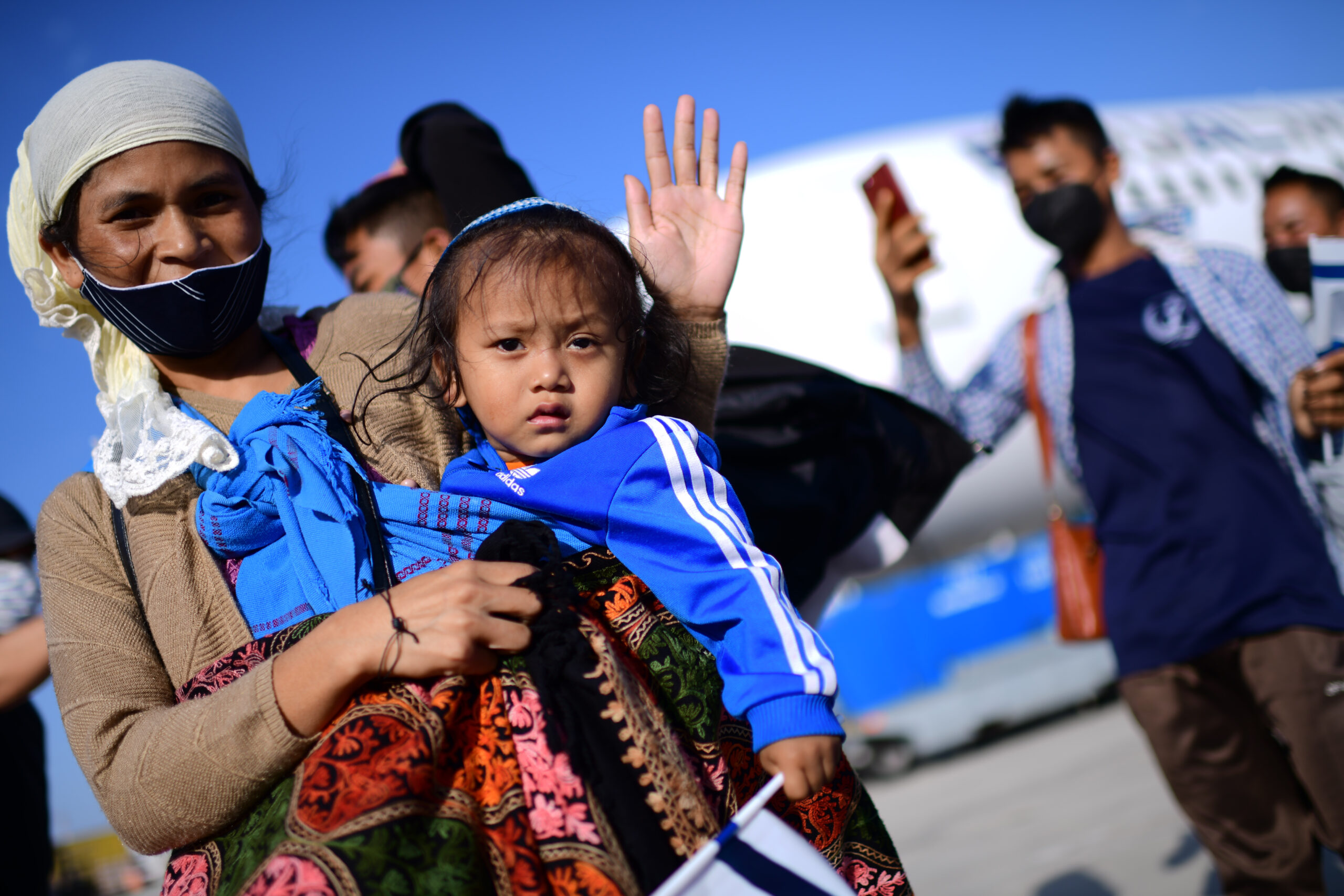
As Israel365 News reported in April, the airlift carries a biblical name: Miftza Kanfei Shachar, “Operation Wings of Dawn.” On 23 April 2026, the first group of around 240 to 250 people arrived at Ben Gurion Airport and were welcomed by supporters. “We are making history as we bring the entire Bnei Menashe community to Israel,” Sofer said that day. Jewish Agency chairman Doron Almog added, “Aliyah is the State of Israel’s growth engine, and every new oleh is a lighthouse of hope.”
Later, Netanyahu pledged to bring the entire Bnei Menashe community from northeastern India to Israel within the next four years, as he joined Finance Minister Bezalel Smotrich, Aliyah and Integration Minister Ofir Sofer and Nof Hagalil Mayor Ronen Plot in welcoming new immigrants. Since the beginning of the year, approximately 600 members of the Bnei Menashe community have immigrated to Israel, with another 600 expected to arrive by the end of 2026.
Today, roughly 5,000 Bnei Menashe live in Israel, primarily in northern towns such as Kiryat Yam and Nof Hagalil, with thousands more still in India. “Nof HaGalil has the ability to absorb everyone,” Mayor Plot said. “The largest Bnei Menashe community in Israel lives here, about 1,500 people.”
The airlift is also a rescue. Clashes in Manipur between the Meitei and Kuki communities have killed more than 250 people over nearly three years, and the Bnei Menashe have been caught in the fighting. According to the International Christian Embassy Jerusalem, synagogues and homes have been burned, and more than 2,000 people displaced.
Christians are helping to carry them home. The ICEJ is sponsoring 100 of the first 600 Bnei Menashe in this ongoing effort in partnership with the Jewish Agency For Israel. At the airport, an ICEJ staffer recalled one young immigrant’s request: “His grandma is on this flight, and he has not seen her for six years—can you take a picture of us?” The International Fellowship of Christians and Jews is flying members of the community to Israel on its Freedom Flights.
Who Are the Bnei Menashe?
The Bnei Menashe, a community from the northeastern Indian states of Manipur and Mizoram, trace their ancestry to the biblical tribe of Menashe, one of the Ten Lost Tribes of Israel. As Israel365 News has reported, some of the Bnei Menashe have an oral tradition that the tribe traveled through Persia, Afghanistan, Tibet, China, and on to India where they live today. In 1951, one of their tribal leaders reported having a dream that his people’s ancient homeland was Israel, and the community began studying and practicing Judaism in the 1970s.
A pivotal breakthrough came on March 30, 2005, when Sephardi Chief Rabbi Shlomo Amar formally recognized the Bnei Menashe as descendants of the tribe of Manasseh, calling them zera Yisrael (“seed of Israel”). Roughly 4,000 Bnei Menashe have arrived in Israel over the past two decades under previous government decisions.
Much of that work was led by Shavei Israel and its founder, Michael Freund. In December 2020, Israel365 News covered a chartered flight that brought 250 Bnei Menashe home. Freund has said, “After 27 centuries of exile, this lost tribe of Israel is truly coming home, but we will not rest until all the remaining Bnei Menashe still in India are able to make aliyah as well.”
The new immigrants arrive ready to defend the country. In January 2024, 100 days into the war in Gaza, Israel365 News reported that hundreds of Bnei Menashe rallied in Aizawl, Mizoram, asking to immigrate immediately so they could join the IDF. Of Bnei Menashe immigrants of military age, nearly all men (99%) and 10% of women join the IDF, with 90% of females performing sherut leumi, national service due to religious reasons. “The Bnei Menashe are dedicated Zionists and passionate about the State of Israel, its people and their security,” Freund said.
That raises a question the Sages argued over nearly 2,000 years ago: did the prophets promise that the ten lost tribes would ever come home?
The Debate in the Talmud
The Mishnah (Sanhedrin 110b) records a dispute between two of the greatest Sages of the second century CE. Rabbi Akiva taught that the ten tribes exiled by Assyria will never return. He cited the verse describing God casting them “into another land, as this day” (Deuteronomy 29:27). Just as a day passes and does not come back, Rabbi Akiva said, the tribes will not return.
Rabbi Eliezer read the same words the opposite way. A day grows dark, and then light returns. The ten tribes went into darkness, and light will come back to them.
The prophets side with Rabbi Eliezer. Isaiah describes a second ingathering, distinct from the return from Babylon:
“And He will set up an ensign for the nations, and will assemble the dispersed of Israel, and gather together the scattered of Judah from the four corners of the earth.” (Isaiah 11:12)
Isaiah uses two different words. Judah, the southern kingdom, is nefutzot, “scattered.” The ten northern tribes are nidchei Yisrael, “the dispersed,” or more literally, “the ones pushed away.” These are the tribes pushed so far from the center that the world forgot them, and the prophet promises that God will gather them too.
Ezekiel describes how it will happen. God commands the prophet to take two sticks, one for Judah and one for “Joseph, the stick of Ephraim,” and join them into one in his hand. Manasseh and Ephraim were the two sons of Joseph, so the Bnei Menashe belong to the stick of Joseph. God explains the sign:
“Thus saith the Lord GOD: Behold, I will take the children of Israel from among the nations, whither they are gone, and will gather them on every side, and bring them into their own land.” (Ezekiel 37:21)
Freund told Israel365 News that the order of events matters. “The return of the Bnei Menashe is a clear and explicit indication that we have entered a new stage of the Redemption,” he said. “The prophecy clearly states that the tribes of Israel and Judah will return separately, and that is what is happening right now with the Bnei Menashe.” First Judah came home, and now the stick of Joseph is following.
Freund also pointed to a role for the nations. “The nations of the world have a direct role to play in returning the jewish people to Israel,” he said, citing Isaiah:
“Thus saith the Lord GOD: Behold, I will lift up My hand to the nations, and set up Mine ensign to the peoples, and they shall bring thy sons in their bosom, and thy daughters shall be carried upon their shoulders.” (Isaiah 49:22)
Hidden Like Fish
The name of the airlift comes from King David’s words about the reach of God’s hand: “If I take the wings of the morning, and dwell in the uttermost parts of the sea; even there would Thy hand lead me, and Thy right hand would hold me” (Psalms 139:9–10). For 27 centuries, the descendants of Manasseh lived at the uttermost parts of the earth, in the hills along India’s border with Burma, and God’s hand held them.
When Jacob blessed Manasseh and Ephraim on his deathbed, he prayed that they would veyidgu larov bekerev ha’aretz, “grow into a multitude in the midst of the earth” (Genesis 48:16). The Hebrew verb veyidgu comes from dag, fish. The Sages taught that Joseph’s descendants would multiply like fish, which live hidden beneath the surface. The tribe of Manasseh disappeared beneath the surface of history for 2,700 years. Now it is rising out of the water, one flight at a time, and landing in the Galilee.
Rabbi Akiva said the day of the ten tribes had passed. In Nof Hagalil and Kiryat Yam, 5,000 descendants of Manasseh are living proof of Rabbi Eliezer’s answer. The darkness lasted 27 centuries, and the dawn has wings.