


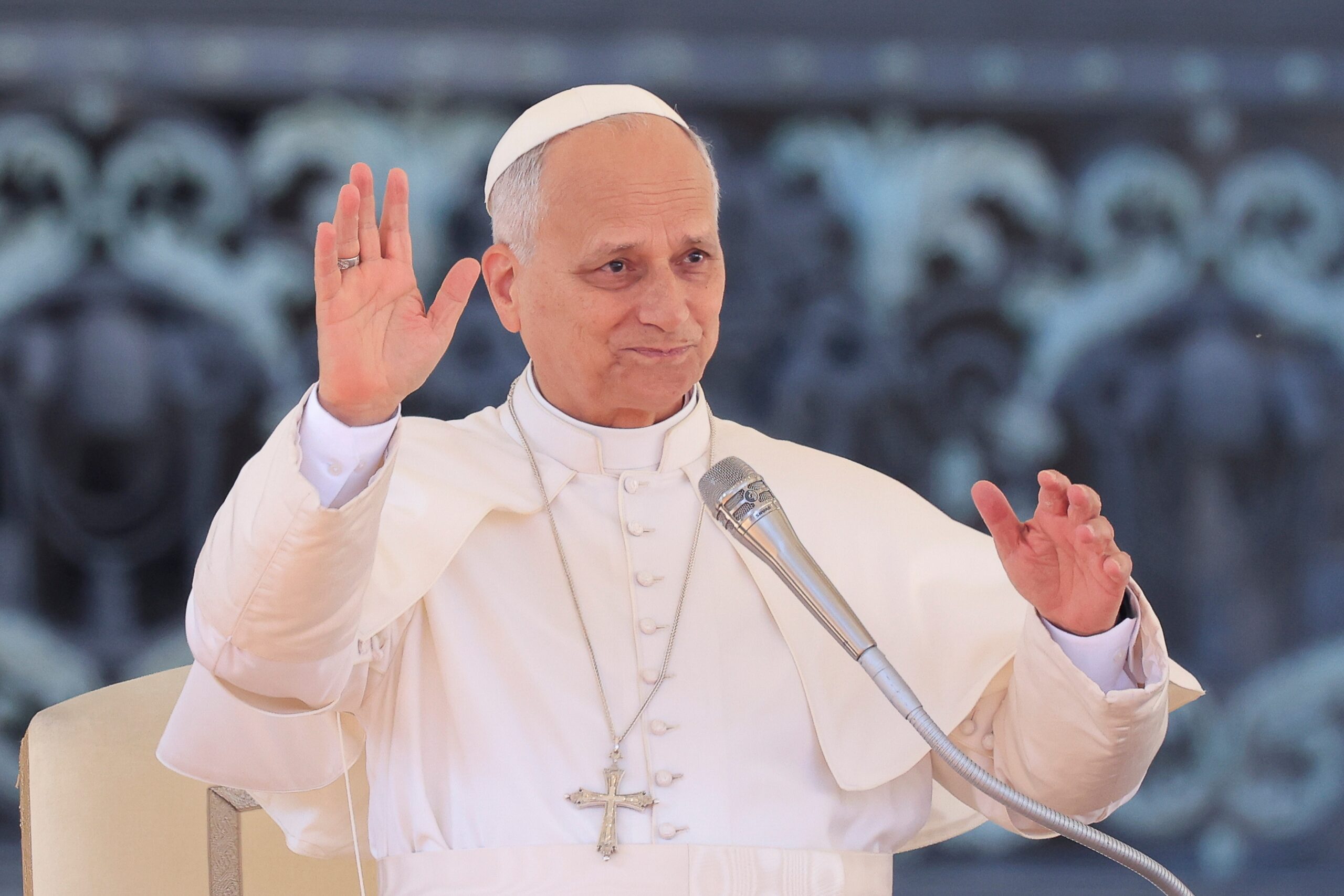
Standing before about 100 religious leaders in Argentina’s Foreign Ministry, Pope Leo XIV chose his words with precision. He spoke of “the people of Israel” rather than “the Jews” or “Judaism.” He put that bond first, ahead of the general courtesies usually offered at interfaith events, and the rabbis in the room noticed.
“I wish to reaffirm the spiritual bond that unites the Church with the people of Israel,” the pope said at the November 9 gathering in San Martín Palace in Buenos Aires, as reported by JTA and The Jerusalem Post. He went on to express “our sincere respect for what is holy and true in the different religious traditions.”
The meeting came on the second day of the pontiff’s four-day visit to Argentina, which began November 8 after a stop in Uruguay. Earlier that day, Pope Leo visited a residential care facility for people with disabilities. He then celebrated Mass in Palermo Park before a crowd estimated at more than two million. The trip continues to Córdoba province and Luján before the pope leaves for Lima, Peru.
Representatives of AMIA and DAIA, the main bodies of Argentina’s Jewish community, attended. The ceremony had no religious music. It opened with a live orchestra playing a tango by Astor Piazzolla and closed with a minute of silence for world peace and for victims of violence.
In his remarks, the pope described Argentina as a nation built by successive waves of believers. “Argentina’s national identity has taken shape as a melting pot of races, cultures and religions,” he said. “At first, they were Catholics, Protestants and Jews, and later many others.”
“A Pleasant Surprise”
Jewish leaders in the room welcomed the statement, particularly its timing.
“The statement was a pleasant surprise to us, especially at a time when antisemitism is resurfacing, as it is in Europe,” said Rabbi Isaac Sacca, chief rabbi of the Sephardic Community of Buenos Aires and president of Menora. “That is very meaningful to our people.”
Rabbi Sacca described the event as “moving on several levels.” He added, “All the different religious communities that coexist in harmony and peace in Argentina came together.” He also noted the secular framing: “There was a tango performance at the beginning, so there were no religious elements in the ceremony.”
Rabbi Marcelo Polakoff of the World Jewish Congress in Latin America focused on the pope’s wording. “Hearing those words from Pope Leo himself, just a few meters away, was very comforting,” he said. “His use of language about honoring the People of Israel struck me as significant.”
Rabbi Polakoff said the work of Catholic-Jewish relations has to continue. “I believe we must remain engaged in this effort,” he said. “I think we have an exceptional partner in Leo XIV to do so.”
Rabbi Ariel Stofenmacher is rector of the Latin American Rabbinical Seminary and of the Isaac Abarbanel University Institute. “The pope emphasized the need to strengthen relations with the people of Israel and with Judaism,” he said. “I think Pope Leo is showing that he is a leader on a global scale.”
AMIA Chief Rabbi Eliahu Hamra pointed to the pope’s message on human dignity. “The pope emphasized at the meeting that religions are guardians of human integrity,” Rabbi Hamra said. “We are united in defending that dignity and in upholding the value of every human being.”
A Shrinking Catholic Majority
Argentina is the home country of the late Pope Francis, and Catholicism is still its largest faith. That majority is shrinking. In a Pew Research Center survey published in January 2026, majorities of adults in Mexico (67%), Peru (67%), Colombia (60%) and Argentina (58%) identify as Catholic.
The drop has been sharp. A study by CONICET, Argentina’s national research council, found that between 2008 and 2019, the proportion of Catholics in Argentina dropped from 77 percent to 63 percent. The 1960 census showed that Catholics represented 90 percent of the population in Argentina. Over the same period, evangelicals rose from 9 percent of the population in 2008 to 15 percent in 2019. Pew also found that in Argentina, Chile, Colombia and Mexico, the unaffiliated population is larger than the Protestant population.
Argentina and Israel
Pope Leo spoke in a country whose government has become one of Israel’s closest allies. Since his election, Milei has broken with decades of Argentine foreign policy by siding firmly with Israel, propelling relations between the two nations to unprecedented heights.
In a June 2025 address to the Knesset, Milei declared, “The Argentine embassy will move to Jerusalem during the year 2026.” The move stalled in January. Argentina put on hold its plan to relocate its embassy in Israel to Jerusalem after diplomatic friction linked to offshore oil drilling near the Falkland Islands by the Israeli company Navitas Petroleum. Some Israeli officials suspected another reason. They told reporters that Argentina was never fully committed to relocating its embassy to Jerusalem, citing concerns over a potential Arab boycott, and is now using the Navitas project as a convenient pretext.
Milei still made his third state visit to Israel from 19 to 22 April 2026, timed to Independence Day. During the visit he said Argentina will move the embassy “as soon as conditions are met” and called the decision already taken. He said Tel Aviv may be the political capital but Jerusalem is the spiritual one. Netanyahu called Argentina the “best partner we could have (alongside) the United States of America.” The two leaders announced the launch of the Isaac Accords to promote cooperation between Israel and the Western Hemisphere, and the two countries signed three memorandums of understanding on military and scientific cooperation. They also confirmed that El Al’s inaugural direct flight between Israel and Argentina will begin in November 2026.
The relationship also carries painful history. Hezbollah was blamed for bombing the Israeli embassy and a Jewish community centre in 1992 and 1994. That community center was the AMIA building, and AMIA’s chief rabbi was in the room to hear Pope Leo speak.
From Vatican II to Buenos Aires
The pope’s statement builds on the Second Vatican Council, known as Vatican II. More than 2,000 Catholic bishops from around the world gathered in Rome for the council, which ran from 1962 to 1965. Pope John XXIII convened it to update the Church’s practice and its relationship with the modern world, and Pope Paul VI brought it to a close. The council made sweeping changes. It allowed the Mass to be said in local languages instead of Latin, and it redefined how the Church relates to other faiths.
Its declaration Nostra Aetate (“In Our Time”), issued on October 28, 1965, rejected the charge that the Jewish people bore collective guilt for the death of Jesus and condemned antisemitism. It also affirmed that Jews remain dear to God. In 2022, the World Jewish Congress presented Kishreinu (“Our Bond”), a Jewish response to Nostra Aetate.
For most of the past 2,000 years, the Church taught that it had replaced Israel as God’s chosen people. That doctrine, known as replacement theology or supersessionism, fueled expulsions, forced conversions, blood libels and ghettos. So it matters when the leader of 1.4 billion Catholics says “the people of Israel” as a living nation bound to the Church.
That raises the central question: what does the Bible say about whether Israel’s bond with God can ever be replaced?
A Covenant Written Into Creation
The prophet Jeremiah answered that question in the language of astronomy:
“Thus saith the LORD, who giveth the sun for a light by day, and the ordinances of the moon and of the stars for a light by night, who stirreth up the sea, that the waves thereof roar, the LORD of hosts is His name: If these ordinances depart from before Me, saith the LORD, then the seed of Israel also shall cease from being a nation before Me for ever.” (Jeremiah 31:35–36)
Jeremiah ties Israel’s survival to the laws of the cosmos. The sun rises, the tides move, and Israel endures. The prophet uses the word goy (nation), which means a people, not a congregation of believers. The covenant belongs to a physical nation descended from Abraham, Isaac and Jacob. Any theology that claims to inherit Israel’s place has to argue with the moon and the stars.
Jewish tradition adds a sharper layer. The Sages identified Rome, and later the Church that made Rome its seat, with Esau (Esav), the brother of Jacob. When Jacob returned to the Land of Israel after 20 years in exile, Esau came to meet him with 400 men. The Bible then says that Esau “ran to meet him, and embraced him, and fell on his neck, and kissed him” (Genesis 33:4).
In the Torah scroll, the word vayishakeihu (“and he kissed him”) is marked with dots above its letters, a sign the Sages read as a hint. Rashi, the great 11th-century French commentator, cites the teaching of Rabbi Shimon bar Yochai: “It is a well-known law that Esau hates Jacob, but at that moment his compassion was stirred and he kissed him with all his heart.”
The Sages believed that Jacob’s return home would reveal a different side of Esau. Today Israel is a sovereign nation in its land again, and the bishop of Rome stands in Buenos Aires and speaks of honoring “the people of Israel.” Rabbi Shimon bar Yochai described exactly this kind of moment.
The Test Ahead
Rabbi Sacca put the pope’s words in the context of rising antisemitism, and that is where they will be tested. Warm statements in Buenos Aires carry weight when the Vatican’s diplomacy in Jerusalem, at the United Nations and in Europe matches them. Leo XIV has given the people of Israel a strong opening line. Jeremiah’s verse sets the standard: a bond with Israel that lasts as long as the sun and the moon.
Two things to check before publishing:
- Jeremiah verse numbers. The verse is cited as 31:35–36 (King James/JPS numbering). In Hebrew Bibles the same verses are 31:34–35.
- El Al route. It’s still worded as planned, since I couldn’t confirm it has launched.
Sources: The Jerusalem Post / JTA, Pew Research Center, America Magazine, Religion Unplugged, JNS, Israel National News, MercoPress, Calcalist, Wikipedia: 2026 Milei state visit, Wikipedia: Argentina–Israel relations

