



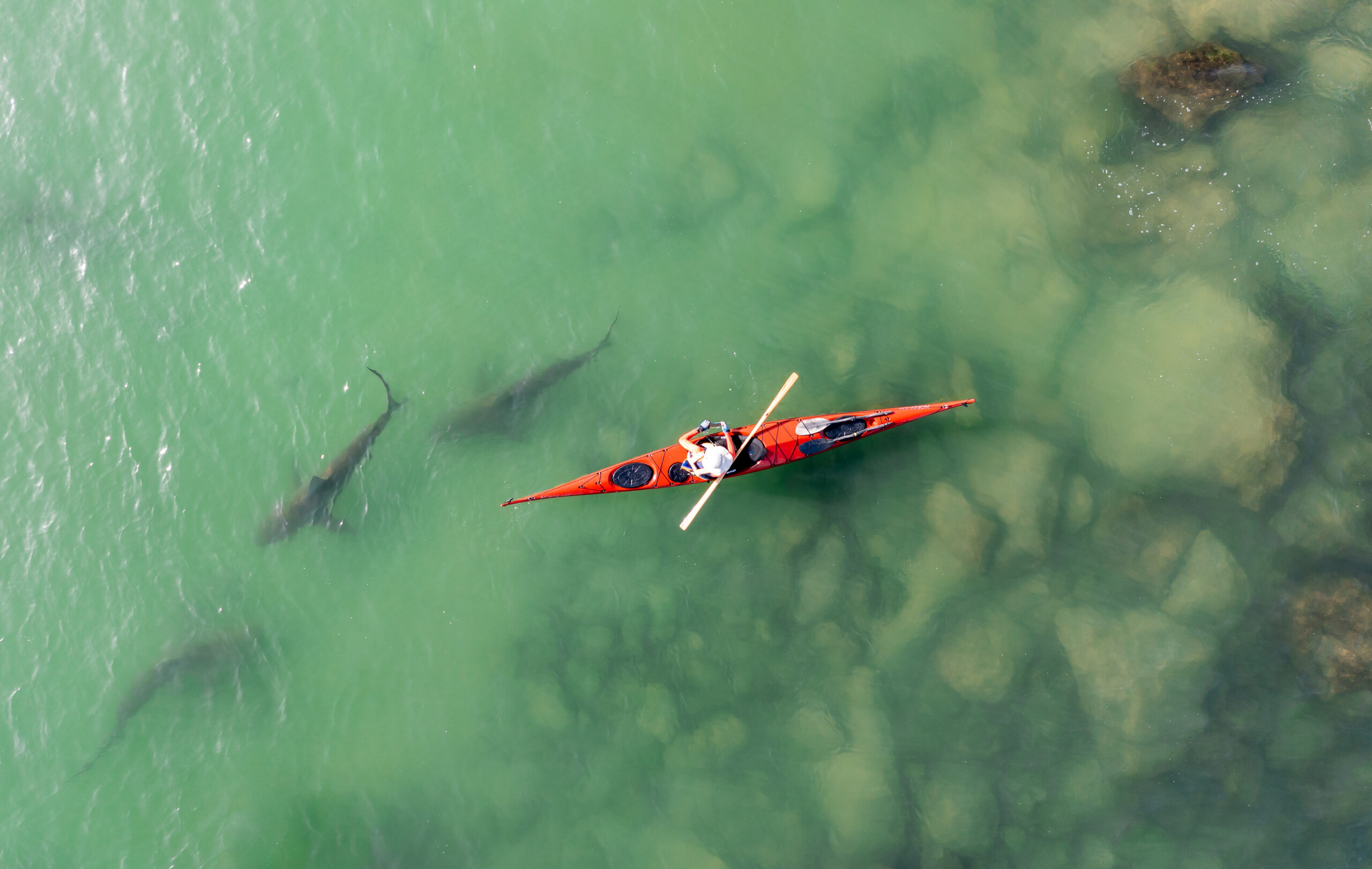
Several dozen endangered sharks have returned to the warm waters off Hadera for the winter. Israel has become a refuge for a predator disappearing across the Mediterranean. The Bible and the Zohar describe the multiplying of fish as a stage in the redemption.
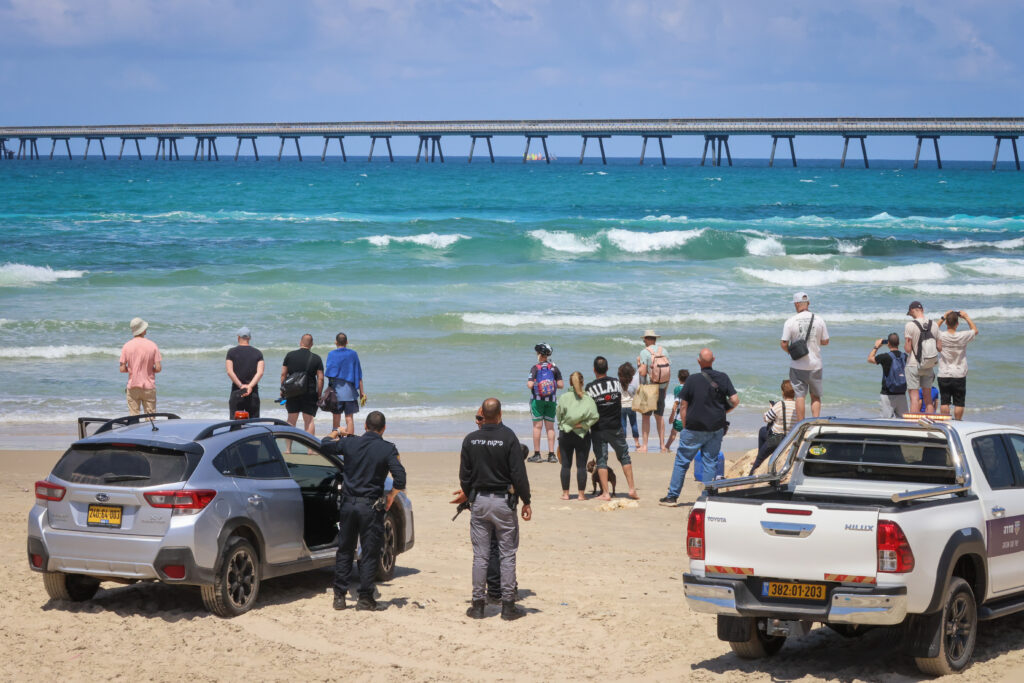
The sharks are back. The Israel Nature and Parks Authority on Tuesday warned the public against diving, snorkeling, or entering the water near the Hadera power station after sharks returned to the area for the winter, cautioning that encounters with the predators are unpredictable and potentially dangerous. Every year, from November to May, several dozen dusky and sandbar sharks congregate in the warm water discharged by the Orot Rabin power plant. They come to Israel’s shore from a sea where their numbers are collapsing, to one of the only coastlines where they are protected by law.
A winter gathering
The two species that gather at Hadera are the dusky shark, which in Israeli waters reaches about three meters in length and about 150 kilograms, and the smaller sandbar shark, which reaches about two meters and 70 kilograms. Their dorsal fins can sometimes be seen cutting the surface near the plant’s outlet, where the discharged seawater is roughly ten degrees warmer than the surrounding sea. The sandbar shark is classified as endangered in the Mediterranean, and too little data exists to determine the status of the region’s dusky sharks.
Researchers say the sharks come to rest and warm themselves. According to the authority, the heated water accelerates physiological processes, including digestion and processes associated with reproduction. Reporting on the gathering has noted that most of the sharks at Hadera are pregnant female dusky sharks and male sandbar sharks.
“In Israel, sharks are a protected species and are highly important in maintaining marine ecosystems,” said Yigal Ben Ari, head of the authority’s Marine Unit. Harming, harassing or feeding them is a criminal offense. Ben Ari said shark populations across the Mediterranean have suffered steep declines from overfishing and accidental capture, and that sharks caught unintentionally are sometimes thrown back into the sea dying or dead.
The authority’s warning carries the memory of a tragedy. In April 2025, Barak Tzach, 40, a father of four from Petah Tikva, took a break from fishing near the mouth of the Hadera Stream to enter the water and film the sharks. Witnesses heard him scream “They’re biting me!” before he was dragged farther out to sea. His remains were recovered after a two-day search by police, navy and rescue divers. Ben Ari said it was only the third recorded shark attack in Israel in some 80 years. The area where the sharks gather is closed to swimming, and the authority warns that strong currents, whirlpools and discarded fishing gear near the outlet add to the danger.
A refuge in a dying sea
University of Haifa researchers have tracked the Hadera sharks for more than a decade. Dr. Aviad Scheinin, head of the Marine Apex Predator Lab at the university’s Morris Kahn Marine Research Station, has run what has been described as the only long-term shark tagging study in the entire Mediterranean. His team has followed sharks tagged off Hadera to Cyprus, Egypt and, in 2021, as far as Sicily, when a sandbar shark the researchers named Hagai made the longest journey ever recorded for the species in the Mediterranean.
The research has turned up a striking picture. With most of the Mediterranean’s shark species in serious danger of extinction, the Jerusalem Post reported that Israel has become an oasis for them because they are protected there. Scientists have also found that different genetic lineages of the same shark species converge in Israeli waters, a phenomenon that, according to Israel21c, has not been documented anywhere else in the world. Sharks scattered across the sea, from different branches of the same family, gather every winter on one coastline: Israel’s.
The fascination is ancient. In 2021, researchers announced the discovery of 29 fossilized shark teeth in a 2,900-year-old site in the City of David in Jerusalem, dating to the generations after King Solomon. The teeth belonged to sharks extinct for tens of millions of years and had been carried to Jerusalem, likely from the Negev, at least 80 kilometers away. Found alongside hundreds of clay seals used by the kingdom’s officials, they may have been prized collectibles in the court of the House of David. “We’ll probably never really be sure,” lead researcher Dr. Thomas Tuetken told the Goldschmidt Conference.
Not everyone in the region sees the sharks as a curiosity. After a series of shark attacks at the Egyptian resort of Sharm el-Sheikh in December 2010, a guest on a popular Egyptian television show accused the Mossad of planting GPS chips in sharks’ fins and steering them to attack. Israel’s Foreign Ministry replied that the host had apparently seen “Jaws” one too many times.
Fish of the Great Sea
Israel is a dry land, dependent on rain and on a handful of springs and rivers. Yet the prophets describe the redemption in images of water and fish.
Why would the Hebrew prophets, writing for a people of shepherds and farmers, describe the final redemption through an abundance of fish?
The clearest answer comes from Ezekiel. In his vision of the future Temple, the prophet sees a river flowing out from beneath the threshold of the Sanctuary, growing deeper as it runs east until it reaches the Dead Sea and heals its waters. Wherever the river flows, Ezekiel says, “there shall be a very great multitude of fish” (Ezekiel 47:9). Then he describes a scene that has no place on today’s lifeless Dead Sea shore:
“And it shall come to pass, that fishers shall stand by it from En-gedi even unto En-eglaim; there shall be a place for the spreading of nets; their fish shall be after their kinds, as the fish of the Great Sea, exceeding many.” (Ezekiel 47:10)
The Great Sea, HaYam HaGadol, is the Bible’s name for the Mediterranean, the waters off Hadera. Ezekiel measures the coming abundance against the richness of the Mediterranean. Zechariah adds that in that day, “living waters shall go out from Jerusalem: half of them toward the eastern sea, and half of them toward the western sea; in summer and in winter shall it be” (Zechariah 14:8). The western sea is the Mediterranean.
The link between fish and the redemption runs back to the Patriarchs. When Jacob blessed Joseph’s sons, Ephraim and Menashe, he prayed that they “grow into a multitude in the midst of the earth” (Genesis 48:16). The Hebrew verb, v’yidgu, comes from dag, fish. Rashi explains that Jacob blessed them to multiply like fish, over which the evil eye has no power. The Talmud (Berakhot 20a) teaches that the descendants of Joseph are protected from the evil eye just as fish, covered by the waters, are hidden from sight.
That connection to Joseph lies at the heart of a teaching in the Tikkunei Zohar (Tikkun 43), the mystical work attributed to Rabbi Shimon bar Yochai. It describes the increase of fish as a sign of a specific stage in the messianic process, when the process of Mashiach ben Yosef, the Messiah from the House of Joseph, joins with that of Mashiach ben David, the Messiah from the House of David. The House of Joseph represents the practical rebuilding of the Land, the return of the people, the planting of fields and the building of cities. The House of David represents the miraculous stage that follows, including the building of the Temple. The period marked by the appearance of fish is described as one of hamtakat hadinim, the sweetening of judgments, symbolized by the fish’s life in the salt sea.
The fish appear in Ezekiel’s prophecy of judgment as well. In his account of the war of Gog and Magog, the prophet describes all of creation trembling at God’s presence: “So that the fishes of the sea, and the fowls of the heaven, and the beasts of the field, and all creeping things that creep upon the ground, and all the men that are upon the face of the earth, shall shake at My presence, and the mountains shall be thrown down, and the steep places shall fall, and every wall shall fall to the ground” (Ezekiel 38:20). The creatures of the sea, in Ezekiel’s vision, are witnesses to both the upheaval of the nations and the healing of the Land.
Sharks make aliyah
Every winter, the sharks of the Mediterranean leave waters where they are hunted and fished out, and gather on the one coast where they are protected. Lineages of the same species, scattered across the sea, converge off Israel’s shore. Many of them are pregnant females, drawn by water that speeds the processes of birth. Scientists explain the gathering by the warmth of a power plant’s discharge. The prophets described a Land of Israel whose waters would one day teem with fish “exceeding many,” and the Zohar tied that abundance to the moment the building of the Land gives way to its redemption. Off the coast of Hadera, in a sea that is emptying of its great fish, the fish are coming to Israel.