


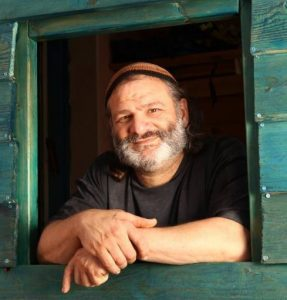
Said Abdelrazek found Christianity in an open Bible in a neighbor’s shop. Egypt answered with torture, a terrorism court, and a prosecutor’s demand for his death.
Egyptian security officers tied Said Mansour Rezk Abdelrazek to a wall in the shape of a cross, tried to strip the cross tattoo from his skin, and sent Muslim clerics to his cell to bring him back to Islam. He refused. Now the Egyptian state is asking a terrorism court for the maximum penalty, death or 25 years in prison, for a 30-year-old man whose crime, his lawyers say, is his refusal to renounce Jesus. His fiancée, Sophia, described his treatment in custody to The Jerusalem Post in a single sentence: “They had him crucified the whole time he was there.”
His lawyers announced in a statement following a hearing in his case that prosecutors are pursuing the maximum penalty, either execution or 25 years in prison. According to the NGO Coptic Solidarity, Abdelrazek faces charges of contempt for Islam, inciting public disorder, disseminating false information, and joining a banned terrorist organization that allegedly does not exist. The office of Said Fayez, which represents him, alleged that he is charged with running an organization that does not exist and is being prosecuted because he refused to “renounce Jesus.” Sophia confirmed that Egyptian authorities have yet to identify the alleged terrorist organization. The lawyers’ statement was posted on Abdelrazek’s X account under the name he is also known by, Said Abu Mustafa. The court adjourned the case until December 8, 2026, when the defense will present its arguments.
Abdelrazek was referred to trial before the Terrorism Circuit of the First Criminal Court in Badr after nine months of pretrial detention, and he is held in the 10th of Ramadan prison amid growing concerns over his health. His lawyers allege torture and medical negligence at the prison, saying he has been held in a crucifixion position and denied medical care despite having a heart stent. Sophia reported severe pain in his lower back and urinary tract with no diagnosed cause, and when the defense requested an urgent medical examination in April, the court refused. The US Commission on International Religious Freedom has designated Abdelrazek a religious prisoner of conscience, finding that “authorities and inmates physically and psychologically abused Abdelrazek for his conversion.” Amnesty International has issued an Urgent Action on his behalf. His defense team includes the Egyptian Initiative for Personal Rights, the Egyptian Commission for Rights and Freedoms, and the office of Cassation lawyer Saeed Fayez. International human rights groups have long criticized the Badr courts for secrecy, lack of due process, prolonged pretrial detention, and limited access to lawyers.
The prison has denied him the most basic acts of faith. He asked permission to attend a Coptic Orthodox Christmas Mass on January 7, and prison authorities refused. After a January 13 visit, his lawyer reported that Abdelrazek was in good spirits and fully understood the possible outcomes of his case. He asked to be allowed to worship in prison, to have a Bible, and to receive communion.
Egypt: State prosecutors are pursuing the “maximum penalty,” either execution or 25 years in prison, for Saeed Mansour Rezk Abdelrazek, a Christian convert from Islam.
— Christian Emergency Alliance (@ChristianEmerg1) November 5, 2026
Arrested in July 2025, Saeed has been detained by Egyptian authorities ever since on undisclosed charges.… pic.twitter.com/V7Kqn5bb37
An open Bible
Born into a Muslim family, Abdelrazek first encountered Christianity when he noticed an open Bible in a neighbor’s shop. He reacted angrily to what he read, then kept thinking about it and returned days later to speak with a part-time minister. He went on to study the Bible at a Protestant Baptist church and was baptized around 2017. He became a Christian in 2016 and later joined the Russian Orthodox Church in Egypt. Sophia said that, raised in an observant Muslim home, he had never felt safe asking questions about faith, and Christianity gave him the freedom to question and seek answers.
The first person to turn him in was his own mother. Sophia said his mother reported him to the security services after he announced his conversion, and she took away his then-wife and son out of fear he would lead them to Christianity. Under Islamic law, his wife was required to divorce him, and he lost custody of his child.
Legal, social and civil difficulties after his conversion drove him to flee to Russia in 2019, where he sought asylum on religious grounds. In 2023, Russian authorities arrested him over a privately filmed video considered offensive to Islam. In 2024, Russia deported him to Egypt even though he held documentation from the UN High Commissioner for Refugees confirming he qualified for international protection, a move rights advocates said violated non-refoulement, the principle that protects refugees from forced return to a country where they face persecution.
On his arrival, Egyptian authorities held him incommunicado for about ten days. He later said he was coerced into the painful removal of a Christian tattoo and suspended for hours at a time in a crucifixion position. Interrogators pressed him to recant, monitor other converts, and delete his social media accounts, then released him with orders not to speak publicly or proselytize. Sophia said interrogators believed wealthy organizations were working to baptize Egypt’s Muslims, and they wanted him to inform on priests and converts and use his social media to attack Christianity.
Released into his family’s custody on condition that he return to Islam, he refused and was ordered to attend classes on Islam. At home, he was pressured to perform the five daily Islamic prayers, and his brother-in-law threw pots of water over his face to wake him for prayers at around 5 a.m. Sophia said the couple both posted regularly about Christianity online and built sizeable followings. On July 15, 2025, police arrested him in Cairo without a warrant after he asked a lawyer to help him obtain identity documents recognizing his change of religion. The arrest blocked the couple’s planned wedding at the Australian Embassy.
The trial opened on April 21 with a procedural hearing. In June, the court adjourned without hearing the scheduled prosecution witnesses or the forensic expert, even with the defense and human rights monitors in the courtroom. On September 6, the court finally heard prosecution witnesses and allowed the defense to cross-examine them.
A one-way freedom
His lawyer, Saeid Fayaz, told Christian Solidarity Worldwide that thousands of Christian converts in Egypt have no rights and live in isolation and constant fear, and that his client trusted the constitution’s guarantee of religious freedom, “not realising that it is a one-way freedom.”
Egypt’s constitution makes a promise its courts refuse to keep. Article 64 states that “freedom of belief is absolute,” yet in practice that right is denied to those who leave Islam. The same constitution, in Article 2, declares the principles of Islamic Sharia the principal source of Egyptian legislation, and Sharia leaves no room for a Muslim to walk away.
Islamic law calls leaving the faith ridda, apostasy, a category reserved for Muslims, and it makes no difference whether the apostate converts to another religion or simply abandons Islam. The punishment comes from the hadith, the recorded sayings attributed to Muhammad that carry legal authority in Islam. Sahih al-Bukhari, the most authoritative hadith collection in Sunni Islam, records the command: “Whoever changes his religion, kill him” (Bukhari 6922). A second hadith, recorded in both Bukhari and Sahih Muslim, permits shedding a Muslim’s blood in three cases, among them “one who abandons his religion and separates from the community.” On that basis, all four classical Sunni schools of law prescribe death for an adult male apostate, traditionally after three days in which he is pressed to repent. The Hanafi school, which shaped Egyptian personal-status law, imprisons a female apostate until she returns to Islam. Under Sharia, an apostate’s marriage is dissolved, he loses custody of his children, and he forfeits his inheritance.
Egypt’s highest religious authority stands behind the death penalty. In 2016, Al-Azhar’s Grand Imam Ahmed el-Tayyib declared on Egyptian television that “The penalty for an open apostate, departing from the community, is well stipulated in Sharia,” treating conversion away from Islam as treason.
Egypt’s penal code contains no crime called apostasy. The state enforces the ban through the civil registry, the courts, and the criminal code. The religion printed on a citizen’s national ID card determines which family court governs his marriage and divorce and which religious education classes his children must attend. A child’s registered religion follows the father’s official faith. A Christian who wants to register as a Muslim meets little resistance. A Muslim who becomes a Christian meets a wall.
In 2007, Muhammad Ahmed Hegazy became the first convert to sue Egypt for refusing to change his official religion. On January 29, 2008, the Court of Administrative Justice, headed by Judge Mohammed al-Husseini, dismissed his petition, ruling that the state was not required to recognize apostasy on official documents, in violation of public order. The judge reasoned that under Islamic law, “Islam is the final and most complete religion,” so a Muslim cannot return to an older faith. The court said a convert may believe what he wants in his heart but cannot legally change his religious status. A second convert, Maher El-Gohary, a Christian for over 30 years, went to court next. When his case was heard, opposing lawyers accused him of apostasy and called cases like his part of a “U.S. Zionist attack on Islam in Egypt.” A Cairo judge rejected his request. The only crack in the wall came in February 2008, when the Supreme Administrative Court ruled that 12 people born Christian could return to Christianity after converting to Islam, but ordered that their documents list them as “formerly declared Muslim,” exposing them to discrimination, police harassment, and violence.
When the registry is not enough, prosecutors reach for the penal code. Article 98(f), Egypt’s blasphemy law, punishes with six months to five years in prison anyone who exploits religion to promote “extremist ideologies” with the aim of provoking sedition. Prosecutors favor it because “contempt of religion” has no exact legal definition. When even that falls short, they add terrorism charges. That is how a Baptist convert with a cross tattoo ended up in a terrorism court facing a possible death sentence.
Twelve countries, one religion
Egypt has plenty of company. Humanists International found that apostasy is a criminal offense in 17 countries and punishable by death in 12 of them. Every one of them is a Muslim-majority country, and in every case the religion a person is forbidden to leave is Islam. As of 2020, leaving Islam carried the death penalty in Afghanistan, Brunei, Iran, the Maldives, Mauritania, Qatar, Saudi Arabia, Somalia (implicitly), the United Arab Emirates, and Yemen. Humanists International also lists Malaysia and Nigeria.
Several countries write the offense directly into their criminal codes, including Mauritania’s 1983 Criminal Code, the UAE’s Penal Code of 1987, Yemen’s Penal Code of 1994, Qatar’s 2004 Penal Law and Brunei’s Criminal Code. In 2018, Mauritania made the death sentence for apostasy compulsory. In Saudi Arabia, Sharia functions as the law of the land without being codified, and apostasy mandates a death penalty. Iran’s penal code mandates death specifically for blasphemy and reaches apostasy by requiring judges to rule on religious offenses according to Sharia. A Library of Congress survey found that Iran appears to be the only one of these countries to have actually executed a person convicted of apostasy, and that in Afghanistan, Brunei, Sudan, and Yemen, a conviction can be vacated if the defendant renounces his new faith and rejoins Islam. That is the same deal Egyptian interrogators offered Abdelrazek. Open Doors ranks Egypt 42nd on its 2026 World Watch List of the 50 countries where it is most difficult to be a Christian.
Abdelrazek has company behind bars. Sophia alleged that at least 180 other Christians are held by Egyptian authorities on similarly dubious charges. Coptic Solidarity named Christian scholar Dr. Augustinos Samaan, Romany Gharib Adly Azer, Sherif Wagih Fahmi, and six young Christians detained over a comedy video as other Coptic prisoners of conscience facing prosecution under blasphemy and national-security laws. Coptic Solidarity warned: “Failure to act risks normalizing the treatment of religious conversion as terrorism.” More than 35,000 people worldwide have signed the group’s petition for his release. “This unprecedented global response shows the world is watching,” said Caroline Doss, President of Coptic Solidarity.
Egyptian Copt Augustinos Samaan gets 5 years hard labor for comparing Christianity and Islam
— Robert Spencer (@jihadwatchRS) October 9, 2026
"He needs our prayers — and our action.The persecution of Christians in Egypt is intensifying. Take the case of Dr. Augustinos Samaan, for example, an Egyptian Coptic Christian scholar… pic.twitter.com/GXNrlxPVXM
A Middle East anomaly or warning to the West?
Egypt’s case is the sharp edge of a wider pattern. Leaving Islam is a crime in 17 countries and punishable by death in 12 of them, according to Humanists International, and every one of those countries is Muslim-majority. The laws protecting Islam from its critics are moving west. From 1999 to 2010, the Organization of Islamic Cooperation, the 57-member bloc of Muslim states, sponsored resolutions every year at the United Nations calling on member states to outlaw “defamation of religions.” USCIRF described the campaign as an effort to export the blasphemy laws of OIC countries to the international level.
In December 2023, Denmark, home of the 2005 Muhammad cartoons, passed a law criminalizing the “inappropriate treatment” of religious texts, punishable by fines or up to two years in prison, after a wave of Quran burnings. Critics called it a return to the blasphemy law Denmark had abolished in 2017. In March, the British government adopted an official definition of anti-Muslim hostility, which one Conservative MP warned could become “a backdoor blasphemy law.” The prosecution of Said Abdelrazek shows where that road ends.
The Danish government justified its law on national security grounds, citing the danger Quran burnings posed to Danes, which arguably strengthens the point: the law was passed under threat of Islamic violence and not under any pretense of jurisprudence.
A fiancée’s campaign
Sophia, an Australian-Egyptian who met Abdelrazek on social media and first met him in person in 2021, has faced online abuse and death threats from Egyptian Islamists. She pays around 11,000 Egyptian pounds a month to have food and clothing smuggled to him in prison. Their lawyer has been able to visit him only once, in January, and the family is banned from visiting. She has called on journalists to break the silence over what she describes as “state-sanctioned religious persecution.”
Abdelrazek applied for a humanitarian visa to Australia in May 2024 and is still waiting for an answer, and Sophia has criticized what she calls Australia’s lack of meaningful diplomatic engagement. In February, Jubilee Campaign joined Coptic Solidarity and more than 20 organizations in calling on Australia’s Home Minister to intervene. Lord David Alton confirmed that he raised the case in the British Parliament, and the US State Department raised concerns with Congress in June.
The United States gives Egypt approximately $1.5 billion in foreign aid each year, and Sophia hopes Washington will condition that aid on Abdelrazek’s release and better treatment of religious minorities. The appeal lands days after President Trump announced the end of US military aid to Israel, the one country in the region where a Muslim can become a Christian without facing a terrorism court. Sophia also hopes the Netherlands will consider a prisoner exchange for Ahmed Nasser, whom Dutch authorities arrested for allegedly running intimidation campaigns on behalf of a foreign power, and whose release Egypt has been working to secure.
