



Eighty-eight years after Nazi mobs burned Germany’s synagogues, antisemitism hits record highs as the far right, the far left and radical Islam converge on the Jews.
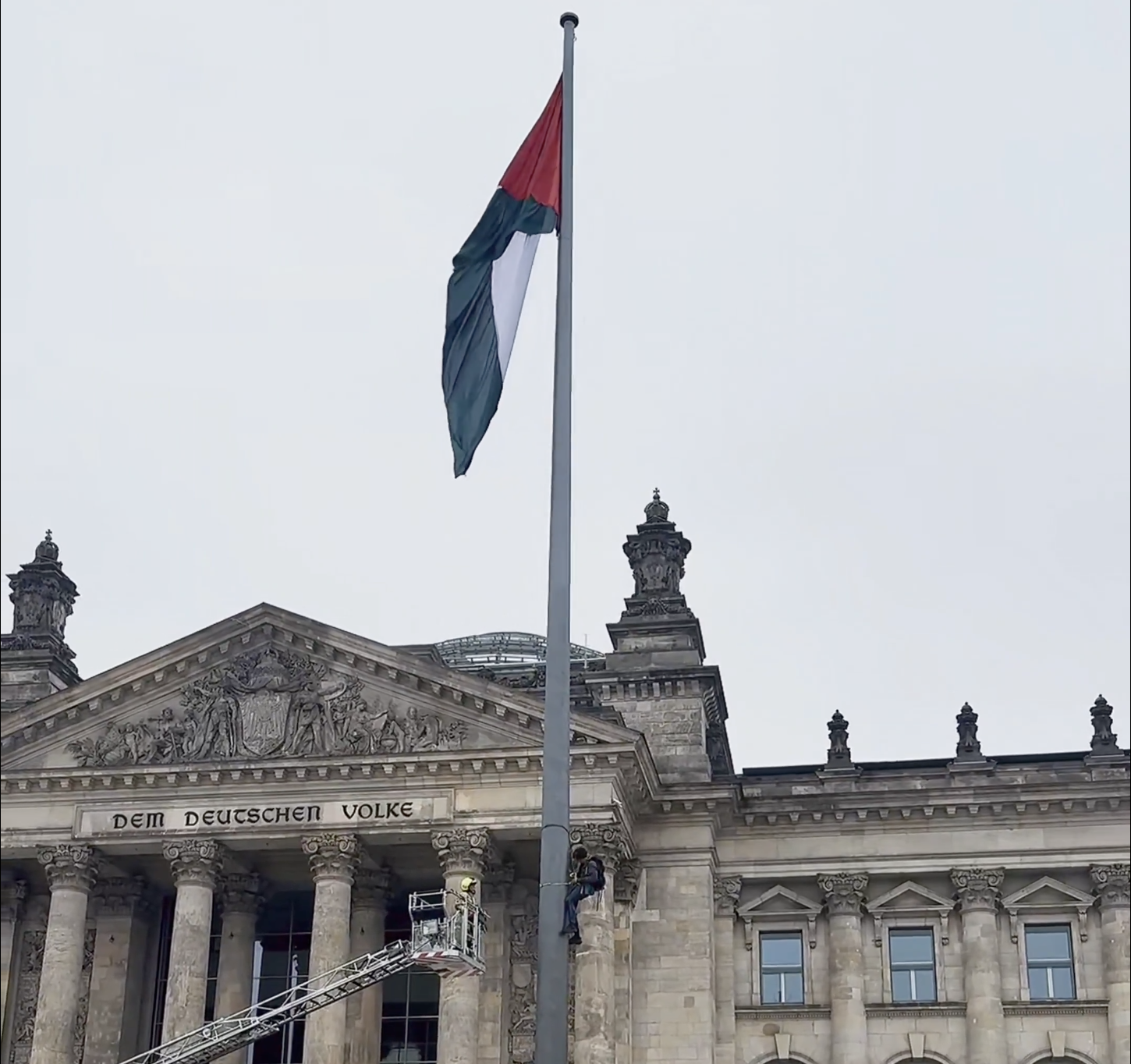
On the eve of the 88th anniversary of Kristallnacht, the night Nazi mobs set Germany’s synagogues ablaze, a Palestinian flag flew over the Reichstag. For one hour on Sunday, the building where Hitler’s seizure of power began flew the banner of a national movement whose founding father spent World War II in Berlin as Hitler’s guest. A man climbed the 28-meter (92-foot) flagpole outside Germany’s parliament, lowered the black, red and gold Flag of Unity that marks the country’s 1990 reunification, and raised the Palestinian colors in its place. Police arrested him and two accomplices who filmed the climb.
A German anti-Israel group called Peacefully Against Genocide claimed responsibility. “Today we raised the Palestinian flag in front of the German Bundestag,” the group announced on Instagram, accusing governments that support Israel of complicity in genocide. A year ago, the same group scaled the Brandenburg Gate, where its activists waved Palestinian flags and chanted in Arabic for an intifada.
The choice of building carried its own history. On February 27, 1933, four weeks after Adolf Hitler became chancellor, the Reichstag burned. Police arrested Marinus van der Lubbe, a young Dutch communist. Historians still debate whether he acted alone, but the Nazis seized on the fire. The next morning, Hitler pushed through the Reichstag Fire Decree, suspending civil liberties across Germany. Within a month, the Enabling Act gave him the power to rule by decree.
Five years later, on the night of November 9, 1938, Nazi mobs burned more than a thousand synagogues across Germany and Austria, smashed thousands of Jewish shops and homes, and murdered at least 91 Jews. The regime sent 30,000 Jewish men to concentration camps. The Germans named the pogrom for the broken glass that covered the streets.
Accept the past or leave
Two days before the Palestinian flag went up last week, German Chancellor Friedrich Merz delivered a warning to Muslim immigrants. Speaking Friday at a Chancellery reception for German medal winners from the 2026 Maccabiah Games, Merz said Germany’s historical responsibility for the Holocaust applies equally to immigrants arriving from Islamic countries.
“Anyone who fails to abide by this must leave our country,” Merz said, according to the German news agency dpa.
The chancellor was responding to a basketball coach who told him that Jewish athletes are afraid to wear their red Maccabi team jackets in public. The jackets carry the Star of David, and the athletes fear being attacked on German streets.
Merz invoked the landmark 1985 speech by President Richard von Weizsäcker on the 40th anniversary of Germany’s defeat. Von Weizsäcker told Germans that the young bear no guilt for the crimes of the Nazi era, but they bear responsibility for “what becomes of it in history.” Merz said that principle binds immigrants as well. He offered no legal mechanism for removing those who reject it.
The German delegation won 128 medals at this year’s Maccabiah, the most of any European team. Merz noted that roughly 90 percent of the members of Makkabi Deutschland’s 40 sports clubs are not Jewish. Those non-Jewish athletes play on teams whose Jewish members are afraid to wear the team jacket outside.
24 incidents a day
The coach’s account matches the numbers. Germany’s Federal Association of Departments for Research and Information on Antisemitism (RIAS) documented 8,725 antisemitic incidents in 2025, an average of 24 every day. Between 2020 and 2022, RIAS recorded about 2,500 incidents a year. The figure has more than tripled since Hamas terrorists invaded Israel on October 7, 2023. Israel-related antisemitism accounted for 68 percent of the total.
“These are not statistical outliers; it is the grim reality in Germany,” said Josef Schuster, president of the Central Council of Jews in Germany.
Germany’s federal police counted 6,548 antisemitic crimes in 2025, a 5 percent increase over the previous year, with nearly half linked to Israel. Crimes motivated by Islamist ideology reached a record 670, and nearly half of those involved the symbols of banned terrorist organizations, including Hezbollah and ISIS.
The sharpest change came in who commits the crimes. In all of 2022, German police attributed 2,185 antisemitic crimes to right-wing extremists and only 67 to “foreign ideology,” the category covering imported Middle East hatreds. In the 12 weeks after October 7, 2023, foreign-ideology crimes jumped to 1,089, outnumbering the 989 right-wing crimes recorded in the same period. Crimes driven by religious ideology, overwhelmingly Islamist, rose from 38 in all of 2022 to 474 in those 12 weeks.
Berlin shows the shift most clearly. Police in the German capital recorded a record 2,267 antisemitic crimes in 2025, up from 900 in 2023. Crimes attributed to foreign ideology rose to 1,484, from just 24 in 2022. Islamist-motivated crimes climbed to 348, from six. Right-wing antisemitic crime in Berlin held steady at around 300 a year, with 327 in 2025. Berlin legislator Sebastian Schlüsselburg called the figures shameful in the city where the Holocaust was planned and ordered.
The old hatred has not gone away. RIAS recorded 807 antisemitic incidents by right-wing extremists in 2025, the highest number since nationwide monitoring began in 2020. Nationally, right-wing extremism remains the largest single category of antisemitic crime in police statistics. In January, Schuster warned that many Jews would leave Germany if the far-right Alternative for Germany (AfD) party entered the federal government.
The horseshoe
Nazism resists the neat labels of right and left. Historians classify it as far-right for its racial nationalism and its war on Communists. Its economic program carried strong socialist elements. The party’s full name was the National Socialist German Workers’ Party. Its 1920 platform demanded the nationalization of trusts, profit-sharing in large industry, and the abolition of income unearned by work.
In power, the Nazis left factories in private hands but placed production under state command. The Four-Year Plan of 1936 dictated what industry would produce. A price freeze that year and state control of wages followed. Independent trade unions were abolished and replaced by the party-run German Labor Front. Economist Friedrich Hayek argued in The Road to Serfdom (1944) that fascism and socialism grew from the same root: central control of economic life by the state.
The Nazis also murdered and imprisoned socialists. Communists and Social Democrats were among the first inmates of Dachau in 1933. In the Night of the Long Knives in 1934, Hitler had Gregor Strasser, leader of the party’s socialist wing, killed.
Political scientists describe the relationship with an image: the horseshoe. The far right and the far left, each racing away from the center, bend toward each other until their ends nearly touch. The French writer Jean-Pierre Faye drew the image from Weimar Germany, where Nazis and Communists who called each other mortal enemies kept finding common cause. In November 1932, the two parties jointly backed the Berlin transport workers’ strike. The Germans coined a word for such alliances: Querfront, the “cross-front.” In August 1939, Hitler and Stalin signed a pact dividing Poland between them.
The horseshoe soon gained a third point. On November 28, 1941, Haj Amin al-Husseini, the Mufti of Jerusalem and leader of the Palestinian Arab national movement, met Hitler in Berlin. The Mufti asked for German backing against the Jewish national home in the Land of Israel. According to the German record of the meeting, Hitler assured him that once German armies reached the southern Caucasus, Germany’s goal in the region would be the destruction of the Jews living under British protection.
The Mufti spent the rest of the war in Berlin as a guest of the Nazi regime. He broadcast propaganda to the Arab world, and in a 1944 radio address he urged Arabs to kill the Jews wherever they found them. He wrote to the foreign ministers of Germany and its allies demanding that they block the emigration of Jewish children to the Land of Israel, at a time when the alternative was the death camps. He helped Heinrich Himmler recruit Bosnian Muslims into the 13th Waffen Mountain Division of the SS, known as the Handschar, which took part in the murder of Serbs and Jews in Bosnia.
The admiration ran both ways. Albert Speer, Hitler’s armaments minister, recorded in his memoir that Hitler regretted the Muslim defeat at the Battle of Tours in 732 CE. Had the Arabs won, Hitler mused, the Germanic peoples would have adopted Islam, a faith he considered “much more compatible to us than Christianity,” for its glorification of conquest and the warrior. Himmler shared the sentiment and praised Islam as a religion that produced fearless soldiers.
Schuster now describes antisemitism as a “bridge ideology” joining right-wing extremists, left-wing extremists, and Islamists. The data bears him out on all three fronts. In Germany in 2025, right-wing antisemitic incidents and Islamist antisemitic crimes both set records. Worldwide, the Combat Antisemitism Movement found that far-left anti-Zionist ideology drove 62.8 percent of antisemitic incidents in 2025, while Islamist-inspired incidents rose 52.2 percent and accounted for a disproportionate share of the deadliest attacks.
In the West, the alliance of the far left with radical Islam has its own name: the red-green alliance, red for socialism and green for Islam. Its banner flew over the Reichstag on Sunday.
A journey through Germany
An Israeli-born writer saw this coming 16 years ago. In 2010, Tuvia Tenenbom, founder of the Jewish Theater of New York, traveled across Germany on assignment from Rowohlt, one of the country’s largest publishers. He interviewed Germans from every walk of life and wrote down what they said, word for word. He came away convinced that Germany was obsessed with Jews, and that much of the hatred hid behind criticism of Israel.
Rowohlt dropped the book. Tenenbom published it himself in New York in 2011 as I Sleep in Hitler’s Room, named for the hotel suite in Weimar where Hitler once stayed. When the Suhrkamp publishing house released it in German the following year, it spent 15 weeks on the Spiegel bestseller list. Tenenbom told the Irish Times he took no pleasure in his conclusion. “I so much wanted it not to be that,” he said.
The antisemitism Tenenbom found in 2010 belonged to native Germans. He went back after Chancellor Angela Merkel opened Germany’s borders in 2015 to more than a million migrants, most of them Muslims from the Middle East. Postwar West Germany had written a guarantee of asylum into its constitution as atonement for the Jews who died because other nations refused to take them in. Commentators across the political spectrum read Merkel’s decision as a search for redemption from the Nazi past.
In Hello, Refugees!, published in 2017, Tenenbom found Germans eager to tell him that their welcome made them morally superior to the Jews. An organizer of a German Catholic gathering told him the refugee welcome proved Germany’s greatness, unlike the Israeli “occupiers” who violate human rights. Tenenbom summed up the conversation: “Germans are good, Jews are bad. What else is new?” He told British journalist Melanie Phillips that taking in the migrants allowed Germany to feel it had finally shed the stigma of its past, leaving it free to hate Jews openly once again.
The Reichstag stunt completes the circle. Germany opened its doors to atone for murdering six million Jews. A decade later, activists championing the cause of Hamas, a terrorist organization whose founding charter calls for killing Jews, claim the lesson of the Holocaust as their own. The group that raised the flag calls itself Peacefully Against Genocide. At the Brandenburg Gate a year ago, its banner read “Never again genocide.” The vow of Holocaust remembrance now hangs over Berlin, aimed at the Jewish state.
Germany has spent 80 years building memorials, funding Jewish communities and teaching the Holocaust in its schools. Its chancellor tells immigrants to accept Holocaust guilt or leave. Its Jewish athletes hide the Star of David, and its streets fill with crowds chanting for intifada. On the anniversary of Kristallnacht, the question stands before every Jew in Germany: is the nation that built the death camps closer to its Nazi past today, or further away?
Germamya of Edom
The Talmud names a nation called Germamya shel Edom, “Germamya of Edom.” In Tractate Megillah (6b), Rabbi Yitzchak teaches that Germamya is a kingdom descended from Esau which, if it were ever released, would destroy the entire world. The resemblance of the name has led many to identify Germamya with Germany, a reading the 20th century did nothing to weaken.
In Jewish tradition, Edom, the nation of Esau, stands for the long line of empires that persecuted Israel, from Rome through Christian Europe. The Sages saw in Esau’s hatred of his brother Jacob a permanent feature of history. Rabbi Shimon bar Yochai taught in the Sifrei that “it is a known halakha (law) that Esau hates Jacob.” Rashi brings his words to explain the moment the brothers met after 20 years apart.
And Esau ran to meet him, and embraced him, and fell on his neck, and kissed him; and they wept. (Genesis 33:4)
In the Hebrew scroll, the word vayishakehu, “and he kissed him,” is marked with dots above its letters, a sign the Sages read as an instruction to look closer. They split over what the dots reveal. Rabbi Yannai taught in the Midrash (Bereishit Rabbah 78:9) that Esau came to bite Jacob’s neck, not kiss it, and that Jacob’s neck turned to marble. Rabbi Shimon bar Yochai taught the opposite: Esau’s hatred is a fixed law, yet at that moment his compassion was stirred, and he kissed Jacob with his whole heart.
The Sages held both truths at once. Edom’s hatred is permanent, and Edom is capable of a real kiss. The tension in the verse is the tension in Germany today. The chancellor’s words at the Maccabiah reception are the kiss, and they are sincere. The flag on the Reichstag pole is the bite.
The Bible also records the first alliance between Esau and Ishmael. When Esau saw that his father Isaac disapproved of his Canaanite wives, he turned to his uncle.
So Esau went unto Ishmael, and took unto the wives that he had Mahalath the daughter of Ishmael Abraham’s son, the sister of Nebaioth, to be his wife. (Genesis 28:9)
The two sons of Abraham’s household who were passed over for the covenant joined their families. The Psalmist foresaw that union reappearing as a coalition sworn to erase Israel, and he named Edom and Ishmael first among its members.
They have said: ‘Come, and let us cut them off from being a nation; that the name of Israel may be no more in remembrance.’ (Psalms 83:5)
The tents of Edom and the Ishmaelites; Moab, and the Hagarenes. (Psalms 83:7)
Rabbis who teach about the end of days read the two brothers as the two great forces arrayed against Israel before the redemption. Ishmael is the Arab and Islamic world. Esau, whose heir in Jewish tradition is Rome and the Christian West, appears today as the secular liberal West, which preaches human rights and judges Israel by a standard it applies to no other nation. Each brother hates Jacob for his own reasons, and each needs the other. Ishmael supplies the fighters and the fury. Esau supplies the legitimacy, the platforms, and the vocabulary of genocide and human rights.
The red-green alliance is the marriage of Esau and Ishmael, renewed in the streets of Berlin. A European activist group dressed the cause of Hamas in the language of “never again,” and raised it over the parliament of the nation that built Auschwitz.
Esau’s line produced Israel’s most relentless enemy. Esau’s grandson was Amalek (Genesis 36:12), the nation that attacked the weakest of Israel in the desert. After that battle, Moses declared that the war would outlast every generation.
And he said: “The hand upon the throne of the LORD: the LORD will have war with Amalek from generation to generation.” (Exodus 17:16)
The Bible commands Israel to zachor, to remember what Amalek did. Germany built an entire national culture of remembrance on that same principle. What the Bible understood, and Germany is learning, is that remembering Amalek’s past does nothing to stop Amalek’s next generation. Amalek changes uniforms. In 1938 it wore brown shirts. On Sunday it climbed a flagpole wearing a keffiyeh.
Where the horseshoe meets
The far right and the far left agree on almost nothing. They split over economics, borders, religion, and nearly every issue that divides a modern society. On the Jews, the horseshoe holds. Neo-Nazis, socialist activists, and Islamists, who would gladly destroy each other, share one target, and in Germany in 2025, all three set records at the same time.
Germany is importing its new partners from a region that has already finished the job. Before 1948, more than 850,000 Jews lived in the Arab world. The Jewish Agency estimates that fewer than 4,000 remain. Israel took in the refugees, and today 2.2 million Arab citizens live in the Jewish state. The Arab countries emptied themselves of Jews, and their hatred followed their emigrants to Berlin.
The answer to the Kristallnacht question is both. The German state has traveled further from its Nazi past than any nation has traveled from its crimes. The German street is closing the distance. Merz can order immigrants to accept Holocaust guilt, but no chancellor can legislate away Esau’s hatred. The Sages knew a kiss from Edom can be sincere and still last only a moment.
The prophet Obadiah, who devoted his entire book to Edom, saw where the story ends.
And saviours shall come up on mount Zion to judge the mount of Esau; and the kingdom shall be the LORD’S. (Obadiah 1:21)
The Bible places the final answer in Jerusalem, on Mount Zion, rather than in Berlin. Eighty-eight years after the synagogues burned, the safety of the Jewish people rests where the prophet placed it, in the Land of Israel.
