Eighty-eight years after Nazi mobs smashed the windows of Jewish shops across Germany and Austria, anti-Israel activists in Philadelphia are planning to ride through the city’s most fashionable neighborhood on Sunday to mark six Jewish-owned businesses for removal. Their flier is blunt: “No business for Zionists. These Zionist establishments must go.”
The “Boycott Ride,” organized by Philly Bike On Your Left with Philly Writers Against the War on Gaza, Boycott CookNSolo and Philly Solidarity Calendar, is set to leave Rittenhouse Square at 11:30 a.m. on November 8, the eve of the anniversary of Kristallnacht. The targets are Dizengoff, K’Far Cafe and Goldie, the Israeli restaurants of chef Michael Solomonov; Huda, a sandwich shop; Schlesinger’s, a Jewish deli; and Mac Mart, a macaroni-and-cheese kiosk.
“Ride around Rittenhouse with us as we show these zio business owners that we see them for the disgusting humans they are,” the organizers wrote online.
Philly Bike On Your Left, the main organizer, describes itself as an “anti-fascist, anti-Zionist social cycling collective.” It posted the flier on October 31, promising, “We’ll flag as many bikes as we can and show our solidarity with the Palestinian community and oppressed (folks) everywhere.” On Wednesday, the group shared another activist group’s post accusing critics of “disingenuously conflating Zionism with Judaism” and calling the Kristallnacht comparison “a cynical take,” CNN reported.
The Anti-Defamation League and American Jewish Committee’s Philadelphia offices, the Jewish Federation of Greater Philadelphia and StandWithUs issued a joint statement on Monday.
“Let’s be clear: This is antisemitism. It is Jew-Hatred, plain and simple,” the groups wrote. “We will not allow antisemitism to be disguised as activism. We will not accept efforts to intimidate Jewish businesses or drive them out of Philadelphia. And we will not remain silent.”
“Marking businesses for removal from Philadelphia is an attempt to intimidate, marginalize and exclude members of the Jewish community from the economic and civic life of our city,” the statement continued. “No business should be targeted because of the identity, heritage or perceived political beliefs of its owners.”
ADL CEO Jonathan Greenblatt called the ride “absolutely vile.” “This is antisemitism disguised as activism. It is Jew-hatred, plain and simple, and it should outrage every person of conscience,” Greenblatt wrote.
The ADL also launched a pledge urging people to eat at the targeted restaurants and other Jewish-owned businesses. “This protest is an attempt to intimidate a Jewish community that has faced generations of violence, exclusion and antisemitism. It’s the latest in a string of incidents that hold Jewish businesses responsible for events in the Middle East,” the ADL wrote. “That’s antisemitic, plain and simple. But we refuse to let hate win.”
“Boycotting Jewish-owned restaurants on the eve of Kristallnacht is a chilling display of antisemitism,” Liora Rez, executive director of StopAntisemitism, told the Jerusalem Post. “Nearly 88 years after Nazi mobs smashed the windows of Jewish businesses simply because they were Jewish, we are witnessing calls to economically target Jewish business owners once again. Dressing up antisemitism as activism does not make it any less hateful. Targeting Jews in their livelihoods is not political; it is discrimination.”
The American Zionist Movement said the businesses “appear to be targeted because of the Jewish identity of their owners.” “Whatever one’s views on Israel or its government, targeting Jewish-owned businesses under the guise of opposing Zionism is antisemitism,” AZM said. “The most meaningful response to this boycott is increased support and visible solidarity.”
The campaign against Solomonov’s restaurants is three years old. In December 2023, two months after the October 7 massacre, a crowd of protesters gathered outside Goldie on Sansom Street chanting, “Goldie, Goldie, you can’t hide, we charge you with genocide.” Shapiro called it “a blatant act of antisemitism, not a peaceful protest.” This July, when CookNSolo announced it was closing six locations of two of its fast-casual chains, the Boycott CookNSolo Instagram account claimed the boycott was the reason. The restaurant group said it was not, JTA reported.
CookNSolo declined to comment on Sunday’s ride.
“All These Restaurant Owners Have in Common”
Jason Holtzman, chief of the Jewish Community Relations Council of the Jewish Federation of Greater Philadelphia, said the campaign has crossed a line.
“This feels different because they’ve extended it past Israeli restaurants. All these restaurant owners have in common is that they’re all Jewish,” Holtzman told Jewish Insider.
Marti Lieberman opened Mac Mart nearly 15 years ago. She has never brought her religion into her business, and she has no plans to hide it now.
“I refuse not to wear my Magen David,” Lieberman said, referring to her Star of David necklace. “It’s on display for people and they can interpret it how they want.”
Allan Domb, a former Philadelphia City Council member, owns Schlesinger’s, which his grandparents Joseph and Molly Schlesinger opened in the 1920s. “I’m not sure why this group is targeting me over owning a delicatessen,” Domb said. “It clearly seems to me to be a high level of antisemitism because I’m Jewish.”
Domb has contacted the local police captain ahead of Sunday. “Not only are we going to stay open on Sunday, but I’m going to be there myself,” he said.
The JCRC is organizing a solidarity lunch with local leaders at one of the targeted restaurants. “We’re telling people to go and eat at these restaurants, buy as much food as you can from them,” Holtzman said. “Let’s make some record sales.”
Officials Respond
Gov. Josh Shapiro’s office said the Pennsylvania State Police is coordinating with local law enforcement.
“This bike ride, masquerading as a protest to advance the cause of justice, is nothing more than blatant antisemitism designed to intimidate and drive Jewish businesses out of our communities, and there is no place for that in our Commonwealth,” Shapiro spokesperson Rosie Lapowsky said.
Pennsylvania Attorney General Dave Sunday called the ride “unconscionable.” “By explicitly targeting businesses because their owners are Jewish, the organizers are engaging in a form of discrimination that falls back on some of the oldest antisemitic tropes and tactics in history,” Sunday said.
“This is not simply a protest directed at the policies of Israel, rather it singles out our fellow Pennsylvanians based on their Jewish identity, targeting them for policies they have nothing to do with and no ability to affect because of their faith,” Sunday added. “That is unconscionable in our Commonwealth which was founded on religious tolerance and unacceptable in a city that prides itself on brotherly love.”
The Pennsylvania Human Relations Commission, the state’s civil rights agency, issued its own condemnation on Thursday. “Publicly identifying Jewish-owned businesses and declaring that they must go sends a message to Jewish Pennsylvanians that they are unwelcome in the economic and civic life of their own communities,” said Commissioner Andrea J. Martin.
“The right to express political views, including through peaceful protest and boycotts, is a fundamental part of our democracy,” said Amber J.E. Harris, the commission’s interim executive director. “However, that right does not place discriminatory intimidation beyond criticism or accountability. When businesses are singled out because of the real or perceived religion, ancestry, or identity of their owners, we must recognize the harm that such actions can inflict on individuals and entire communities.”
“The timing of this event, on the eve of the anniversary of Kristallnacht, underscores why Pennsylvanians must remain vigilant against antisemitism and all forms of hate,” said Alana Burman, the commission’s director of policy. “Civil discourse and protected speech must never become a pretext for intimidation based on religious identity.”
The commission noted that the ADL recorded 6,274 antisemitic incidents across the United States in 2025, including 281 in Pennsylvania. State law bars discrimination based on religious creed, national origin and ancestry in public accommodations.
Rep. Brendan Boyle drew the historical line directly. “It evokes the darkest chapters of history, including the Nazi boycotts of Jewish businesses in the 1930s and Kristallnacht,” he said.
Sen. Dave McCormick called the ride “pure, unadulterated antisemitism” that “echoes some of the darkest chapters of human history.” Sen. John Fetterman said, “I am proud to stand with these Jewish and Israeli-owned businesses, Philadelphia’s Jewish community and Israel,” and called on “every Democrat of conscience” to condemn “this sick parade of rank antisemitism.”
Mayor Cherelle Parker, who had initially referred reporters to a city commission, issued her own statement on Thursday. “Singling out businesses because their owners are Jewish is unacceptable and has no place in our city,” Parker said, adding that she had ordered an increased police presence for Sunday. City Council President Kenyatta Johnson said, “We cannot ignore the historical significance of this moment or the dangerous consequences of allowing antisemitism and hatred to go unchecked in America.”
Parker said city police will be on hand Sunday to “maintain safety and order.” “Anyone who engages in threats, intimidation, or unlawful conduct will be held accountable,” she said.
From the Mufti to Rittenhouse Square
On April 1, 1933, two months after Hitler took power, Nazi storm troopers stood outside Jewish shops across Germany with signs reading Kauft nicht bei Juden, “Don’t buy from Jews.” Five years later the boycott became a pogrom.
Kristallnacht, German for the “Night of Broken Glass,” was organized by the Nazi Party across Germany, Austria and the Sudetenland on November 9 and 10, 1938. The pretext was the assassination of German diplomat Ernst vom Rath in Paris by a 17-year-old Polish Jew, Herschel Grynszpan. Over two nights, mobs burned synagogues and smashed and looted thousands of Jewish businesses, homes and schools. The name comes from the shattered shop windows that covered the streets. Some 30,000 Jewish men were arrested and sent to concentration camps. Kristallnacht marked the turn from persecution to the violence that ended in the Holocaust.
The Jews whose windows were shattered in 1938 had no state. Israel would come into being a decade later. There was no Gaza, no IDF and no “occupation” to protest. The Nazis marked Jewish storefronts because Jews owned them, and the Philadelphia flier marks a deli founded in the 1920s and a macaroni-and-cheese kiosk for the same reason. Marti Lieberman and Allan Domb have as much say over the war in Gaza as the shopkeepers of Berlin had over British policy in Palestine. When the targets of “anti-Zionism” turn out to be any Jew with a storefront, anti-Zionism and antisemitism are one and the same.
The Nazi war on the Jews began at the shop door. On April 1, 1933, just two months after Hitler took power, SA storm troopers stood guard outside Jewish stores across Germany, painting Stars of David on the windows and holding signs reading Kauft nicht bei Juden, “Don’t buy from Jews.” Over the next five years, a campaign of “Aryanization” pressured Jewish owners to sell their businesses to non-Jews at a fraction of their value. On Kristallnacht, November 9 and 10, 1938, the mobs went straight for the storefronts, smashing and looting thousands of Jewish shops until broken glass covered the streets. Two days later, the Nazi regime issued a decree barring Jews from owning retail businesses altogether and fined the Jewish community one billion Reichsmarks for the damage the mobs had done. The path to the gas chambers began with a list of Jewish businesses that “must go.”
The bond between Palestinian nationalism and Nazism is a matter of historical record. Haj Amin al-Husseini, the Grand Mufti of Jerusalem and the dominant leader of Palestinian Arab nationalism before 1948, fled a British arrest warrant and arrived in Berlin in 1941. On November 28, 1941, Hitler received him at the Reich Chancellery. According to the official German record of the meeting, Hitler promised that once German forces reached the Middle East, “Germany’s objective would then be solely the destruction of the Jewish element residing in the Arab sphere under the protection of British power.” The Mufti thanked him.
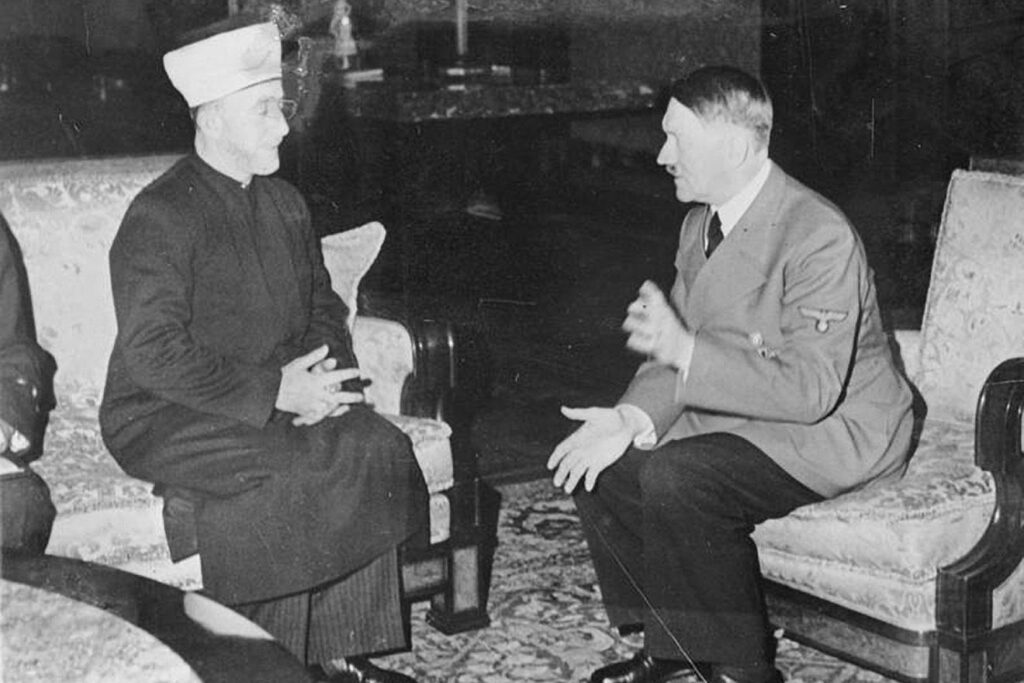
(Source: JNS)
Husseini spent the war in Berlin, broadcasting Nazi propaganda in Arabic and helping recruit Bosnian Muslims into the Waffen-SS Handschar division. In 1943 he wrote to the governments of Bulgaria, Hungary and Romania urging them to stop Jewish children from emigrating to the Land of Israel and to send them to Poland instead, where the death camps were operating at full capacity. Eighty-three years after the Mufti sat with Hitler, his movement’s heirs in Philadelphia picked the anniversary of Kristallnacht to mark Jewish shops for removal.
“There Is a Certain People”
Why does the war on the Jews so often begin at the cash register?
The Bible’s first recorded plan to annihilate the Jewish people opened with an economic argument. Haman did not ask King Ahasuerus for permission to commit genocide. He presented the Jews as a drain on the empire:
And Haman said unto king Ahasuerus: ‘There is a certain people scattered abroad and dispersed among the peoples in all the provinces of thy kingdom; and their laws are diverse from those of every people; neither keep they the king’s laws; therefore it profiteth not the king to suffer them.’ (Esther 3:8)
Haman never named the people. He called them am echad, “a certain people,” and let the king fill in the blank. He offered ten thousand talents of silver to the royal treasury to make the deal worthwhile. Before a single Jew could be killed, the Jews had to be cast as foreign, disloyal and bad for business.
Philadelphia’s activists use the same method. Their flier never says “Jews.” It says “Zionists” and “zio business owners,” and it lists a deli founded in the 1920s and a macaroni-and-cheese kiosk alongside Israeli restaurants. The code word is new. The list gives the game away.
The Megillah also records how the Jews of Persia answered. Mordechai sat at the king’s gate and refused to bow:
And all the king’s servants, that were in the king’s gate, bowed down, and prostrated themselves before Haman; for the king had so commanded concerning him. But Mordecai bowed not down, nor prostrated himself before him. (Esther 3:2)
Marti Lieberman’s Star of David stays on. Allan Domb will be standing behind his own counter on Sunday. They are keeping their seats at the king’s gate.
The Day That Turned
Haman cast lots to choose the day the Jews would be destroyed. The Bible records what happened when that day arrived: v’nahafoch hu, “it was turned to the contrary” (Esther 9:1). The day of slaughter became a day of feasting. “The Jews had light and gladness, and joy and honour” (Esther 8:16).
The activists chose the eve of Kristallnacht to mark Philadelphia’s Jewish shops for removal. Philadelphia’s Jews and their friends have chosen the same weekend to fill those shops with customers. Haman wanted the Jews out of the marketplace. On Sunday, the lines at Schlesinger’s counter will answer him.