



In late autumn, workers on the Carmel coast pressed olives. In spring, after the sheep were shorn, the same floors held looms. In the cold months, animals sheltered there, and their dung was swept up and the floors cleaned with wood ash. Through it all, 16 giant vats stood ready to turn sea snails into the royal purple worn by kings and priests.
A new study of Tel Shiqmona, a state-run industrial compound of the biblical Kingdom of Israel, has found that a single building there was used for different industries in different seasons, rotating with the agricultural year. The research, published in PLOS ONE, dates the phase to roughly 790 to 740 BCE, the reign of King Jeroboam II.
A kingdom’s factory
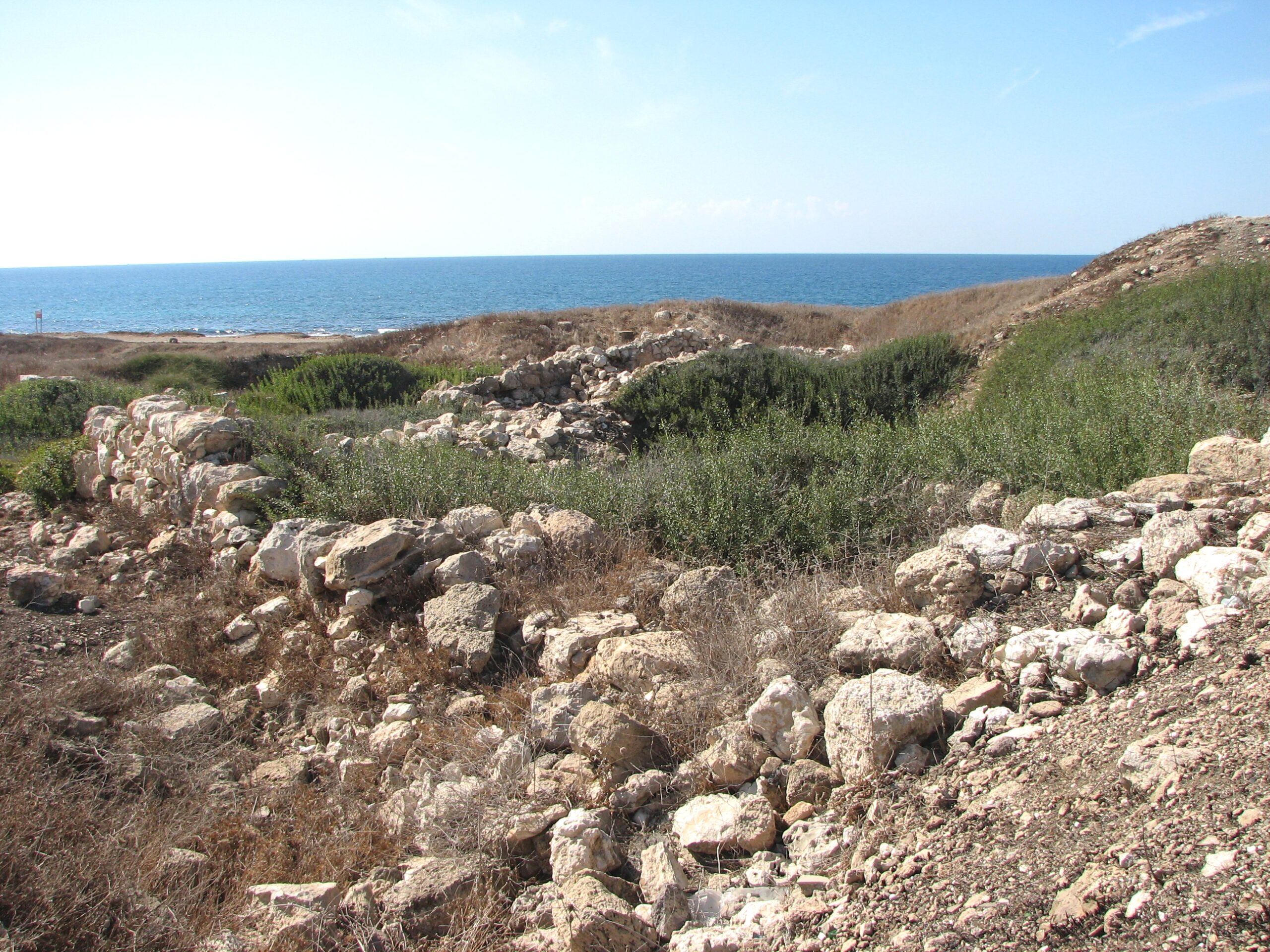
Tel Shiqmona sits on a rocky promontory on the Carmel coast at the southern edge of modern Haifa. The site covers only about two acres, yet it is the largest known Iron Age purple dye factory in the Mediterranean. It began as a small Phoenician village. In the 9th century BCE, the Kingdom of Israel took it over and turned it into a fortified, state-controlled industrial hub. Excavators have found at least 16 dyeing vats from the period, each holding about 350 liters. According to the Times of Israel, Shiqmona likely exported its products to Judah, Philistia, Moab, and Edom.
The study, “Seasonal and multi-functional use of industrial space at Iron Age Tel Shiqmona, Israel,” was led by a University of Haifa team: Isaac Ogloblin Ramirez, Golan Shalvi, Sonia Pinsky, Madeline Jacobson, Roni Zuckerman-Cooper, Prof. Ayelet Gilboa, and Prof. David Friesem. They focused on a structure known as Building B283, which contained an olive press, loom weights, and pottery stained with purple dye.
The researchers took 28 bulk sediment samples and three blocks of undisturbed floor from two adjoining rooms excavated in 2023. Using infrared spectroscopy and microscopic analysis, they identified olive pits, plant remains, layers of wood ash, and dung spherulites, the microscopic crystals left behind by penned livestock.
The evidence pointed to a building that changed jobs with the seasons. Olives were pressed in late autumn. Weaving took place in spring, following the shearing. Animals were likely penned there in winter, with the floors cleaned between uses. Purple dye production fit into the remaining windows, though the researchers say its exact timing remains unresolved, since harvesting enough murex snails was itself a seasonal undertaking.
“The olive harvest lasts for only a relatively short period at the end of autumn,” Shalvi, who directed earlier excavations at the site, told the Times of Israel.
Gilboa stressed the scale of the operation. “It was not just one individual dyeing a garment for a king,” she said.
Friesem said “improving efficiency and maximizing the use of resources and space” was a feature of ancient societies.
The paper challenges archaeologists to rethink how they label ancient sites. A purple dye factory, the authors note, did not produce purple dye every day of the year. “One must ask: what happened there during the many months each year when the industry stood idle?” they wrote. “Recognizing these seasonal rhythms is fundamental to re-evaluating the operational complexity and efficiency of the Iron Age economy.”
Stratum 11, the phase the team studied, ended in a violent destruction around 740 BCE.
The new study builds on years of work at the site that Israel365 News has followed closely. In 2019, Gilboa and Shalvi reported finding blue and purple dye residue on nearly 30 pottery sherds from Shiqmona, the largest amount ever found at a single archaeological site. “The rocky reefs adjacent to Tel Shikmona were the ideal habitat for the snails,” Shalvi said then. He was careful about the Temple connection: “I cannot determine definitively that this was or was not the source for Techelet and Argaman for the Temple”
In 2023, a study in the journal of Tel Aviv University’s Institute of Archaeology argued that the Omride kings of Israel seized a small Phoenician village in the mid-9th century BCE and fortified it to control dye production. “This is the best place along the Israeli coast with the best habitat for the snails that produce the dye,” Gilboa said. “This color was one of the most commercially expensive things available and really created a lot of wealth,” Shalvi added. Roughly 12,000 snails produce about 1.4 grams of dye, enough to trim a single garment.
Later research reconstructed the site’s 16 uniform clay basins, each about a meter high, and identified evidence for tola’at shani, the biblical scarlet dye made from oak scale insects. “This is the first time that we can reconstruct the shape of the tools used in the scarlet dye industry,” Shalvi said. “Shikmona was a production center on an extraordinary scale for its time,” Gilboa said.
The Tabernacle’s shopping list
What does a single Israelite building that rotated between olive oil, wool, and royal purple reveal about the land the Bible describes?
The answer begins in the desert. When God commanded Moses to collect materials for the Mishkan (Tabernacle), the list read like an inventory of Shiqmona:
And blue, and purple, and scarlet, and fine linen, and goats’ hair; and rams’ skins dyed red, and sealskins, and acacia-wood; oil for the light, spices for the anointing oil, and for the sweet incense. (Exodus 25:4-6)
Techelet (blue) and argaman (purple) were both extracted from murex snails. The wool they colored came from the flocks. The oil that lit the menorah (candelabrum) was shemen zayit zach, pure olive oil. The dyes and textiles of the priestly garments, and the oil of the Temple lamp, came out of the same economy that archaeologists have now found operating under one roof on the Carmel coast. The Times of Israel noted that fabrics dyed at Shiqmona may have reached the First Temple in Jerusalem.
The Sages knew exactly where these snails were found. The Talmud (Shabbat 26a) identifies the yogvim, the laborers whom the Babylonians left behind in the land after the destruction of the First Temple, as “the trappers of the chilazon (dye snail) from the Ladder of Tyre to Haifa.” Tel Shiqmona sits inside modern Haifa, at the southern end of that exact stretch of coast.
The Talmud (Megillah 6a) records that the tribe of Zebulun complained to God that his brothers had received fields and vineyards while he received seas and rivers. God answered that all the tribes would come to depend on Zebulun for the chilazon. The Sages read this into Moses’ blessing that Zebulun would draw out “the hidden treasures of the sand” (Deuteronomy 33:19). The neighboring tribe of Asher, whose border reached “to Carmel westward” (Joshua 19:26), received a blessing to “dip his foot in oil” (Deuteronomy 33:24). Purple and oil, the blessings of two tribes, were produced side by side on the same stretch of coast.
The thread of blue
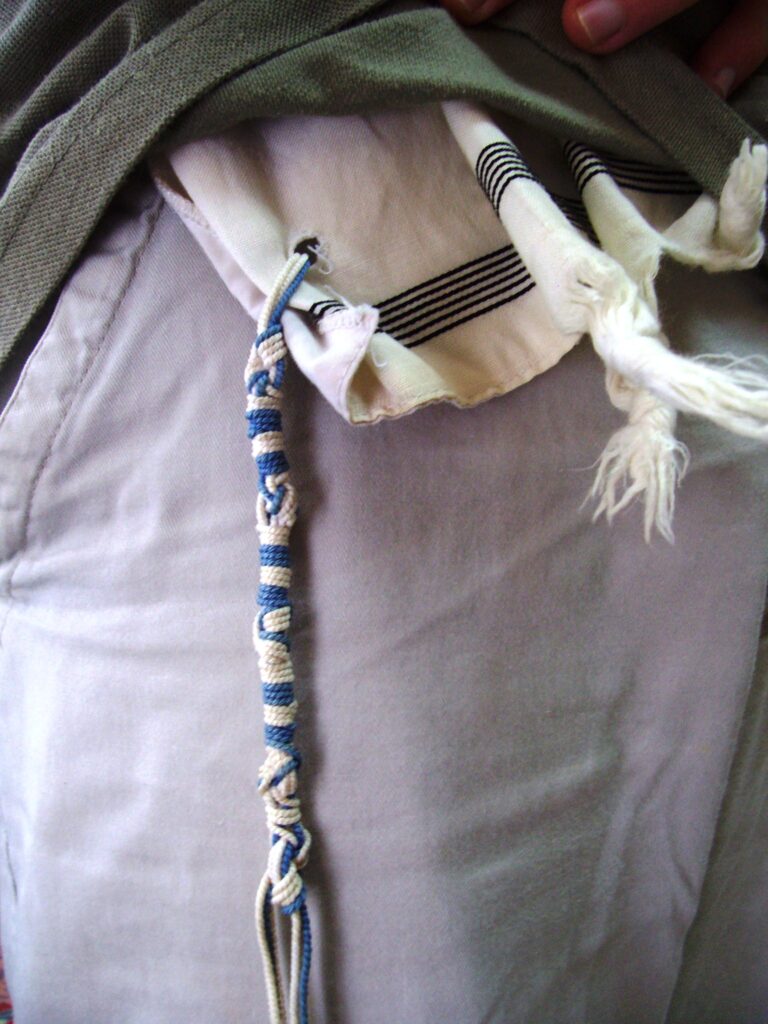
Of all the colors produced at Shiqmona, techelet carries the deepest weight in the Bible. The word appears 49 times in the Hebrew Bible. It colored the curtains of the Tabernacle, the cover of the Ark of the Covenant on the march through the desert, and the robe of the Kohen Gadol (High Priest), which the Bible commands be made “all of blue” (Exodus 28:31). A cord of techelet bound the golden plate inscribed “Holy to the LORD” to the High Priest’s forehead.
The commandment was never limited to the priesthood. Every Jew was commanded to wear it:
Speak unto the children of Israel, and bid them that they make them throughout their generations fringes in the corners of their garments, and that they put with the fringe of each corner a thread of blue. And it shall be unto you for a fringe, that ye may look upon it, and remember all the commandments of the LORD, and do them; and that ye go not about after your own heart and your own eyes, after which ye use to go astray. (Numbers 15:38-39)
The Sages explained why a color would serve as a reminder of all the commandments. “Why is techelet different from all other colors? Because techelet resembles the sea, and the sea resembles the sky, and the sky resembles the Throne of Glory,” Rabbi Meir taught (Menachot 43b). A Jew looking at the thread on his garment was meant to follow it upward, from the sea to the heavens to God Himself.
The Talmud (Menachot 44a) describes the source of the dye as the chilazon, a creature of the sea whose blood produced the color. After the destruction of the Second Temple, under Roman persecution and the loss of the coastal communities, the knowledge was lost, and by the close of the Talmudic era Jews were tying their tzitzit (fringes) in plain white. For some 1,300 years, the thread of blue disappeared.
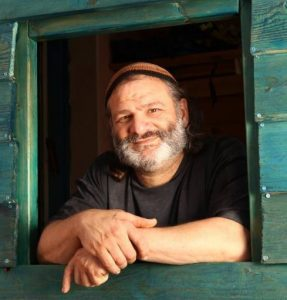
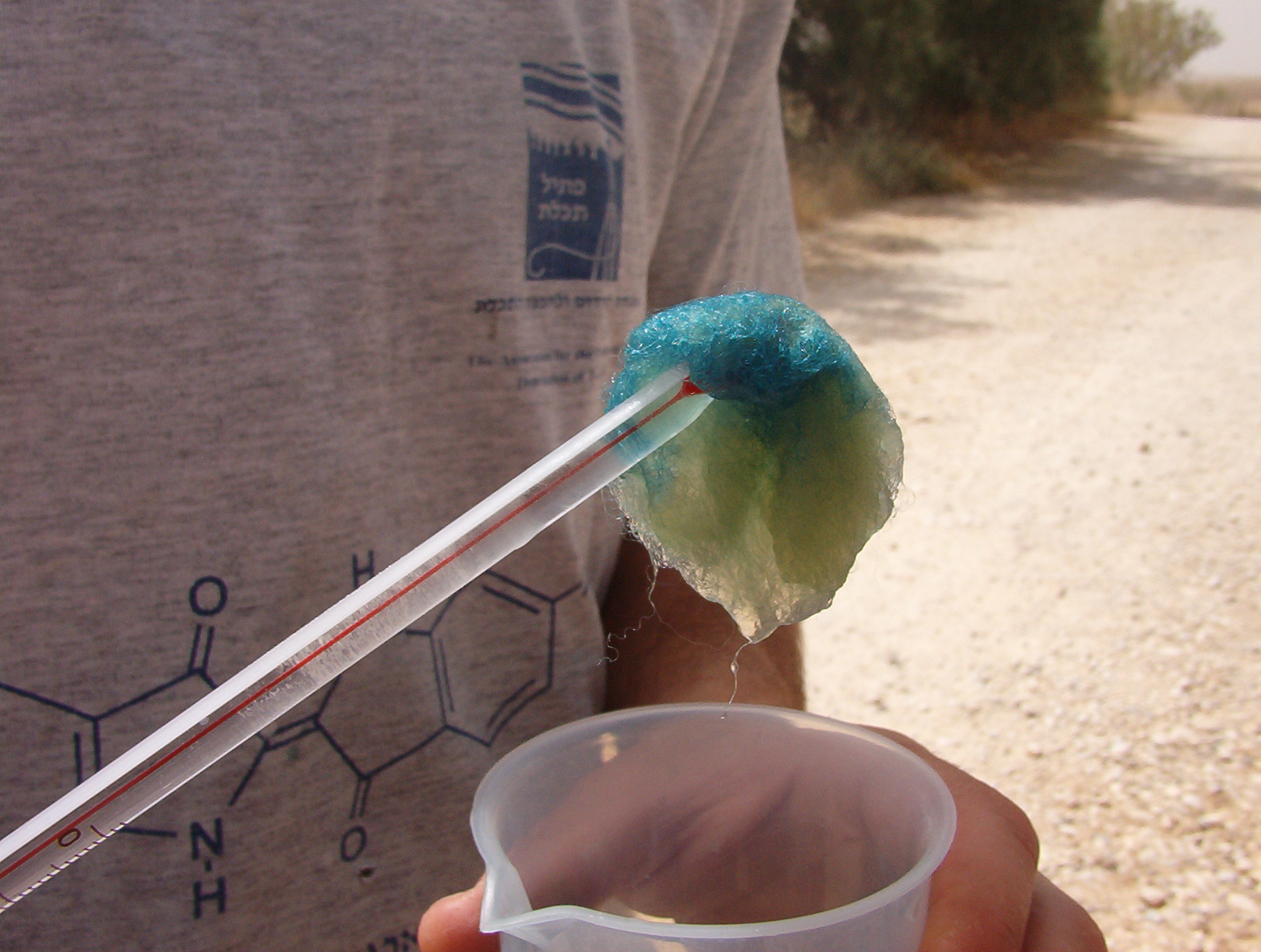
It has returned in this generation. Ptil Tekhelet, a non-profit in Kfar Adumim, began producing techelet from murex snails in 1991 with about 300 sets of threads in its first year. By 2021, it had produced more than 270,000 sets and could not keep up with demand. “The Temple requires a ton of techelet,” co-founder Baruch Sterman told Israel365 News.
Rabbi Tuly Weisz, founder of Israel365, has tied the revival to the prophecy of Zechariah, in which ten men of the nations “take hold of the skirt of him that is a Jew” (Zechariah 8:23). The Hebrew word for that skirt is kanaf, the same word the Bible uses for the corners of the garment where the tzitzit hang. “The meaning of the prophecy in Zechariah was hidden, actually indecipherable,” Rabbi Weisz said after the first Shiqmona discovery. “This discovery portends a greater fulfilling of this prophecy”.
A calendar written into the land
The researchers describe a factory that ran on the agricultural year. The Bible describes a nation that did the same. In the second paragraph of the Shema, recited by Jews twice daily, God ties the prosperity of the land directly to its seasons:
That I will give the rain of your land in its season, the former rain and the latter rain, that thou mayest gather in thy corn, and thy wine, and thine oil. And I will give grass in thy fields for thy cattle, and thou shalt eat and be satisfied. (Deuteronomy 11:14-15)
The yoreh (early rain) of autumn and the malkosh (late rain) of spring framed the year. Oil was pressed at the end of autumn, the flocks were tended through the winter, and the wool came in with spring. The floors of Building B283 preserve that rhythm in ash and dung and olive pits, layer by layer.
The era matters as well. Jeroboam II presided over the last great flourishing of the Northern Kingdom. The Bible says “he restored the border of Israel from the entrance of Hamath unto the sea of the Arabah” (II Kings 14:25). The prophet Amos, who prophesied in his days, condemned the elite of Samaria who lived off that wealth: they “drink wine in bowls, and anoint themselves with the chief oils; but they are not grieved for the hurt of Joseph” (Amos 6:6). The phase of Shiqmona the researchers studied ended in fire around 740 BCE. Within two decades, Assyria had carried the Northern Kingdom into exile.
The land remembers
The scientists of the University of Haifa set out to correct an error in how archaeologists label ancient buildings. Along the way, they recovered a working model of the Israelite economy the Bible describes: oil in its season, wool after the shearing, flocks fed through the winter, and a royal industry in purple drawn from the sea of Zebulun.
The site is open to visitors again. Last month, Tel Shiqmona National Park reopened after two years of conservation and development work costing about NIS 3 million, funded by the Foundation for the Preservation of Open Spaces, the Jerusalem Post reported. The project was led by Israel Oceanographic and Limnological Research, whose institute sits beside the mound, together with the Israel Nature and Parks Authority, the Haifa Municipality, the University of Haifa’s Zinman Institute of Archaeology, and the Israel Antiquities Authority. Visitors can now walk paved paths past exposed excavation walls and explanatory signs. Haifa Mayor Yona Yahav and Nature and Parks Authority Director-General Raya Shurki attended the opening.
Purple production at Shiqmona outlived the Kingdom of Israel by a thousand years. The site has been identified with the Byzantine city of Porphyreon, a name meaning “purple,” and a Byzantine church with mosaic floors still stands at the center of the mound.
The Kingdom that ran Shiqmona fell, and its floors were buried under ash for 2,700 years. The olive trees of the Carmel still give their oil at the end of autumn. The flocks still graze the hills. In recent decades, Israeli researchers and the Ptil Tekhelet association revived the production of techelet from the same murex snails, and Jews around the world once again wear the blue thread on their tzitzit (fringes). The land kept its calendar through every exile, waiting for its people to come home and pick up the work where they left it.

