




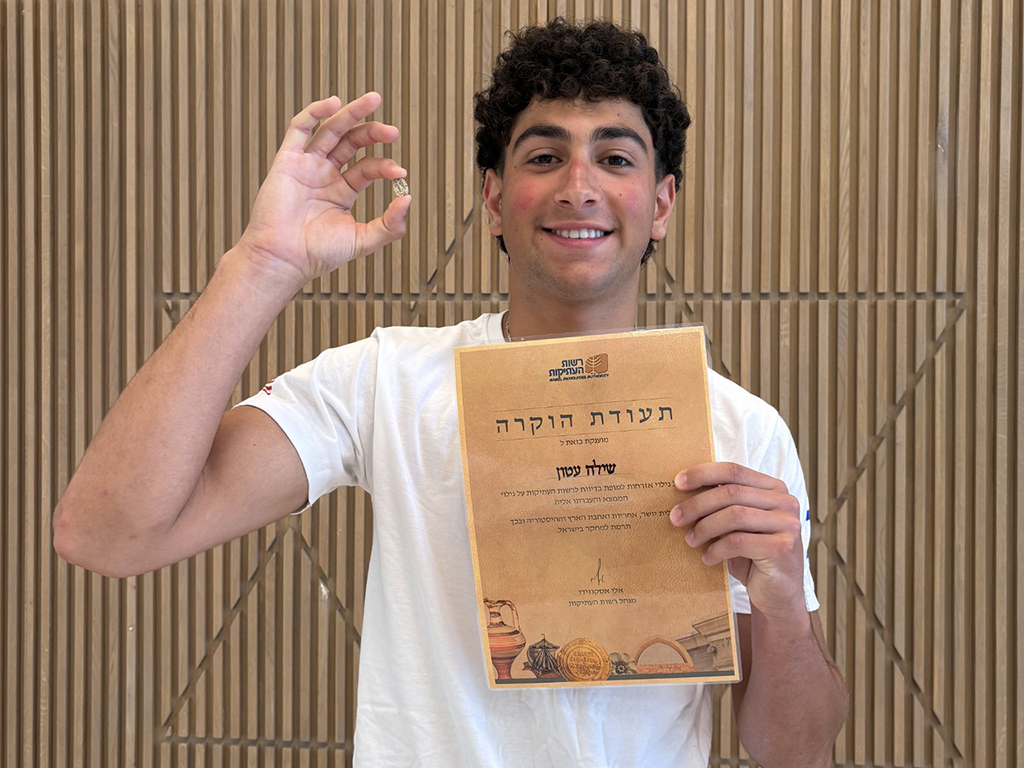
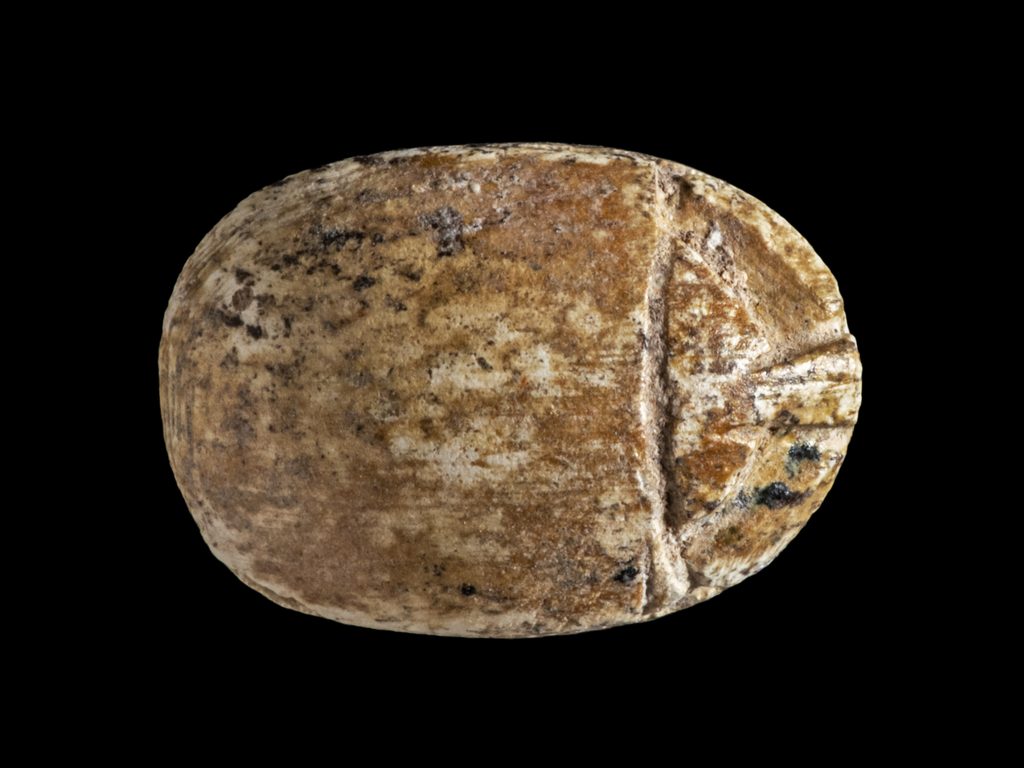
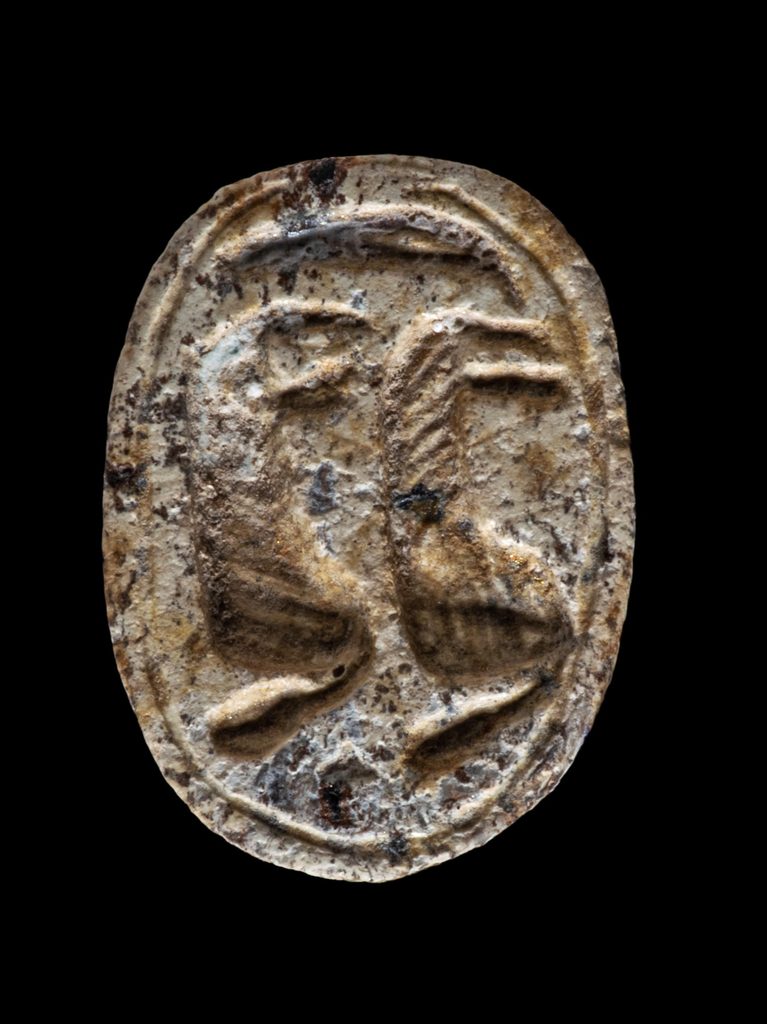
Shiloh Attoun had been in Israel for exactly two days when the land handed him a piece of its history. The 17-year-old American was walking through Tel Gezer National Park with his classmates from Jewish National Fund-USA’s Muss High School Israel program, listening to his guide explain how rare it is to find an artifact at an excavated site, when he looked down and saw a small object lying on the road. It turned out to be a 3,300-year-old Egyptian scarab amulet, carved with two cobras perched above the hieroglyphic sign for “lord.”
“This was our class’s first trip to see the country; we arrived only two days earlier,” Shiloh said. “As we were learning about Tel Gezer’s history and archaeology, I noticed a small, interesting object on the ground. It looked ancient. I picked it up and consulted my guide. I couldn’t believe it was happening to me. A moment ago we were talking about the slim chances of ever discovering such a find, and here was one right in my hand!”
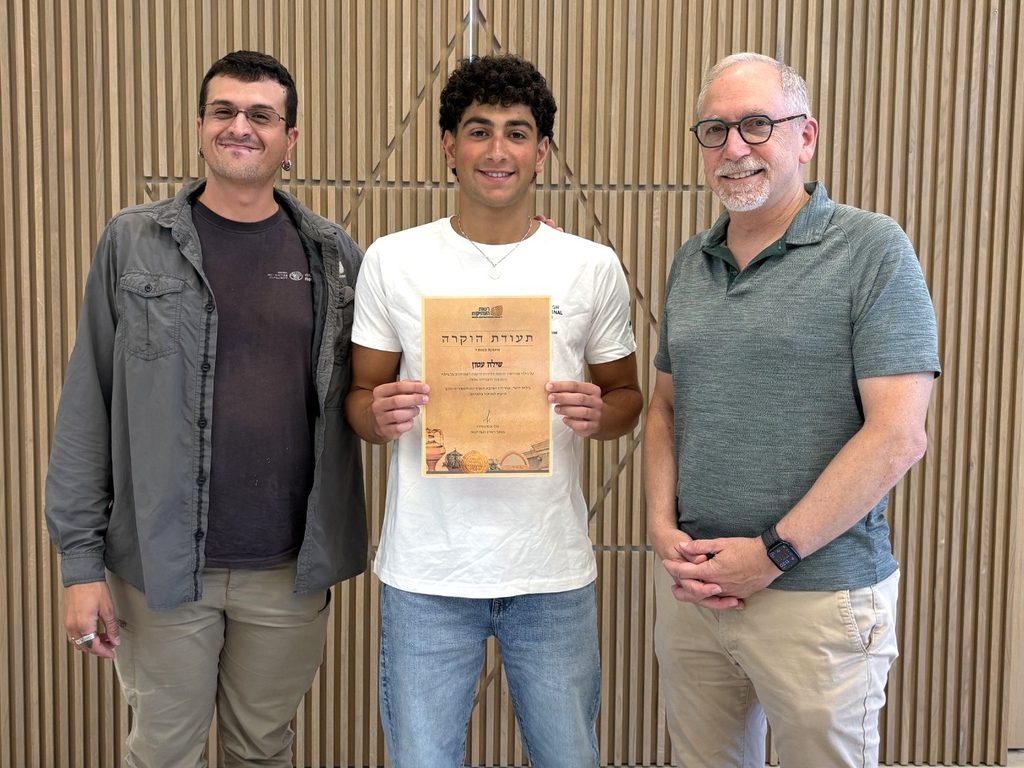
Together with Benji Hain, Dean of Students at Muss, Shiloh reported the find to the Israel Antiquities Authority. Archaeologist Adam William Asper, a supervisor in the IAA’s Central Region, met the group at the school, collected the amulet for the National Treasures of Israel, and presented Shiloh with a certificate of appreciation for good citizenship.
“This discovery sparked great excitement among the students,” Hain said. “As soon as we realized that this might be a significant archaeological find, it was important for us to immediately contact the Israel Antiquities Authority, report it, and ensure that we were acting in the right way.”
Cobras and a Claim of Lordship
Professor Ido Koch of Tel Aviv University’s Department of Archaeology and Ancient Near Eastern Cultures examined the seal and dated it to the Late Bronze Age, in the second millennium BCE.
“An interesting scene appears on the scarab: two cobras above a semi-ellipse,” Koch explained. “The cobra, identified with the biblical serpent and called in Egyptian and in Greek ‘Uraeus,’ was a very common protective and royal symbol in ancient Egypt and the southern Levant. The semi-ellipse below the cobras represents the Egyptian hieroglyphic sign ‘nb’, which means ‘lord.’ A scarab depicting a similar scene, but with three snakes, was earlier found in the Tel Megiddo excavations.”
The scarab itself is shaped like a dung beetle, an insect the Egyptians held sacred. The beetle rolls a ball of dung, which the Egyptians associated with death, and lays its eggs inside it, producing new life. The Egyptian name for the scarab derives from a verb meaning “to come into being” or “to be created,” and the Egyptians treated the beetle as the living emblem of the god who creates life.
Scarabs found in Israel, some used as seals, testify to the heavy cultural and political weight Egypt carried in the region during its rule here roughly 3,500 years ago. Gezer was one of the most important Canaanite cities of that era, guarding a strategic crossroads in the Judean Lowlands, known in Hebrew as the Shephelah. The site is now a national park managed by the Israel Nature and Parks Authority.
Amit Melman, Central Region Educational Director at the IAA, praised the students. “Shiloh’s story is a charming example of the connection forged between the young people who come to study in Israel and the country’s history and archaeology, through firsthand experience in the field,” Melman said. “Shiloh and the program instructors deserve praise for showing responsibility and immediately handing over the find to our national repository. Thanks to them, this special find was preserved, and we can all learn from it.”
Tali Tzour Avner, Director of JNF-USA in Israel, said the moment captured the purpose of the program. “Already on his very first trip, he got to know the country on foot and met a piece of its history up close,” she said. “There is something exciting about the moment here in Israel when the history studied in class becomes a personal encounter. This is the experience we work hard to give our students: to get to know Israel, to feel they belong to it, and to discover that they too have a place in its story.”
Israel’s Minister of Heritage, Rabbi Amichai Eliyahu, also commended the teen. “This discovery underscores the tremendous importance we place on connecting young people from the Diaspora with the heritage of the Land of Israel through direct encounters with the sites and artifacts that tell its story,” Eliyahu said. “I commend Shiloh for his discovery and for acting responsibly by handing over the ancient amulet to the state.”
The IAA reminds the public that any archaeological find discovered in the field should be left in place and reported immediately, so archaeologists can document its context, which holds information that cannot be recovered once an object is moved.
Pharaoh’s Serpent in Solomon’s City
A tiny Egyptian seal declaring a serpent to be “lord” turned up in a city the Bible ties directly to both Pharaoh and King Solomon. What does the Bible say about the clash between Egypt’s claim to lordship and the true Lord of the Land of Israel?
Gezer appears repeatedly in the Hebrew Bible. Joshua defeated Horam, king of Gezer (Joshua 10:33). Centuries later, the city passed from Egyptian hands into the kingdom of Israel in a remarkable way:
“Pharaoh king of Egypt had gone up and taken Gezer, and burnt it with fire, and slain the Canaanites that dwelt in the city, and given it for a portion unto his daughter, Solomon’s wife.” (1 Kings 9:16)
Solomon then rebuilt Gezer as one of his great fortified cities, alongside Hazor and Megiddo (1 Kings 9:15). The six-chambered Solomonic gate still stands at the site today. The amulet Shiloh found belongs to the earlier world, when Egypt ruled Canaan and Pharaoh’s cobra stood as the badge of his power.
The cobra, the uraeus, sat on the brow of Pharaoh’s crown. It was his personal emblem of divine kingship. That explains a detail in the Exodus story that otherwise seems strange. When Moses and Aaron first stood before Pharaoh, God instructed Aaron to throw down his staff and it became a tanin, a serpent. The Egyptian magicians matched the sign, and then Aaron’s staff swallowed theirs (Exodus 7:10-12). The Sages connect this sign to Pharaoh himself, whom the prophet Ezekiel calls “the great tanin that lies in the midst of his rivers” (Ezekiel 29:3). The message to Pharaoh was unmistakable: the serpent on your crown, the very symbol of your lordship, will be swallowed whole.
Pharaoh understood the challenge. His first answer to Moses was a flat denial of any lordship above his own: “Who is the Lord, that I should hearken unto His voice to let Israel go? I know not the Lord, and moreover I will not let Israel go” (Exodus 5:2). The scarab Shiloh held carries Pharaoh’s position in miniature, two cobras guarding the word nb, “lord.”
The beetle carries a theological claim as well. The Egyptians named it for the act of coming into being and credited it with the power of creation. The Bible answers with the Name God revealed to Moses at the burning bush, Ehyeh Asher Ehyeh, “I Will Be What I Will Be” (Exodus 3:14), drawn from the Hebrew root hayah, “to be.” Egypt carved its idea of existence into a beetle. The God of Israel declared that existence itself belongs to Him.
History rendered its verdict at Gezer. Pharaoh burned the city and then surrendered it as a dowry to the king of Israel. The cobra-crowned empire faded, and its amulet lay in the dust of the Land of Israel for more than three millennia until a Jewish boy, two days off the plane, picked it up and handed it to the Jewish state.
The boy’s name carries its own weight. In Jacob’s blessing to Judah, the Bible promises that the scepter will remain in Judah “until Shiloh comes” (Genesis 49:10), and the Talmud (Sanhedrin 98b) teaches that Shiloh is one of the names of the Messiah. Pharaoh’s seal of lordship has been surrendered, once again, into the hands of Judah.

