


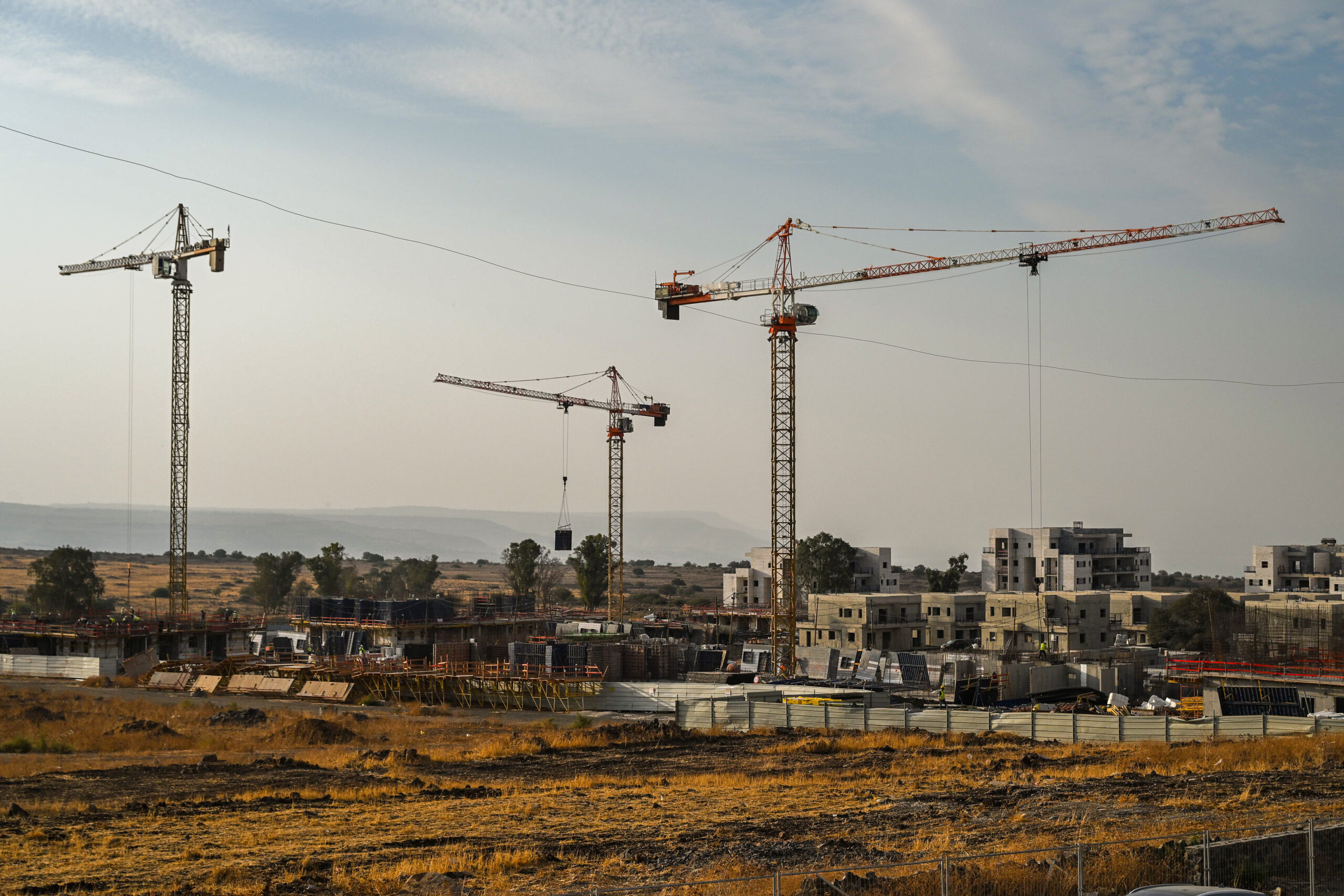
Israel is sitting on a record 85,000 unsold new apartments, with another 217,000 homes rising behind construction cranes, the most in the country’s history. A Jew who boards a flight to Ben Gurion Airport tomorrow could walk straight into a brand-new home, and developers are offering discounts to make it happen. But Jewish tradition reserves a far greater reward for the Jews who are already here.
A seventeenth-century Kabbalistic text teaches that when the Messiah gathers the last of the exiles, the Jews who came to the Land of Israel before him will rise into the air on wings, while the latecomers will be handed the treasures of the sea as a consolation prize.
The numbers come from Israel’s Central Bureau of Statistics (CBS), and they were laid out in an October 30 Times of Israel report by Zev Stub. After more than three years of war, Israel is building more housing than at any point since the state’s founding, with no sign of slowing. Home prices have dipped 1.8% over the past year, yet they remain near record highs. According to the CBS, selling every available new apartment at the current pace would take about two and a half years.
A building boom in wartime
In the 12 months from October 2024 to September 2025, construction began on 81,020 apartments, an all-time record and a 31.5% jump over the previous year. By the end of June 2026, some 217,200 homes were under active construction, 8% more than a year earlier.
Of the more than 85,000 unsold new homes, about 46,000 are in Tel Aviv and the central region, and roughly 10,000 are in Jerusalem. The picture in the capital is different from the rest of the country. Jerusalem real estate agent Nachi Paris told the Times of Israel that move-in-ready apartments in the city number fewer than 100, and that projects still three to four years from completion are already half sold. Eran Rolls, head of the Israel Building Center, predicted that prices in Jerusalem’s historic neighborhoods will keep climbing, and pointed to construction cranes filling Netanya, Sderot, Ashkelon and Jewish communities in Judea and Samaria.
The building extends deep into the biblical heartland. Since the current government took office, Israel’s Higher Planning Council has approved more than 51,000 housing units in Judea and Samaria, a pace without precedent. As of January 1, 2026, 529,704 Jews lived there. In June, the council approved the first new construction in Hebron under Israel’s direct planning authority, along with thousands of new residents for Mitzpe Yericho.
“We continue to build the Land of Israel in practice,” Finance Minister Bezalel Smotrich said at the time.
A nation growing against the trend
The homes are going up as Israel’s population surges. Ahead of Rosh Hashanah, the CBS put the population at 10.305 million, an increase of about 124,000 in a single year. Israel’s fertility rate stands at 2.88 children per woman, more than double the OECD average of 1.41.
Jewish births are driving the growth. In the 12 months ending in June 2026, 137,343 Jewish babies were born in Israel, the highest figure in the CBS records since 1996. Jewish births rose 4.2% over 2025, while Arab births fell 4.1%. Tel Aviv University real estate economist Dani Ben Shahar told the Times of Israel that Israel’s population is expected to double within four decades.
The ingathering is already reshaping the Jewish world. Of the roughly 15.9 million Jews alive at the start of 2026, about 46% live in Israel. Since 1948, some 3.51 million people have immigrated to the Jewish state.
Rising antisemitism abroad is sending Diaspora Jews to Israeli sales offices. Rolls told the Times of Israel that hatred of Jews overseas is already pushing buyers to Israel, and that a wave of new Jewish buyers would transform the market overnight: “If there was a sudden influx of thousands of Jews buying homes here.” Real estate agents serving overseas clients report a new phrase in their conversations.
“A lot of people are saying to us, ‘I need a safety apartment in Israel,'” Eliyahu Kleinman, co-founder of Aliyah IL, told the Jerusalem Post.
The land that makes room
The prophet Isaiah described the moment when a land emptied by exile would suddenly find itself too small.
“The children of thy bereavement shall yet say in thine ears: ‘The place is too strait for me; give place to me that I may dwell.'” (Isaiah 49:20)
In the next verse, the prophet describes Zion looking at the crowds of returning children with astonishment, unable to understand where they all came from after generations of loss. The Hebrew phrase tzar li hamakom, “the place is too narrow for me,” is the cry of a homeland straining to hold its people.
The Sages taught that the Land of Israel responds to its people. The Talmud in Tractate Gittin (57a) explains why the Bible calls Israel eretz tzvi, “the land of the deer.” The skin of a deer, once removed, can no longer contain its flesh. So too the Land of Israel: when the Jewish people live in it, it expands, and when they are absent, it contracts.
For nearly two thousand years, the land shrank. Mark Twain toured it in 1867 and described a desolate country of empty hills and silent villages. Today the same land holds more than 10 million people and is building homes for millions more.
The clearest sign of the end
The prophet Ezekiel addressed the mountains of Israel directly and told them to prepare for their returning owners.
“But ye, O mountains of Israel, ye shall shoot forth your branches, and yield your fruit to My people Israel; for they are at hand to come.” (Ezekiel 36:8)
The Talmud in Tractate Sanhedrin (98a) records the teaching of Rabbi Abba that no sign of the redemption is clearer than this verse. The Hebrew term is ketz meguleh, the revealed end. When the Land of Israel begins producing abundantly for its people, the final redemption is at the door. The land does not wait for the exiles to arrive. It prepares for them in advance, because they are karvu lavo, “at hand to come.”
Two verses later, Ezekiel describes the result.
“And I will multiply men upon you, all the house of Israel, even all of it; and the cities shall be inhabited, and the waste places shall be builded.” (Ezekiel 36:10)
The prophet specifies “all the house of Israel, even all of it,” kol beit Yisrael kulo. The Sages read this as a promise that the ingathering will include every Jew, from every corner of the exile. Israel’s record construction pipeline, with 217,000 homes going up at once, is building cities for people who have not yet bought their plane tickets.
Buying houses during the siege
The prophet Jeremiah received a strange command while the Babylonian army surrounded Jerusalem. God told him to buy a field in his hometown of Anathoth, a field about to fall into enemy hands. Jeremiah paid the full price, signed the deed before witnesses, and sealed it in an earthenware jar so it would last for many years. Then he explained why.
“For thus saith the LORD of hosts, the God of Israel: Houses and fields and vineyards shall yet again be bought in this land.” (Jeremiah 32:15)
Jeremiah’s purchase was a statement of faith made in the middle of a war, at a moment when every sign pointed to destruction. Israel’s builders have spent the past three years doing the same thing. Through the October 7 massacre, the war against Hamas in Gaza, Hezbollah rockets in the north and missile barrages from Iran, Israelis kept pouring foundations and raising cranes, and they set an all-time record for construction in the process.
Wings for those who came first
The homes are ready, and millions of Jews in the Diaspora remain where they are. Many of the overseas buyers filling Israeli sales offices are purchasing a “safety apartment” that will sit empty until a crisis forces them to move. Rabbi Natan Shapira, a seventeenth-century Kabbalist who left Krakow to settle in the Land of Israel, described what awaits those who wait in his book Tuv HaAretz (The Goodness of the Land).
According to the tradition he records, when the Mashiach (Messiah) arrives with the exiles of the Diaspora, they will find six or seven thousand Jews already living in the Holy Land. On that same day, the dead will rise, the walls of Jerusalem will be restored, and the Holy Temple will be rebuilt from precious stones and gems.
The Jews buried in the Land of Israel will be resurrected as beings of the highest spiritual order, and the Jews living there will undergo the same transformation. Their bodies will return to the state of Adam before the sin, clothed in light, and will resemble the body of Moses, who stood on Mount Sinai for forty days at a time without food, water or sleep. They will float in the air and fly like eagles.
The arriving exiles will be stunned. Troubled, they will come to the Mashiach with a complaint: they are Jews just the same, so why do the residents of the land merit to fly and live in an exalted spiritual state while they do not?
The Mashiach will answer that all of God’s ways work midah k’neged midah, measure for measure. The Jews who left the Diaspora to live in the Holy Land cared little for their finances or their health. They crossed vast lands and seas, ignoring the dangers of drowning, robbery and captivity by foreign rulers. Because they placed their spirit ahead of their material lives, they will be raised to a lofty spiritual level. The ones who stayed behind had the same opportunity and hesitated, enamored with their material standing. They made the spiritual secondary, and so they will remain physical.
God will still satisfy their desire for wealth. Every treasure ever lost beneath the waves will come to the Land of Israel, because all the seas have been sworn to deliver them onto the shores of Yaffo (Jaffa). The shore will fill with the riches of all history, and the Mashiach will distribute them to each person according to his needs. Treasures buried in the earth will be brought to the Land of Israel as well. Rabbi Shapira finds both in Moses’ blessing of the tribes.
“They shall call peoples unto the mountain; there shall they offer sacrifices of righteousness; for they shall suck the abundance of the seas, and the hidden treasures of the sand.” (Deuteronomy 33:19)
The wealth will serve as the consolation of those who put material things first. The Jews who put their neshama (soul) first will be transformed into heavenly beings and led into the earthly Gan Eden, the Garden of Eden.
The latecomers will receive gold. The early arrivals will receive wings.
The teaching offers a sharp explanation for the empty apartments standing across Israel today. The houses are built, the land has expanded to receive its children, and the door is open. The Jews who live here have paid for that open door through rocket fire, terror attacks and three years of war, and they stayed. What holds the exiles back is the same attachment to comfort, careers and possessions that Rabbi Shapira described nearly four centuries ago.
The doves return to their windows
Economists measure a housing surplus by how long it will take to sell. By that measure, Israel has two and a half years of inventory. The prophets measured it differently.
“Who are these that fly as a cloud, and as the doves to their cotes?” (Isaiah 60:8)
The Hebrew word arubotehem describes the openings of a dovecote, the nesting places a keeper builds and prepares before the birds come home. Isaiah saw the exiles of Israel returning in a cloud, filling the sky like doves streaming back to the shelters waiting for them.
The shelters are built. Eighty-five thousand of them are standing empty right now, with another 217,000 on the way, in Tel Aviv and Jerusalem, in Netanya and Sderot, in the hills of Judea and Samaria. The Land of Israel has done its part and made room. The doves are already beginning to fly.
