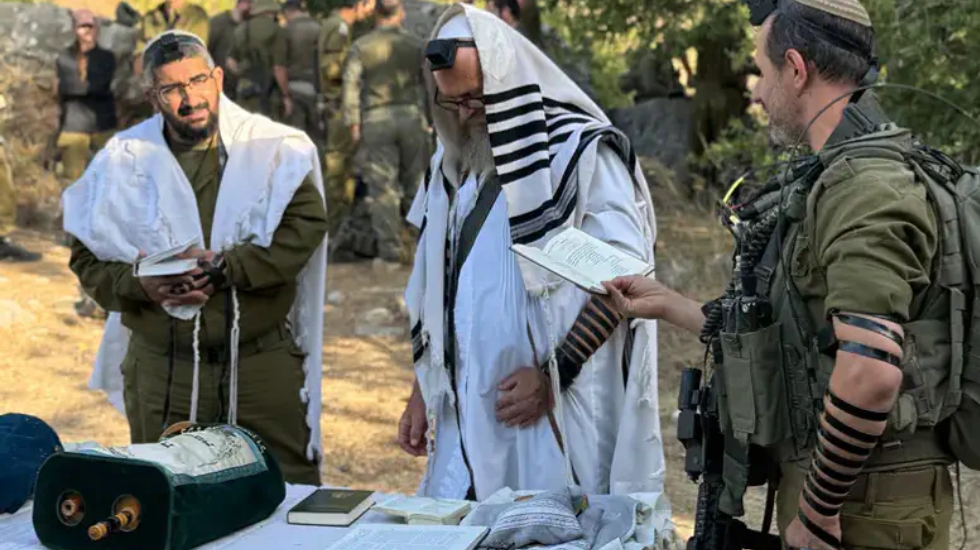
Battalion Rabbi Elyashiv Hacohen put on a white kittel (the white linen robe worn on solemn occasions), climbed Mount Betarim on Friday morning, and blew the shofar for victory in the war. Around him stood the commanders and soldiers of the 21st Battalion of the Carmeli Brigade, on a ridge of Mount Dov within sight of the Lebanese border. A company commander then read aloud the words that tradition says God spoke to Abram on that mountain:
“In the same day the LORD made a covenant with Abram, saying, Unto thy seed have I given this land, from the river of Egypt unto the great river, the river Euphrates:” (Genesis 15:18)
The soldiers prayed for the welfare of the State of Israel and for the success of the troops defending it. Afterward they described the ascent as “a very special and moving mission,” according to Israel National News.
A custom older than the state
The ceremony took place ahead of Shabbat Lech Lecha (“Go forth”), the weekly Bible reading that recounts the covenant. Israel National News reported that the ascent revived a custom documented in historical sources dating back about 700 years, in which Jews from the Galilee climbed the mountain on the eve of that Shabbat to pray and read the verses of the Brit Bein HaBetarim (the Covenant Between the Pieces). The report names no source text for the 700-year figure. JNS, reporting on an earlier ascent, attributed the custom over the generations to the Jews of Safed.
The custom had been interrupted. On Oct. 31, 2025, about 300 worshippers and soldiers from the 810th Mountain Brigade climbed Mount Betarim for the first time in three years, after the area had been closed to civilians as a military zone during the war with Hezbollah. This year, the soldiers who hold the line came up on their own.
The covenant on the mountain
Genesis 15 opens with a childless man. God tells Abram not to fear and promises him a great reward, and Abram answers that he has no heir. God leads him outside, tells him to count the stars if he can, and says his descendants will number as many. Abram believes. Then he asks the question that sets the scene: how will he know that he will inherit the land?
God’s answer is a ceremony. Abram brings a three-year-old heifer, a three-year-old female goat, a three-year-old ram, a turtledove and a young pigeon. He splits the three animals in half and lays the halves opposite one another. He leaves the birds whole. Birds of prey swoop down on the carcasses, and Abram drives them away. At sunset a deep sleep falls on him, and with it a great dread.
In that sleep God tells Abram that his descendants will be strangers in a land not theirs, enslaved and oppressed for four hundred years, and will then leave with great wealth. Then the night closes with the sign that gives the covenant its name. A smoking furnace and a flaming torch pass between the pieces. The Hebrew idiom for making a covenant is karat brit, literally “to cut a covenant,” and here the cutting is physical. Only the flame passes between the halves. Abram, asleep, does not walk the path. The promise rests on God alone.
The text then names the land: from the river of Egypt to the Euphrates, the territory of ten peoples, the Kenites, Kenizzites, Kadmonites, Hittites, Perizzites, Rephaim, Amorites, Canaanites, Girgashites and Jebusites. The Sages read the scene as a map of Jewish history. Rashi, citing them, explains that the whole birds stand for Israel, which survives, while the divided animals stand for the empires that rule over it and pass away.
The Bible does not say where this happened. The identification of Mount Betarim, whose name comes from betarim, the “pieces” of the covenant, is a tradition, and the sources I found trace it to the sages of Safed.
Abraham and the birds in Islam
Islam preserves a scene of its own with Abraham and birds. In the Quran (2:260), Abraham asks God to show him how He gives life to the dead. Asked whether he believes, he answers yes and says he wants his heart reassured. God instructs him to train four birds to come to him, cut them into pieces, and scatter the pieces on different hilltops. When Abraham calls, the birds come back to life and hurry to him. The classical commentators read the episode as a preview of the Day of Resurrection. Genesis and the Quran share a man asking for assurance and receiving it through a scene with animals. Genesis answers with a promise of the land, and the Quran answers with a demonstration of God’s power over death.
The prayer for rain
The soldiers also recalled a tradition attributed to Rabbi Mordechai Eliyahu, the late Chief Rabbi of Israel, that this mountain is an appropriate place to pray for rain. The Bible gives the land a particular relationship with water:
“But the land, whither ye go to possess it, is a land of hills and valleys, and drinketh water of the rain of heaven: A land which the LORD thy God careth for: the eyes of the LORD thy God are always upon it, from the beginning of the year even unto the end of the year.” (Deuteronomy 11:11-12)
Egypt, the same chapter says, is watered by the foot, from the Nile. The land of Israel depends on the sky. The numbers show how closely. The 2025-26 rainy season finished at about 95 percent of the long-term national average, according to the Hydrological Service, with the Sea of Galilee basin near 90 percent and the Western Galilee at 85 percent. The Sea of Galilee’s cumulative water over two seasons was the lowest in a century of measurements, because the winter before it was worse: about half of the average rainfall nationally and 40 percent around the lake.
The new season began with a forecast. The Israel Meteorological Service predicted above-average rainfall for October, November and December. For the days after the ascent, it forecast local rain beginning Monday in the south, intensifying Tuesday with thunderstorms, hail and flash-flood warnings in the Negev, the Arava and the Dead Sea region, with unsettled weather through the end of the week.
The promise and the rifle
Abram asked how he would know. The answer he received on that night was a fire passing between severed animals, with no one else making a promise and no condition attached. On Friday, soldiers who guard Israel’s northern border stood on the mountain where tradition places that night and read the promise aloud, in the land it describes, in the year the war with Hezbollah left their commanders reading it from a closed zone. They blew the shofar for victory and prayed for rain over a land the Bible says drinks from the sky. The covenant still stands, and the people who guard it still read it aloud.