Hamas wants Israel to know it is ready to slaughter Jews again, and a senior United Nations official delivered the message. Senior Hamas officials sent Israel an unusually blunt and direct warning that the terrorist organization is prepared to carry out another attack similar to the October 7, 2023, massacre and could strike wherever the opportunity arises, inside Israel, in Judea and Samaria and abroad. The courier was Dr. Ramiz Alakbarov, the UN’s Deputy Special Coordinator for the Middle East Peace Process and its Resident and Humanitarian Coordinator.
For a body that has spent three years refusing to hold Hamas accountable for October 7, serving as its mailman marks a new low.
Delivered without a word of rebuke
The Hamas officials met with Alakbarov at his office in the Gaza Strip and asked him to convey the warning to Israel. He did. Alakbarov conveyed the message to Israel’s Coordinator of Government Activities in the Territories (COGAT), Maj. Gen. Yoram Halevy, who wrote to Prime Minister Benjamin Netanyahu and Defense Minister Israel Katz that the threat was unusually blunt.
Channel 13 published an excerpt from Halevy’s memo. According to the excerpt, Hamas told Alakbarov it is “ready to again carry out an attack such as the October 7 attack” and is prepared to act on any front where this becomes possible. Israeli officials described it as an extraordinary threat, unprecedented in its bluntness and directness.
The reports by Ynet, Channel 13, Israel National News and the Times of Israel contain no mention of Alakbarov condemning the threat, warning Hamas against carrying it out, or refusing to serve as its messenger. The UN official passed along a promise of mass murder as routine diplomatic business.
The meeting itself flies in the face of the ceasefire framework. Under President Trump’s 20-point plan, Hamas and other factions agree to not have any role in the governance of Gaza, “directly, indirectly, or in any form.” Hamas members who pledge to live peacefully and support coexistence with Israel will be offered amnesty, and those who refuse will be provided safe passage out of Gaza. A year later, the UN’s top humanitarian official in Gaza is hosting senior Hamas officials in his office and relaying their demands to Israel along with a threat that is the antithesis of a vision of coexistence.
Hamas lays out its grievances
The Hamas officials told Alakbarov that Israeli military operations in Gaza, the shifting of the Yellow Line marking Israeli military positions, and the Palestinian Authority’s cancellation of elections were causing Hamas to lose control on the ground, and they made clear that they were unwilling to accept the continuation of this situation. Israel currently controls over 60% of the territory, with Hamas the de facto ruler of the rest. PA President Mahmoud Abbas had set legislative elections for November 28, but earlier this month postponed them until September 2027. The PA has not held legislative elections since 2006, when Hamas won and then violently ousted Abbas’s Fatah faction from Gaza.
The threat is backed by preparations on the ground. Israel’s security cabinet was briefed that Hamas has ramped up preparations for renewed fighting, including by stockpiling weapons and moving them to civilian areas. Hamas assumes Israel’s hands are tied on launching a large-scale operation until after the November 3 US midterm elections. Implementation of President Trump’s peace plan has stalled, with Hamas refusing to disarm and Israel refusing to withdraw from any part of Gaza until that condition is met.
A long partnership
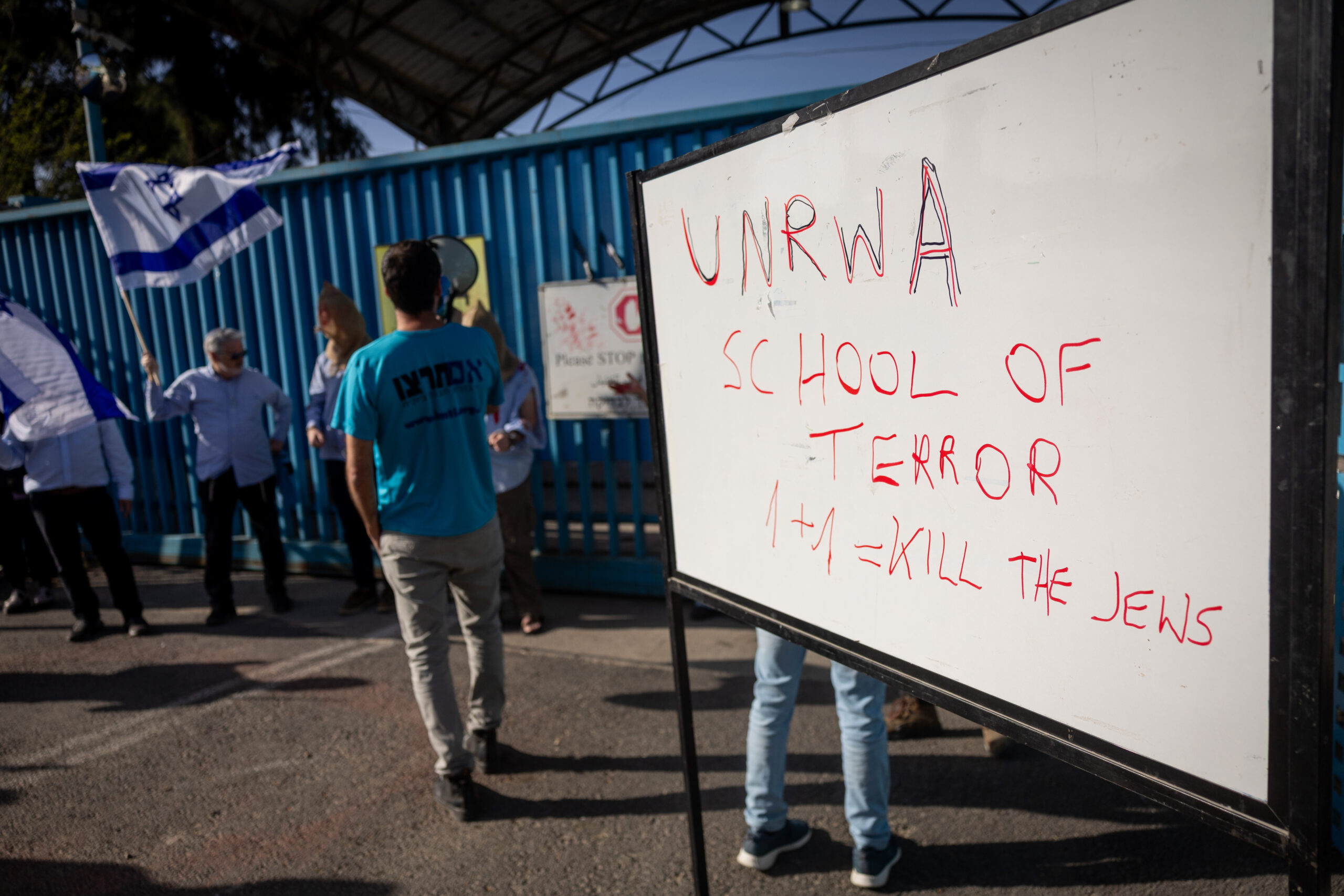
The UN’s ties to Hamas run deep, and most of them run through UNRWA, the UN agency for Palestinian refugees. The late Hamas chief Ismail Haniyeh was once an UNRWA teacher.
In June, the IDF published findings that 101 UNRWA employees were involved in the October 7 massacre or linked to Hamas’ military wing. Among them were school principals, teachers, medical personnel, and security staff. UNRWA staff helped transfer weapons, support operational communications, and use UNRWA facilities for Hamas terrorist activity. A US foreign aid watchdog announced the debarment of a former UNRWA school principal found to have participated in the attack as a member of Hamas’s East Jabalia Battalion. During the war, the IDF discovered weapons, tunnel shafts, and other Hamas infrastructure in UNRWA facilities, including schools.
UNRWA’s payroll also fed Hamas’s treasury, according to a lawsuit filed by Israeli hostages and families of October 7 victims. The suit claims the agency helped finance Hamas by paying its Gaza staffers in US dollars, funneling them to Gaza money-changers who give a cut to Hamas. According to the complaint, Hamas runs the majority of the currency exchangers and extracts a 10% to 25% fee from the rest, ensuring a predictable percentage of UNRWA’s payroll went to Hamas. The money was wired from a bank in New York and trucked into Gaza, with the payroll totaling at least $20 million a month from 2018 until September 2023. The plaintiffs argue Hamas’s capacity for October 7 would have been “possibly fatally weakened without that UNRWA-provided cash.” UNRWA has denied that it knowingly aids Hamas.
A former UNRWA legal adviser, James Lindsay, said UNRWA leadership historically did not attempt to bar Hamas members from employment. “UNRWA has made no effort to keep Hamas out,” Lindsay said. Secretary of State Marco Rubio called UNRWA a “subsidiary of Hamas” and vowed it will not play any role in delivering aid to Gaza.
The UN’s response was to keep the agency running. The UN General Assembly renewed UNRWA’s mandate through 2029, despite the allegations that UNRWA employees participated in the October 7 attacks. On January 20, 2026, Israel demolished UNRWA’s headquarters in Jerusalem, after the Knesset passed two laws prohibiting UNRWA’s work.
Three years of excuses for October 7
The UN’s reluctance to confront Hamas began within days of the massacre. UN Secretary-General Antonio Guterres condemned the attacks but said they “did not happen in a vacuum.”
Three weeks after October 7, the General Assembly passed its first formal response to the war without naming the perpetrators. The resolution, introduced by the UN’s 22-nation Arab coalition, made no mention of Hamas or the attacks. Canada proposed an amendment that would have “unequivocally reject[ed] and condemn[ed] the terrorist attacks by Hamas that took place in Israel starting on 7 October 2023 and the taking of hostages.” The amendment failed to garner the required two-thirds majority, with 88 in favour, 55 against and 23 abstentions. The resolution itself passed by a margin of 120-14.
Then-US Ambassador Linda Thomas-Greenfield said, “It is outrageous that this resolution fails to name the perpetrators” of October 7. Canada said it was “disappointed by the failure of the General Assembly to condemn Hamas.”
“I felt ashamed”
This month, a woman who spent four years inside the UN’s human rights system confirmed the pattern from the inside. Alice Jill Edwards, who served as the UN special rapporteur on torture from August 2022 to July 2026, accused her colleagues in a Daily Telegraph column of an obsessive focus on one side of the Gaza conflict, undermining the UN’s credibility in the process.
Edwards described visiting Kibbutz Kfar Aza about 14 months after the massacre, where Mandy Damari and Simona Steinbrecher, the mothers of hostages Emily Damari and Doron Steinbrecher, guided her through their daughters’ destroyed homes. The visit convinced her that hostage-taking is torture, and she pushed the issue through the General Assembly. She counts among her significant achievements a General Assembly resolution requiring countries to define hostage-taking as a form of torture.
Her colleagues refused to follow. Edwards wrote that Francesca Albanese, the UN’s special rapporteur assigned to the Palestinians, and Reem Alsalem, the special rapporteur on violence against women, never formally documented these horrors, despite the growing body of evidence. Alsalem cited Israel’s refusal to grant her entry and access as the reason she could not expand her investigation. “My colleagues said nothing, even when the Hamas captors put videos online,” Edwards wrote, referring to videos with Hebrew subtitles showing captives in horrifying scenes, including an emaciated hostage digging what he said was his own grave.
The resistance reached her own work. When Edwards published a report on October 7, including the massacre of more than 370 young people at the Nova music festival, only one other special rapporteur agreed to sign it. Others refused, and some attempted to have material removed from the report.
Edwards is no partisan for Israel. As chief legal adviser to the UN High Commissioner for Refugees, she defended Palestinians against discrimination, drafted the UN’s position on Palestinian refugees, and this year published a second detailed report on the mistreatment of prisoners in Israeli jails.
Attorney Ayelet Razin Bet-Or, who documents the sexual violence committed on October 7 and in captivity, praised the former rapporteur. “Edwards’ courage should not be the exception. It should be the standard,” she told Ynet.
“Got even so much worse”
Hillel Neuer, executive director of the Geneva-based UN Watch, has tracked the UN’s hostility to Israel for two decades. He said the organization’s obsession with Israel “got even so much worse after October 7th, in particular because of Antonio Guterres.”
The rewards for that record keep coming. UN Watch strongly criticized the decision to award the 2026 Nobel Peace Prize to former UN human rights chief Navi Pillay. Neuer argued that Pillay’s record as chair of a UN commission investigating Israel raised serious questions about her impartiality.
The UN refused to name Hamas in October 2023. It renewed the mandate of an agency whose employees joined the massacre. Its rapporteurs ignored the rape and torture of Israeli hostages. Now, with Hamas openly vowing to do it all again, the UN’s man in Gaza delivered the threat to Israel and had nothing to say to the terrorists who made it.