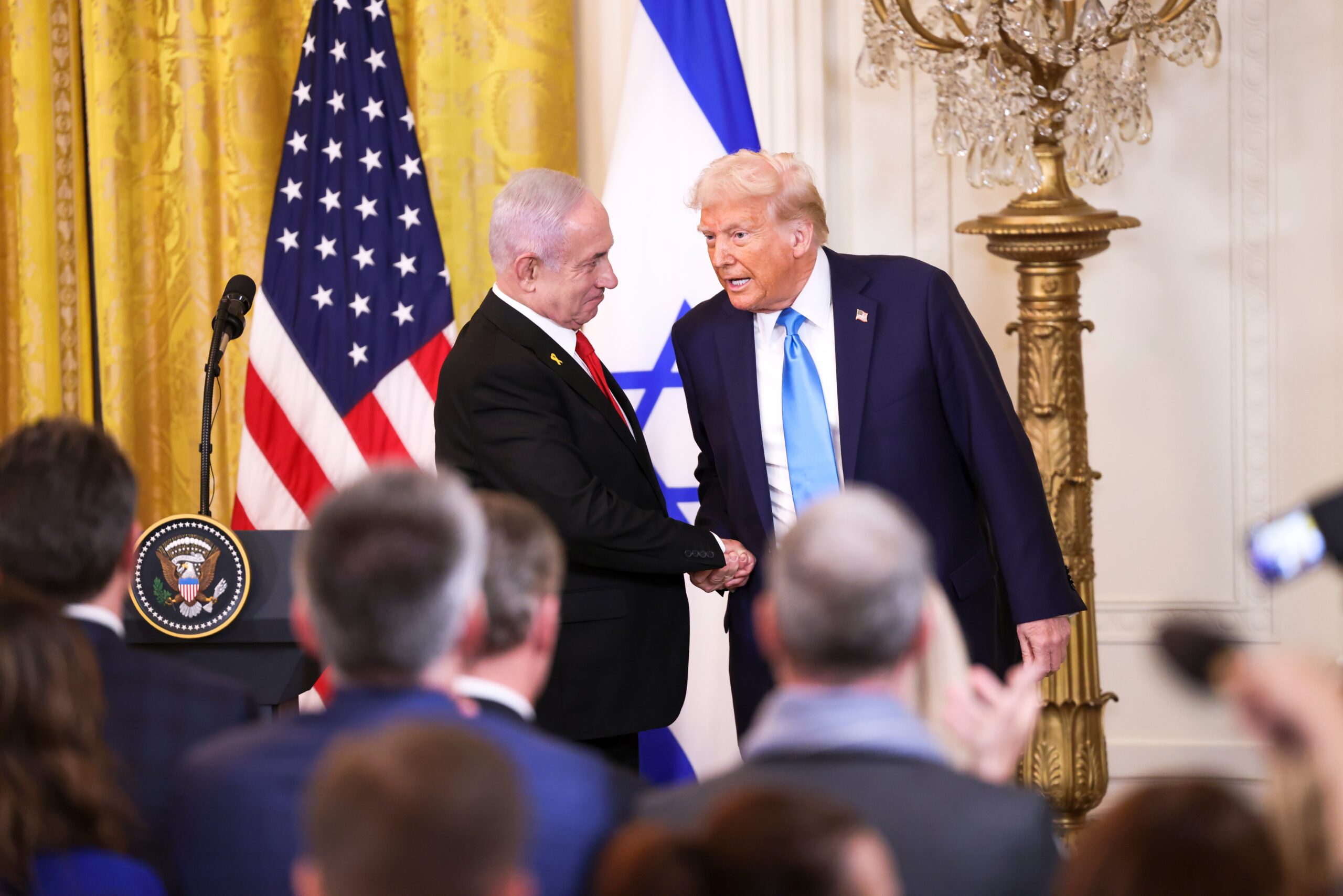
President Donald Trump gave Prime Minister Benjamin Netanyahu his “Complete and Total Endorsement” on Sunday, nine days before Israel’s October 27 election, in a letter addressed directly to “the Great People of Israel.” It marked the first time in the history of US-Israel relations that an American president explicitly and publicly endorsed a candidate in an Israeli election, according to Axios. The endorsement comes as Netanyahu’s Likud trails Gadi Eisenkot’s Yashar party in most polls, and neither bloc is close to the 61 seats needed to form a government.
In his Truth Social post, Trump called Netanyahu a great warrior prime minister and an even greater partner in the fight against the Islamic Republic of Iran, citing the regime’s decades-old chant of “Death to Israel, Death to America.” He praised Netanyahu as “Strong, Brave, and Brilliant in the face of tremendous opposition, including that coming from even Israel itself.” He wrote that he had watched Netanyahu under the most trying of times, that ordinary leaders would have wilted under such pressure, and that Netanyahu instead grew stronger. The letter closed in capital letters: “BIBI NETANYAHU WILL NEVER LET YOU DOWN!”
The letter carried a warning as well. Trump wrote that if Israel chose the wrong leader, “which would be anyone other than Bibi,” America would have to deal with Iran on its own, and he said he was not inclined to do so. In a short phone interview with Axios on Sunday, Trump said the endorsement had been his plan all along. “I was always going to do that. I just didn’t want to do it too soon,” he said, explaining that he and Netanyahu have a good relationship and would continue to do well together. Asked whether he could work with a different Israeli leader, Trump answered, “Maybe I will, maybe I won’t. Who wants to take the chance?” He also signaled that the campaign against Iran could resume, declaring in his letter that “we will soon finish the job.” Axios reported that the two leaders discussed launching a major new operation against Iran two weeks ago, and that Trump decided to wait until after the elections.
The endorsement reversed Trump’s public position from days earlier. In a Newsmax interview the previous Thursday, he refused to endorse any candidate, including Netanyahu, and earlier in October he repeatedly declined to say whether he backed the prime minister. When TIME asked him in late September whether Israelis should give Netanyahu another term, Trump said he was no longer involved in politics, though he predicted a comeback, noting that people had written off Netanyahu many times, just as they had written off Trump. “I wouldn’t underestimate Bibi,” he said. Axios reported that some of Trump’s closest advisers believed his Middle East agenda would fare better if Netanyahu lost, and that some of Netanyahu’s rivals had urged Trump to stay neutral. Trump had also grown frustrated with Netanyahu in private, at one point calling him his own worst enemy, according to two people who spoke directly with the president. In the end, Trump decided to stick with Netanyahu. The Jerusalem Post reported that pollster John McLaughlin, who works for both Trump and Netanyahu, may have influenced the decision with the data at his disposal.
The endorsement caps a turbulent year between the two leaders. Trump publicly told Netanyahu to halt Israeli strikes on Iran’s South Pars gas field in March, and in April he declared Israel prohibi ted from further bombing Lebanon. In June, after Netanyahu ordered strikes on a Hezbollah stronghold in Beirut, Trump reportedly berated him by phone; Netanyahu later described their disagreements as tactical, like those in the best of families. In August, Netanyahu rejected the Board of Peace’s Gaza ceasefire plan, insisting Israel would not withdraw before Hamas fully disarmed. The relationship goes back more than a decade: in 2013, while still a television personality, Trump publicly endorsed Netanyahu for the first time.
Sunday’s letter also continues a pattern. Trump has broken with longstanding American tradition by backing candidates in foreign elections, including in Hungary, Colombia, Argentina, Japan, and Honduras. The Hungarian endorsement ended in defeat in April, when Viktor Orbán lost to Peter Magyar.
Netanyahu responded within hours. “Thank you, President Trump, for the tremendous support and work together,” he wrote on X. “Together we will complete the mission!” His Likud Party attached a 35-second video of the two leaders together. In a follow-up video, Netanyahu thanked his “dear friend Donald,” saying he was honored and humbled by the endorsement and that the United States was fortunate to have Trump leading the fight to stop Iran’s nuclear program.
In an interview with Arutz Sheva-Israel National News on Wednesday, Netanyahu denied reports that he had lobbied for the endorsement. Asked whether he ever requested it, he answered, “Not once.” Asked whether Trump’s announcement surprised him, he said, “Completely. I didn’t know.” Netanyahu recounted that when the two leaders spoke afterward, Trump told him he had written the letter himself, which Netanyahu described as “very Trumpian, very cuts to the chase.” American diplomats were caught off guard as well. A senior US diplomat told Politico on condition of anonymity that there had been no indication the endorsement was coming, even shortly beforehand. Netanyahu framed the race as a choice between allies, pointing out that Trump is backing him while Arab party leaders Mansour Abbas and Ahmad Tibi support Eisenkot. “So choose,” he said.
Netanyahu’s allies welcomed the endorsement. Finance Minister Bezalel Smotrich called Trump one of Israel’s greatest friends in the world and said that while Israelis would decide the election, it would be wise to listen to the president of the world’s greatest superpower because he is right. Defense Minister Israel Katz welcomed what he called Trump’s unequivocal support and said only Netanyahu could maintain the historic cooperation between the two leaders and between the IDF and the US military to achieve the remaining objectives of the campaign against Iran. Rabbi Shmuley Boteach celebrated the endorsement on X, writing that he has known and loved Netanyahu for some 35 years. Conservative radio host Mark Levin called Trump’s post “an extraordinarily strong statement.”
Eisenkot, a former IDF chief of staff who lost a son in the war in Gaza, told a student audience at Tel Aviv University that he has great appreciation for the US president, but that Israel is a democracy and its citizens alone will choose the prime minister. In an interview with Channel 12 later that day, Eisenkot was asked whether he had tried to stop the endorsement. He said there had been a number of meetings he preferred not to elaborate on. “I requested that there be no intervention in Israel’s internal election,” he said, adding that he would deal with it. In the United States, Democratic lawmakers, policy analysts, and liberal advocacy groups criticized the endorsement.
A record of Democratic intervention
The Democratic objections to foreign meddling in Israel’s election follow a record of Democratic efforts to remove Netanyahu. Ahead of Israel’s 2015 election, a campaign called V15 worked to replace Netanyahu, partnering with OneVoice, an organization that had received $349,276 in State Department grants under the Obama administration. V15 hired a consulting firm headed by Jeremy Bird, the national field director of Barack Obama’s 2012 reelection campaign. A bipartisan investigation by the Senate Permanent Subcommittee on Investigations found that once the election was called, OneVoice turned the infrastructure built partly with American taxpayer money, including its social media platform, its voter database, and a network of activists recruited and trained under the grant, over to the campaign to defeat Netanyahu. The subcommittee found no evidence that the grant money itself was spent on the election, but concluded that the State Department “failed to take any steps to guard against the risk” that its funded resources would be used for political purposes, even though OneVoice had campaigned in Israel’s previous election and had emailed a strategic plan for its pivot to electoral politics to a State Department official, who said he never reviewed it.
The pressure continued under the Biden administration. In March 2024, five months into the war against Hamas, Senate Majority Leader Chuck Schumer, the highest-ranking Jewish elected official in the United States, took to the Senate floor to call Netanyahu one of four major obstacles to peace, alongside Hamas, Mahmoud Abbas, and radical right-wing Israelis, and declared that a new election was the only way forward for Israel. President Joe Biden, who said Schumer had informed his staff in advance, praised the remarks: “He made a good speech.” Likud responded that Israel “is not a banana republic” but an independent democracy that elected Netanyahu, and Netanyahu called the speech totally inappropriate.
Vance stays out
One senior Republican declined to follow Trump’s lead. Vice President JD Vance told reporters in Ohio on Wednesday that he would not endorse Netanyahu and would no longer endorse candidates in any foreign election. Vance pointed to his endorsement of Orbán, quipping that it “didn’t go particularly well.” Vance’s neutrality is new. In April, he traveled to Budapest and rallied alongside Orbán days before the Hungarian election, putting the weight of the American vice presidency behind a foreign candidate in person. He insisted his decision on Israel was neutral. “I’m not attacking Bibi Netanyahu. I’m not endorsing Bibi Netanyahu,” Vance said, adding that the president’s endorsement is ultimately what matters. Vance and Netanyahu have reportedly clashed over Iran policy, after Vance alleged on Joe Rogan’s podcast this summer that factions within the Israeli government had financed efforts to undermine negotiations with Tehran. Michael Oren, Israel’s ambassador to Washington from 2009 to 2013, predicted that Vance’s refusal would have no impact on Israeli voters, but accused the vice president of a double standard. “One does not get the sense that he is a tremendous fan of Netanyahu,” Oren told Politico.
Will it move votes?
The polls show a steep climb for the prime minister. A Channel 12 poll conducted the day after the endorsement found no immediate bump for Netanyahu, with Yashar at 24 seats, Likud at 21, and Naftali Bennett’s B’Yachad at 14. The anti-Netanyahu bloc stood at 55 seats and the pro-Netanyahu bloc at 51. The same survey found 81 percent of opposition supporters intend to vote, compared to 74 percent of pro-Netanyahu voters. Netanyahu’s coalition held 60 of the Knesset’s 120 seats before parliament was dissolved in July, and a Walla poll published Tuesday projected just 48 seats for his bloc, 13 short of a majority, with Yashar widening its lead over Likud to four seats.
Analysts are divided on how much the endorsement will matter. Veteran Israeli pollster Dahlia Scheindlin told Politico that the coalition’s numbers have been stuck well below a majority for two years, and that Trump alone seems unlikely to close a gap nothing else has. Oren estimated the endorsement might be worth one additional seat, and said it would have carried more weight six or seven months ago, before public disappointment with the outcome of the Iran war set in. Tamar Hermann, a senior research fellow at the Israel Democracy Institute, told Reuters that the endorsement could win back wavering Netanyahu voters but was unlikely to draw broad new support. Aaron David Miller of the Carnegie Endowment for International Peace said that in an election this close, “it couldn’t hurt him, and it might help.” Miller suggested Trump had held back earlier to keep leverage over Netanyahu on Gaza and Lebanon, and that withholding the endorsement would have invited questions about whether the joint war on Iran had been the right decision.
Others see more potential. An Israel Democracy Institute survey found that half of Israelis consider the relationship with the United States an important factor in choosing a party. Shai Bazak, who advised Netanyahu during his first term and is now a critic, told Politico that because Israelis see America as their indispensable ally, even small gestures can make a difference. Trump himself remains enormously popular in Israel. A Pew Research Center survey in June found that 79 percent of Jewish Israelis expressed confidence in his handling of international affairs, goodwill built on his recognition of Jerusalem as Israel’s capital, the move of the US Embassy there, the Abraham Accords, and his hard line against Iran.
Israeli commentator Naveh Dromi offered a broader reading in a Ynet column. She argued that Trump issued the endorsement over the objections of some of those close to him because he sees the election as a contest over Israel’s character as a Jewish state. Dromi wrote that Trump views Mansour Abbas’s Ra’am party, rooted in Israel’s Islamic Movement, as a parallel to Abdul El-Sayed, the Democratic Senate candidate in Michigan who has accused Israel of genocide in Gaza and declined to say unequivocally whether the Jewish state has a right to exist. She warned that Ra’am’s influence would grow if the opposition depended on its support to form a government, and argued that radical Islamism is the central threat facing both Israel and the United States. In her reading, the endorsement was Trump’s attempt to draw Israelis’ attention to that danger.
If neither bloc reaches 61 seats on Tuesday, Netanyahu would remain caretaker prime minister until yet another election. Likud used giant billboards of Netanyahu shaking hands with Trump in the 2019 campaign. With four days left, the president has handed the prime minister a reason to put them back up, and some seven million Israeli voters will decide whether the man Trump calls irreplaceable gets another term.