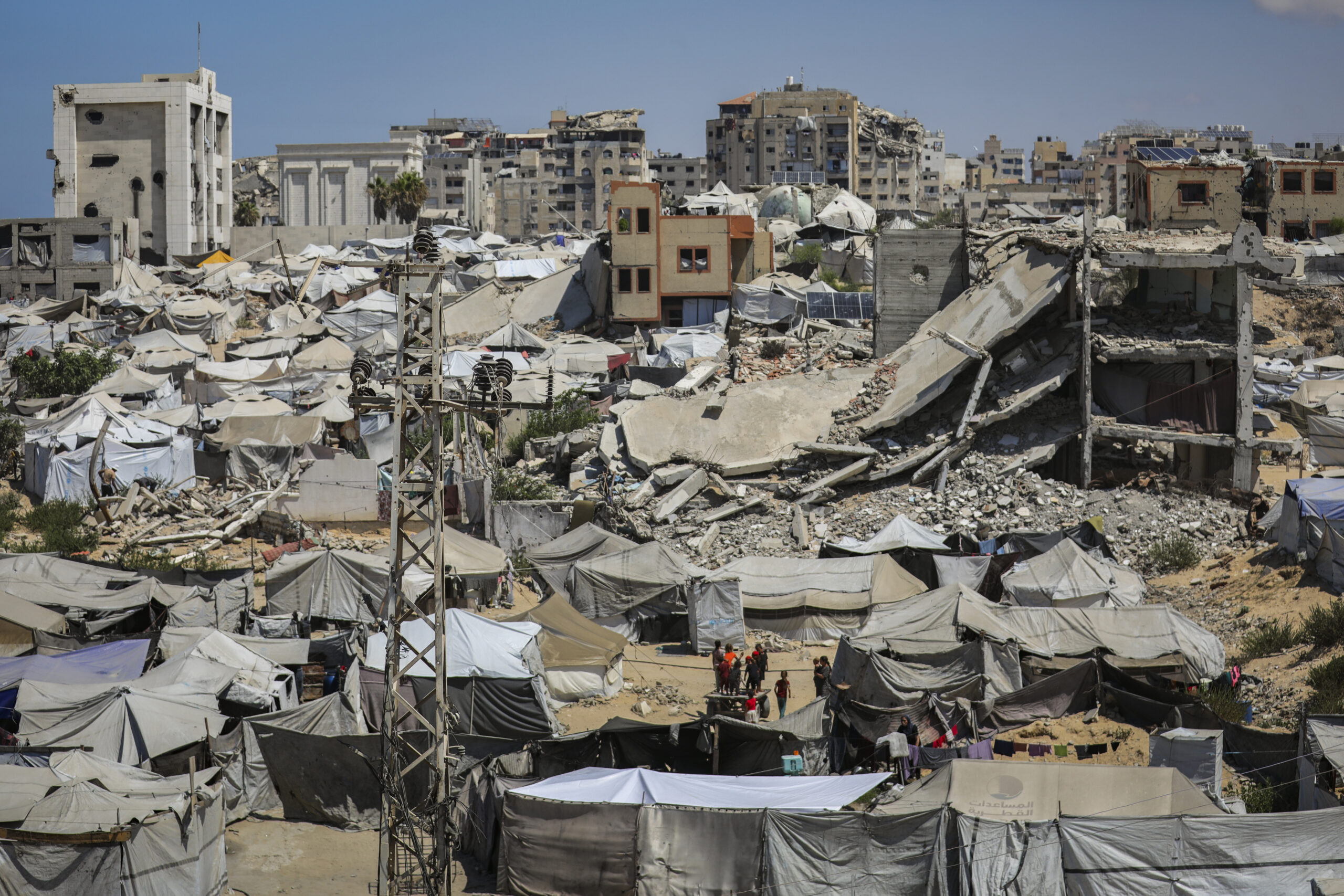
Hamas planned to detonate explosives among Gaza’s own displaced civilians as Israeli troops approached, using the resulting panic and carnage as a smokescreen for its terrorists to flee, according to an internal Hamas document released by the Israel Defense Forces on Monday. The document, written in April 2024 by the terror organization’s engineering department, was made public for the first time.
According to the IDF, the document proposed “planting explosive devices around displaced persons camps and detonating them as IDF troops approached,” with the aim of creating “panic as a smokescreen for the escape of its operatives.” The camps housed Gaza civilians who had fled the fighting, many of them following IDF evacuation instructions intended to move them out of harm’s way.
The engineering department laid out two additional methods. The first called for “planting explosive devices along routes used by residents of the Gaza Strip” to slow the IDF’s advance, turning the roads civilians used to escape into minefields. The second proposed “firing stun grenades into the camps to create chaos and panic, to allow Hamas terrorists hiding in the area to flee.”
The IDF said the plans were part of Hamas’s “preparations to protect its leadership and operatives and evacuate them from areas where the IDF was expected to operate.” According to the military, Hamas drew up the proposals “fully aware that these actions were likely to cause direct harm to civilians.” The IDF concluded that “the Hamas terror organization is willing to endanger the lives of the civilian population in the Gaza Strip to advance its terrorist activities.”
The IDF did not say where or how the document was obtained, or whether Hamas approved or carried out any of the proposals.
The timing of the document is significant. April 2024 was the month before the IDF launched its ground operation in Rafah, Gaza’s southernmost city, where more than a million displaced Gazans were sheltering and where Israel said Hamas’s remaining battalions and senior leadership were hiding. As Israel prepared for that operation under heavy international pressure to protect civilians, Hamas’s engineers were drawing up plans to use those same civilians as explosive cover.
In Their Own Words
The document matches what Hamas’s leaders have said openly since the war began: the deaths of Gaza’s civilians serve their cause.
Less than three weeks after October 7, Ismail Haniyeh, then the head of Hamas’s political bureau, spoke on Lebanon’s Al-Mayadeen television about the casualties in Gaza. “The blood of the women, children and elderly,” Haniyeh said, according to a translation by the Middle East Media Research Institute (MEMRI). “We are the ones who need this blood, so it awakens within us the revolutionary spirit.” Haniyeh delivered his remarks from the safety of Qatar.
Days earlier, former Hamas political chief Khaled Mashal was asked by Al Arabiya anchor Rasha Nabil about the price Gaza’s people were paying for the October 7 attack. Mashal answered with a list of historical death tolls. “The Russians sacrificed 30 million people in World War II, in order to liberate it from Hitler’s attack,” he said. “The Vietnamese sacrificed 3.5 million people until they defeated the Americans.” He continued: “The Algerian people sacrificed six million martyrs over 130 years. No nation is liberated without sacrifices.”
When Gazans asked why Hamas’s vast tunnel network, estimated to stretch hundreds of kilometers, offered no shelter to civilians, senior Hamas official Mousa Abu Marzouk explained on RT Arabic that the tunnels were built for Hamas. “We built tunnels, these tunnels are meant to protect us from the airplanes,” he said. As for the civilians above ground: “Everyone knows that 75% of the residents of the Gaza Strip are refugees – and that it is the responsibility of the United Nations to protect them.”
The most revealing statements came from Yahya Sinwar, the architect of the October 7 massacre, who directed the war from Gaza’s tunnels until the IDF killed him in Rafah in October 2024. In June 2024, The Wall Street Journal published leaked messages Sinwar had sent to Hamas officials in Qatar. In them, Sinwar described civilian deaths in Gaza as “necessary sacrifices,” comparing them to the death tolls of historic national liberation wars. He assured his colleagues abroad, “We have the Israelis right where we want them.” After an Israeli airstrike killed the sons of a senior Hamas leader, Sinwar wrote that their deaths would “infuse life into the veins of this nation, prompting it to rise to its glory and honor.”
The April 2024 document turns those statements into operational planning. Haniyeh said Hamas needed Gaza’s blood. Sinwar called it a necessary sacrifice. Hamas’s engineering department drew up the plans to spill it.
A Pattern of Human Shields
The document adds to an extensive record of Hamas embedding its operations among Gaza’s civilians. In November 2023, the IDF exposed a tunnel beneath Shifa Hospital, Gaza’s largest medical center. In February 2024, the IDF uncovered a Hamas data center in a tunnel directly beneath the headquarters of UNRWA, the United Nations agency for Palestinian refugees, drawing electricity from the UN building above.
Throughout the war, Israel faced accusations of indifference to civilian life in Gaza, while casualty figures issued by the Hamas-run Gaza Health Ministry were widely reported without distinguishing between terrorists and civilians. Every one of those deaths served the strategy Hamas’s leaders described on Arab television and in their private messages. Israel was blamed for the bodies. Hamas counted them as gains.
Hamas’s leaders told the world they needed Gaza’s blood. In April 2024, their engineers wrote down how they planned to spill it. While international pressure mounted on Israel to spare civilians in Rafah, the organization claiming to defend those civilians was planning to blow them up.