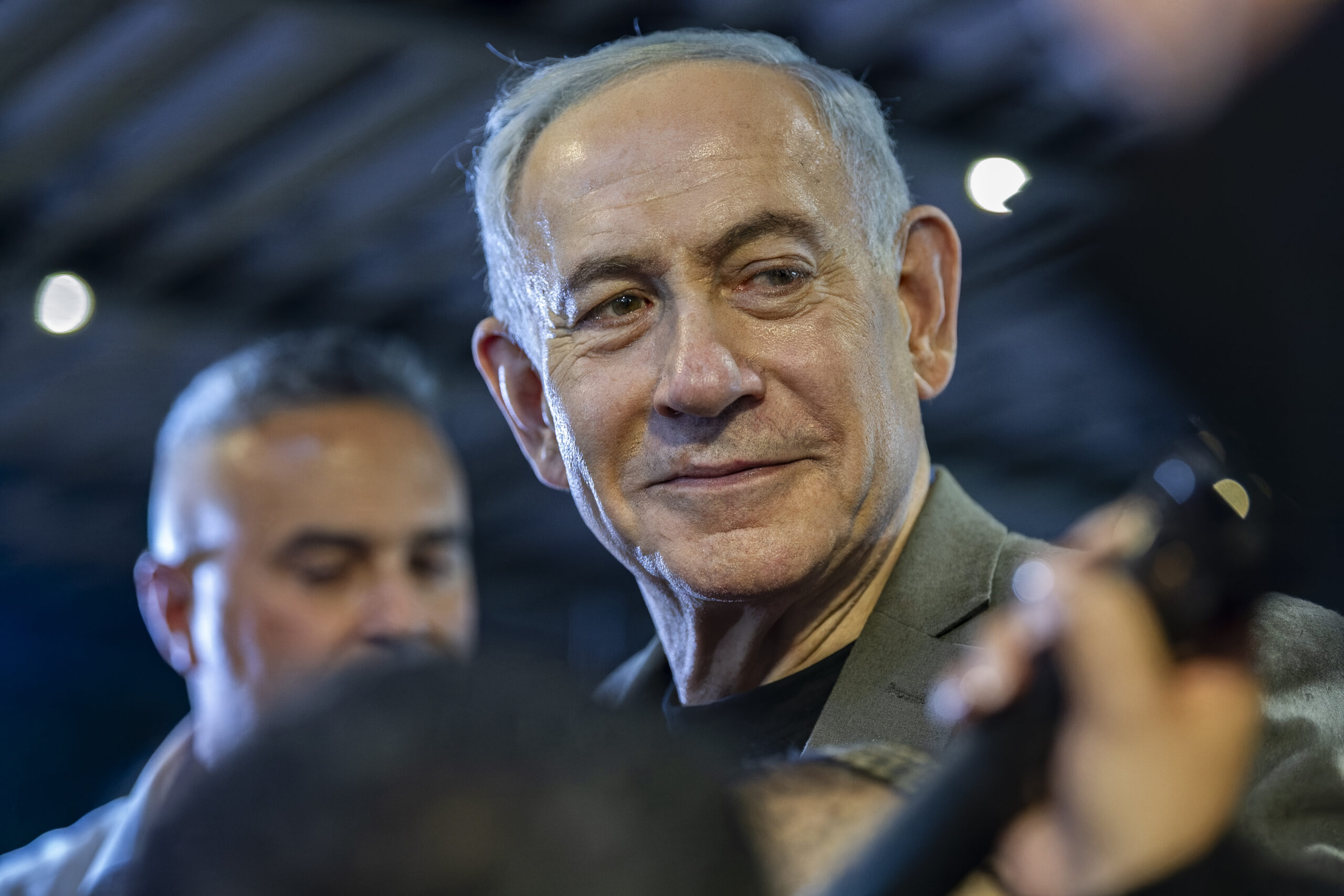
On the eve of Hoshana Rabbah, the final day of the Feast of Tabernacles, Prime Minister Benjamin Netanyahu stood in the Knesset sukkah wearing a kippah. Before him sat Knesset Speaker Amir Ohana, senior defense officials, wounded IDF soldiers, wives of reservists, and cadets from the Tavor pre-military academy. One day earlier, the Omani co-pilot of a flydubai flight to Tel Aviv stabbed the captain and sent the plane plunging toward the ground, trying to kill all 172 Israelis on board. Israel came within seconds of another national catastrophe.
Netanyahu opened the Book of Samuel and read: “The Lord brought about a great victory for all Israel, and you saw it and rejoiced” (1 Samuel 19:5).
Then he put the verse into his own words. “This was a chain of miracles and siyata diShmaya,” Heavenly assistance. “We could have been sitting here today in national mourning, and there was a great salvation here.”
For most of his career, Netanyahu built his politics on security: peace through strength, the most powerful army in the Middle East, the best intelligence services in the world, the strongest prime minister. His speeches focused on deterrence, not Divine Providence.
Now, a week before Israelis go to the polls, the man most identified with Israeli power will not stop talking about God.
October 7, the Draft and the Heartland
Israelis have no shortage of important issues to fight about in this election.
October 7, and the war that followed, is on the ballot. Netanyahu’s opponents blame him for the worst massacre of Jews since the Holocaust, which happened on his watch. His supporters credit him with leading Israel through a brutal multi-front war that turned Israel into a regional superpower and brought Iran to the brink of collapse.
Then there are the Haredim, the ultra-Orthodox, a deeply emotional issue for Israelis. Three years of war left the IDF short of soldiers, and the reservists and their families are paying the price. The same men go back for round after round of duty, some for hundreds of days. Self-employed reservists watched their clients disappear and their businesses go under while they serve in Lebanon and on the Gaza border. A third of reservists’ wives told a government survey they considered divorce or separation since the war began. Meanwhile, tens of thousands of young Haredi men refuse to serve in the IDF.
And there is Judea and Samaria. Israel haters across the globe are obsessed with ripping the biblical heartland away from the Jewish people. Last weekend, European diplomats claimed masked settlers attacked them near Ramallah, and Belgium demanded new EU sanctions within hours. No one has been arrested, and no one knows who the attackers were. Ten days before the election, this is no accident. Israel’s enemies stir up these confrontations, and the headlines that follow, to brand the Jews of Judea and Samaria as violent extremists and scare Israeli voters away from the right.
These issues may decide who wins on October 27. But underneath them, a deeper shift is underway in Israeli society, one that will decide elections for decades to come. It will determine what kind of country Israel becomes: a Jewish state in name only, or a nation bound up with its God, its Bible, and its land.
God, Blessed be He, Always Loves Me
The Knesset sukkah was not the first sign. The day the passengers came home, Netanyahu stood with them and their children, raised his hands in the air, and sang: Hashem yitbarach tamid ohev oti, “God, blessed be He, always loves me.”
Every Israeli knows that line. It is the heart of “Tamid Ohev Oti,” a song about God and His unbreakable love for Israel. Throughout the war, the whole country sang it: religious and secular, right and left, soldiers and their families. In the darkest days since the Holocaust, it reminded Israelis that God had not abandoned His people. When Netanyahu sang it with the passengers, he was singing the song of his nation.
He kept going. He posted the blessing Jews recite over a miracle: “Blessed are You, Lord our God, King of the universe, Who performed a miracle for us in this place.” At the Prime Minister’s Office, he took each of the men who stormed the cockpit by the hand and told them they saved lives “through prayer, faith, resourcefulness, and courage.”
Is Bibi’s religious awakening real? Plenty of Israelis watched the clips and rolled their eyes. Netanyahu has dominated Israeli politics for decades, and no one reads Israeli voters better. To his critics, the answer is obvious: a week before a close election, talking about God is smart campaigning.
Maybe. But since October 7, Jews all over the world are drawing closer to God and to the Bible. Assimilated students on American campuses who never thought about their identity now wear Stars of David to class. Many so-called “secular” Israelis are praying and donning tefillin. Netanyahu lived through these three years more intensely than any Israeli alive: every rocket, every hostage, every funeral, every miracle. It would be strange if he came out of it unchanged.
Either way, the answer tells us something about Israel.
Netanyahu is the most successful campaigner in Israel’s history. He knows what Israelis want to hear better than any pollster. If he is quoting the Book of Samuel and singing about God’s love a week before the election, it is because he knows his voters want to hear it.
And no one wants to hear it more than Israel’s youngest voters.
A Generation That Believes
Between 550,000 and 640,000 young Israelis will vote for the first time on October 27, nearly 10 percent of all voters. That is enough to swing between 10 and 17 seats in the 120-seat Knesset. Netanyahu has been prime minister for 16 of their 18 years, with only a brief break under Naftali Bennett and Yair Lapid.
These new voters are more religious than the Israelis who came before them. Around 80 percent believe in God, according to a News 12 survey by the Midgam Research Institute. More than 40 percent kiss the mezuzah, the small case of Bible verses fixed to the doorposts of Jewish homes, compared with about a third of older voters. A slim majority believe the Messiah will come, the final redemption Jews have prayed for three times a day for two thousand years.
Politically, they lean right. About three-quarters of first-time voters call themselves right-wing, with only about 5 percent call themselves left-wing. Likud leads among them with roughly one in five, and 16 percent are still undecided.
These 18-year-olds have no memory of the failed peace process of the mid-1990s. They grew up with rockets from Gaza. Then came October 7. Their older brothers went to war. They stood at the funerals of friends. Reserve duty became part of normal life. Many of them came out of it with the same conclusion Netanyahu reached in the Knesset sukkah: military strength alone does not explain how Israel survived.
Birthrates add to the trend. Religious Zionist and Haredi families have far more children than secular families, so every year a bigger share of 18-year-olds grows up in religious homes. October 7 pushed many secular Israelis toward faith, and birthrates keep growing the religious population. Both trends point the same way.
The Israel Europe Doesn’t See
The European diplomats who drove into Taybeh want Israelis to see their country through Europe’s eyes: settlers as criminals, Judea and Samaria as occupied land. That message worked on the Israel of the 1990s. It is losing its grip on the Israel of today, where the youngest voters pray, kiss the mezuzah, and recognize Judea and Samaria as the biblical heartland of the land of Israel.
In the Knesset sukkah, the prime minister read from the Book of Samuel and thanked God for a great salvation. Whether he spoke from faith or from political instinct, he knew his country wanted to hear it.
On October 27, Israel will show whether it votes the way it prays.