

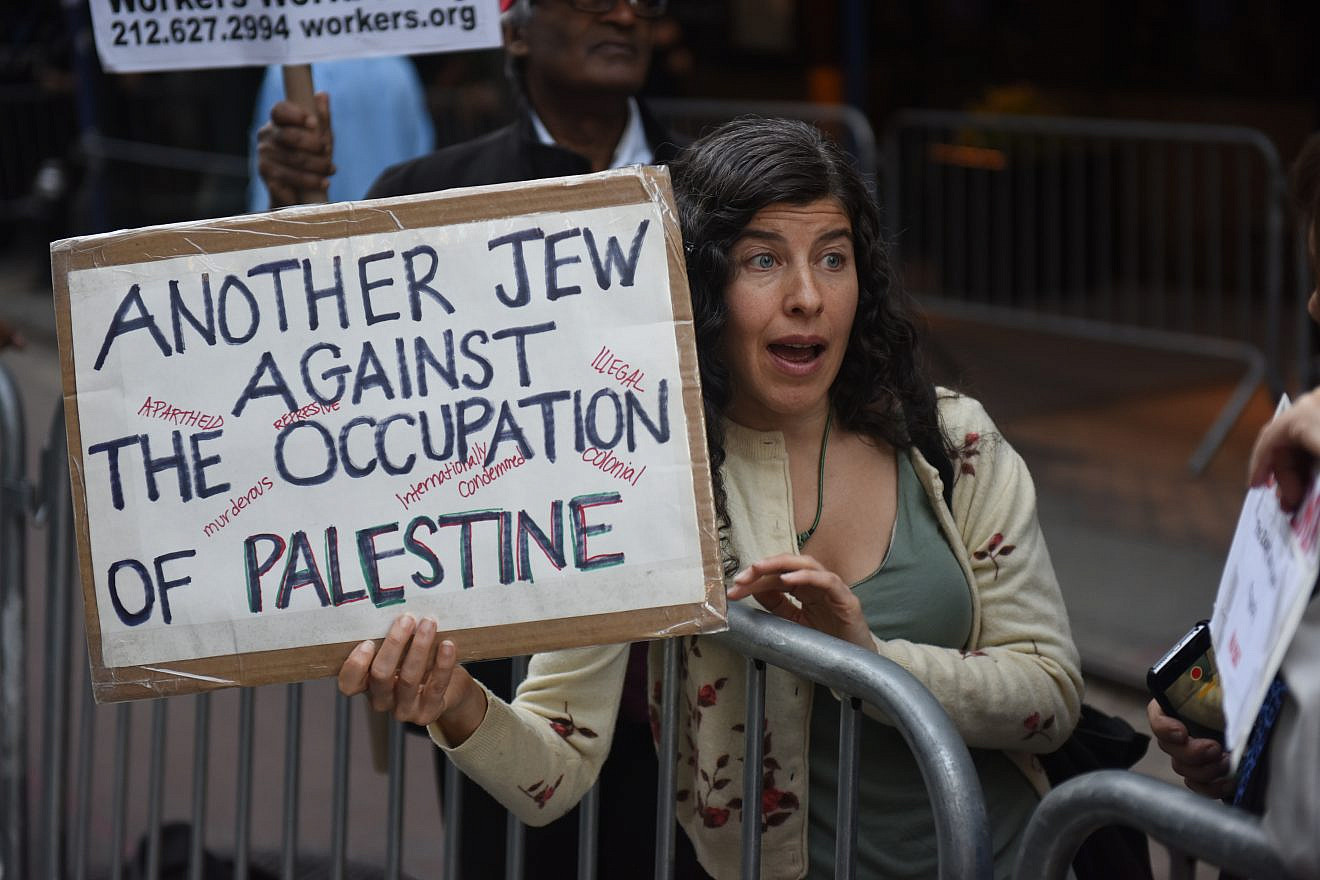
Today it is all too common for people trying to avoid the accusation of racism to claim that their anti-Zionism is something different from antisemitism. New York Mayor Mamdani is one of the most prominent people to make this claim. Yet distinguishing anti-Zionism from antisemitism or anti-Jewish racism as I prefer to call it, isn’t restricted to those guilty of it. Even among Jews and our friends, there is the popular idea of what I call the chronological development theory of Jew hatred. This theory proposes three distinct forms of Jew hatred that developed in particular eras of history: Namely, anti-Judaism, antisemitism and anti-Zionism. According to this idea, anti-Judaism focuses merely on religious hatred of Jews and developed and flourished during late antiquity, the Middle Ages, and early modernity. While antisemitism allegedly developed in the 19th century with a focus for hatred towards Jewish peoplehood. Lastly, this theory says anti-Zionism, as the latest iteration of Jew hatred, is hatred of Jewish sovereignty in our homeland, primarily developing and flourishing in the 20th and 21st centuries. According to this theory anti-Zionism and antisemitism didn’t exist until late modernity.
Now one issue with this theory of Jew hatred is that before the modern era, peoplehood, religion, and land couldn’t be separated, rather they fit together as an intricate whole. To be Jewish meant to be a people permanently attached to the land of Israel (even if in exile) and given the Torah along with its obligations. In contrast, this theory presupposes the modernist divorce between the different elements that together make up the people of Israel, and it projects it onto different epochs of history where this separation didn’t yet exist. So a pre-modern Jew hatred that presupposes the modern divorce between Israel’s peoplehood, land, and Torah is impossible, since pre-modern Jew hatred presupposed no separation between Israel’s peoplehood, land, and Torah. In other words, if Israel’s peoplehood, land, and Torah were inseparable before modernity then before modernity there couldn’t have existed forms of Jew hatred that clearly distinguished between Israel’s peoplehood, land, and Torah.
The second and related problem with this theory is that each of these “distinct” hatreds can be found in each of the time periods where there said to not yet exist. Moreover, this theory of Jew hatred developing over chronological periods implies that anti-Zionism is indeed different from antisemitism, despite the fact many Jews and our allies believe that anti-Zionism is a form of antisemitism. In this way, the developmental theory of Jew hatred actually works against many of our claims that anti-Zionism is antisemitic.
My contention is that these three distinct types of Jew hatred cannot be so clearly distinguished and certainly cannot be limited to the time periods that there said to have developed. Rather they are clearly found throughout history, and this includes what we call anti-Zionism, which is my focus here. There may be an emphasis on either peoplehood, religion or land in Jew hatred in various provenances, and or different writings, sometimes by the same author, but they certainly cannot be completely distinguished from one another.
Additionally, an idea the proponents of the chronological developmental theory of Jew hatred readily admit exists alongside each of their distinct Jew hatreds is that of Gentile Christian supersessionism. This teaches that God’s covenant with Israel has been transferred over to Gentile Christianity and that each aspect of Israel, it’s land, Torah, and peoplehood has been superseded and given over to the Gentiles who are now the new covenant people of God. Yet often supersessionism is distinguished from the various forms of Jew-hatred. The problem with this distinction is that supersessionism is an inherently racist framework because it creates a hierarchy of peoplehood with Jews at the bottom and every other people at the top. In this schema the people of Israel are often presented as morally and spiritually backwards, underdeveloped, the only people in the world rejected by God and doomed to wander aimlessly upon the earth in exile from their homeland, the only people doomed to damnation; while all other peoples are benefactors of the superseded covenant and its promises.
Furthermore, each of these forms of Jew hatred is supersessionist. Anti-Zionism, at least in its Gentile Christian iteration, assumes that the land promise to the Jewish people is no longer valid and has been transferred to other people. Anti-Judaism also presupposes the supersessionist notion that God is punishing the Jewish people for supposedly rejecting him and has thus given the covenant and its benefits to the Gentile church. And antisemitism is, of course, rooted in that racial hierarchy that’s inherent to the supersessionist framework.
Now anti-Zionism, which is opposition to Zionism, can be found throughout history. Including during many of the periods in which foreign oppressors occupied and controlled the land and people of Israel. The Romans, for instance, although they didn’t use the term, were obviously anti-Zionist as they opposed Jewish sovereignty in the Jewish homeland and sought to subjugate them under Roman power. Anti-Zionism is also strong among early, mediaeval, and modern Gentile Christianity. Several early Christian leaders, who are called the church fathers, can be described as anti-Zionist even though that term wasn’t in currency at the time.
Justin Martyr the Samaritan, and Origen the Egyptian, for example, believed that God had kicked the Jews out of the land because of their supposed murder of Jesus and therefore were now doomed to live in exile. The idea of Jewish sovereignty in the land was therefore anathema. Indeed, Justin explicitly states that the land of Israel now belongs to Christians rather than Jews because Christians are the true children of Abraham and thus the true recipients of the land promise. In Dialogue with Trypho he writes,
And we [Christians] shall inherit the Holy Land together with Abraham, receiving our inheritance for all eternity, because by our similar faith we have become children of Abraham…Thus, God promised Abraham a religious and righteous nation of like faith, and a delight to the Father; but it is not you [the Jews], in whom there is no faith.
In other words, Justin is saying that Jews are a faithless and unrighteous people, and therefore God seeking a true religious and righteous nation has chosen the Gentile Christians to become the new children of Abraham and thus the new inheritors of the land. This idea is also found almost a thousand years later in the origin story of how the Russians became Eastern Orthodox. The Jews are allegedly reported to have come before Prince Vladimir to convince him to convert to Judaism, describing the various points of their religion. At which point the prince asked:
So where is your land? And they [the Jews] said: in Jerusalem. And he [Vladimir] then said: So are you [still] there? And they [the Jews] said: God became angry at our fathers and scattered us among the nations on account of our sins, and our land was given to Christians. And he [Vladimir] then said: So how do you teach others, while you yourselves are rejected by God and scattered?…
This story is probably historical fiction, representing the perspective of medieval Russians a thousand years ago rather than that of Jews. Though the point here remains, Christians in Russia in the Middle Ages, like Justin, still believed that the land of Israel now belonged to Christians and not Jews. An implicitly, if not an explicitly anti-Zionist position. A few hundred years later, the Protestant German reformer Martin Luther believed that the fact the majority of Jews were no longer in the land of Israel with sovereignty was proof that Christianity had superseded Israel and was thus no longer the people of God. He was so confident of this that he said if the Jewish people ever returned, namely if they ever reestablished a “kingdom” what we would today call a “state,” he himself would go to Jerusalem and get circumcised, namely he would convert to Judaism.
…let them [the Jews] even now travel to the land and to Jerusalem, build the temple, establish priesthood, kingdom [statehood], and Moses with his law, and thus again become Jews and possess the land. After that is done they will soon find us on their heels, coming right after them, and we will also become Jews.
Luther was so confident in his supersessionist anti-Zionism that he was even willing to bet his foreskin. Lastly, Theodore Herzl approached the current Catholic Pope of his time to request his assistance for the return of the Jewish people to the land of Israel. The Pope essentially stated that unless all the Jews became Christians, their return to the land was illegitimate and therefore, he would not support a Jewish state. He said this because he held the same supersessionist anti-Zionism as all our examples before him, namely, that Christians were the true inheritors of the land of Israel because Jews had been rejected by God. A day before Israel’s reestablishment of statehood, the Osservatore Romano of the Catholic Church published the following lines:
Modern Zionism is not the true heir of biblical Israel…Therefore, the Holy Land and its sacred sites belong to Christianity, which is the true Israel.
In other words, in the mind of the Catholic Church of the day, the true heir of biblical Israel is the Gentile Church, not the Jewish people, thus Zionism is illegitimate because the land belongs to Christians as the “new Israel.” All of these instances of anti-Zionism are found before the Jewish state was reestablished in 1948.
In each of these examples throughout history, while the term anti-Zionism does not appear, the idea is clearly there, namely the Jews do not have a right to sovereignty in the Jewish homeland because the covenant and its land promise no longer belongs to them but to the Gentile Church. For many, the reestablishment of Jewish sovereignty in 1948 would have come as quite a shock, and I’m sure must have created quite the cognitive dissonance. In reality it is still creating cognitive dissonance. For many before 1948, the Jewish return to the land and the reestablishment of sovereignty over a Jewish state was simply theologically an impossibility, and therefore opposition to Zionism was often assumed rather than explicitly stated. What is significant, however, is that in all of these historic expressions of anti-Zionism there was at least an implicit if not at times explicit recognition that Jews were in fact from the land of Israel. In that way, anti-Zionism today, as it’s manifested on the left, is different from historic anti-Zionism.
Although modern leftist and Islamic anti-Zionism today is like historic Christian anti-Zionism in that it too is supersessionist. In the sense that the Jewish people, their culture, Torah, and especially their history are being superseded and replaced by another people, culture, and history. But it is not simply a replacement of what was there, as in Christian supersessionism which recognized this was originally and historically Jewish land, but it is a replacement of history itself. A sort of supersessionism on steroids. The act of replacing actual history with a novel fictitious history that erases any historical connection Jews have with the land of Israel is a deeply supersessionist act.
Now, to be completely fair, we also need to recognize there were instances among Gentile Christians at different time periods that complicate the story of pre-1948 anti-Zionism. We might say that there has always been righteous Gentiles. Since many thought the Jews would return to the land of Israel at some point as the Scriptures themselves spoke of. In this sense, anti-Zionism was not the whole story.
Nonetheless, the point remains that anti-Zionism is not a new phenomenon. It is in reality very old and cannot be separated from either the Gentile Christian doctrine of supersessionism, anti-Judaism nor can it be separated from hatred towards Jewish peoplehood (antisemitism) as if that was merely an invention of the 19th century, a so-called new stage in the development of Jew hatred.
Given that anti-Zionism has always been part and parcel of the supersessionist and anti-Jewish racist ecosystem, it cannot now suddenly be separated in the aftermath of the renewing of the Jewish state in 1948. Even if the term wasn’t yet in use anti-Zionism was part and parcel of the idea that God had forsaken the Jewish people, exiled them to wonder the Earth perpetually, and were therefore below all peoples, to be despised and seen as an inherently wicked and morally bankrupt people by nature. Religion, peoplehood, and land were never separate in anti-Zionism of the past, nor are they necessarily separate today
To that point, contemporary anti-Zionism recycles some of the oldest tropes from anti-Jewish racism and supersessionism. For example, the idea that Jews are inherently wicked and therefore do not deserve or have any rights to the land of Israel goes back to the second century as we saw in Justin. This idea gets recycled in today’s anti-Zionism with the main difference being that the former recognized that this was the ancestral homeland of the Jewish people while the ladder refuses to recognize that reality and uses that refusal in their effort to oppose Zionism.
This is also seen in the following historical racist tropes: Such as the blood libel seen in the cartoon image of Benjamin Netanyahu eating “Palestinian” Arab babies or the Madonna and her child imagery used by Palestinians to portray Jews/Israel as once again persecuting a non-Jewish Jesus. Or similarly, the image of the Jewish holy family depicted as being buried under the ruble of Gaza, identifying them with “Palestinians” rather than Jews. A kind of historic dejudazing of the holy family that once again blames Jews for the persecution of Jesus. In making them Gentiles this depiction makes Jews once again the oppressor of their non-Jewish neighbors, a historic racist trope going back to at least the medieval period. This trope of Jews as oppressors is even embodied in the genocide libel, which historically goes back to at least the Black plague. Or memes that imply the Jews of Israel are killing the children of Gaza, another racist trope dating back to the middle ages. So it is hard to distinguish anti-Zionism from “older” forms of Jew hatred when it uses all of the same accusations, libels, and tropes. The difference being that these tropes historically recognized Jews are from Israel, while today they have “forgotten” Jews are from Israel.
So long as Jewish sovereignty had still not been re-realized one could continue to recognize that the land of Israel was indeed the ancestral homeland of the Jewish people and merely use these racist tropes to oppose any sort of return to the land, but as soon as the Jewish state was reestablished these tropes could no longer recognize the connection of the people to the land and therefore in order to continue to delegitimize Zionism needed to add to their repertoire this notion that Jews were in “fact” not from the land of Israel.
All in all, it is historically undeniable that anti-Zionism has been around a long time, and it has always been a kind of anti-Jewish racism. Racists like Mamdani should take a cue from his white supremacist compatriots and simply admit he is racist against Jews. After all the first step to recovering from an addiction is recognizing and admitting you have a problem. And that’s just as true for racist anti-Zionists.