Dawn was still a long way off when the alarm went off at four, but by a quarter past, Tanya was in the car with her laces double-knotted and her headlamp on the seat beside her. She knew the road well and loved driving up the empty dark road toward the border. The air in the Golan had an almost-winter snap, waking her up and making her feel alive.
In five weeks she would stand at the start line of an IRONMAN triathlon in Greece: the swim, then the bike, and then a full marathon on the road from the town of Marathon toward Athens, the first marathon course in history. She had run marathons and finished IRONMAN races before, and as a middle-aged mother she had no illusions about fame or fortune, but this one she had been dreaming about for years.
The plan called for a training run of twenty-seven kilometers, and she had planned out the route the night before. She found a spot to park on the side of the road and started out slowly, checking her GPS running watch even though she knew the route by heart. She liked it there. She liked the air, cold and thin and smelling of wet basalt, and the way the Hermon went pink before the sun cleared the hills on the other side. A jackal yelped somewhere off in the dark and then went quiet. Her breathing and her shoes on the asphalt were the only other sounds.
The border fence was a dark shape rolling past on her right. She entered the small Druze town of Buqata and turned around when she passed the last house, checking the time and her heart rate as the sun began to peek over the slope leading up to Mount Hermon. Everything seemed on track to get her to Athens.
She made it back to her parked car just before seven, a good time that would make her happy if she could match it in five weeks. Even better if she could squeak a little more out of her middle-aged body. Her legs were heavy, the good kind of heavy that means the work is in them.
The road was still empty, but Tanya drove slowly, enjoying the air and the scenery. Rather than go straight home, she pulled into the gas station. Her daughter and her boyfriend were sleeping in, resting up from a tough week in uniform, and they would surely want milk for their coffee when they woke. The convenience store was open 24-7. Tanya wasn’t religious, but having the family together for the holiday went beyond religion, and the house had been full. A festive family breakfast was certainly called for.
Susie, an Israeli woman Tanya had had a nodding acquaintance with for years, was behind the counter. Tanya smiled and gave her the usual, “Boker Tov, Susie,” (good morning), and was surprised when she just shook her head, barely looking up from her cell phone.
“Oh my God, Tanya,” she said. “There’s a war.”
Tanya laughed, because there is always a war, and then she saw Susie’s face.
“In the south. Hamas broke through. Look.”
“How…” It seemed impossible. Every Israeli grew up knowing the tiny country was surrounded by enemies who wanted us dead, but the IDF had always seemed invincible. Sure, Palestinian terrorists in Judea and Samaria were a problem, and sometimes more than that, and the cities in the south were always under rocket attack. But Hamas breaking through the border? It was simply impossible to imagine armed Hamas terrorists entering Israeli communities to run amok.
Susie turned her phone around. It was one of the Telegram channels, the ones that get things before the news does. Video after video. A pickup truck in a town street with men in the back holding rifles. Smoke over fields. A number that kept going up every time Susie refreshed the screen. Tanya read until the words stopped meaning anything. She was sitting in her car with the engine running before she realized that she had left without paying for the milk. She went back to pay and found Susie kneeling behind the counter, crying quietly.
She drove home faster than she should have, steering on autopilot. Her hands were sweating on the wheel, and the sweat drying on her back made her shiver.
The neighbors were walking down the street in white shirts, on their way to synagogue, the men with their prayer shawls folded under their arms, the little kids carrying paper flags for the dancing. One of them waved, calling out a holiday greeting. Religious Jews turned off their phones on Shabbat and surely were unaware of what was playing out in the rest of the country.
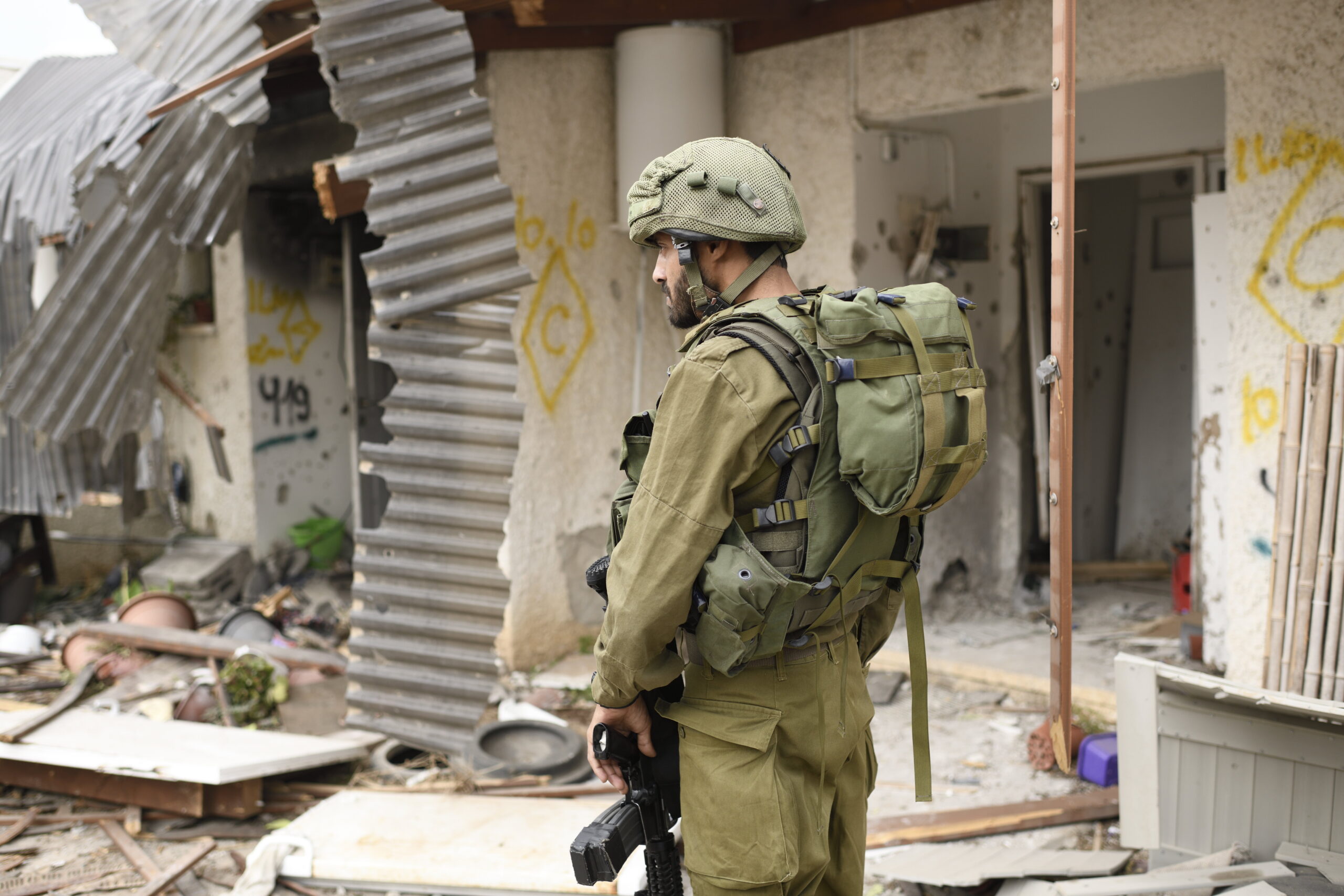
It was seven-thirty when Tanya let herself in to the quiet house. The sukkah stood in the yard where they had eaten all week, its palm fronds starting to curl brown at the edges, waiting to be taken down after the holiday. Two pairs of army boots were lined up by the door, big ones and smaller ones, laces tucked in. Two uniforms were folded over the back of a chair in the hall, ready for their return to their respective bases. Her daughter was a soldier in the Armored Corps, stationed nearby in the Golan. Her daughter’s boyfriend was a reservist in the Nahal Brigade, a combat soldier.
Tanya was churning with emotion, the images she had seen on Susie’s cell phone running over and over in her mind. But everyone in the house was asleep, still dreaming about last night’s family get-together. In a house full of people, people she loved, she felt scared and alone. It was the strangest thing she had ever felt. Somewhere a few hours south of here, people were living through the worst morning of their lives, worse than hell, and in her house nobody knew. Here, in her house, everyone except for Tanya was still living in yesterday. She was the only one who had already crossed over.
She stood outside her daughter’s door with her hand up, ready to knock. She had to wake them up and let them know.
Tanya hesitated. She knew that once she knocked, once they opened their eyes, nothing would ever be the same. October 7 would always exist, a dark evil looming in their minds. As soon as she knocked, she would become a mother waking her children to send them to war. Her family would wake up to a nightmare in which friends and loved ones lay senselessly dead, murdered by an evil too great for the mind to grasp.
Her whole life as a mother had been about standing between her child and the world. Scraped knees, fevers, a broken heart at sixteen. She had always found a way to get there first. She could not stand between her daughter and this. The army would take her daughter today, and Tanya did not want to be the one to give her to them. At least not yet. The horror had not reached this room yet, and for as long as Tanya kept her hand off that door, it would not.
She put her hand down. Let them sleep. Tomorrow was already gone. Let them have the rest of today. She walked past their door, went into her own bedroom, and shook her husband awake.
They sat on the edge of the bed in front of the television with the sound turned almost all the way down. They barely spoke since there was nothing to say. It took all of their strength to absorb what they were seeing on the screen.
After a while her husband said, “We have to wake them.”
“I know.”
She was still in her running clothes and the salt had dried on her neck, making her collar itch.
“I want to bake them something first,” she said. “Cinnabons. To take with them. Who knows when they’ll eat.”
Her husband looked at her. Then he nodded.
So that is what she did. She took out the flour and the yeast and the butter, and warmed the milk she had just bought. She kneaded the dough on the counter with the heels of her hands, the way her mother taught her, harder than she needed to. She covered the bowl with a towel and set it by the window in the sun to rise, and while it rose she stood in the kitchen doorway and watched the television over her husband’s shoulder, and the number in the corner of the screen rose too.
She rolled the dough flat. She spread it with butter and brown sugar, adding too much cinnamon so that it made her eyes sting. She rolled it up and cut it into rounds and laid them in the pan close together, so they would bake into each other.
She understood what she was doing while she did it. She could not stop the war. She could not keep her daughter home. What she could do was what mothers have done since there were mothers: feed them and let them sleep. Every minute the dough took to rise was another minute her daughter spent in the lovely world she had fallen asleep in, the world where a holiday was a holiday and a weekend pass meant sleeping late. Ninety more minutes. It was the last protection she had to give, and she wrapped it in butter and sugar and gave it all to them.
The house filled with the smell. Down the hall, two soldiers slept.
At nine o’clock the buns were out of the oven and packed into a plastic container with the lid snapped shut. Tanya washed her hands. Then she went and knocked on the door.
He reached for his phone first, before his eyes were even open, the way they all do. He had put it on silent for the holiday. The screen was full of missed calls, one on top of another, more than he could scroll through. She watched him read them. She watched the boy who had sat at her table all week, teasing her daughter and asking for seconds. She watched his eyes change, and watched him shake her daughter awake. Her daughter sat up and looked at her own phone. Tanya knew what it said. A message from her commander. Come to the base. Now. It was the message almost every young person in Israel was reading this morning.
He dialed his phone, and Tanya left the room, not wanting to hear the conversation, but knowing what would be said.
They did not ask questions. They knew how to do this better than she did. It took only moments to turn from a child home on a visit into a soldier: boots, uniforms, the big duffel bags from the hall. Her daughter tied her hair back without a mirror. Nobody cried. The time for that would come.
At the door, Tanya pushed the container into her daughter’s arms, and when her daughter tried to hand it back, she pushed it into the boyfriend’s arms instead, and he held on to it.
“Eat,” she said. “Both of you. Share.”
They were out of the house fifteen minutes after Tanya had knocked on the bedroom door.
She stood in the doorway until the car turned the corner. Then she went back inside, where the kitchen still smelled of cinnamon and the oven was still warm. She was still wearing the clothes she had run in that morning, when it was just a Saturday, and the biggest thing in her life was a race in Greece in November.
That woman was gone. Tanya would remember her, the way you remember someone who moved away. She had run twenty-seven kilometers along the border in the dark without a worry in her head, and she had stopped for milk.
But that was Saturday, Simchat Torah. Even though it was still the same morning, that day was gone. For now and forever, it would be October 7th.
This was a true story told to me by Tanya, a woman I first met when she was twelve years old. I don’t know a single Israeli who heard about the attack on the news. Every Israeli had a moment like Tanya’s, a deeply personal revelation that changed them forever. A phone call, a siren, a radio, a neighbor at the door. Religious Jews praying in synagogue watched as security personnel and off-duty soldiers checked their cell phones and slipped out. Every Israeli can tell you exactly where they were standing when the before ended. For Tanya it was a gas station counter at a quarter past seven. For her daughter it was a knock on a bedroom door at nine. Ask any of them, and they will tell you the minute, because their lives have been cut in two, and the scar runs through that morning.