



The IDF on October 1 published a 10-page rebuttal of NAZA, the Venice Film Festival prize-winner that accuses Israel of mass killing in Gaza, calling the documentary “distorted, misleading and disingenuous” and denying its central claim that the army ever approved a strike expected to kill 500 civilians. At the same time, three Israeli reservists and media professionals released NAZA: The Real Story, a counter-film shot on the same Tel Aviv rooftops, in which senior IDF officers describe Hamas fighters in civilian clothes, weapons stored beside children’s cribs, and rules of fire so strict that strikes were canceled whenever doubt remained. Israel’s embassies in Washington and London are now promoting the counter-film as NAZA opens in theaters across the United States on October 9.
In a school compound in Gaza turned into a shelter for displaced families, IDF troops screening the crowd noticed a man holding a child of three or four. They brought him forward. Soldiers handed the child to the women in the shelter and detained the man, a member of Hamas’s Nukhba commando force who had taken part in the October 7 massacre. The toddler, according to the IDF staff officer who tells the story, was his ticket past the search.
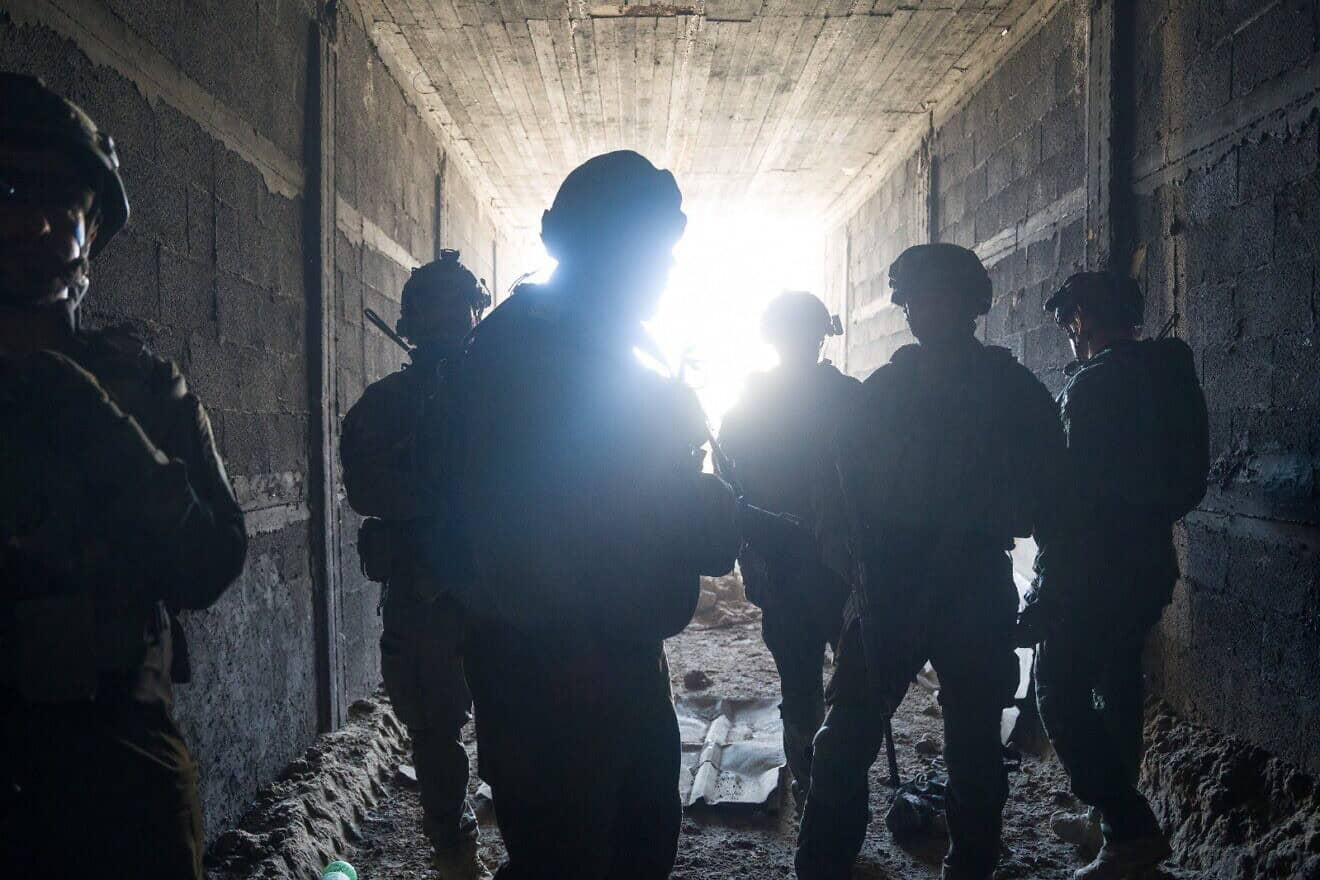
That account comes from NAZA: The Real Story, a new Israeli documentary filmed at night on the rooftops of Tel Aviv. The setting is deliberate. NAZA, the film that won a special jury prize at the Venice Film Festival last month and accuses the IDF of mass killing in Gaza, was shot on those same rooftops, with anonymous soldiers whose faces and voices were digitally disguised. The answer from Israel came last week on two fronts: a 10-page IDF rebuttal that calls the Venice film “distorted, misleading and disingenuous,” and a counter-film in which senior IDF officers, speaking with the army’s cooperation, describe the war they actually fought.
The Film That Won Venice
NAZA takes its title from the Hebrew acronym for nezek agavi, “collateral damage.” Its directors, Yuval Abraham and Rachel Szor, are part of the collective behind the Oscar-winning No Other Land. Over three years, they interviewed 24 people described as Israeli soldiers and intelligence officers, all anonymous, all filmed in darkness. The British newspaper The Guardian produced the film, which builds on reporting by +972 Magazine, its Hebrew sister site Local Call and The Guardian itself.
The film charges that the IDF used artificial intelligence to generate targets, approved strikes with fixed quotas of civilian deaths, and once approved a strike expected to kill 500 civilians. That last claim featured in the official trailer. One interviewee, asked whether he had witnessed genocide, answers yes.
NAZA premiered in Venice on September 10 and won the festival’s Special Jury Prize two days later. It opened in New York on September 30 and expands across the United States on October 9.
IDF Chief of Staff Lt. Gen. Eyal Zamir answered on September 14. “It is based on blood libels, deliberate distortion of reality, and false and serious accusations against IDF soldiers and commanders,” he said. He added that “false, manipulative and unfounded vilification is not legitimate criticism, even if it receives sanctimonious applause.” Zamir instructed the Military Advocate General, Maj. Gen. Itai Ofir, to examine legal action against the film and those involved, and ordered an investigation into the leak of classified material used in its production.
The IDF could not answer the film in detail because it had not seen it. The filmmakers never presented their allegations to the military before release and refused the IDF’s request for a copy. IDF Spokesperson Brig. Gen. Effie Defrin publicly invited them to let military representatives view the full film. In the end, the IDF built its response from the notes of a representative who attended a public screening.
“Analysts Don’t Sit at His Table”
On October 1, the IDF published a 10-page English response to the film, along with a 17-page Hebrew version. It states that the film’s narrative “is based on substantial factual errors stemming from a misrepresented and manipulative depiction of reality.”
The core of the rebuttal concerns who was talking. A military official laid out the targeting process for i24NEWS correspondent Ariel Oseran as a chain of seven stages. Intelligence analysts first gather and cross-reference sources. A separate intelligence officer then verifies the material and decides whether to designate a target. Operations staff, who are not intelligence personnel, plan the munition, the timing and the intended effect. Independent military legal advisers review the plan and can impose conditions or send it back. An operational commander weighs expected civilian harm against military advantage and approves, restricts or rejects the strike. Real-time surveillance is checked again before the strike, which can still be changed or cancelled. A separate unit reviews the results afterward.
According to the IDF, the film’s interviewees served at the first stage. “Analysts don’t sit at his table,” the official said of the commander who makes the final decision. An analyst who remembers an early, high estimate of civilians near a target has no view of the later decisions that narrowed the target, changed the weapon or timing, or updated the count after evacuation warnings.
That gap explains the film’s headline claim. “The IDF has never planned, approved or carried out a strike in Gaza in which 500 civilians, or anything close to that number, were expected to be killed,” the military stated. The filmmakers, it said, featured the allegation in their trailer “even though they necessarily could not have verified it and had no evidence to prove it.”
The IDF said the same confusion lies behind the film’s claim of civilian quotas, 20 for a junior operative and 200 for a senior commander. An approval threshold determines which level of command has authority to sign off on a strike. It grants no permission to kill. Every commander must still assess proportionality for each strike. “Specifically, no approval-authority threshold of 200 casualties for a strike against a military objective has ever applied or existed,” the IDF wrote.
On artificial intelligence, the military was equally direct. Lavender, the system the film presents as a kill list, “is not a list of targets approved to strike” but a database that cross-references intelligence for analysts. “In the IDF, artificial intelligence does not determine whether an object or a person is designated as a target, nor whether a target is struck.” An IDF source told JNS military analyst Yaakov Lappin: “No strike was ever decided based on an algorithm.”
The IDF also answered the film’s charge that civilian casualty estimates do not distinguish adults from children. “A civilian is a civilian regardless of age, and no civilian life is assigned a lesser value,” the response states, adding that the presence of children led commanders to cancel, postpone or replan strikes throughout the war.
Beyond the specific claims, the IDF faulted the film’s method. It cites no directives, records or documents. Its accounts of alleged strikes name no target, date, place or casualty count, which leaves them impossible to check. The film also gives little weight to October 7 and to Hamas’s deliberate embedding of its fighters, weapons and tunnels in homes, schools, mosques and hospitals.
The Guardian stands by the film. A spokesperson said the 24 participants include officers involved in “multiple stages of the targeting process,” including final authorization, and that the reporting was verified with leaked documents and confidential sources. The film itself does not make that clear, Times of Israel military correspondent Emanuel Fabian noted, and gives no dates or target names for the strikes it describes.
The Price of Restraint
The IDF’s response lists what the film leaves out: a dedicated Civilian Harm Mitigation Cell that issued warnings and tracked civilian presence across Gaza, independent legal advisers embedded in the planning process, and strikes canceled or never approved because of the risk to civilians. The military’s warnings went beyond the law. International law requires advance warning “where feasible.” The IDF source who spoke to JNS said the army chose, “as a matter of policy, not of law,” to warn entire areas before moving in so that the population could evacuate.
That choice carried a military cost. “Whenever such a warning is issued, you completely lose the element of surprise in the sense that the adversary knows when you are coming, where you are coming from, and the parameters of that action,” the source said.
The IDF’s closing describes what restraint meant in practice: more intelligence required, plans changed, strikes canceled and military opportunities forgone. Several of the film’s interviewees speak of the moral weight they carried. “That weight is real, and the IDF does not dismiss it,” the response states. “Yet that moral burden is not evidence that decisions were unlawful or indifferent to civilian lives; it reflects the seriousness with which they were made.”
The American Jewish Committee, in an explainer on the film, made the same legal point: civilian casualties, however tragic, do not by themselves establish that a strike was unlawful.
On genocide, the IDF called the allegation “outrageous and unfounded.” Under the 1948 Genocide Convention, the crime requires intent to destroy a national, ethnic, racial or religious group “as such,” and courts treat proof of that intent as the central question. The film asked anonymous interviewees, who took no part in command decisions and have no legal expertise, for their personal opinion. In the IDF’s words, they could not testify to genocidal intent “because none ever existed.” The army of a state bent on destroying a people does not phone its enemy’s neighbors before a strike or announce its routes of advance.
NAZA: The Real Story
NAZA: The Real Story, in Hebrew Naza: HaSipur HaAmiti, runs 49 minutes and is free to watch online at nazadocumentary.com in 17 languages. Its creators are three Israelis with a direct stake in the war. Lt. Col. (res.) Roi Danino, an entrepreneur and author, served more than 600 days of reserve duty with the Nahal Brigade during the fighting. Maj. (res.) Ariel Averbuch is an attorney who co-founded and chairs Sword of Gideon, an organization that combats antisemitism through international advocacy. Hagay Gutman is chief editor of Israeli morning television shows. The film was made with the cooperation of senior IDF commanders.
The creators make no pretense of neutrality. “This is an offensive film, not a defensive one,” they told Maariv, and the film is being pushed through influencers and international networks directly to policymakers and journalists. Its interviewees include officers responsible for the chain of command that approves airstrikes, the people from the later stages of the process that the Venice film never reached.
A company-level reserve commander describes a child’s bedroom with a cartoon rug, an anti-tank charge under the bed and about 30 mortar bombs beside a crib. He describes an RPG fired at his troops from a kindergarten, in a firefight that wounded five soldiers. A staff officer who says he spent almost two years in Gaza describes a living room stocked with hate literature, including Mein Kampf, then weapons, then a tunnel shaft. Officers describe a tunnel shaft beneath a baby’s crib, a Hamas training camp and an explosives lab inside civilian buildings, and a headquarters with weapons and planning rooms at Shifa Hospital.
The officers explain why the war looked the way it did on screen. On October 7, the terrorists who invaded southern Israel wore combat gear, and those are the images the world remembers. Once the IDF entered Gaza, the gear disappeared. A drone can identify a man who looks like the October 7 footage, one interviewee notes. A man who looks like a neighbor pushing a cart is far harder to identify, and that difference governs when fire is opened and when it stops. In one account, a Hamas fighter disguised himself as a hostage.
The rules they describe answer the charge of indifference. Schools, kindergartens, mosques and clinics were marked in the IDF’s systems with safety zones of 200 to 300 meters. A shot inside one of those zones was never a small unit’s decision. The request went up through brigade, division and regional command, and sometimes to the Chief of Staff, and approval sometimes arrived after the target had moved. Legal officers sit at every level. Areas where a hostage might be held became no-fire or no-entry zones, even when armed Hamas cells were in plain view. One rule runs through every account: “when there is doubt, you do not fire.”
One commander says Hamas blocked civilians from evacuating, turning families back at a square, and that when civilians stayed, the safety zone stayed and the strike waited. In one sweep of a school compound used as a shelter, he says, a third of the men screened turned out to be Hamas operatives, some of whom took part in October 7. The film presents these figures as his account, and the website itself notes that Hamas and aid organizations describe events differently.
The hostages shaped every decision. In June 2024, Operation Arnon rescued Almog Meir Jan, Andrey Kozlov and Shlomi Ziv from the Nuseirat home of Abdallah Aljamal. The IDF and the Shin Bet confirmed that Aljamal was a Hamas operative who held the three in his family home. He was also a journalist. He wrote for the U.S.-based Palestine Chronicle and filed a dispatch on June 7, the day before the rescue, while three Israeli hostages sat captive in his house.
Where the Aid Went
The officers in The Real Story say Hamas seized humanitarian convoys from the first day of the war. Armed men approached trucks during humanitarian hours and stood on them to keep civilians away, and weapons were handed down from pickup beds. Some of the cargo was cigarettes and narghile tobacco. Carts carrying sacks that looked like flour, some bearing UNRWA logos, hid weapons and explosive charges. One scene shows food packages with UN agency markings inside a building the officers identify as a Hamas compound.
The United Nations documented the same pattern 17 years ago. On February 6, 2009, UNRWA suspended all aid imports into Gaza after Hamas seized its supplies. Trucks contracted to Hamas’s Ministry of Social Affairs took ten truckloads of flour and rice from the Gaza side of the Kerem Shalom crossing. Days earlier, Hamas police broke into an UNRWA warehouse in Beach Camp and took 3,500 blankets and more than 400 food parcels after UN staff refused to hand them over. Then-UN Secretary-General Ban Ki-moon demanded the food be returned.
The numbers from this war tell a similar story. COGAT, the Israeli body that coordinates aid, reports that by October 15, 2024, Israel had moved 1,081,294 tons of aid into Gaza on 54,786 trucks, 837,440 tons of it food. After the October 2025 ceasefire, it reports more than 1.7 million tons of food and a 72 percent drop in food prices between September 2025 and May 2026. Getting the aid across the border, however, did not guarantee it reached civilians. Citing UN Office for Project Services tracking data, the Foundation for Defense of Democracies reported that of more than 2,600 trucks that entered Gaza between May 19 and August 5, 2025, only about 300 reached their intended destinations. The other 2,309, or 88 percent, were intercepted along the way. The UN data did not record who took each truck, and armed men and hungry crowds were counted together.
The famine charge remains disputed. In June 2024, the UN-backed Famine Review Committee found that the available evidence did not show famine in Gaza. In August 2025, the Integrated Food Security Phase Classification declared famine in Gaza City, a finding Israel rejected. One officer in the film says he never saw hunger anywhere in Gaza. The film presents that as his personal testimony, and it should be read that way.
The most damning account concerns medicine. In January 2024, Qatar and France brokered a deal to deliver months of urgent medication to 45 Israeli hostages, packaged individually in France from an Israeli list, in exchange for aid to Gaza’s civilians. A medical officer in the film describes that labeled channel, with its lists and records of which hostage was to receive each package. To the best of his knowledge, he says, no hostage ever reported receiving the medicine. A second officer says the same. Hamas had insisted that all of it, the hostages’ medicine included, be delivered to hospitals across Gaza, which Hamas ran.
The Embassies Join the Fight
Israel’s diplomats have taken up the counter-film. In posts on X, Israel’s embassies in Washington and London promoted The Real Story as “setting the record straight,” pointing viewers to its combat footage, declassified material, captured intelligence and firsthand testimony. The timing matters. NAZA opens nationwide in American theaters on October 9, and its makers plan to stream it free online beginning in November.
The IDF released its rebuttal of NAZA on the same day it published “The Press Files,” naming 170 Gazans mourned worldwide as journalists who served in Hamas and Palestinian Islamic Jihad. Both releases make the same argument. The case against Israel was built on testimony no one checked, and when someone finally checked, the case fell apart.
The Verdict Comes Before the Evidence
NAZA received a standing ovation in Venice, a jury prize and a release in American theaters before the army it accuses had seen a single frame. Its most explosive claim, a strike planned to kill 500 civilians, ran in the trailer without a date, a target or a document behind it. The IDF has now answered every major charge in writing, and the officers who made the decisions the film describes have told their side on camera: the safety zones around schools, the requests that climbed to the Chief of Staff, the strikes canceled because a hostage might be inside, and the warnings that handed Hamas the element of surprise.
The festival jury and the critics in Venice handed down the verdict first and left the evidence for later. The IDF’s response and The Real Story have now supplied the scrutiny the film never faced: named places, documents on screen, and a targeting process laid out stage by stage and open to challenge. Every American who buys a ticket to NAZA this month can watch the other side for free.

