


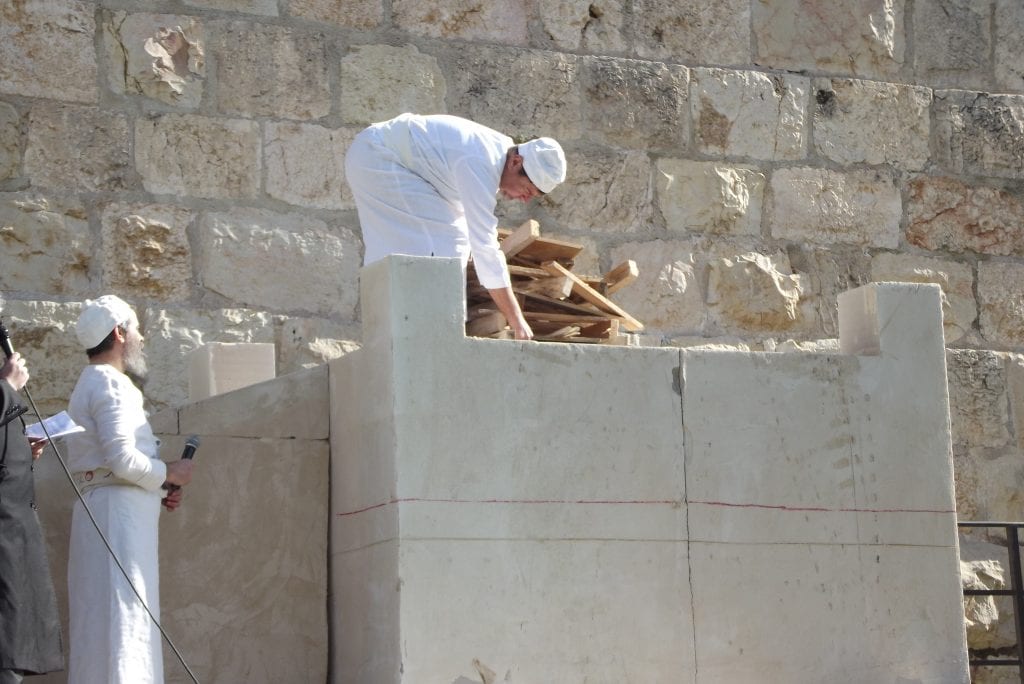
The stones have already been prepared, uncut as prescribed by the law. The priestly garments are sewn, and the silver trumpets are made. According to Rabbi Tovia Singer, the only thing missing for sacrifices to resume in Jerusalem is the decision to carry the altar up the Temple Mount.
“We have an altar that’s ready to go,” Singer said in an interview with Rabbi Aron Sokol on the Parsha Inspired podcast, released during the holiday of Sukkot. “It’s built. It’s here. It’s ready to go on the Temple Mount. You technically do not need a Temple in order for an altar to be placed there and sacrifices to be offered.”
Singer, the founder of Outreach Judaism and one of the most widely followed Jewish teachers on the internet, described watching the mizbeach (altar) being assembled. “The stones have to be stones that no metal has ever touched,” he said. “Everything in the Temple is about a place of peace. They were cut with lasers. So it’s ready.”
He said the priestly vestments and trumpets have been prepared “just as they are in scripture and according to our tradition,” while the stones for the Temple building itself are, to his knowledge, still unavailable. He described the work of the Temple movement this way: “They’re saying, ‘Look, Lord, we’re going to go as far as we can on this one, and we’re going to walk until the water is up to our nostrils.'”
This raises a question that surprises many Bible readers: how can the Jewish people offer sacrifices on the Temple Mount when there is no Temple standing there?
The Ezra Precedent
Singer pointed to the third chapter of the Book of Ezra, which records the return of the Jewish exiles from Babylon around 538 BCE. The returnees found Jerusalem in ruins, and the Temple burned. The first thing they built was the altar, and they began bringing offerings on it immediately, years before the Second Temple was built.
“From the first day of the seventh month began they to offer burnt-offerings unto the LORD; but the foundation of the temple of the LORD was not yet laid.” (Ezra 3:6)
“Believers do not look at Ezra and Nehemiah, which is really one book, as a history book,” Singer said. “It’s pointing us to the future.”
The timing in Ezra carries weight for this moment. The seventh month is Tishrei, the month of Rosh Hashanah, Yom Kippur and Sukkot. The verses just before describe the returnees celebrating the festival with offerings on that newly built altar.
“And they kept the feast of tabernacles, as it is written, and offered the daily burnt-offerings by number, according to the ordinance, as the duty of every day required.” (Ezra 3:4)
The verse before that records the conditions they faced. “And they set the altar upon its bases; for fear was upon them because of the people of the countries, and they offered burnt-offerings thereon unto the LORD, even burnt-offerings morning and evening.” (Ezra 3:3) The returnees built the altar surrounded by hostile neighbors and brought the offerings anyway.
The Sages established this principle in Jewish law. The Mishnah records Rabbi Yehoshua testifying, “I have heard that they offer sacrifices even though there is no House” (Eduyot 8:6), meaning a Temple building. The Talmud (Zevachim 62a) teaches that three prophets came up with the exiles from Babylon: one testified about the altar, one testified about its exact location, and one testified that offerings may be brought even without a Temple. Maimonides rules that the sanctity of the Temple Mount was never cancelled by its destruction, because the holiness of the site comes from the Divine Presence, which is eternal (Hilchot Beit HaBechirah 6:16).
The ban on metal tools comes directly from the Bible. “And if thou make Me an altar of stone, thou shalt not build it of hewn stones; for if thou lift up thy tool upon it, thou hast profaned it.” (Exodus 20:22) Rashi explains that the altar was created to lengthen the life of man, while iron was created to shorten it, so the instrument of death has no place on the instrument of atonement.
Why the Temple Unsettles the Nations
Singer said the rebuilt Temple strikes at the heart of replacement theology in both Christianity and Islam. He described the Even HaShetiya (Foundation Stone) as “the holiest place on earth. Full stop,” the spot from which the world was created and where Abraham bound Isaac. Above it now stands the Dome of the Rock, whose inscriptions carry the Islamic declaration of faith.
According to Singer, the Church Fathers, led by Augustine, taught that the Jews would remain in exile as a sign that God had finished with them. “They all said what’s happening now couldn’t happen,” he said. Islam, he added, holds that God once chose the Jews and then replaced them. “When the Jews return to Jerusalem and build the Temple,” the claims of replacement collapse.
He set Christian Zionists apart, estimating them at 80 to 100 million worldwide. “They’re different,” he said.
Singer also rejected the idea that the Temple described by the prophet Ezekiel is a metaphor. “If you go to your synagogue, your church, your mosque, or whatever, and they tell you that’s a spiritual temple, go back to the scripture,” he said. “It’s a very physical place.” He noted that Ezekiel records the Temple’s measurements, windows and courtyards in exact detail, and that Ezekiel 37 promises the sanctuary will stand among the people of Israel forever.
“It’s Happening Now”
Singer described the sweeping changes on the Temple Mount in recent years. Until recently, non-Muslims could visit only during limited morning hours, Bibles were forbidden, and a Jew caught blowing a shofar (ram’s horn) faced arrest. “Could you imagine if in Missouri, in Kentucky, in California, someone said no Jews allowed?” he said. “That would be inconceivable.”
Today, Jews pray openly on the Mount, and the shofar has sounded there on Rosh Hashanah. “This is in scripture, and it’s happening now,” Singer said. “What you are seeing now could not have occurred anytime in roughly 2,000 years.”
Sokol tied the moment to the third anniversary of the October 7 massacre, which fell on Simchat Torah. He described the building of the Dome of the Rock between 688 and 691 CE as an act intended to declare the covenant between God and Israel broken. “Now that the Jews have returned, we’re coming back to Hashem (God),” he said.
The returnees in Ezra’s day built their altar in fear and offered sacrifices on it during Sukkot before a single stone of the Temple was laid. Twenty-five centuries later, an altar sits finished in Jerusalem, built to the same specifications, waiting for the same mountain. “We have the altar. We have the trumpets. We have the priestly vestments,” Singer said. “Everything is spinning now very quickly, so fast that none of us can keep track of it.”