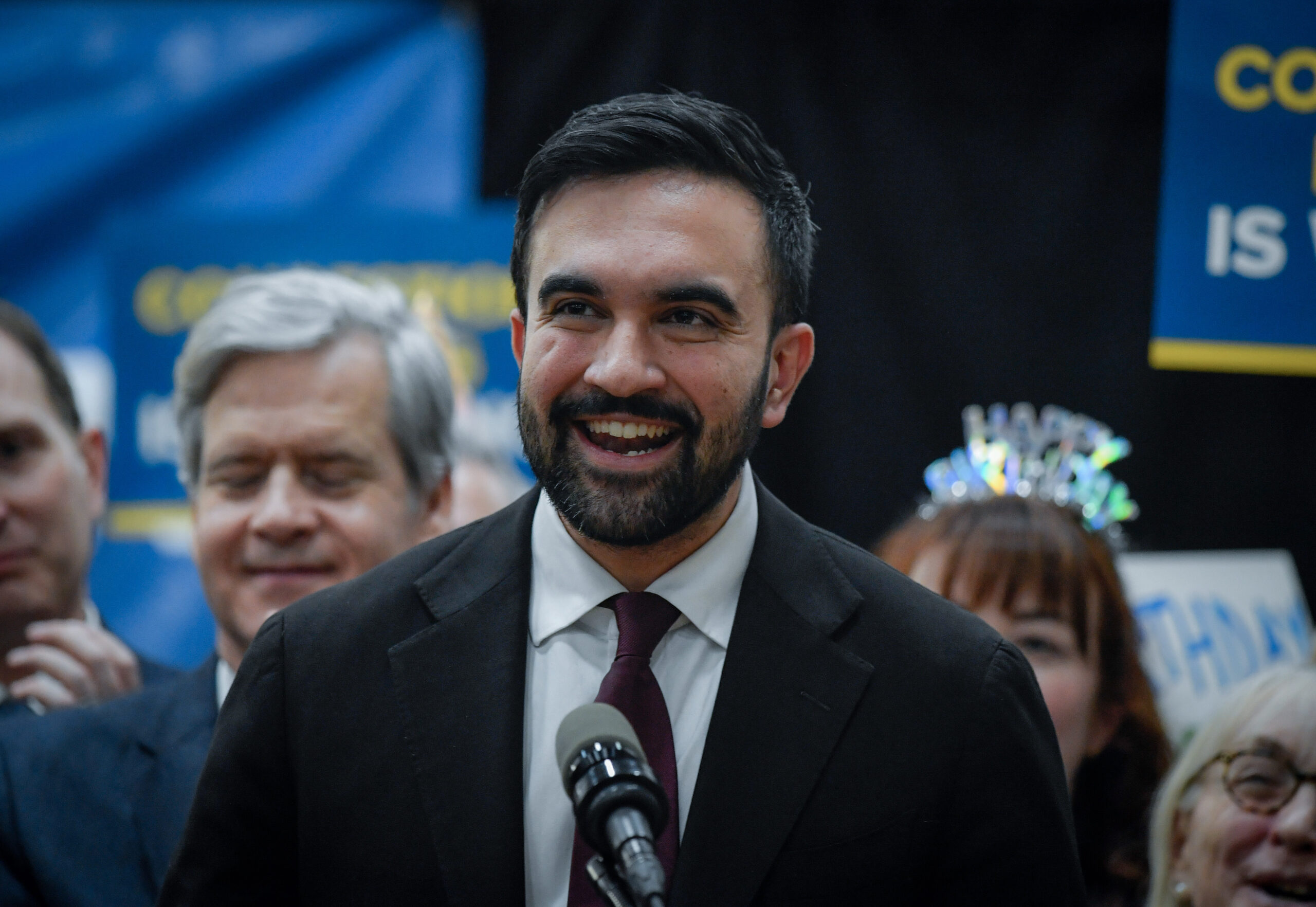
Hours after New York City Mayor Zohran Mamdani unveiled what he calls the nation’s first municipal strategy to combat antisemitism, he walked into a Brooklyn sukkah to celebrate the festival of Sukkot, the Feast of Tabernacles, with Jewish New Yorkers, but protesters were waiting outside, and some cursed him as he arrived. The host was Devorah Halberstam, whose 16-year-old son Ari was murdered in the 1994 terror attack on a van of Chabad students on the Brooklyn Bridge.
A reporter at the event from Israel Hayom asked the mayor whether his new plan would cover every form of Jew-hatred. “We will combat all forms of antisemitism,” Mamdani answered. Pressed on why the plan never defines the term, he said it did not need a specific definition.
Mamdani’s response is problematic as he has rejected several formal definitions of antisemitism and his plan mirrors this, explicitly rejecting the need to define Jew-hatred.
The 33-page strategy, released Tuesday, promises money for security, Holocaust education, and Jewish cultural institutions. It never mentions Zionism, relegates anti-Israel protests to a single footnote, and names only white supremacist attacks as examples of the hatred it sets out to fight. Mainstream Jewish organizations, the Israeli consulate, and the man who once ran the city’s antisemitism office all responded with the same verdict: the plan leaves out the antisemitism Jews in New York face every day.
That raises the question at the center of this story as Mamdani refuses to define the problem the program purports to address or name the movement driving it.
A plan without a definition
The strategy commits $7.4 million to two programs. It doubles grants for community groups working on hate-crime prevention and survivor support to $6.4 million, and sets aside $1 million for physical security at synagogues and other houses of worship. It revives an interagency working group to help Jewish institutions assess threats, allocates $2 million to complete a Holocaust memorial in Queens, and allocates $2.5 million to a new Jewish cultural center in central Brooklyn. A public campaign on the city’s LinkNYC kiosks will highlight the contributions of Jewish New Yorkers.
In a video announcing the plan, Mamdani mentioned composer Leonard Bernstein and Katz’s Delicatessen. He said Jewish New Yorkers had told him the same thing everywhere he went: “antisemitism is real, and it is growing.”
The numbers support this. Jews make up about a tenth of the city’s population and were the victims of more than half the hate crimes confirmed by police in the first eight months of this year, according to Ynet. Antisemitic crimes rose 9% over that period, all of it on Mamdani’s watch.
The plan lists seven objectives, including a pledge to combat antisemitism “in all its forms.” It then declines to say what those forms are. The document reviews three competing frameworks: the International Holocaust Remembrance Alliance (IHRA) working definition, the Nexus Document, and the Jerusalem Declaration on Antisemitism. Significantly, the plan adopts none of them. The city will fight antisemitism, the plan states, “without needing to adopt a definition for this specific form of hate.”
The Talmud teaches that anyone who sustains one soul, has sustained an entire world. For generations, Jewish New Yorkers have sustained our city. Today, we are launching the first-ever municipal Strategy to Combat Antisemitism.
— Mayor Zohran Kwame Mamdani (@NYCMayor) September 29, 2026
Together, we will ensure Jewish New Yorkers are… pic.twitter.com/nUpTy7mFlT
The IHRA definition had been city policy until January 1. Revoking it was one of Mamdani’s first acts as mayor. That definition classifies denying the Jewish people’s right to self-determination as antisemitic. The Jerusalem Declaration, which the new plan places beside it, was drafted by academics who argue that boycotts of Israel and calls to replace the Jewish state are not inherently antisemitic.
Phylisa Wisdom, who heads the Mayor’s Office to Combat Antisemitism, told reporters the city modeled its approach on the Biden administration’s 2023 national strategy, which also cited several definitions without choosing one. Wisdom said disagreement with the mayor on foreign policy should have no bearing on whether a Jewish New Yorker receives the city’s protection.
The model Wisdom chose carries its own baggage. When the Biden White House released its national strategy in May 2023, it listed several definitions of antisemitism, noted that the United States had embraced the IHRA definition, and said the administration “welcomes and appreciates” the Nexus Document. The Zionist Organization of America objected that the strategy used the soft past-tense “has embraced” for IHRA while speaking far more warmly of Nexus, and that it failed to recognize denying the Jewish people self-determination as antisemitism. B’nai B’rith said the Nexus definition lets Israel’s most hostile critics hide their animus behind strident criticism of Israel.
The strategy’s supplemental fact sheet also named the Council on American-Islamic Relations as a partner. CAIR was assigned to educate faith groups on protecting their houses of worship, and its deputy director applauded the fact that the White House did not endorse the IHRA as the sole definition. After CAIR’s executive director, Nihad Awad, said he “was happy to see people breaking the siege” on October 7, the White House condemned his “shocking, antisemitic statements” and in December 2023 removed CAIR from its antisemitism strategy. This week, Florida designated CAIR a domestic terror group. Mamdani’s strategy follows the same template, setting IHRA beside Nexus and the Jerusalem Declaration and adopting none of them.
Charlottesville, Pittsburgh, Poway, and nothing since
The only specific antisemitic incidents the plan names are the 2017 white supremacist rally in Charlottesville, Virginia, the 2018 Tree of Life synagogue massacre in Pittsburgh, and the 2019 synagogue shooting in Poway, California. All three were driven by white supremacist ideology. The Times of Israel noted that organized white supremacist activity in New York City is scant.
The plan leaves out the Jews murdered by attackers motivated by hatred of Israel. Yaron Lischinsky and Sarah Milgrim, two Israeli embassy staffers, were gunned down outside the Capital Jewish Museum in Washington in May 2025 by a man who then shouted “Free Palestine.” In June 2025, a man firebombed a march for the hostages in Boulder, Colorado, killing 82-year-old Karen Diamond. He reportedly told police he wanted to kill “all Zionist people.” The October 7 massacre appears in the plan only as a date after which anti-Jewish crime increased.
Moshe Davis served as the first executive director of the Mayor’s Office to Combat Antisemitism under Eric Adams. The Mamdani administration removed him in February. Writing in The Free Press this week, Davis laid out the numbers the plan skips. The NYPD recorded 22 anti-Jewish hate crimes in October 2022 and 69 in October 2023. By fall 2024, the total was up 74% from the year before, and the NYPD itself tied the rise to the “fury and vitriol” at more than 4,100 demonstrations in the year after October 7. No comparable surge followed Charlottesville.
The attacks have come close to home. In November 2023, some 400 students at Hillcrest High School in Queens rampaged through the halls chanting “Free Palestine” and demanding the firing of a Jewish teacher who had attended a pro-Israel rally. In July, a worshipper leaving The Jewish Center in Manhattan was stabbed in the chest with a screwdriver. In August, a congregant and a security guard were assaulted at Central Synagogue during Shabbat services. Last week, Davis wrote, a man on the subway muttered that he wanted to kill him because he is Jewish while Davis rode with his four-year-old daughter.
One case ties directly to the mayor. A Florida man charged this summer with throwing a brick through the window of a Chabad House in Sarasota had reposted Mamdani’s video calling Prime Minister Benjamin Netanyahu a war criminal eight days earlier.
ADL CEO Jonathan Greenblatt told the mayor at the time that words have consequences and that his inflammatory rhetoric can lead to violence. Days later, Mamdani’s spokesperson declined to say whether the mayor would dial back his anti-Israel commentary if there were any chance it could inspire anti-Jewish violence.
The plan does identify one classic antisemitic trope. It warns that 29% of Americans believe wealthy Jewish donors have too much control over American politics. Davis pointed out that in June, Mamdani stood on a Brooklyn stage and described the American Israel Public Affairs Committee as “monsters” who “move millions in dark money.”
The plan’s only mention of anti-Israel protests is a footnote stating that federal agencies do not classify political protest as a crime and that the administration supports the right to protest. The document adds that neither the NYPD nor the FBI considers protest outside a house of worship hateful or antisemitic, and that the administration shares that view. One day before releasing the plan, Mamdani recommitted to disbanding the NYPD’s Strategic Response Group, the unit that handles the city’s largest demonstrations. Four days earlier, that unit arrested more than 100 protesters who blocked a Manhattan street during Netanyahu’s address to the United Nations.
Before he was removed, Davis said, he gave Mamdani two proposals: a ban on masked intimidation at protests and legislation keeping protesters from targeting houses of worship. The mayor adopted neither. Davis has since helped develop the federal Right to Worship Act, introduced by members of both parties on August 6, which would set a 100-foot protective zone around houses of worship during services.
“We are not asking for belonging,” Davis wrote. “We are asking the mayor to do his job and keep the city safe.”
“Money can’t buy values”
The UJA-Federation of New York, the Jewish Community Relations Council of New York, American Jewish Committee New York and the New York Board of Rabbis issued a joint response. The groups credited the plan’s security funding and expanded programs, then said it “fails to address a central issue that the mayor himself has perpetuated”: rhetoric that demonizes Israel leads to the targeting of Jewish New Yorkers.
Israel’s Consul General in New York, Ofir Akunis, was blunter. “Money can’t buy values,” he said. He told the mayor that antisemitism in New York will keep rising until he stops “the incitement and blood libels against the Jewish state,” a state Akunis noted Mamdani does not recognize. He called on Mamdani to restore the IHRA definition, to tell his supporters to stop chanting “from the river to the sea” and “globalize the intifada,” and to have them condemn the October 7 massacre and declare Hamas a terrorist organization.
Rabbi Ammiel Hirsch, senior rabbi of Stephen Wise Free Synagogue, a Reform congregation on the Upper West Side, told JNS the report omits the central driver of antisemitism, which is hostility to Israel, and with it the mayor’s own role. Hirsch called the omission an evasion and said the mayor knows better.
Rabbi Mark Goldfeder, CEO of the National Jewish Advocacy Center, said the plan is the Adams plan that Mamdani deleted on his first day in office, with every page that touches Israel torn out. He closed with a line from Hillel in the Talmud (Shabbat 31a): the rest is commentary, in Hebrew v’idach perusha hu.
The criticism came from inside the mayor’s own party. City Councilman Eric Dinowitz, a Democrat who co-chairs the Council’s Jewish Caucus and represents the heavily Jewish Riverdale section of the Bronx, praised the plan’s focus on education and enforcement. He said it missed the chance to confront where anti-Zionism and antisemitism meet, warning that attacking “Zionists” has become a convenient way to disguise antisemitism as political disagreement.
Republican Assemblyman Michael Novakhov put it most directly. At a briefing for elected officials before the release, he told Wisdom, according to Ynet, that “the primary source of antisemitism in the city right now is Mayor Mamdani.”
The Anti-Defamation League had asked the city to include a clear, formal definition of antisemitism in the plan and to keep city contracts, pensions, and procurement free of ideological boycotts. The plan does neither. Mamdani revoked the order barring city agencies from boycotting Israel on the same day he revoked the IHRA definition.
The ADL has been watching this mayor more closely than any other. Shortly after his election, the organization launched the Mamdani Monitor, a website that tracks the administration’s statements, appointments and policies on antisemitism, along with a tip line for New Yorkers. Its policy scorecard rates six of his actions. Four are marked negative: the IHRA revocation, the end of the anti-boycott policy, the veto of the schools buffer-zone bill, and the refusal to sign the synagogue buffer-zone law. Two are marked positive: keeping the Office to Combat Antisemitism and a stated commitment to protect houses of worship. The ADL lists five expectations for City Hall. The new plan meets the call to protect Jewish institutions. It sidesteps two others: keeping city contracts and pension funds free of ideological boycotts, and refusing language that demonizes the Jewish connection to Israel. Its personnel file tracks some 20 appointees. One of them is Phylisa Wisdom, the official who wrote the antisemitism plan. Another is Ramzi Kassem, the mayor’s chief counsel, a lawyer who has represented terror suspects. The Monitor also records Mamdani telling an interviewer in June that he cannot support any state that privileges one religion over another, “whether it be Israel or Saudi Arabia.”
The Simon Wiesenthal Center welcomed the plan’s funding for security, prevention and Holocaust education, then zeroed in on the missing definition. A strategy against antisemitism, said Jim Berk, the Center’s CEO, “has to be able to state plainly what is being combatted.” Berk asked what standard the city will apply when “Zionist” becomes a stand-in for Jew, or when Jews are targeted for their connection to Israel. He noted that Mamdani skipped this year’s Israel Day on Fifth parade, breaking a longstanding tradition for New York mayors.
Security grants protect doors and windows, Berk said, and police investigate crimes after they happen. The first duty of leadership is to confront antisemitic rhetoric before someone throws a rock, paints a swastika, or attacks a Jew. The Center said it will hold the administration to its own promise that Jewish New Yorkers will be able to see and feel whether the strategy is working.
The rollout came five days after Netanyahu used his address to the UN General Assembly to call Mamdani an antisemite. Netanyahu said that since the mayor’s election, “many Jews no longer feel safe in New York.” Mamdani answered that Netanyahu was trying to “sanitize his genocide of Palestinians.”
The endorsers, and the Speaker left out
City Hall’s press release carried dozens of endorsements. The Jewish organizations quoted come almost entirely from the progressive left, including groups hostile to Zionism: T’ruah, New York Jewish Agenda, the Jewish Council for Public Affairs, New Jewish Narrative, Jews for Racial & Economic Justice, Bend the Arc, the Nexus Project, J Street NYC, Rabbis for Human Rights, and IfNotNow.
Several praised the plan for the very omission its critics condemned. Bend the Arc’s CEO, Jamie Beran, commended Mamdani for declining to enshrine a definition, calling one “unnecessary and often a distraction.” IfNotNow’s political director used his statement to criticize establishment Jewish institutions for separating Jewish safety from that of other groups.
Even among the supporters, the gap showed. Amy Spitalnick of the JCPA, quoted praising the plan in the city’s release, told Ynet the report should also acknowledge violence against Jews carried out under the guise of protests against Israel. State Senator Liz Krueger, a Democrat, used her endorsement to say the mayor must make clear that Jews who support Zionism can express their views without fear.
The release also quoted Debbie Almontaser, a Muslim interfaith leader. In August 2007, she resigned as founding principal of the Khalil Gibran International Academy, a public Arabic-language school in Brooklyn, after defending “Intifada NYC” T-shirts sold by a women’s group that used school facilities. She told reporters the word intifada means “shaking off.” A federal agency later found that the city had bowed to bias in forcing her out.
The organizations that signed the critical joint statement appear nowhere in the release. Neither do the ADL, the Orthodox Union, or Agudath Israel. The two Hasidic leaders quoted, Rabbi Moishe Indig of the Williamsburg JCC and Rabbi David Niederman of United Jewish Organizations of Williamsburg, thanked the mayor. Indig added that the plan’s true measure will be its impact on the streets.
One of the release’s details carries an irony. It names the Jewish Community Relations Council as an example of the groups receiving the doubled grants, and JCRC will anchor the grant program. JCRC co-signed the statement saying the plan ignores the mayor’s own role in fueling antisemitism.
The most conspicuous absence was City Council Speaker Julie Menin, the first Jewish Speaker in the Council’s history. According to amNY, Menin was left out of City Hall’s rollout. She issued her own statement afterward, saying she was pleased the mayor’s plan “shares certain prongs of the Council’s Five-Point Plan to Combat Antisemitism.” Menin announced that plan in January. Its centerpiece was a pair of bills that would create buffer zones to shield synagogues and schools from protesters. On April 24, Mamdani vetoed the schools bill and let the house-of-worship bill become law without his signature. His strategy mentions neither. Menin told the Forward she had no input in developing the strategy, and her office said she was briefed the day before its release.
The contrast between the two leaders drew attention months ago. In February, The Jewish Press editorial board wrote that on antisemitism, the mayor talks the talk while the Speaker walks the walk. At the time, the editors noted, Mamdani’s Office to Combat Antisemitism sat without a leader or significant funding, and one critic called it “a dysfunctional, single-person office.” Menin, meanwhile, had formed a Bipartisan Task Force to Combat Antisemitism, co-chaired by Democrat Eric Dinowitz and Republican Inna Vernikov. Her five-point plan called for protective perimeters around houses of worship and schools, a hotline for reporting incidents, funding for Holocaust education, and subpoena power for the task force to investigate institutional antisemitism. Days before her announcement, a man had rammed a car into Chabad-Lubavitch World Headquarters in Crown Heights, and swastikas had defaced a playground in Borough Park. Jews, the editors noted, were about 10% of the city’s population and roughly 60% of its hate crime victims in 2025.
The office that wrote the strategy has a staff of three: Wisdom and two others, according to the Forward. That is the team charged with a whole-of-government plan for the largest Jewish population outside Israel.
The record behind the plan
The silence on Zionism reflects a position Mamdani has held for years. As a student at Bowdoin College, he co-founded the school’s chapter of Students for Justice in Palestine and backed the American Studies Association’s 2014 academic boycott of Israel. He supports the Boycott, Divestment and Sanctions movement. At a 2021 protest, as a state assemblyman, he declared that “anti-Zionism is not antisemitism.” He repeated the point to a crowd in 2023, calling antisemitism charges against his movement a politically motivated effort to silence it.
During the mayoral campaign, Mamdani initially declined to condemn the slogan “globalize the intifada,” later saying only that he would discourage its use. He pledged to have Netanyahu arrested under the International Criminal Court warrant if the prime minister set foot in New York. His administration later conceded the city has no such authority. As mayor, he produced a Nakba Day video commemorating the displacement of Arabs during Israel’s founding in 1948 and has repeatedly accused Israel of genocide in Gaza.
The shape of this week’s plan was set a year ago. In September 2025, Mamdani told Bloomberg News he would drop the IHRA definition if elected because it conflates criticism of Israel and Zionism with antisemitism, adding that he has supported and continues to support BDS. His spokeswoman, Dora Pekec, told the New York Post that a Mamdani administration would approach antisemitism in line with the Biden administration’s national strategy. That is the model Wisdom cited on Tuesday.
The pledge drew a bipartisan rebuke. Representatives Mike Lawler, a New York Republican, and Josh Gottheimer, a New Jersey Democrat, called the move to scrap IHRA “shameful, dangerous, and completely disgusting.” In a joint statement, they said the BDS movement is antisemitic, that efforts to delegitimize Israel’s right to exist are antisemitic, and that refusing to condemn “globalize the intifada” outright is indefensible. The two congressmen are pushing the Antisemitism Awareness Act, which would write the IHRA definition into federal law.
The defining episode came before he took office. On November 19, 2025, Park East Synagogue, a Modern Orthodox congregation on Manhattan’s Upper East Side whose senior rabbi, Arthur Schneier, is a Holocaust survivor, hosted an aliyah event for Nefesh B’Nefesh, the organization that helps North American Jews move to Israel. Protesters outside chanted “globalize the intifada” and “death to the IDF.” Mamdani’s spokeswoman responded that the mayor-elect discouraged the language, then suggested the synagogue had misused a sacred space for activities that violate international law.
Mamdani kept his IHRA promise within hours of taking office. On January 1, Mamdani signed an executive order wiping out every order Adams had issued since September 26, 2024, the day Adams was indicted. His campaign called it a fresh start. The sweep erased the IHRA definition, which labels as antisemitic the denial of Jewish self-determination and the claim that Israel’s existence is a racist endeavor. Mamdani has repeatedly refused to recognize Israel’s right to exist as a Jewish state. The same order canceled Adams’s directive opposing the boycott of Israel, and an order telling the NYPD to reassess how it handles protests at houses of worship. A later Mamdani order restored similar instructions to the police. In December, before he was sworn in, an ADL review found that his appointees had posted that Zionists were worse than Nazis, that “Zionists are never Jews,” and that Zionism was a genocidal ideology. One incoming staffer who wrote about “money hungry Jews” resigned, and Mamdani said he would not have hired her had he known. He dismissed the rest of the criticism, saying the ADL ignored the distinction between antisemitism and criticism of the Israeli government.
Within two weeks, a firebombing hit a synagogue in Jackson, Mississippi. Mamdani posted on X that he was “horrified by this violent act of antisemitism” and called on Americans to stand “alongside our Jewish brothers and sisters.” Writing in The Hill, Adela Cojab Moadeb, a legal fellow at Goldfeder’s National Jewish Advocacy Center whose 2019 Title VI complaint against New York University over its neglect of Jewish students contributed to the federal Executive Order on Combating Antisemitism, called the statement polished and hollow. The mayor, she wrote, had stayed silent while “globalize the intifada” rang through New York’s streets, and had spent his first hours in office “dismantling the very anti-discrimination rules meant to stop antisemitism before it turns bloody.”
Moadeb cited a report that Mamdani’s aides folded the pro-Israel measures into the sweeping Adams revocation as political cover, worried that a direct rollback on day one would provoke backlash. Among the orders erased, she wrote, was one requiring demonstrators to stay 15 to 60 feet back from houses of worship. The anti-boycott order he canceled protected more than $300 million the city has invested in Israel bonds and other Israeli assets. She noted that anti-Jewish crimes made up 54% of the 641 hate crimes reported to New York police in 2024.
Mamdani defended the revocations by saying a number of leading Jewish organizations supported him. Moadeb answered that he was using fringe groups such as Jewish Voice for Peace, which seeks to dismantle Israel, as a Jewish mask, while 76% of American Jews call Israel’s existence vital. A broad coalition of mainstream Jewish groups condemned the rollback at the time, saying in a joint statement that singling out Israel for sanctions does nothing to make Jewish New Yorkers feel included and safe. Nine months later, the endorsers lined up behind his antisemitism plan come from the same progressive corner.
In August, rabbis he invited to City Hall told him his rhetoric on Israel was causing harm to Jews. The plan he released this week shows how much of that message landed.
In fairness to the mayor, he has condemned Hamas and support for terror groups in the city, and the NYPD under Commissioner Jessica Tisch has tightly controlled protests at synagogues since he took office.
Mamdani’s plan offers Holocaust memorials, subway kiosk ads, and a video about Katz’s Deli. His record offers a revoked definition, a boycott order erased on his first day, a vetoed buffer zone, a synagogue blamed for the mob outside its doors, and a movement he still calls his own.
Jews have lived in New York since 1654, when Peter Stuyvesant tried to expel the first 23 refugees who landed in New Amsterdam. Davis noted they never asked Stuyvesant’s permission to stay, and they will not ask this mayor’s. He ended his essay with a message for City Hall that most of New York’s Jews would sign: “We don’t need you to celebrate us. We just need you to do your job and keep New York safe.”