


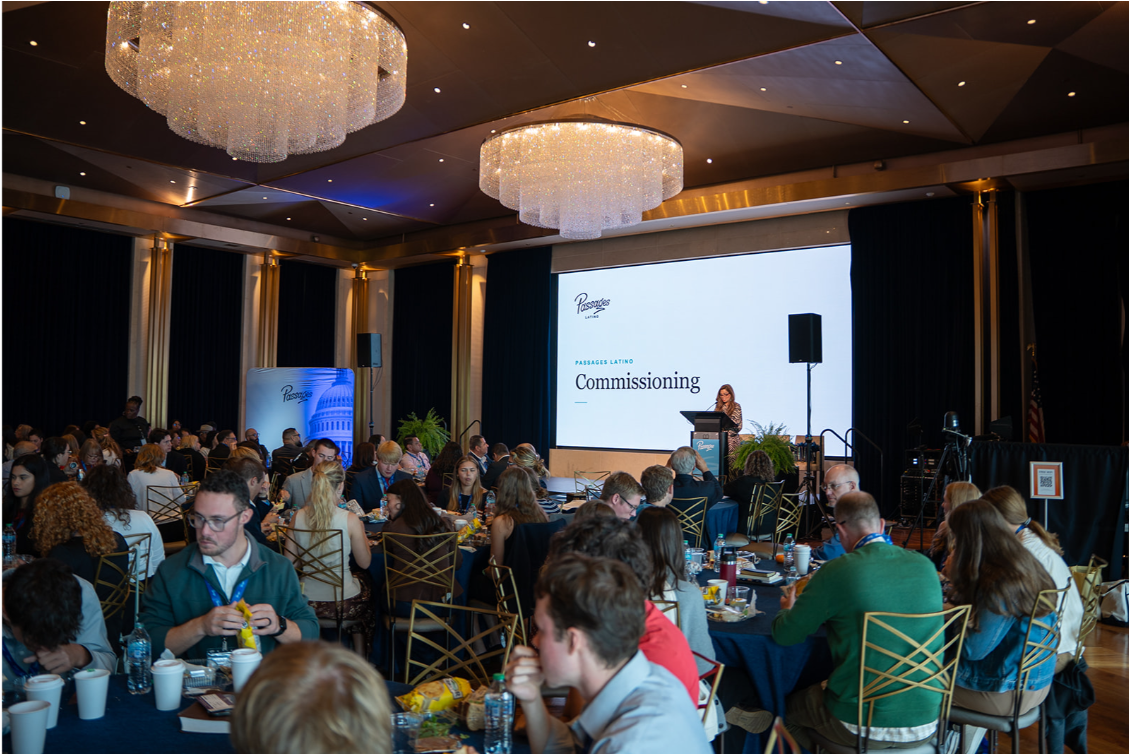
As American college students returned to campuses where Jewish classmates still face harassment, more than 250 young Christian leaders, students, and alumni gathered at the Museum of the Bible in Washington with a clear mission: to stand beside the Jewish people publicly, when it counts. Passages’ Israel Impact Summit ran from September 25 to 27, opening on Erev Sukkot, the eve of the Feast of Tabernacles, the biblical festival the prophet Zechariah foretold the nations would one day celebrate alongside Israel.
The three-day event combined education on Israel and Christian Zionism with practical training in confronting antisemitism, answering misinformation, and advocating on social media. A student panel put campus experiences at the center of the discussion.
The urgency is real. The Anti-Defamation League recorded 583 antisemitic incidents on American college and university campuses in 2025. That figure marked a substantial decline from the 2024 peak, and it remains nearly three times the number recorded in 2021.
“Be the safe place for your Jewish peers,” Rebecca Heinrichs, a senior fellow at the Hudson Institute, told participants. “Because antisemitism is a sickness, and it’ll ruin this American experiment and self-government.”
The Summit comes as pro-Israel Christian leaders grow increasingly concerned about the next generation. A survey of evangelicals aged 18 to 29 commissioned by researchers at the University of North Carolina at Pembroke found that in 2021, just 33.6 percent sided with Israel, down from 69 percent in 2018. The same 2021 poll found 24.3 percent siding with the Palestinians and 42.2 percent taking neither side. The erosion has continued. The Pew Research Center found in 2026 that 74 percent of white evangelical Protestants view the Israeli people favorably, down from 84 percent in 2024.
Passages marked its tenth anniversary with this year’s Summit, and its leaders framed the gathering as a response to that challenge. The organization provides educational trips to Israel for Christian high school and college students and challenged its alumni to carry the relationships formed in Israel back to their campuses, churches, and workplaces.
“Over the past decade, Passages has had the privilege of introducing thousands of young Christians to Israel, strengthening their faith and helping them build meaningful relationships with the Jewish people,” said Zach Bauer, chief executive officer of Passages. “The Israel Impact Summit is a celebration of that legacy, but more importantly, it is an investment in the next generation of Christian leaders who will carry our mission forward for years to come.”
Senator Ted Cruz addressed the Summit by video, recalling the Hamas massacre. “We all remember the horrific attack on October 7th, the largest single-day massacre of Jews since the Holocaust,” Cruz said. “It is a day none of us will ever forget.” He credited the United States and organizations like Passages with helping Israel stand strong in the years since. “But Israel and the Jewish people still face incredible threats, and among the most pervasive is antisemitism,” he said.
The Summit opened with remarks from the White Rose Society, which shares its name with the German student resistance group in Munich whose leaders, including Hans and Sophie Scholl, were executed in 1943 for distributing leaflets against the Nazi regime. Keynote addresses came from Passages board member Will Davis and Dr. Hunter Baker.
Jonathan Schanzer, executive director of the Foundation for Defense of Democracies, addressed U.S. foreign policy with remarks that spoke directly to a debate now splitting the American right. Prominent conservative voices, including Tucker Carlson and former Congresswoman Marjorie Taylor Greene, have questioned American aid to Israel from an “America First” perspective. Schanzer rejected that framing. “This is not a transactional relationship. Alliances cannot be transactional relationships,” he told the Summit, pointing to the intelligence, technology, values, and vision the two countries share.
Other sessions featured Passages Vice President of Education Josiah McGee on Christian Zionism, HonestReporting CEO Jacki Alexander on misinformation and social media, and a fireside chat with Heinrichs. Participants toured the Museum of the Bible, joined a discussion on the theology of Christian Zionism, heard from a panel of social media influencers, and attended an advocacy fair designed to keep them engaged after returning home.
The Summit closed with a video message from George Deek, Israel’s Special Envoy to the Christian World. Deek, an Arab Christian from Jaffa who previously served as Israel’s ambassador to Azerbaijan, brings a perspective rarely heard in American churches: that of a Christian citizen of the Jewish state. He called for a lasting partnership between Christians and Jews centered on religious freedom and access to the Holy Land.
“What I’m asking is not political support. What I’m asking is a partnership,” Deek said. “We need to partner together, Christians and Jews, to make sure that the land of the Bible remains open to every Christian, whoever and wherever he is.”
Throughout the weekend, Passages alumni described how their time in Israel shaped their careers in faith, policy, and advocacy. On the first days of Sukkot, while Christians from around the world filled the streets of Jerusalem for the Feast of Tabernacles, 250 young American Christians spent the holiday in the nation’s capital learning how to stand with the Jewish people back home.

