




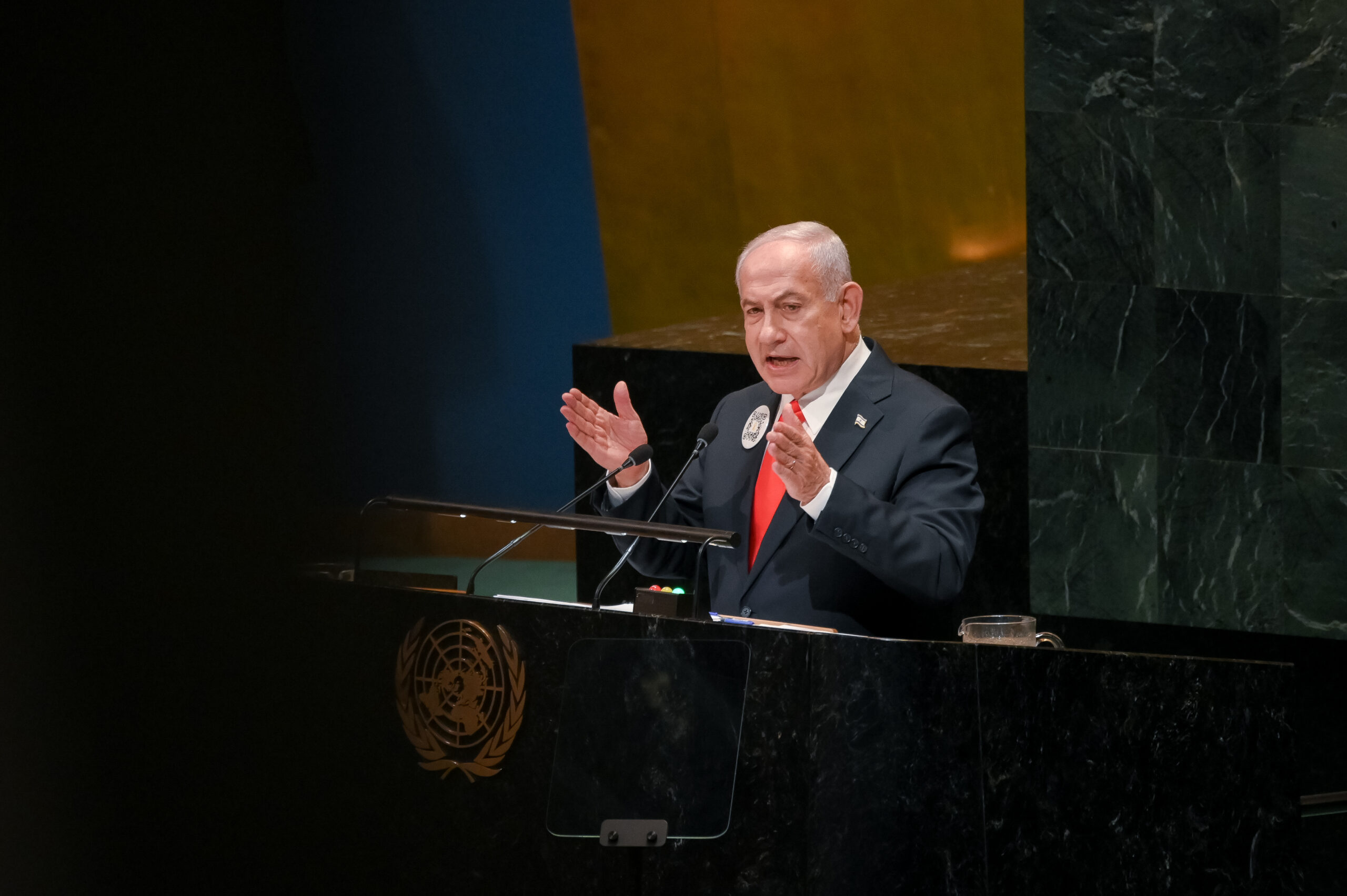
From Guterres’s farewell to Erdogan’s “concentration camp,” Israel was the target of the opening day. World leaders spent the opening day of the 81st General Assembly calling Israel’s war against Hamas “genocide,” while President Trump, in a 38-minute speech built around the war with Iran, mentioned Israel exactly once.
On Tuesday, the day after Yom Kippur, the leaders of the world filed into the green marble hall of the United Nations General Assembly in New York. By the time the sun set over the East River, Israel had been called a perpetrator of “genocide,” a “regional threat,” and the operator of “the most inhumane and shameful concentration camp of our time.” Israel’s delegation walked out. And the President of the United States, Israel’s closest ally and its partner in a seven-month war against the Islamic Republic of Iran, stood at the same podium for 38 minutes and said the word “Israel” a single time.
The 81st session of the General Assembly opened with Israel at the center of nearly every speech, whether as target, subject, or glaring omission. Prime Minister Benjamin Netanyahu will address the Assembly on Thursday afternoon. He is flying in for barely 24 hours, squeezed between Yom Kippur and Sukkot (the Feast of Tabernacles), in the middle of an Israeli election campaign, and with New York City’s mayor calling for his arrest.
What emerged on the first day was a stark picture. One nation was singled out by dozens of others, and even its friend chose to speak around it. That picture raises the question that runs beneath every General Assembly session since 1948: why does the gathering of the nations always end up aimed at one small people?
Trump: Iran, Cuba, AI, and One Line About Israel
President Trump’s address, which the White House released under the title “While Others Have Talked, I Have Acted,” focused on Iran. The United States has been at war with the Islamic Republic since February 28, a war in which Israel is the only country that joined American military operations.
“I have a big decision to make,” Trump told the Assembly. “Will a deal be made with Iran that lets them rebuild and create a far greater country than it ever was before … or do I annihilate the Islamic Republic, and do it quickly?” He pressed the point further: “Do I drive them into hell with no chance of survival and no hope of future greatness for generations?”
Trump said Tehran was stalling “to see how I do in the midterm election,” then brushed the idea aside. “I am not running,” he said. “I gave absolutely no credence and will not give credence to the election when it comes to Iran. It doesn’t even enter my mind. The only thing that does is that Iran will never have a nuclear weapon.”
He boasted that the U.S. Navy had “escorted more than 1 billion barrels of oil out of the Strait of Hormuz.” He also dismissed reports that American stockpiles were running low, saying the United States has “more munitions than we could ever possibly think of using.”
“From the first day I entered the political arena, I have been unwavering,” Trump declared. “I will never allow Iran to have a nuclear weapon.”
Israel appeared in that entire discussion of Iran only once, and only as the site of an atrocity. “In two weeks, we will mark the third anniversary of the October 7th attack in Israel,” Trump said, “where terrorists funded by Iran tortured, mutilated, and killed 1,200 very innocent civilians, including dozens of Americans.”
Trump did not mention Netanyahu. He said nothing about the Israeli pilots who flew alongside American crews over Iran, the Israeli families who spent months in bomb shelters under Iranian missile fire, or the Abraham Accords. The Times of Israel counted the references and headlined its report: “In 38-minute speech to UN, Trump makes one reference to Israel, none to Netanyahu.”
The same silence covered Israel when Trump turned to Gaza. He took credit for ending the war there. “A year ago, the war in Gaza was still raging brutally,” he said. “We ended the war in Gaza, saving untold thousands of lives.” He added that “we brought home all remaining hostages — both living and dead, every single one of them.”
Trump then praised his Board of Peace, the body overseeing Gaza’s postwar reconstruction under his 20-point plan. He thanked 30 member countries and named Morocco, Bahrain, Qatar, Kuwait, Kazakhstan, Saudi Arabia, Turkey, and Uzbekistan as contributors of billions in reconstruction funds. Israel, whose cooperation the entire plan depends on, went unmentioned. The Times of Israel reported that the pledged money has yet to be transferred, the international stabilization force remains undeployed, and the disarmament of Hamas has stalled.
Two of the countries Trump thanked by name are Turkey and Qatar. Within hours, the leaders of both stood at the same podium and accused Israel of genocide.
The two leaders will not meet this week. Trump left New York before Netanyahu’s arrival. Israel Hayom noted that since 2009, a meeting with the American president has been part of roughly two-thirds of Netanyahu’s General Assembly trips, which makes its absence this year “relatively unusual.”
“I Don’t Know About the Move”
The distance between Washington and Jerusalem showed up again on Tuesday outside the Assembly hall. On September 8, Britain announced a ban on trade with Israeli communities in Judea and Samaria. Within days, eleven more Western countries, including France, Canada, and Norway, adopted similar measures. Israel formally asked the Trump administration to intervene. According to the Times of Israel, two weeks passed with no American action.
On Tuesday, standing beside British Prime Minister Andy Burnham at the UN, Trump was asked about the ban. “I don’t know about the move,” Trump said. “Do you know about the move?”
A Western official told the Times of Israel that Burnham had called Trump before announcing the measure and that Trump “did not push back on the British initiative.” Secretary of State Marco Rubio’s response was limited to: “Obviously, we’re not going to do what the UK did.”
Burnham defended the ban at length. “If we face a situation where there’s a tender to put settlements on the West Bank that, in effect, make a two-state solution non-viable, what do we do?” he said. The British answer, he explained, is “banning the import of goods from the settlements, because at the end of the day, you have to have meaning behind your words.”
Trump responded by praising Burnham’s “very strong condemnation” of antisemitism, and said relations between the two countries are “more up” under Burnham than under his predecessor.
Norway’s Foreign Minister Espen Barth Eide drew his own conclusion from Trump’s reaction, saying American “sympathy is on its way down.”
Guterres Bids Farewell
Secretary-General António Guterres opened the session with his final General Assembly address before leaving office. “The fault lines in our world are widening,” he said. “Cracks have become canyons.”
Guterres gave the massacre that started the war a single sentence. “It is nearly three years since the abhorrent terror attacks by Hamas on 7 October,” he said. His next sentence went straight to Israel. “What followed was an onslaught on Palestinians in Gaza, with a scale of killing and destruction unlike anything I have witnessed in all my years as Secretary-General.”
The record of his own tenure contradicts him. The war in Ethiopia’s Tigray region, fought on Guterres’s watch between 2020 and 2022, may have killed as many as 600,000 people, according to the African Union’s peace envoy, Olusegun Obasanjo. Sudan’s civil war, now in its fourth year, has killed between 150,000 and 400,000 people, according to estimates from the Center for Strategic and International Studies, and has driven about 11 million from their homes. UN’s own development agency projected that Yemen’s war had killed 377,000 people by the end of 2021. Russia’s invasion of Ukraine has killed at least 325,000 Russian soldiers alone. The Gaza toll Guterres cites comes from the Hamas-run Health Ministry, which makes no distinction between terrorists and civilians.
He then turned to Judea and Samaria and accused Israel of preparing the worst. “Meanwhile violence, displacement and settlement expansion by Israel in the Occupied West Bank are bulldozing the path to peace and raising the spectre of ethnic cleansing.”
In the section of his speech on the Middle East, the word “hostages” does not appear. The 251 men, women, children and elderly people whom Hamas dragged into Gaza, some of whose bodies were held for more than two years, got no mention from the head of the world body in his final address.
“So-called ceasefires have amounted to little more than ‘lesser fires,'” Guterres said, and called for compliance with International Court of Justice orders on Gaza. “We cannot allow the two-State solution to disappear before our eyes.”
Israel’s Ambassador to the UN, Danny Danon, summed up the Guterres years to JNS in four words: “Anyone would be better.”
A Chorus of “Genocide”
The Muslim leaders who spoke on Tuesday left no room for nuance.
Turkish President Recep Tayyip Erdogan claimed that “in Gaza alone, over the past three years, we have lost 74,000 of our brothers and sisters, most of them women and children,” blaming “acts of state terror by Israel.” He called Gaza “the most inhumane and shameful concentration camp of our time” and declared, to applause from the hall, “We are faced with a genocidal mindset that can never get enough of killing.” Israel’s delegation stood up and walked out.
Erdogan’s own record went unmentioned. In 2017, the UN human rights office found that Turkish operations against Kurdish towns in the country’s southeast had killed about 2,000 people, wiped out entire neighborhoods and displaced more than 355,000. Ankara rejected the report as “biased,” arguing that Kurdish fighters had “dug trenches in city centres” among civilians, the same argument Israel makes about Hamas in Gaza. In 2019, Turkey’s offensive against the Kurds of northeastern Syria drove more than 200,000 people from their homes. William Roebuck, then the senior American diplomat in the region, wrote in an internal memo that the operation, “spearheaded by armed Islamist groups on its payroll, represents an intentioned-laced effort at ethnic cleansing.” At home, Erdogan purged more than 160,000 judges, teachers, police officers and civil servants after the failed coup of 2016 and jailed more than 160 journalists. His leading political rival, Istanbul Mayor Ekrem Imamoglu, has been in prison since March 2025. Ten days before Erdogan lectured the world on human rights, a Turkish court handed Imamoglu another prison sentence of more than two years, for “insulting” a local official.
Turkey’s own genocide remains officially denied. Between 1914 and 1923, the Ottoman Empire and the nationalist movement that founded modern Turkey murdered up to 1.5 million Armenians, along with hundreds of thousands of Assyrian and Greek Christians. Scholars of genocide recognize all three as genocide, and Ankara rejects the term to this day. In 2020, Erdogan turned Hagia Sophia, for nearly a thousand years the greatest cathedral in Christendom, back into a mosque. His view of Israel’s enemy is equally clear. Less than three weeks after October 7, Erdogan declared that “Hamas is not a terrorist organization, it is a liberation group, mujahideen waging a battle to protect its lands and people.” Turkey has hosted senior Hamas officials ever since, and it sits on Trump’s Board of Peace. Hours before Erdogan took the podium, Trump had thanked Turkey by name.
Qatar’s Emir, Sheikh Tamim bin Hamad Al Thani, whose country hosted Hamas’s political leadership for years, told the Assembly that “what has transpired in Gaza is genocide in every sense of the word, and a stain of shame on the conscience of humanity as a whole.” He accused Israel of “persecution, apartheid, and settler terrorism” and said that “there can be no talk of a just international order as long as Palestine remains a blind spot.” He also condemned Israel’s security zones in southern Lebanon and Syria.
Jordan’s King Abdullah II, whose country has been at peace with Israel since 1994, called the Jewish state a danger to the entire region. “This government’s sense of impunity has reached terrifying levels,” the king said. “It no longer feels compelled to ask, ‘Can we get away with this?'” He claimed that “in the first 300 days of the so-called ceasefire, at least 300 Palestinian children were killed,” and that “Israeli soldiers stand by as settlers attack Palestinians, often protecting the attackers or joining them.” He pointed north toward Israel’s operations in Syria: “Today, Syria is the warning the international community is choosing not to see.” He also pledged that Jordan will “uphold the historic and legal status quo” at the Muslim and Christian holy sites in Jerusalem, a status quo that bars Jewish prayer on the Temple Mount, the holiest place in Judaism.
The king’s concern for Palestinians has limits at home. In September 1970, his father, King Hussein, sent the Jordanian army against the PLO in a campaign Palestinians still call Black September. The Palestinian refugee camp at Wahdat was reduced, in one reporter’s words, to “a pile of smoking rubble.” Jordan put the dead at 3,000, and the PLO claimed tens of thousands. The PLO’s leadership was driven out of the country. Jordan’s treatment of Palestinians in the decades since has been harsh. Between 2004 and 2008, Jordan stripped more than 2,700 citizens of Palestinian origin of their nationality, according to Human Rights Watch, cutting them off overnight from health care, jobs, property and public schools. “One day you’re Jordanian, and the next you’ve been stripped of your rights as a citizen in your own country,” one of them told the organization. Amnesty International, citing Jordan’s 2016 census, counts more than 630,000 Palestinians living in the kingdom without citizenship, many of them families who fled Gaza in 1967. They are barred from professions such as law and engineering, excluded from public health insurance, and charged double university tuition as foreigners. When Palestinians fled the Syrian civil war in 2013, Jordan closed its border to them while admitting hundreds of thousands of Syrians. A Jordanian official explained that taking in Palestinians would “alter the demographic balance of the kingdom and cause instability.”
Jordan’s own record as guardian of Jerusalem’s holy places is also on the record. During its 19-year rule over the Old City, from 1948 to 1967, Jordan barred Jews from praying at the Western Wall, destroyed dozens of synagogues in the Jewish Quarter, and allowed Jewish graves on the Mount of Olives to be torn up and used as building material.
Brazil’s President Luiz Inácio Lula da Silva, who by tradition opens the debate, spoke before Trump. “Generations of Palestinians will carry the pain and trauma left by the genocide committed by the Netanyahu government against women and children in Gaza,” Lula said. He did acknowledge that “Israeli civilians paid the price for the radicalism and intolerance of Hamas’ terrorist acts.” He then attacked the Trump administration’s sanctions on the International Criminal Court, saying that “persecuting the International Criminal Court and its members is an incentive for these crimes to go unpunished.”
Macron: “Hamas Has Never Been Active”
French President Emmanuel Macron, giving his last General Assembly speech as France’s leader, called the situation in Gaza “a spectacle that shames us all.” “What is our credibility worth if we remain inactive on Gaza?” he asked the hall. “Some claim that peace has been achieved, but this has not opened up humanitarian deliveries.”
Macron then made the claim that set off a storm in Jerusalem: “Hamas has never been active in the West Bank.”
But Macron made the claim two days after a French citizen was murdered in exactly the territory he said Hamas had never been active in.
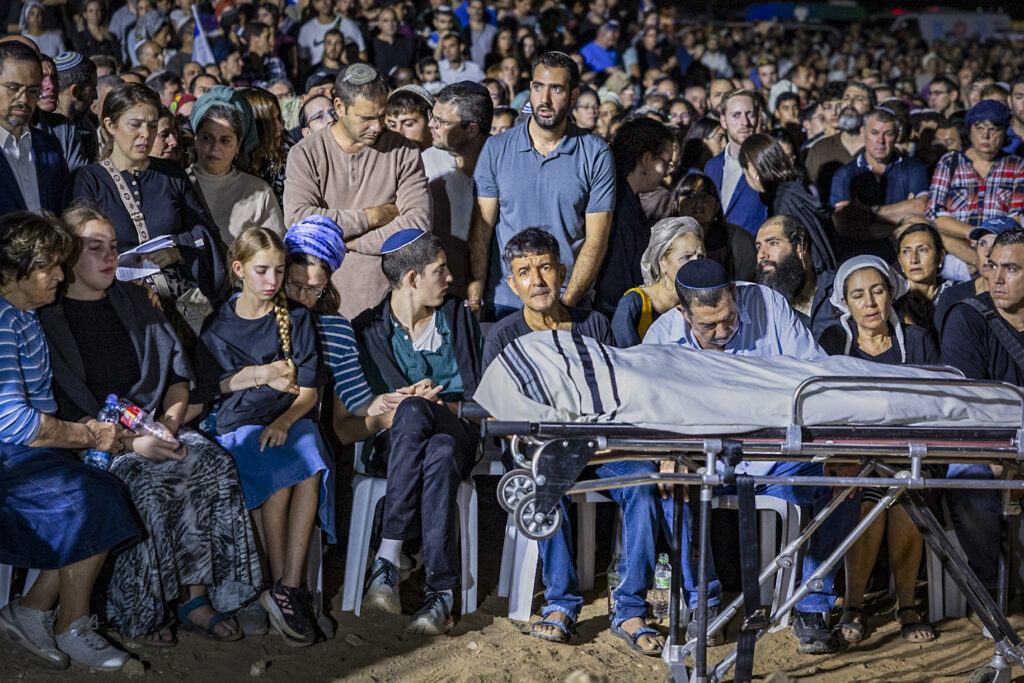
On Sunday, the eve of Yom Kippur, a terrorist in Samaria had murdered Netanel Shukrun, a father of six who held French citizenship. The Prime Minister’s Office called Macron’s statement a “grotesque absurdity.” “Today, six young Israeli children lost their father to heinous terrorism. May his memory be a blessing,” a government statement said after the attack. Netanyahu’s response to Macron was blunt: “Hamas terrorists carry out attacks against Jews almost every day. They have murdered countless Israeli civilians in Judea and Samaria.”
Finance Minister Bezalel Smotrich accused Macron of lying, saying that “the terrorist organization is fueling Arab terrorism in Judea and Samaria.” Yesha Council Chairman Israel Ganz said Macron had taken “fake news to a new high.” Even opposition figure Gadi Eisenkot, a former IDF chief of staff who spent years hunting Hamas cells in the region, called the remarks “extremely divorced from the reality on the ground.” A French diplomat later said Macron “meant to say that Hamas does not govern the West Bank.”
Sharaa: “Give New Jersey to the Israelis”
Syrian President Ahmed al-Sharaa, who as a jihadist commander once pledged allegiance to al-Qaeda, gives his General Assembly address on Thursday. At an Atlantic Council event on the sidelines, he previewed his message on Israel.
“It’s not appropriate that what happened on October 7 set Israeli policy for Syria,” Sharaa said. “This is not logical.” He claimed that talks with Israel under American mediation “almost reached 90% of agreements,” and demanded that Israel withdraw to the 1974 disengagement lines before any security arrangement.
On the Golan Heights, where Trump recognized Israeli sovereignty in 2019, Sharaa offered a joke. “Why don’t you give New Jersey to the Israelis?” he said. “You don’t own the Golan Heights to give, but you own New Jersey.” He added: “I believe New Jersey is full of Democrats, and they are not voting for Trump, so it would be good to give it to the Israelis.”
Pressed about his al-Qaeda past, Sharaa declined to renounce it: “I don’t believe that it is appropriate to discuss things that happened 25 years ago.”
Abbas Barred, Pezeshkian Admitted
On September 17, the State Department made two visa decisions. It approved visas for Iranian President Masoud Pezeshkian and Foreign Minister Abbas Araghchi, the leaders of a regime the United States has been at war with since February 28 and that Washington still designates as the world’s leading state sponsor of terrorism. On the same day, it rejected Palestinian Authority chairman Mahmoud Abbas for the second year in a row, along with dozens of other PA officials.
The State Department cited Section 212(a)(3)(B) of American immigration law, “which prohibits the issuance of a visa to a person who at any time engaged in terrorist activities or was associated with a terrorist organization.” It listed the PA’s campaigns against Israel in international bodies, its drive for unilateral recognition of a Palestinian state, and its “providing stipends to terrorists and glorifying violence.” “As a consequence of their failure to reform,” the State Department said, “the United States will extend sanctions that deny visas to PLO members and PA officials.”
The PA foreign ministry called the ban “an unjustified measure that runs counter to efforts to rebuild trust, develop Palestinian-US relations, and create the necessary political climate for implementing the two-state solution.” Abbas reportedly asked Erdogan to raise the matter with Trump. The ban stayed in place.
The General Assembly responded by voting 152 to 3, with 4 abstentions, to let Abbas address the session by prerecorded video on Thursday, the same day Netanyahu speaks. Only the United States, Israel, and Paraguay voted no. “Abbas cannot expect the international community to simply ignore it,” Danon said, referring to the PA’s continued “payments to terrorists and their families.”
Washington admitted the Iranians on strict terms. “The delegation will be under travel restrictions and will face prohibitions on the purchase of luxury and other goods per our policy,” a State Department spokesperson said. As in past years, Iranian officials are barred from traveling far from their UN mission and from shopping at wholesale stores like Costco and Sam’s Club. Pezeshkian’s delegation is much smaller than in past years, with its movements confined mainly to the UN headquarters, the Iranian mission, the ambassador’s residence, and JFK Airport.
The regime Pezeshkian represents lost its Supreme Leader, Ayatollah Ali Khamenei, in the war. Its ports are under an American naval blockade in the Strait of Hormuz, and Tehran has issued seven conditions for reopening the strait. Pezeshkian addresses the Assembly on Wednesday.
Netanyahu’s 24 Hours
Netanyahu arrives in New York Wednesday night and flies home Thursday evening, in time for Sukkot. Ambassador Danon said that “there is no option” of skipping the speech. “It became very trendy to do politics by blaming Israel,” Danon said. He expects “another show” of walkouts like last year’s, and insisted Netanyahu is “a seasoned statesman who will deliver his message regardless of any attempts to disrupt the speech.” Danon told JNS that Netanyahu will address the General Assembly on “Iran, the Abraham Accords and opportunities in the region.”
The trip also sets up a confrontation with New York City Mayor Zohran Mamdani. In a CNN interview at Gracie Mansion, the mayor’s official residence, Mamdani called Netanyahu “a war criminal and an architect of a horrific genocide.” He insisted that the International Criminal Court’s arrest warrant against the prime minister “should be honored” for the sake of “accountability.” Mamdani has repeatedly vowed to enforce the warrant, although he has no legal authority to do so.
Mamdani said he had raised the matter with Trump during a recent meeting at the White House. Trump came out of that meeting telling reporters he wanted Mamdani “to be a great mayor” and that the mayor has “great potential.”
Netanyahu answered the mayor in a video: “Shame on you, Mr. Mamdani.” He promised to address him from the UN podium. “I’m going to tell the truth about you,” Netanyahu said.
Israel is also answering the Assembly with a campaign of its own. On Wednesday, the Ministry of Diaspora Affairs and Combating Antisemitism and the National Public Diplomacy Directorate launched “The UN’s Lie Industry.” Its video shows the General Assembly hall packed with parrots, each representing a country and each repeating the same line: “Blame Israel.” The video closes with the words: “Repeating lies doesn’t make them true.”
“Even 1,000 repetitions of a lie will not make it true,” said Diaspora Affairs Minister Amichai Chikli, “and we will continue to expose the facts behind the anti-Israel choir.” Tzipi Hotovely, head of the directorate, said that “a large portion of the false blood libels against Israel come from the workshop of UN reports.”
The Nations in an Uproar
The Bible described this gathering thousands of years before anyone built a hall on the East River.
“Why are the nations in an uproar? And why do the peoples mutter in vain? The kings of the earth stand up, and the rulers take counsel together, against the LORD, and against His anointed” (Psalms 2:1–2).
The Sages taught that the hostility has a source, and that it goes back to the mountain where Israel received the Bible. The Talmud asks why the mountain of revelation is called Sinai, and answers that it is the mountain from which sinah, hatred, descended upon the nations of the world (Shabbat 89a). Israel’s election at Sinai set it apart, and the world has resented it ever since. The nations need no new reason each September. The resolutions, the “genocide” speeches, and the walkouts are the latest form of a hostility that began at the foot of that mountain.
The non-Jewish prophet Bilaam, hired to curse Israel, could only describe what he saw: “Lo, it is a people that shall dwell alone, and shall not be reckoned among the nations” (Numbers 23:9). In Hebrew, am levadad yishkon. Tuesday fulfilled the verse twice. Israel stood alone against the hall, and then its greatest friend delivered a speech about a war Israel is fighting and left Israel out of it. The Bible promises Israel something more durable than a reliable ally among the kings of the earth. It promises that Israel will dwell alone and endure.
The calendar carries its own message. Netanyahu will fly home to celebrate Sukkot, the one festival in the Bible that concerns the nations of the world. In the Temple, Israel offered seventy bulls over the seven days of the festival. The Talmud explains that they correspond to the seventy nations, and that Israel brought them to atone for the very peoples who hate it. Rabbi Elazar lamented: “Woe to the nations, for they lost and do not know what they lost. When the Temple stood, the altar atoned for them” (Sukkah 55b).
The prophet Zechariah foresaw the day that ends this story. “And it shall come to pass, that every one that is left of all the nations that came against Jerusalem shall go up from year to year to worship the King, the LORD of hosts, and to keep the Feast of Tabernacles” (Zechariah 14:16).
The nations spent Tuesday gathered against Jerusalem. On Thursday, Israel’s prime minister will stand before them for a few minutes and then fly home to build his sukkah. The day is coming when those same nations will follow him there.

