




Hours before sundown, which brought in the holiest day of the Jewish year, Netanel Shukrun took his eldest son, sixteen-year-old Yoav, to a natural spring near the settlement of Neve Tzuf to immerse before Yom Kippur. It was meant to be a father and son observing a custom of purification passed down for generations. Instead, a terrorist opened fire on the spring from a red Mitsubishi SUV bearing Palestinian Authority plates. Shukrun, a father of six, used his last seconds to shout a warning to his son. Magen David Adom medics restored his pulse with CPR at the scene, but he died of his wounds at Beilinson Hospital. Within the hour, a second cell attempted to ram Israeli troops with a vehicle near the former settlement of Ganim; soldiers of the Paratroopers Brigade’s 890th Battalion shot the driver dead and took his accomplice into custody.
This was Netanel Shakron, a father of six.
— Israel Foreign Ministry (@IsraelMFA) September 20, 2026
On the eve of Yom Kippur, he was brutally murdered in a Palestinian terror attack.
Today, six young Israeli children lost their father to heinous terrorism.
May his memory be a blessing. 🕯️ pic.twitter.com/xgaZnBD00B
By the time the fast ended twenty-five hours later, a police officer in Ontario lay critically wounded outside a synagogue, a Connecticut town line was covered in swastikas, and a German synagogue had been firebombed for the second time in twelve years.
Israel had braced for exactly this kind of week, and still could not stop it. Even before Shukrun’s murder, the United States State Department had placed Israel under a Level 3 “Reconsider Travel” advisory, warning Americans of a security environment with “the potential for unforeseen escalation.” The alert was tied to the Houthi missile war against Saudi Arabia rather than to any specific threat against Jews at prayer, but by Washington’s own classification, Israelis were already living inside a “reconsider travel” country before the first shot was fired at the spring. IDF Chief of Staff Lt. Gen. Eyal Zamir ordered reinforced companies into the Northern, Southern, and Central commands, additional armed aircraft on standby, and extra missile boats at sea. In Judea and Samaria, the Nahal Brigade had spent weeks running a large-scale counterterror operation ahead of the holiday, questioning roughly 930 suspects, arresting some 230 wanted men, and seizing more than 100 weapons — M-16s, submachine guns, handguns, and ammunition. None of it stopped the attack at the spring. Hamas tested the Gaza ceasefire the same week, planting a roadside bomb that struck an unmanned IDF engineering vehicle near the border, what the army called a “blatant violation” of the truce, and drew Israeli airstrikes on Hamas positions in response.
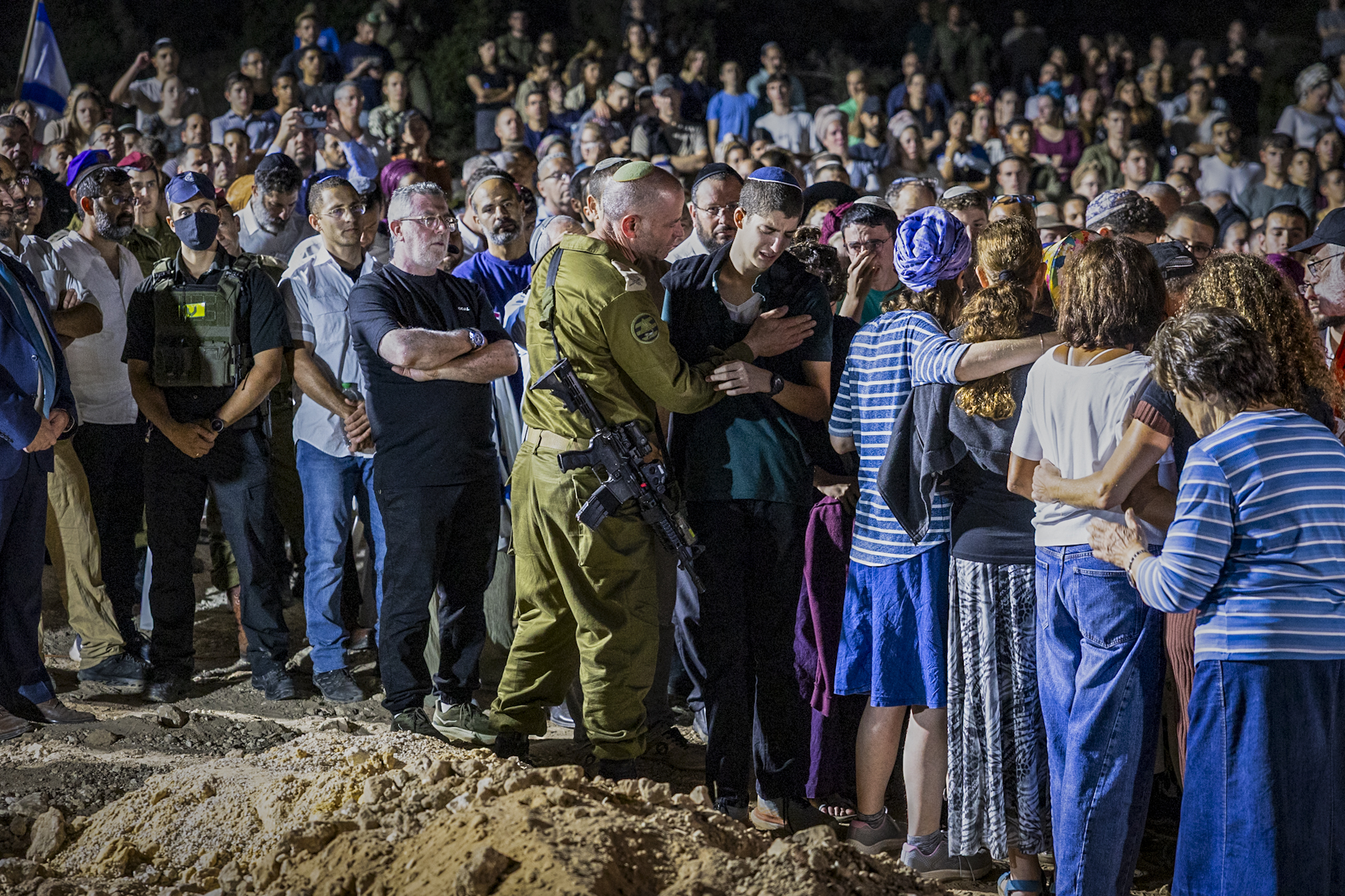
Shukrun was buried Monday night in his home community of Alei Zahav before hundreds of mourners, including Finance Minister Bezalel Smotrich and IDF Central Command chief Maj. Gen. Avi Bluth. His widow, Meirav, said that after eighteen years together, “everything was perfect,” and that in his final seconds, he had warned their son. Yoav spoke at the graveside: “Thank you for shouting to me when the terrorist came in. I don’t remember what you said, and I escaped. Thank you for saving my life.” Samaria Regional Council head Yossi Dagan used the moment to demand a full military operation across Judea and Samaria, telling the crowd that “these barbarians will never break us; we will build our land even more.”
What binds a terrorist firing from a car in Samaria to a gunman driving toward a synagogue in Ontario two days later? These are two men who never met, never coordinated, and shared no cause beyond the address they chose to attack? The Sages answered that question two thousand years before Belleville, Ontario existed. In a teaching quoted by the medieval commentator Rashi on the biblical account of Jacob’s reunion with Esau, the Sages taught: halacha hi she’Eisav sonei es Yaakov, it is an established law that Esau hates Jacob. The pretext changes with every generation. The target does not. King David put the same truth into Scripture centuries earlier, describing a persecution that answered to no border dispute and no political grievance: “Yet for Thy sake are we killed all the day; we are accounted as sheep for the slaughter” (Psalms 44:23). The psalmist was not writing about settlements. He was writing about a hatred that attaches to the Jewish people simply for belonging to God.
That principle traveled from Samaria straight across the ocean. As Sunday evening services began at the Sons of Jacob Synagogue in Belleville, a 29-year-old man named Sean Ward drove down the street armed with a shotgun and opened fire on the police officer stationed outside, Const. Jeff Smith, a nearly 13-year veteran positioned in an unmarked car specifically because of the threat level. The exchange of gunfire ran to as many as 30 shots. Synagogue president Norm Weddum described ushering congregants into the sanctuary when he heard “boom, boom, boom” and ordered everyone to the floor as bullets tore through nearby homes and vehicles. He had no doubt what he had witnessed: the gunman was “headed toward the synagogue where Jewish people were having service.” Twenty-five people were inside. Ontario’s Special Investigations Unit said it would make sense to believe the synagogue was deliberately targeted. It was not the first time gunfire had reached a Toronto-area synagogue this year; shots damaged the entrances of synagogues in Vaughan and Toronto back in March. Canadian Prime Minister Mark Carney called Belleville proof that Ottawa was still failing to protect its Jewish community, a warning he had issued months earlier after citing shootings at Jewish schools and synagogue firebombings across the country. Conservative leader Pierre Poilievre went further, calling it “vile antisemitic violence” and demanding the government “act now.”
🚨 BREAKING | POLICE OFFICER SHOT OUTSIDE CANADIAN SYNAGOGUE ON YOM KIPPUR, THE HOLIEST DAY IN THE JEWISH CALENDAR.
— Salman Sima (@SalmanSima) September 21, 2026
A Belleville police officer was injured in a shooting outside the Sons of Jacob Synagogue in Belleville, Ontario, during Yom Kippur observances on Sunday evening,… pic.twitter.com/ccorwxRQ30
Three days before Belleville, a 37-year-old man threw incendiary devices soaked in flammable liquid at the Bergische Synagogue in Wuppertal, Germany — the second arson attack on that same building in twelve years. He was arrested making antisemitic remarks at the scene. And the reach of this pattern was not confined to synagogues or named institutions.
Over the weekend, swastikas and antisemitic graffiti covered vehicles, fences, and street signs along the Rocky Hill and Wethersfield town line in Connecticut, vandalism so extensive that Rocky Hill Mayor Allen Smith said he had never seen anything like it: “Not to this level of property destruction and not to this many locations.” There was no synagogue involved in Connecticut, no public figure, no policy dispute of any kind. Someone simply covered a stretch of a small New England town in swastikas.
No one in Wuppertal, Belleville, or Rocky Hill was debating Israeli settlement policy. There was no argument over sovereignty to be had with a father immersing his son in a spring, or with two dozen Jews beginning Kol Nidrei, the prayer that opens Yom Kippur.
The claim that anti-Zionism and Jew-hatred are separate phenomena has circulated for years among activists eager to distance themselves from the word antisemitism while opposing the Jewish state’s existence. This week buried that claim under its own contradictions. The Community Security Trust recorded 1,926 antisemitic incidents in the United Kingdom in the first six months of 2026 alone, a 21 percent rise over the same period the previous year. A separate study by the Anti-Defamation League found that roughly 55 percent of American Jews reported experiencing at least one antisemitic incident during 2024 and 2025, with about 18 percent experiencing direct physical harm. These are not statistics about Israeli policy. They are statistics about Jews.
Police in two towns are looking into racist and anti-Semitic graffiti. https://t.co/nwye17Lx5r pic.twitter.com/qD3PRkIxor
— WFSB Channel 3 (@WFSBnews) September 21, 2026
Yom Kippur is the day the Jewish people stand before God and give an accounting of the year behind them. This year’s accounting includes a father of six buried in Alei Zahav, a synagogue scarred by fire a third time in Wuppertal, a police officer critically wounded defending Jews at prayer in Belleville, and swastikas scrawled across a Connecticut town most of the country had never heard of before this week. Every government spokesman offered a different explanation for why his particular attack occurred. The Sages gave the only honest answer two millennia ago, and Netanel Shukrun, Const. Jeff Smith, and the congregation of the Bergische Synagogue paid the price for a hatred that has never once needed a policy dispute to justify itself. It required only that its victims be Jewish.

