



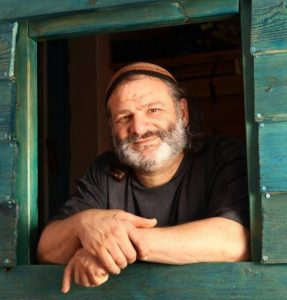
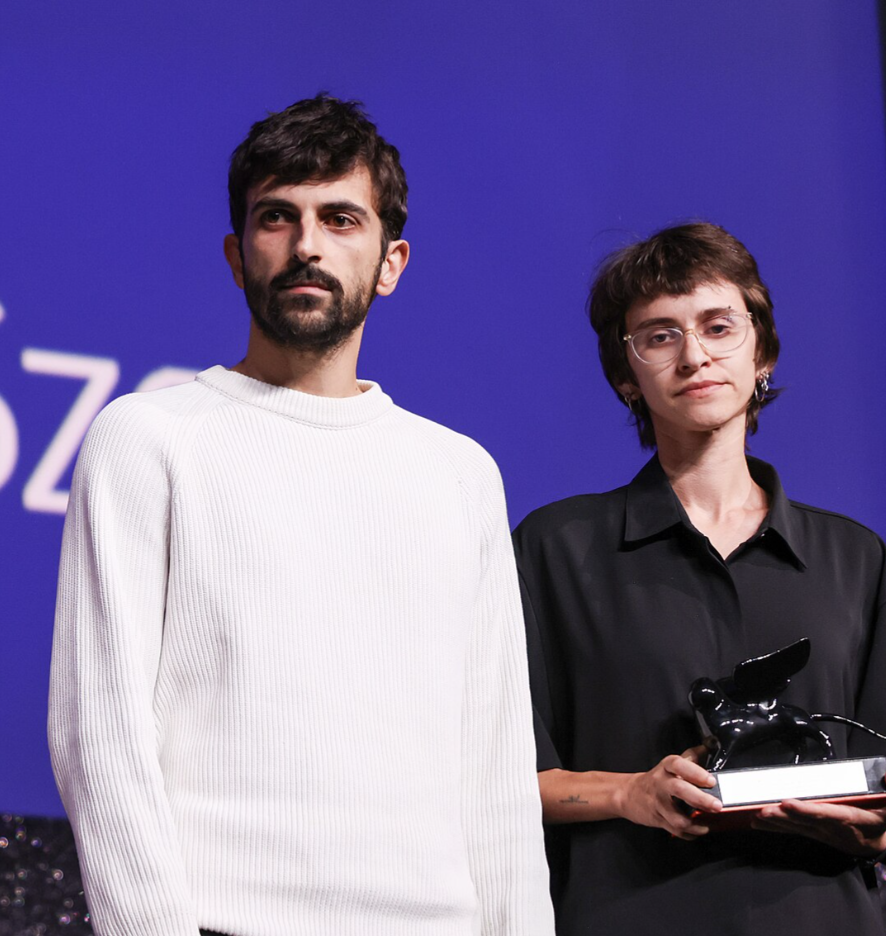
“Naza” arrived at the Venice Film Festival on September 10 with a claim large enough to fill a headline: that the Israel Defense Forces has been running a policy of mass civilian killing in Gaza, executed with the help of artificial intelligence and accepted in advance rather than treated as an accident. The film’s directors, Yuval Abraham and Rachel Szor, left Venice two days later with the Special Jury Prize and a standing ovation that ran nearly 25 minutes, the longest in the festival’s history. What they did not leave with was a film that could withstand scrutiny of either its messenger or its internal logic.
The title itself is drawn from a Hebrew military acronym, netzek agavi, meaning “collateral damage.” Built on interviews with 24 people presented as soldiers and officers from Unit 8200, Israel’s signals intelligence division, filmed at night on Tel Aviv rooftops with their faces and voices altered, the film alleges that an AI-assisted targeting system estimated the number of uninvolved civilians likely to die in a strike and that the military approved strikes anyway. In the scene at the center of the dispute, one interviewee describes a screen displaying a map of a neighborhood, allowing personnel to select individual buildings and see an estimated casualty count drawn from detailed information on the residents inside. Asked whether the system distinguished between children, infants, and adults in that estimate, he says it did not. Asked for the highest number he recalls being approved for a single strike, he answers, “I can’t say how many were killed because they never check that, but there was approval for 500.”
The IDF called the claim “completely false” in a statement posted to X, stating that it has “never planned, approved, or carried out a strike in Gaza in which 500 civilians or anything near that number were anticipated to be killed,” and that no credible claim during the war ever suggested a strike caused a toll near that figure. The military added that “the filmmakers couldn’t possibly verify this claim, there is no real supporting evidence, and yet they published it anyway,” and closed with an instruction to the public: “Judge the rest accordingly.” IDF Chief of Staff Lt. Gen. Eyal Zamir went further, calling the film a “blood libel” built on “deliberate distortion of reality” that “adopts narratives of Israel’s haters” to defame Israeli soldiers and commanders. Zamir ordered the Military Advocate General to examine legal action against the film and those involved in producing it, and separately ordered an investigation into how classified material used in the film was leaked. “False, manipulative and unfounded vilification is not legitimate criticism,” Zamir said, “even if it receives sanctimonious applause.”
It should be emphasized that the IDF soldiers and officers were unidentified, so neither their claims nor their actual involvement in the alleged activities could be verified.
Pressed on this exact problem, Abraham offered a response that deflected rather than addressed what is a basic procedure for investigative journalism. In his first Hebrew media interview since Venice, on Channel 13 with veteran investigative journalist Raviv Drucker, one of the few Israelis who has actually seen “Naza” in full, Abraham was asked repeatedly how he and Szor could have verified allegations made by 24 anonymous soldiers. His answer did not address the question. “This is a Guardian film, made in cooperation with a leading publication, with a staff of editors who had access to the raw materials. The identities of the people were verified, the cases they discussed were verified.”
Abraham’s appeal to the Guardian’s credibility is also worth examining on its own terms. The Guardian has faced sustained, well-documented criticism for anti-Israel bias for more than two decades. Lord Greville Janner, former chairman of the Board of Deputies of British Jews, once called the paper “viciously and notoriously anti-Israel.” Media watchdogs including CAMERA and HonestReporting have cataloged a consistent pro-Palestinian slant across the paper’s news and opinion coverage, and in 2023 CAMERA identified eleven separate Guardian articles and op-eds accusing Israel of “ethnic cleansing” and “genocide” over its evacuation warnings ahead of the Gaza ground offensive. Even the paper’s own former editor, Alan Rusbridger, acknowledged in 2005 that its coverage of the conflict was its “most controversial” editorial subject. An institution with that record is not a neutral guarantor of anything. Asking the public to trust that the Guardian independently verified anonymous soldiers’ identities and claims is asking the public to trust an outlet that critics, for twenty years, have accused of approaching this exact subject with its conclusion already in hand.
Naming the Guardian as a co-producer is not evidence of verification; it is a request that the public extend trust to an institution that has never itself confirmed, documented, or made public any verification process at all. A documentary that asks its audience to accept anonymous, unverifiable testimony as established fact, on the strength of an unstated and unproven claim that someone else checked it, is not practicing journalism. It is asking for faith. Drucker was not satisfied, and said so in terms that undercut Abraham’s claim directly: “We don’t have their names, we don’t have their units, to know that they were really exposed to the information that they’re talking about. We don’t have the dates of the events, places, who was hit. We basically have nothing to hold on to, to refute or confirm the grave testimonies.” A journalist who has seen the whole film, and who says on the record that there is nothing available to check its central claims against, is not a small data point. It is the closest thing to independent scrutiny “Naza” has received, and it did not resolve the problem. It confirmed it.
That dispute over facts is one thing. But before any of it can be weighed, a more basic question needs an answer: does the record support treating Yuval Abraham as a reliable narrator of what happens in Gaza? The evidence says no.
A Prize for a Film No One Has Seen
Set aside, for a moment, the question of whether “Naza’s” claims are true. A prior question comes first: has anyone actually been in a position to check them? The IDF’s initial response was blunt: it “categorically rejects” the film’s allegations. But days later, IDF Spokesperson Brig. Gen. Effie Defrin issued a more pointed statement acknowledging the obvious problem. “The film ‘Naza’ has not yet been released in full,” Defrin said. “However, based on what can be seen in promotional material, it presents a series of serious and false allegations regarding the IDF and its personnel.” Defrin then extended an invitation that the filmmakers have not accepted: “To enable a substantive, professional, and fact-based discussion, rather than one based on misleading portrayals, I invite the filmmakers to allow IDF representatives to view the film in full so that we can address each of the allegations it raises on merits.” Weeks after Venice, the military tasked with answering the film’s charges still has not been shown the film in full. Neither has the Israeli public; “Naza” is not being screened in Israel. The anonymous interviewees’ faces and voices were digitally altered, and the IDF says their identities, ranks, and roles cannot be independently confirmed by anyone outside the production. What has been judged, awarded, and applauded, in other words, is not the film. It is a trailer, a handful of leaked scenes, and the reputation of the men who assembled them.
That did not stop the Venice Film Festival jury from awarding “Naza” the Special Jury Prize, or a premiere audience from giving it a nearly 25-minute standing ovation, the longest in the festival’s history, with some of them waving Palestinian flags as they clapped. A film cannot be verified by people who have not seen it, and a documentary is supposed to be a record of evidence examined and tested, not a claim accepted on faith because of who is making it and what audience wants to hear it. A film that wins prizes and draws record ovations before the people accusing its subjects, and the public whose military is on trial in it, have been allowed to see it in full is not functioning as a documentary. It is functioning as a verdict handed down before the evidence has been entered.
A Convicted Terrorist, Recast
Long before “Naza,” Abraham produced a 2020 episode of the web series Shasheh, or “Screen,” profiling the Nafha Center, a Hebrew-language school in Gaza run by Ahmad Al-Faleet. The episode presented Al-Faleet as a former prisoner who had served roughly 20 years after killing “a soldier his own age.” He had not killed a soldier. His victim was Shimon Biran, a 32-year-old Israeli civilian murdered on his way to work in Kfar Darom. The outlet that produced the episode, the Forum for Regional Thinking, later corrected its own description to acknowledge Biran was a civilian.
The Regavim Movement, an Israeli research organization, spent years examining what else Abraham’s report left out and this week published a previously unreleased investigation into its findings. According to Regavim, Arabic-language footage published before Abraham’s report shows Al-Faleet returning to the scene of Biran’s murder, describing two months of planning for the attack, and reenacting the stabbing. In the same interview, he defended Palestinian “resistance” carried out with “a stone, a knife or a gun.” Social media posts predating the report show Al-Faleet celebrating his release in the Gilad Shalit prisoner exchange as his “rebirth,” praising senior Hamas commander Ahmad Jabari, and honoring the men who carried out Shalit’s abduction. Content published by Al-Faleet’s own school, Regavim found, included a Hebrew-language video of a student telling Israelis to leave the land because “the only language you understand is resistance,” set against imagery of masked men holding knives, and a message from Hassan Salameh, a Hamas terrorist serving 47 life sentences. After October 7, Regavim documented Al-Faleet sharing footage from the Hamas assault, describing civilians fleeing the Nova festival as “settlers” fleeing “resistance,” and circulating a prayer calling for the destruction of the Jews.
“Abraham wants to be treated as an investigative journalist,” Regavim said in its statement, “but this record gives the public every reason to see an ideological activist whose reporting repeatedly serves a deeply political narrative. Turning a convicted terrorist into the sympathetic face of a ‘coexistence’ story while his victim becomes a ‘soldier’ is whitewashing, plain and simple.”
Following the success of “No Other Land,” the Oscar-winning documentary Abraham co-directed on Israeli demolitions in Masafer Yatta, Regavim released footage the film had left out, showing provocations it says were omitted from scenes presented as unprovoked Israeli aggression, and participated in “No Other Lie,” a Daily Wire documentary that returned to the same village to fact-check the original film.
The Company He Keeps
A second thread emerged this week from investigative journalist Eitan Fischberger, who reported that Abraham has maintained a longstanding relationship with Ahmed Alnaouq, a London-based Palestinian activist. The two met in 2019, when Abraham, then a young journalist, reached out to Alnaouq to discuss what young Palestinians in Gaza thought about local politics. The relationship grew from there: the pair co-created Across the Wall, a platform that publishes personal essays by young Palestinians translated into Hebrew, and Abraham has since repeatedly referred to Alnaouq as a “close friend” and “partner,” not as a source he keeps at arm’s length.
Alnaouq serves as vice president, treasurer, and outreach and advocacy officer of the Euro-Med Human Rights Monitor, an organization Israel designated a terrorist entity in 2015 and which has a documented history of circulating blood libels, including accusations that Israel harvests organs from Palestinians and trains police dogs to rape detainees. Israel’s Diaspora Affairs Ministry stated earlier this year that Euro-Med’s founder, Ramy Abdu, is a Hamas operative. Alnaouq has described his brother, Ayman, killed in 2014, as a “member of the resistance”; Hamas’s Qassam Brigades posted a eulogy for him at the time, with a photograph showing him holding a machine gun and wearing a Hamas headband. In a 2021 interview with Zman Yisrael, Abraham described Ayman’s killing as a “very great tragedy,” a description that leaves out what his own close friend and the group that eulogized him say Ayman actually was.
Abraham claims to be an investigative journalist, but this title has rigorous standards that the director clearly has not upheld. Yet he was rewarded with a Special Jury Prize. Abraham’s record includes recasting a knife-wielding murderer as a schoolteacher and a murdered civilian as a soldier, and maintaining ties to a man embedded in an organization designated for terrorism. A filmmaker asking the world to accept anonymous, unverifiable testimony about what happens inside Israeli command rooms is asking for something that the record does not support giving him.
The Film Contradicts Itself
Even taken entirely on its own terms, “Naza” has a logic problem, one identified by Ariel Oseran, senior Middle East correspondent for i24NEWS. Abraham has said publicly that his film proves Israel is committing genocide. But the film’s own title, netzek agavi, “collateral damage,” concedes the opposite of what genocide requires. Collateral damage is a legal term describing harm that occurs alongside a lawful target, not harm that is itself the objective. If Israel’s actual goal were the destruction of the Palestinian population, as a genocide charge requires proving, Palestinian deaths would not need to be classified as collateral at all; they would be the point. Genocide requires evidence of specific intent to destroy a protected group, not evidence, even extensive evidence, that civilians died in a war. A film that names itself after a legal category built to distinguish unintended harm from intended killing has, in its own title, already conceded the distinction its central allegation depends on erasing.
Oseran also noted that the only material publicly available before the film’s release, a two-minute trailer, features two unnamed alleged intelligence officers describing a targeting system that estimates civilian presence before a strike, a system whose output both the officers and Abraham agree classifies those civilians as uninvolved and not as targets. Gaza’s Hamas-run Health Ministry has recorded the war’s deadliest single strike, an October 2024 attack in Beit Lahiya, at 132 deaths, well below the scale described in some of the film’s claims.
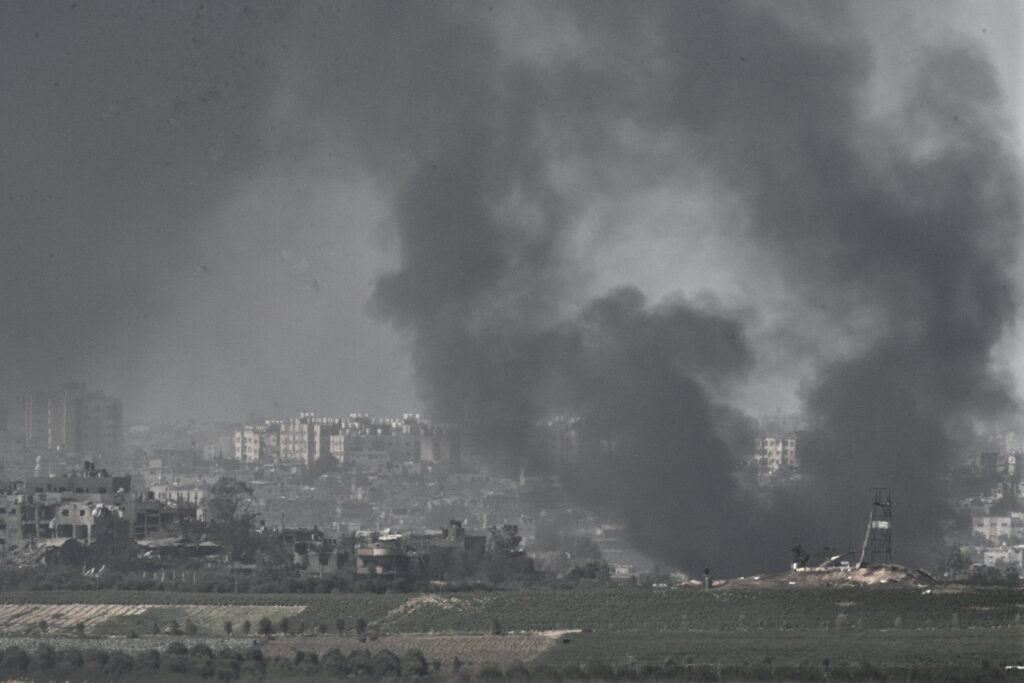
Haviv Rettig Gur, the Israeli journalist and analyst, raised a related and equally basic point. A significant amount of the online reaction to “Naza” treats the mere existence of pre-strike civilian casualty estimates as proof that killing civilians was the objective. That reasoning has it backwards. Estimating likely civilian harm before a strike is not evidence of criminal intent; it is a requirement of the laws of armed conflict, part of how a military is supposed to judge whether a strike is proportional to its military value. Treating the calculation as the crime means condemning an army for doing precisely what international law obligates it to do.
While assessing civilian deaths as collateral damage may seem brutal and cold-blooded, it is codified in the law of armed conflict. Article 51 of Additional Protocol I to the Geneva Conventions defines an unlawful indiscriminate attack as one “which may be expected to cause incidental loss of civilian life… which would be excessive in relation to the concrete and direct military advantage anticipated,” a standard that by definition requires estimating civilian harm before a strike in order to weigh it against military necessity. A military that skipped this calculation would be violating international law, not honoring it. “Naza” treats the existence of a pre-strike civilian casualty estimate as damning evidence of intent to kill civilians. Under the actual rules of proportional warfare that every modern military, including the United States and its NATO allies, is bound by, that estimate is not evidence of a crime. It is the documentation of compliance.
Rettig Gur also returned to Abraham’s own history with casualty statistics. In August 2025, Abraham co-authored an investigation with The Guardian and +972 Magazine reporting that an Israeli intelligence database had named 8,900 Hamas and Islamic Jihad fighters as dead or presumed dead, against a total death toll of roughly 53,000, and the resulting headline stated flatly that 83 percent of the dead were civilians. Buried inside the article itself was an acknowledgment that the database did not capture fighters recruited outside formal membership rolls, a category Hamas actively expanded by paying new recruits as its ranks were depleted. The caveat stayed inside the article. The 83 percent figure is what circulated. “I think these experienced journalists understand that a headline will reach people who don’t read the caveats at a vast scale,” Rettig Gur said, “and that sort of bait and switch is routine in Yuval’s work.”
Rettig Gur further argued that no honest account of Israeli strike decisions in the war’s early months can ignore the collapse of Israeli intelligence on October 7 itself, the fear of a coordinated regional attack from Hezbollah and Iran, and Hamas’s documented use of tunnels and civilian infrastructure to shield its own command structure. A film that renders that context invisible, he said, is not raising hard moral questions about the war. It is refusing to raise them.
What “Naza” dismisses as a footnote, the record treats as central. One interviewee in the film calls the explanation that Hamas uses human shields “absurd,” insisting the real reason for civilian deaths is that “it’s just easier” to strike people in their homes. But Hamas’s own officials have said otherwise, on camera and in their own words. Hamas political bureau member Moussa Abu Marzouk stated plainly in a 2023 interview that the roughly 500 kilometers of tunnels beneath Gaza exist to protect Hamas fighters, not civilians, and that protecting the civilian population was the United Nations’ responsibility, not his organization’s. Hamas built no shelters for the people of Gaza while building one of the most extensive underground fortification networks in the history of warfare for itself. Hamas leader Yahya Sinwar was even more direct in 2016, admitting that the group had “decided to turn that which is most dear to us, the bodies of our women and children, into a dam blocking the collapse in Arab reality,” an open acknowledgment of a human-shield strategy. And according to leaked internal messages reviewed by The Wall Street Journal, Sinwar described the mounting civilian death toll during the war itself as “necessary sacrifices” that would “infuse life into the veins of this nation,” while a senior Hamas official, Ghazi Hamad, said openly in 2025 that October 7 had produced a “golden moment” precisely because of the international condemnation of Israel it generated. A film that dismisses human shields as an “absurd” excuse never has to reckon with an enemy that has told the world, repeatedly and in its own voice, that Palestinian civilian deaths serve its cause.
Applause Is Not Evidence
A documentary asking the world to accept a genocide charge on the strength of anonymous testimony has to be judged by the record of the men who made it and by the coherence of what they are claiming. On both counts, “Naza” fails. Its director has a documented history of turning a terrorist into a martyr and a murder victim into a soldier. Its central allegation is undercut by its own title. And the audience giving it a 25-minute ovation in Venice was applauding a film whose argument they had not yet examined and whose target they had decided, long before the lights went down, they wanted to convict.
The director has a documented history of turning a terrorist into a martyr and a murder victim into a soldier. Its central allegation is undercut by its own title. And the audience giving it a 25-minute ovation in Venice was applauding a film most of them had not yet seen, an argument they had not yet examined, and a target they had already decided, long before the lights went down, that they wanted to convict.
The people the film’s release has actually reached first are not film critics. Rom Braslavski, who spent 738 days as a Hamas hostage, called Abraham and Szor “traitors” who “should be sent to prison.” Eliya Cohen, held in Gaza for more than 500 days and subjected, by his own account, to starvation and torture at the hands of his captors, said in an Instagram video that “something must be done… a lesson that will make them understand that they are not welcome in Israel,” and described “Naza” as “a movie that completely erases what we’ve been through, reverses reality, and presents a one-sided story.” Those are not the words of men objecting to inconvenient facts. They are the words of men who survived the war this film reinterprets, watching their own captivity disappear from a story told by a man whose own relationship to Israeli military service is worth remembering here. At 19, Abraham was enlisted and assigned to the IDF’s Intelligence Corps, the same corps his anonymous “Naza” interviewees claim to represent. He never assumed the role. After a week of training, he refused to serve, citing political and personal reasons, and left the army. The man now asking the world to convict soldiers he never stood beside never served a day in the uniform he is asking the world to judge.
Hamas has already moved to convert the film into ammunition, calling on the International Criminal Court, United Nations bodies, and human rights organizations to formally document the testimony in “Naza” and use it in investigations and accountability proceedings against Israel. This would effectively create a closed system, an echo chamber transforming fantasy into fact that will be recycled to condemn Israel. The terror group cited the same 24 anonymous accounts at the center of the film’s disputed claims, and pointed to the 25-minute Venice ovation as proof of the film’s reach. “What NAZA revealed must not remain merely material for viewing and sympathy,” Hamas said, calling for it to become “an additional impetus for investigation and accountability.” A film built on testimony the IDF says it cannot verify, from a director with a documented history of recasting terrorists as sympathetic figures, is now being cited by the organization responsible for October 7 as evidence in a legal campaign against the soldiers who fought it. That is what happens when a documentary is treated as a verdict before it has been tested as evidence.
“Naza” is the latest entry in a pattern that has repeated itself throughout this war: when the subject is Israel, the ordinary standards of journalism and documentary filmmaking get set aside in the rush to publish the most damning possible story. In February, the BBC aired “Gaza: How to Survive a Warzone,” a documentary narrated by a 13-year-old boy presented to viewers as simply a child living through the war. The boy’s father, it turned out, was Ayman Al-Yazouri, Hamas’s deputy minister of agriculture. The independent production company behind the film, Hoyo Films, knew about the connection and did not disclose it, even after the BBC asked in writing, more than once, whether the boy or his family had any ties to Hamas. The company had also paid the boy’s mother for his participation, with the payment funneled through his sister’s bank account. The BBC pulled the film from iPlayer five days after it aired. Its own internal review found a breach of editorial guidelines on accuracy, and Britain’s media regulator, Ofcom, later sanctioned the broadcaster for airing a program it called “materially misleading.”
In both cases, a Western institution with a reputation to protect- the BBC in one instance, the Venice Film Festival and The Guardian in the other- put its full weight behind a Gaza story whose central figure had a direct, material connection to Hamas that never should have survived basic vetting. In both cases, that connection surfaced only after publication, through outside scrutiny the production itself failed to perform. And in both cases, the response of the institutions involved was not to ask how the failure happened but to treat the exposure as the real scandal. Hoyo Films apologized only once it was caught. Abraham has not apologized for Al-Faleet at all; he has simply moved on to a new film with the same unverifiable structure and the same institutional cover. A pattern this consistent is not a coincidence of bad luck striking two different productions in two different countries. It is what happens when the appetite for a damning story about Israel outruns the willingness to check who is telling it.
That is the real story here, larger than any single film. The problem is not that difficult, legitimate questions about the conduct of the Gaza war cannot be asked. They can, and they should be. The problem is a media and cultural apparatus that has decided those questions are so important, and the desired answer so obvious, that ordinary journalistic caution- verifying who your source is, disclosing what you know, checking whether a “coexistence” story is being built around a terrorist- can be skipped. Every time that apparatus is caught doing it, and the correction arrives days or years too late, after the ovation, after the prize, after the headline has already circled the globe, the pattern should register as scandal rather than misfortune. It has happened again with “Naza.” It will keep happening as long as institutions reward the story that confirms the narrative faster than they verify its truth.