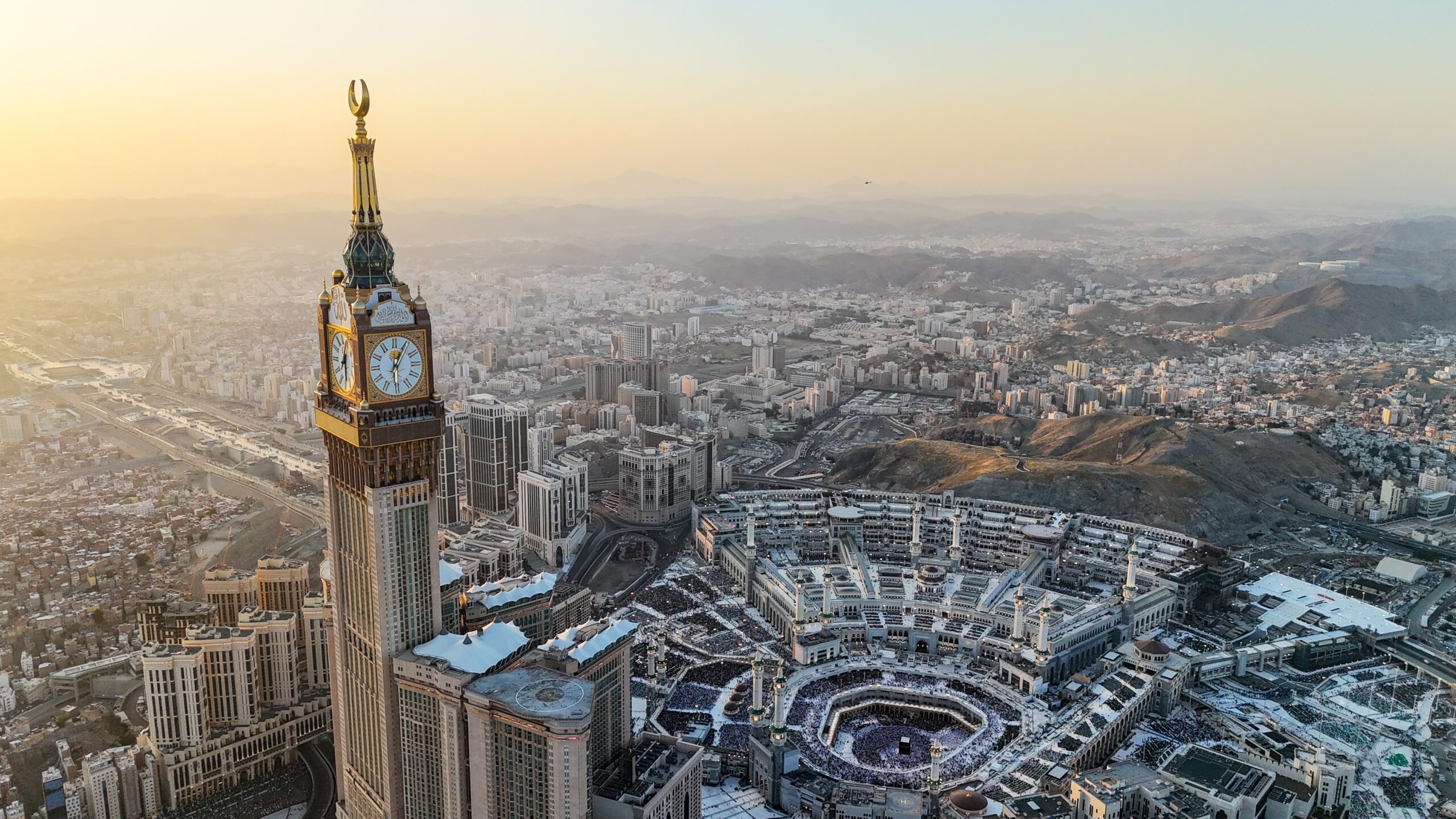
Saudi air defenses shot down a Houthi drone just south of Mecca on Tuesday evening, hours after missile warning sirens sounded across the holy city for the first time in the current round of fighting between Saudi Arabia and Yemen’s Iran-backed rebels.
The drone was intercepted at 6:50 p.m. local time before it could enter Mecca’s restricted airspace, according to Turki al-Malki, spokesman for the Saudi-led military coalition. Its wreckage fell south of the city. Al-Malki called it the second Houthi attempt to target Islam’s holiest city, after a ballistic missile launch in July 2017, and said the security of the Two Holy Mosques was a “red line.”
The Houthis denied responsibility. “The claims about targeting Mecca are a worn-out lie that has been used before and no longer fools anyone,” Houthi politburo official Hazem al-Assad wrote on X. A second Houthi political bureau member, Mohammed al-Farah, told the group’s SABA news agency the allegation was “an outright lie.” Neither official denied the group’s broader missile and drone campaign against Saudi Arabia this week, which coalition officials say has wounded 13 civilians and damaged seven homes since Monday.
Tuesday’s alerts began before dawn in Abha and Khamis Mushait and spread through the day to AlUla, Jazan, Jeddah, Taif and Yanbu. By evening, sirens had reached Mecca and Jeddah directly, and air traffic bound for Prince Mohammad bin Abdulaziz International Airport in Medina was halted. Saudi authorities activated the kingdom’s national emergency alert system in Mecca for the first time this year, telling residents to shelter indoors before later announcing the danger had passed.
The Organization of Islamic Cooperation condemned the drone strike as “heinous.” The United States issued an advisory urging citizens to “reconsider travel” to Saudi Arabia.
The strikes land a month after Saudi Arabia, Turkey and Pakistan signed a mutual defense pact in Mecca committing each country to treat an attack on any one of them as an attack on all three. Turkey and Pakistan have so far responded with statements of condemnation rather than military support, with Pakistan noting the pact remains unratified. Dr. Yoel Guzansky, who heads the Gulf program at Israel’s Institute for National Security Studies, called that response “a catastrophe from the Saudi perspective” and said Riyadh’s partners “did not think it through.” Crown Prince Mohammed bin Salman has since sought support from Egypt’s Abdel Fattah el-Sisi and phoned President Trump last week requesting military assistance, which has so far been limited to intelligence sharing.
The Mecca strikes come as the Houthis press a broader offensive across Yemen. The group has seized large stretches of the country’s southwestern coast in recent weeks, taking effective control of the Bab el-Mandeb Strait and disrupting Saudi oil exports already constrained by the ongoing US-Iran war in the Strait of Hormuz. A separate attack Friday, which Saudi Arabia has attributed to a distinct Iran-aligned faction based in Iraq, knocked out the kingdom’s 1,200-kilometer East-West Pipeline, its main export route, while Hormuz traffic remains disrupted; traders warn a prolonged shutdown could remove up to 4 percent of global oil supply, though US Energy Secretary Chris Wright said Tuesday he expects the pipeline running again within days. The UN refugee agency said more than 100,000 people have now been displaced inside Yemen, with thousands more fleeing by sea to Djibouti.
Guzansky said Israel has a stake in the outcome even without becoming a direct party to the fighting, and argued Jerusalem should quietly offer Saudi Arabia missile-defense assistance rather than act against the Houthis independently. “Imagine an Israeli system protecting Mecca and Medina against attacks by other Muslims,” he said. “That would be a greater achievement than many others we could seek.”
Arab tradition traces its own lineage to Ishmael, son of Abraham, and Muslims the world over regard the Kaaba in Mecca as the house Abraham and Ishmael built together. A group tracing its spiritual inheritance to that same man, striking at the city built in his name, looks, on its face, like a nation turning its weapons against itself.
The Bible predicted exactly this centuries before the birth of Islam. When Hagar fled into the wilderness while pregnant with Ishmael, an angel of the Lord met her there and described the son she would bear:
“He shall be a wild donkey of a man, his hand against everyone, and everyone’s hand against him, and he shall dwell over against all his kinsmen.” (Genesis 16:12)
The Hebrew describing Ishmael is pereh adam, a wild donkey of a man, an image of untamed strength that answers to no master. The phrase describing his relationship to his own family is al p’nei kol echav yishkon, he will dwell in the face of, or in constant tension with, all his brothers. This is a prophecy about conflict within Ishmael’s own house, a permanent condition of internal strife written into the character of his descendants from the moment of his birth. The Bible foretold that Ishmael’s hand would turn against everyone, including his own kin. Jewish tradition sees end-of-days significance in the Biblical figure of Ishmael, describing in detail how it will unfold.
The Sages who studied that verse for centuries elaborated on its implications in detail, and their conclusions describe something far more specific than a generalized hostility.
The midrash on robbery and torment
The Sages read Hagar’s prophecy in Genesis 16:12 as describing a livelihood rather than just a temperament. According to this tradition, Ishmael’s descendants would sustain themselves through robbery and theft, an economy built on taking from others rather than producing for themselves. Other midrashic traditions go further, stating plainly that Ishmael’s offspring would torment the Children of Israel. The angels who witnessed this prophecy being given raised an objection before God, asking whether it was right to save a boy destined to father a people who would persecute the Jews. God’s answer, drawn from the same passage in Genesis, was that a person is judged by what he is in the moment, not by what his descendants will become. That answer preserved Ishmael’s life in the wilderness. It did not soften the forecast for what his descendants would do.
Rambam’s letter from exile in Yemen
The clearest classical statement on Ishmael’s persecution of Israel comes from the Rambam, writing in his Iggeret Teiman, his letter to the besieged Jewish community of Yemen. The Rambam connected the suffering he described to King David’s own lament in the Psalms. David, moved by prophetic insight into Israel’s future exiles, mourned specifically over the exile under Ishmael’s rule: “Woe is me, that I sojourn with Meshech, that I dwell beside the tents of Kedar” (Psalms 120:5). Kedar is the biblical name for the Arabian tribes descended from Ishmael, and Jewish tradition has long used it as shorthand for the broader Ishmaelite nations. The Rambam pointed to the next line of that same psalm as capturing the specific character of the persecution: “I am all peace, but when I speak, they are for war” (Psalms 120:7). Israel’s posture is conciliation. The response, across the exile of Ishmael, is war regardless. The Rambam wrote this from personal experience of that persecution in Yemen, the very land the Houthis now rule.
The final and hardest exile
Later Kabbalistic tradition, associated with the teachings of the Arizal, describes Jewish history as passing through four historical exiles: Babylonia, Media, Greece and Edom. But this same tradition, drawing on Pirkei D’Rabbi Eliezer, the Midrashim and the Zohar, describes a fifth exile still to come before the redemption: the exile of Ishmael. This tradition explicitly identifies that final exile as harder than any of the four that preceded it, and ties the description directly back to the “wild man” language of Genesis 16:12. The order matters here. Ishmael’s exile is not one among equals. It is the last stage before the end, and the most severe.
Gog and Magog, and Ishmael turning on Esau
Jewish eschatology places the sharpest description of this violence in the War of Gog and Magog, the climactic conflict that precedes the final redemption. Rabbi Pinchas Winston, drawing on the Zohar, has taught that this war unfolds in a specific sequence. Ishmael, representing the Arab and Islamic world, and Esau, representing the Western nations, will first ally together against Israel. “According to the Zohar, in the War of Gog and Magog, Ishmael, that is to say, the Arabs, will go to war against Esau, the West, and defeat them,” Rabbi Winston has explained. “The first conflict on the Gog and Magog agenda is a war between Esau and Ishmael. When that is finished, Ishmael will then go to war against Israel.” Rabbi Winston has stated the outcome of that internal conflict plainly: “In the end, Esav and Ishmael will turn on each other, and Ishmael will emerge victorious against Esav.” Only after that internal war concludes, on this reading, does Ishmael turn his full attention toward Israel itself.
That sequence gives the Mecca strikes their weight. A Zaidi Shia movement in Yemen, armed by Iran, striking the holiest city of Sunni Islam and its Saudi custodians is not a stray or self-defeating act once measured against this framework. It is Ishmael’s hand turning against his own kinsmen, precisely as Genesis 16:12 described nearly four thousand years ago, and precisely where Jewish tradition says that hand must turn before the final and larger confrontation begins.