


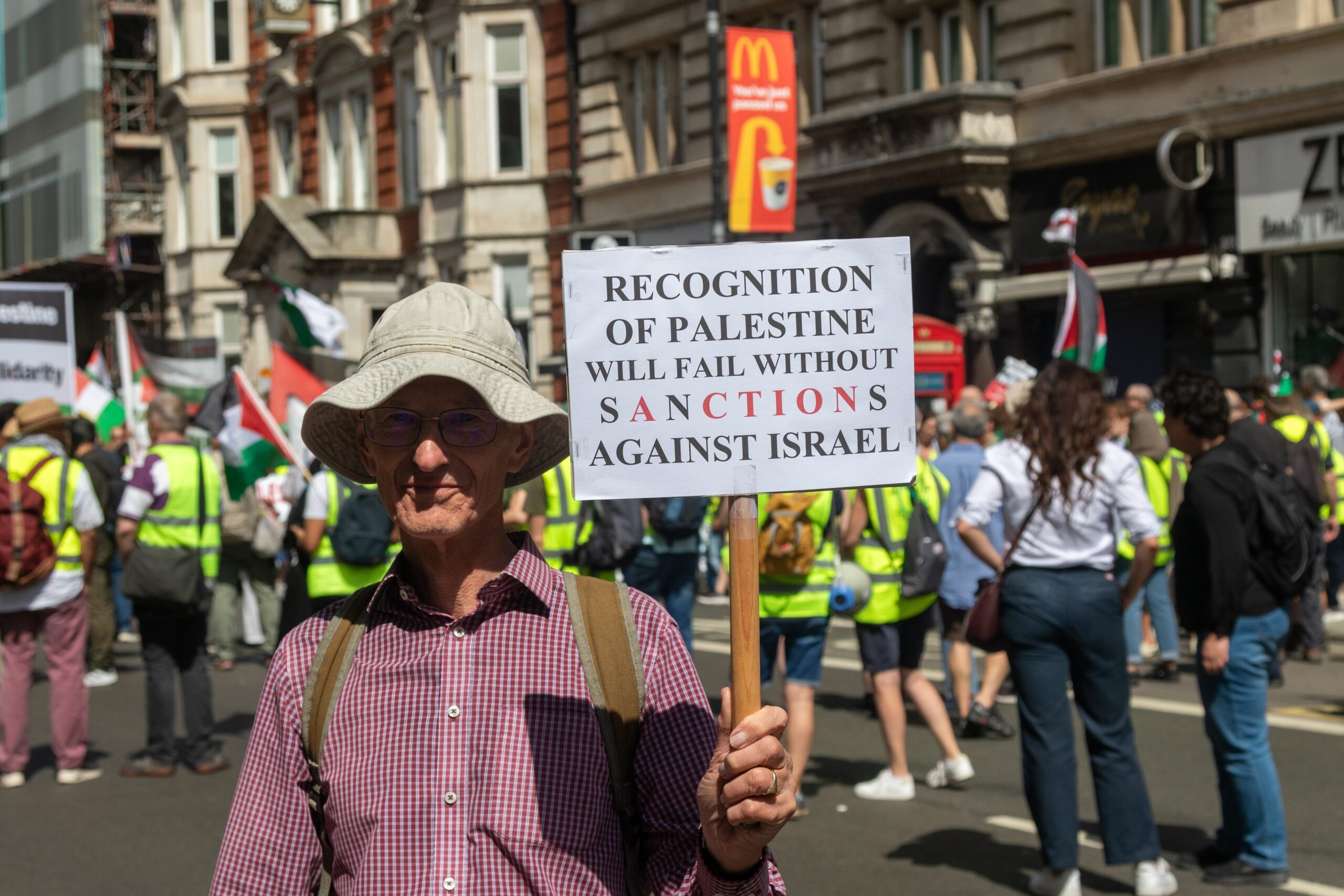
British Foreign Secretary Ed Miliband stood before the House of Commons on Tuesday and delivered what may be the harshest condemnation of Israeli sovereignty in Judea and Samaria ever issued by a Western government. Britain, he announced, will ban all trade with Jewish communities there, sanction companies and individuals connected to them, and refuse arms export licenses tied to what he called Israel’s “unlawful occupation.” France and Canada immediately followed with their own import bans. Nine other countries, including Denmark, Norway, Poland, Spain, and Sweden, issued a separate statement reaffirming support for a two-state solution, without committing to sanctions of their own.
Miliband did not soften his language. He accused Israel’s government of allowing “ethnic cleansing” of Arabs in the region, charging that officials “have made statements and taken actions to support the forced displacement of Palestinians.” He built this claim on quotes from former Israeli Prime Minister Ehud Olmert, who called the Jewish settlement of the Biblical homeland “a violent and criminal effort to ethnically cleanse territories in the West Bank [SIC],” and from former IDF general and health minister Ephraim Sneh, who used the same term.
Miliband said settler attacks against Palestinians now average six per day, the highest rate on record. The issue of settler violence is hotly contested and far from settled. In the past, settler violence has been grossly misreported.
Miliband cited a population jump in Judea and Samaria from roughly 270,000 residents at the time of the Oslo Accords in 1993 to some 770,000 today, though that figure appears to combine multiple regions beyond Judea and Samaria proper.
The gap between these figures is not incidental. Roughly 541,000 Jews live in Judea, Samaria and the Jordan Valley as of this year. Miliband’s figure of 770,000 is nearly 230,000 higher, a difference too large to be explained by rounding or a different data year. The most likely explanation is that his number folds in Jewish residents of eastern Jerusalem neighborhoods, which Israel considers part of its unified capital but which Britain and most of the international community classify as occupied territory and count alongside settlements. Combining the two lets a foreign secretary describe Jews living in neighborhoods of their own capital city as part of an “occupation” crisis, inflating the settler population by nearly half without ever saying so directly. It is a small sleight of hand with a large effect: it makes the number sound more alarming, and it erases the distinction between Jerusalem, which Israel has never treated as negotiable, and Judea and Samaria, where the political argument is at least contested.
Miliband also quoted Finance Minister Bezalel Smotrich directly, saying Smotrich wants to “bury the idea of a Palestinian State.”
British Prime Minister Andy Burnham, French President Emmanuel Macron, and Canadian Prime Minister Mark Carney issued a joint statement calling the day “a further turning point” in their efforts to protect the two-state solution. Canadian Foreign Minister Anita Anand wrote that illegal settlements “significantly undermine” the prospects for a negotiated peace. France cited what it called the “frenzied expansion” of settlements and a “flare-up of violence” as its own justification.
That two-state solution, stripped of the diplomatic packaging it is usually given, is geared towards the creation of an unprecedented Palestinian state carved from inside Israel’s own borders, militarized and ethnically cleansed of Jews, with an exclusively Muslim capital in Jerusalem centered on Judaism’s holiest site, the Temple Mount. It was this same vision that drove the Oslo Accords of the 1990s, a land-for-peace framework that traded Israeli territory and security for promises of Palestinian recognition and coexistence. Instead of peace, Oslo produced three intifadas, countless terrorist attacks against Israeli civilians, years of rocket fire from Gaza, and the war against Hamas that Israel is fighting today.
Foreign Minister Gideon Sa’ar answered within hours. He called the accusations “outrageous lies” and “morally distorted,” accusing Britain of “blatant interference in the affairs of a sovereign state and its electoral process” ahead of Israel’s late-October elections. He shuttered the British consulate in Jerusalem, pulled Israel out of a US-led coordination mission for Gaza that included Britain, and barred entry to eleven members of the UK Parliament along with a lawyer who has represented Hamas in British courts. “We did not return to our land after 2,000 years only to lose it under pressure from jihadists, Islamists, antisemites, far-leftists and wokes,” Sa’ar said.
Before Miliband appeared on BBC Breakfast to defend the announcement, the Israeli embassy in London had already gotten ahead of him. Spokesperson Alex Gandler told Radio 4’s Today program that the sanctions came down to “internal UK politics,” noting that the timing could not be worse, arriving less than fifty days before Israel’s elections and just as the Jewish High Holy Days approach. Gandler went further, warning that the decision “creates an atmosphere for violence against Jews” and “creates a fertile ground for antisemitism to flourish.” He called the sanctions a “nuclear option,” particularly striking given that Israel has spent the past several years at war and, in his words, is “fighting a shared enemy in Iran” alongside the very countries now moving to punish it.
Miliband did not back down when he appeared on BBC Breakfast that morning. He said he regretted Israel’s response and the closure of the UK consulate, but insisted the government had weighed the costs and benefits of acting and “could not simply stand by because we feared Israeli reaction.” He said Britons “have been stirred by the suffering of the Palestinian people” and expect their government to respond. Citing unnamed voices on the ground in Judea and Samaria, he claimed Palestinians are being “intimidated, harassed, bullied out of their homes by these settler terrorists,” and said he feared the Israeli government was “turning a blind eye” to what he called enforced displacement. The UK, he said, could not remain “silent or passive.”
Miliband framed his own identity as central to the decision. He told BBC Breakfast he is a “proud British Jew” and said that background makes him acutely aware of the “scourge of antisemitism.” He rejected the idea that Britain cannot simultaneously stand up for the rule of law and the dignity of Palestinians while also countering antisemitism at home, saying “anyone who holds British Jews responsible for the actions of the Israeli government is engaging in antisemitism, pure and simple, and we all have to call it out.” He said he wants “thriving relations with Israel” within its “legal borders”, but that wherever “illegal settlements” exist, the government will act.
Miliband opened his BBC Breakfast remarks by grounding the entire decision in the two-state solution, which he called “essential for security and dignity” for both Israelis and Palestinians. “That prospect is being destroyed by the facts on the ground,” he said, pointing specifically to proposals for the E1 settlement project. “We and our allies did not feel we could stand by and be passive and powerless in the face of this destruction of the two-state solution,” he said, calling it essential to the security of the entire Middle East.
Britain’s own Chief Rabbi, Sir Ephraim Mirvis, did not wait for Jerusalem to respond before condemning the move himself. He called the sanctions “a dark day for British Jews” and dismissed them as “gesture politics,” warning that “these measures will succeed only in bolstering the very extremism they seek to target.” It is worth sitting with that fact plainly: the most senior rabbinic authority in the United Kingdom looked at his own government’s flagship Middle East policy and called it a mistake that would achieve the opposite of its stated goal.
The Trump administration made its own position clear without ceremony. Secretary of State Marco Rubio told reporters the sanctions could prove destabilizing in Judea and Samaria and confirmed Washington would not block imports from Jewish communities there.
Judea and Samaria — the biblical heartland where the Patriarchs walked, where Joshua led the tribes into their inheritance, where David reigned before ever reaching Jerusalem — is not, in this framing, occupied territory. It is not disputed. It is not a bargaining chip for the next round of European diplomacy. But three Western governments now treat Jewish presence there as a crime deserving of sanction.
Every Measure Announced
The United Kingdom’s package is the most sweeping. It bans importing goods from Jewish communities in Judea and Samaria, sanctions companies and individuals who facilitate settlement expansion, refuses arms export licenses for anything deemed to materially support the “occupation”, and bans advertising Jewish settlements within the UK. These form part of a “comprehensive sanctions regime” expected to take effect within six to nine months, with unspecified religious exemptions. Britain also sanctioned a group they defined as “extremist settlers” immediately, expanded its human-rights sanctions framework to move faster against growth of Jewish settlement — naming the E1 project between Jerusalem and Ma’ale Adumim specifically — and targeted companies providing construction, infrastructure, financing, or real estate services tied to Jewish settlement expansion. Miliband said Britain will continue trading with Israel inside the Green Line and opposes the broader Boycott, Divestment and Sanctions movement. In the same speech, he announced sanctions on Hezbollah’s financial arm and said the UK would reimpose major economic sanctions on Iran alongside the EU and US.
France and Canada committed to imposing their own import bans alongside Britain. The nine other signatories to the accompanying statement, which are Denmark, Finland, Iceland, Ireland, Norway, Poland, Portugal, Spain, and Sweden, pledged only to consider national or European-level trade restrictions, a materially weaker commitment than an active ban. The Netherlands, Belgium, and additional European states have separately already banned settlement goods or are in the process of doing so, according to Miliband’s own account, meaning the European picture is considerably more fragmented than a single unified bloc.
Israel’s countermeasures were immediate. Sa’ar closed the British consulate in East Jerusalem, which had been accredited to the Palestinian Authority, ended Britain’s role in the Gaza coordination mission, and barred entry to eleven British parliamentarians: Jeremy Corbyn, Zarah Sultana, Naz Shah, Diane Abbott, John McDonnell, Richard Burgon, Hannah Spencer, Carla Denyer, Sian Berry, Ellie Chowns, and Adrian Ramsey, along with Fahad Ansari, a lawyer who has represented Hamas’s political wing in UK courts.
The Sanctions Are Largely Theater
Strip away the political drama and the trade measures themselves accomplish almost nothing economically. The primary produce exported from Jewish communities in Judea and Samaria is agricultural, including dates, citrus fruit, herbs, and wine, representing only a tiny fraction of Israel’s total exports. The bans will not meaningfully affect broader trade between Israel and any of the three countries imposing them. This was policy theater dressed as economic consequence, aimed at making a moral statement rather than inflicting real financial damage.
The timing underscores the point. On the very same day Britain, France, and Canada announced their sanctions, Israel announced plans for 1,000 new homes in Judea and Samaria. Whatever leverage London, Paris, and Ottawa believed they were exercising, the government they targeted responded by building more, not less.
The Irony Miliband Didn’t Mention
Miliband built his case on a single word: “ethnic cleansing.” But the population data tells a different story. Jewish presence in Judea and Samaria has grown every year for decades, and Arab population figures there have long been inflated by methodology critics call deeply flawed. As of January 2026, 541,085 Jews lived in Judea, Samaria and the Jordan Valley, a figure that grew by 2.2% last year, exactly double the growth rate of the nation as a whole. New Jewish towns have created territorial contiguity across roughly 82% of the region. This is not the demographic signature of ethnic cleansing. It is the demographic signature of a community that keeps growing precisely where Miliband insists it is being violently erased.
The Arab population figures Britain relies on to make its case are themselves contested. Demographic analysis has found that the Arab population of Judea and Samaria is roughly 1.5 million, not the 3.25 million the Palestinian Authority claims, with the inflated figures built on double-counted residents, uncorrected emigration, and birth statistics a World Bank audit flagged as artificially padded.
Whatever the precise number, no honest reading of the data shows Arabs vanishing from Judea and Samaria. It shows Jews returning to it, in growing numbers, year after year.
If ethnic cleansing is Miliband’s standard, he has aimed his sanctions at the wrong government. Since 1997, the Palestinian Authority has treated selling land to a Jew as a capital offense. Justice Minister Freih Abu Medein announced that any land dealer selling to Jews would be tried and sentenced to death, calling such sellers traitors more dangerous than collaborators. Mahmoud Abbas has never authorized an execution under the law, but Palestinian courts have handed down prison sentences up to life with hard labor for the crime of selling property to a Jewish buyer, and multiple land dealers accused of the same have turned up dead. A United Nations submission on Palestinian law concluded plainly that the prohibition on land sales to Jews, paired with its draconian penalties, demonstrates that the PA intends to keep its territory judenrein — cleansed of Jews.
That is the actual ethnic cleansing policy operating in this conflict: a legal code, still on the books, designed to guarantee that wherever the Palestinian Authority governs, not a single Jew may own so much as a plot of land. Britain has sanctioned no one over it. France has sanctioned no one over it. Three governments found the will to punish Jews for building homes in Hebron and Shiloh, and found no comparable will to say a word about a law built to keep those same communities Jew-free by force of execution.
Israel has carried out an act of ethnic cleansing, targeting Jews and not Palestinians. In August 2005, the Israeli government forcibly expelled roughly 8,800 Jewish residents from the seventeen communities of Gush Katif in Gaza, along with four more communities in northern Samaria, bulldozing homes, synagogues, and greenhouses that had sustained those communities for decades. Soldiers carried resisting families out of their houses. Cemeteries were disinterred and relocated. Families who lost their homes to Israel’s own government waited years, in some cases over a decade, for permanent housing. The stated purpose was land for peace. The actual result was a Judenrein Gaza that Hamas seized within a year and turned into the staging ground for October 7.
Area A functions the same way today, without the bulldozers. Under the Oslo Accords, Area A comprises the major Palestinian population centers of Judea and Samaria, which are Jenin, Nablus, Ramallah, Bethlehem, and most of Hebron, and is under full Palestinian Authority civil and security control. No Jew lives in Area A today, and none legally can: Israeli military law itself bars Israeli citizens from entering the zone for their own safety, while Palestinian Authority law makes selling so much as a plot of land to a Jew a capital offense. Israeli security officials have repeatedly warned that any Jew who crosses into Area A risks lynching or murder, and near-lynchings have only been prevented by rapid IDF extraction operations. That risk is not incidental to Palestinian Authority rule. PA security forces have themselves carried out attacks against Israelis on numerous occasions, including officers who opened fire on soldiers and civilians, sheltered wanted terrorists, and in one case murdered a 22-year-old Israeli security guard at the Gush Etzion junction. A watchdog report identified dozens of such cases involving PA security personnel, concluding that the PA does not merely fail to stop this pattern, but glorifies it and pays stipends to the attackers and their families. Two different mechanisms, one identical outcome: a growing swath of the land of Israel now exists as territory no Jew may legally inhabit, and where a Jew who does set foot risks death, sometimes at the hands of the very police force entrusted with keeping order there.
A Movement Already Judged
Miliband’s claim to oppose the broader BDS movement is worth evaluating, because that movement has already been formally judged by multiple Western governments to be an explicitly anti-Jewish campaign. In 2019, the German Bundestag passed a resolution declaring BDS antisemitic, explicitly comparing its call to boycott Israeli goods to the Nazi slogan “Don’t buy from Jews.” Austria, Switzerland, the Czech Republic, Spain, Canada, and the United States have all passed similar condemnations. The Canadian Parliament’s resolution called BDS “a broader movement to demonize and delegitimize Israel,” rooted in the same instinct that has always targeted Jews as the source of society’s problems. Britain’s own former home secretary, Priti Patel, said it plainly in 2022: “Everything we have seen around the BDS movement is racist,” pointing to the antisemitic tropes and imagery that accompany it wherever it appears.
Miliband wants to have it both ways, invoking opposition to BDS as proof of his good faith while building a sanctions regime that accomplishes precisely what BDS has always demanded: the economic strangulation of Jewish communities in Judea and Samaria, targeted at Jews and no one else. A government that says it rejects a racist movement while adopting that movement’s core policy has not distanced itself from the racism. It has simply given it an official letterhead.
The Ethnic Cleansing No One Sanctions
If ethnic cleansing is truly the standard Britain, France, and Canada intend to enforce, an actual, documented, completed campaign of ethnic cleansing against Jews sits untouched on the record, and none of the governments behind Tuesday’s sanctions has said a word about it.
Between 1948 and the late 1970s, more than 850,000 Jews were driven out of Egypt, Iraq, Syria, Yemen, Libya, Morocco, Algeria, Lebanon, and Iran. These were not communities that drifted away. Arab governments stripped Jews of citizenship, seized their property, and in many cases jailed, tortured, or killed them outright. Iraq’s Jewish population, which numbered roughly 150,000 in 1948, fell to fewer than a few hundred within a generation. Algeria’s Jewish community, which traced its roots back to the first centuries of the Common Era, went from 140,000 people in 1948 to fewer than fifty by 2018. Egypt enacted nationality laws that explicitly excluded anyone who did not “belong racially” to the Arabic-speaking, Muslim majority, a provision used to strip Egyptian Jews of citizenship and drive them out entirely. These communities had lived in these lands for over a thousand years before Islam existed. Within three decades, they were gone.
Not one of those countries faces an import ban today. Not one has had a foreign minister stand before parliament and call its conduct “unlawful.” Not one company doing business with Baghdad or Cairo or Damascus has ever been sanctioned over the disappearance of Iraq’s, Egypt’s, or Syria’s Jewish communities. Britain, so exacting in its judgment of Jews building homes in Judea and Samaria, has never proposed a single measure against the governments that actually emptied entire nations of their Jewish populations within living memory.
That silence is the tell. This was never really about ethnic cleansing. If it were, the sanctions would be aimed at the countries that committed it, not at the Jews who survived it and rebuilt their homes in the only land where no one can expel them again.
A Boycott That Only Applies to Jews
Strip away the diplomatic language and Britain’s new sanctions regime targets one specific category of business: those owned or operated by Jews in Judea and Samaria. Arab-owned businesses in the same territory, operating under the same Israeli civil administration, face no import ban, no advertising restriction, and no threat of sanction. This is not a policy against an “occupation.” It is a policy directed specifically at Jewish commerce, applied nowhere else on earth, for the sole reason that the owners are Jewish and live in a place Britain has decided they should not.
The last time the world ran this experiment, the results were instructive. SodaStream, the Israeli beverage company, built its main factory in the industrial zone of Mishor Adumim, in Judea and Samaria. Sixteen hundred people worked there. Roughly 500 of them were Palestinian, working alongside Jewish and Israeli Arab colleagues at identical pay and benefits, according to company management and outside reporting. CEO Daniel Birnbaum held the factory up as proof that Jews and Palestinians could build something together in the very territory the boycott movement insisted must be economically strangled.
The BDS campaign targeted SodaStream anyway, precisely because it was a Jewish-owned business operating in Judea and Samaria. Activists pressured retailers to drop the product, recruited celebrities to the cause, and drove down the company’s stock. In 2014, SodaStream capitulated and closed the Mishor Adumim plant, relocating to the Negev. Palestinian workers needed Israeli work permits to follow their jobs to the new site. Most could not get them. Within two years, the last of SodaStream’s five hundred Palestinian employees were let go.
One of them, Mohammed Jaradat, who had worked at the factory for seven years and had four children to support, told reporters at the time that he was not against the boycott campaign in principle, but that the activists needed to find Palestinian workers jobs before they cost them their existing ones. No one ever did. The factory that BDS destroyed had been paying Palestinian families a living wage. The racist campaign that replaced it delivered unemployment equally to Jews and Palestinians alike.
This is the model Britain has now adopted as official government policy: identify a business as Jewish-owned, cut it off from markets, and treat the resulting economic damage as a victory regardless of who actually bears the cost. Judea and Samaria’s economy runs on integration: Jewish employers, Palestinian workers, shared industrial zones, and shared supply chains. A sanctions regime that singles out Jewish businesses for punishment does not liberate the Palestinians working inside them. It fires them.
Conclusion
Foreign ministries can close consulates. They can ban imports, bar visas, and draft comprehensive sanctions regimes with six- to nine-month implementation windows. What they cannot do is un-write a covenant that predates the United Kingdom, France, and Canada by three and a half thousand years. Chief Rabbi Sir Ephraim Mirvis called this a dark day for British Jews, and he was right. But it will not be the last day. Jews will continue building in Hebron, in Beit El, in Shiloh, and across the land God promised to Abraham, not because Whitehall, the Élysée Palace, or Parliament Hill grants permission, but because the promise in Genesis was never theirs to revoke in the first place.
