


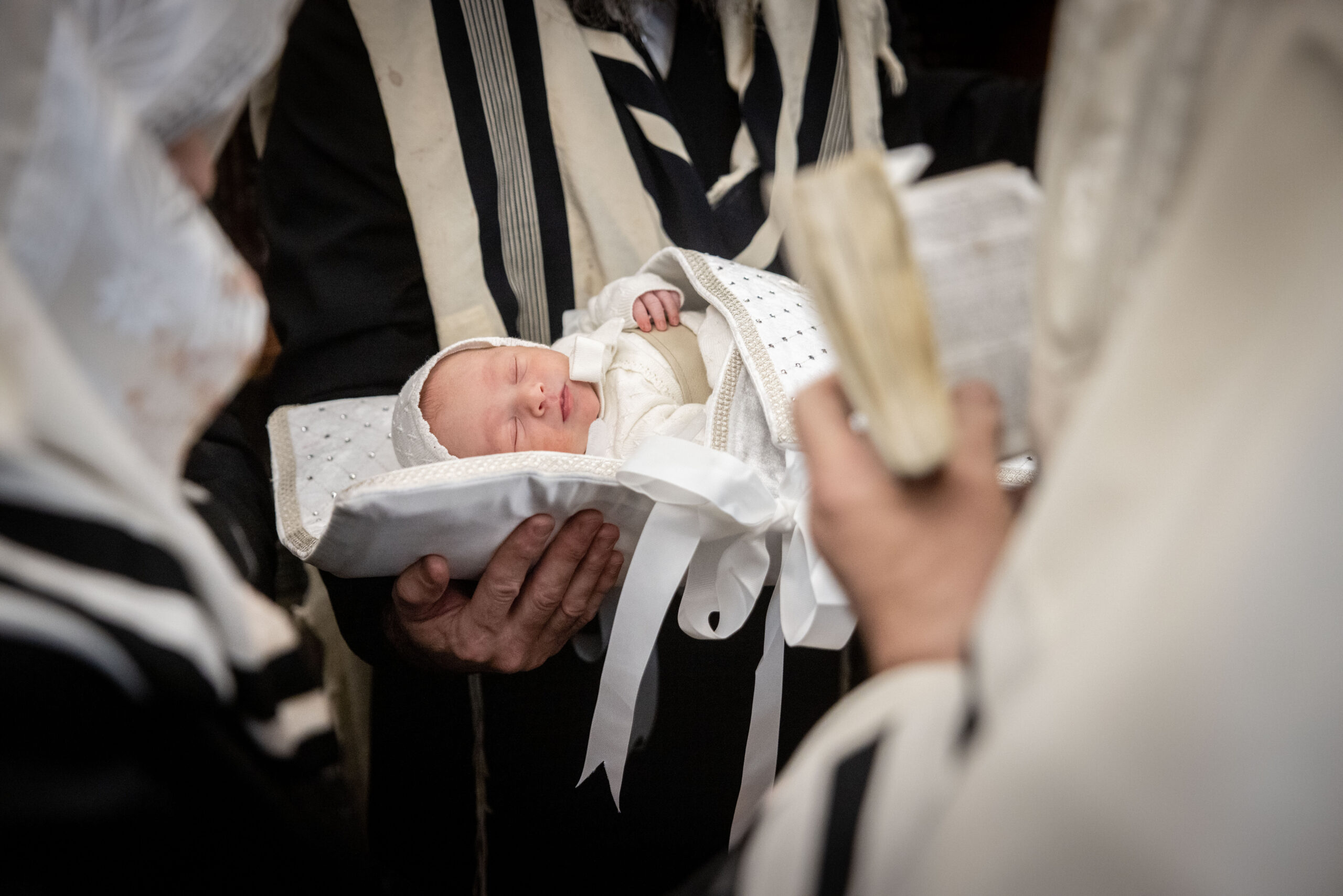
European Commissioner for Health and Animal Welfare Olivér Várhelyi told a room of rabbis in Brussels this week that Europe cannot claim to welcome Jewish communities while making Jewish life impossible to practice. Speaking at a Rosh Hashanah gathering organized by the Conference of European Rabbis (CER), the Hungarian commissioner delivered a blunt message to his own institution: “Europe cannot say that Jewish life belongs here, while making it increasingly difficult, if not impossible, to live a full Jewish life here.” His words landed in the middle of a legal crisis that has put the ritual of brit milah, circumcision, on trial in a European Union member state for the first time in the bloc’s history.
Circumcision has its roots in the Bible’s first covenant. God commanded Abraham: “And ye shall circumcise the flesh of your foreskin; and it shall be a token of a covenant betwixt Me and you” (Genesis 17:11). Brit milah is not a cultural custom that Jews might modernize away under legal pressure. It is the physical sign of the covenant between God and Abraham’s descendants, performed on the eighth day of a boy’s life for four thousand years, through exile, expulsion, and genocide. The Bible commands that this covenant be marked in the flesh precisely so it cannot be forgotten, hidden, or legislated out of existence. Belgium is now testing that proposition directly.
Belgian prosecutors in Antwerp indicted three men this year for allegedly violating a law requiring surgical procedures to be performed only by licensed physicians. The men are mohalim, ritual circumcisers trained for years in Jewish law and practical technique, not surgeons. Belgian police had already raided the mohalim’s homes in 2025. Israeli Foreign Minister Gideon Sa’ar called the prosecution a “scarlet letter on Belgian society,” placing Belgium alongside Ireland on what he described as a shameful list of nations criminalizing Jewish religious practice. U.S. Ambassador to Belgium Bill White went further, warning that Belgium “will be thought of now as antisemitic by the world” until the case is resolved. Belgian Foreign Minister Maxime Prévot defended the prosecution and claimed Jewish community representatives supported it, a claim Jewish organizations dispute.
The case is part of a disturbing trend of legislation targeting Jewish rituals. Two of Belgium’s three regions, Wallonia and Flanders, have already banned shechitah, the kosher slaughter of animals, a restriction shared by several other EU states. The precedent of this being anti-Jewish legislation was established when Nazi Germany banned shechitah in 1933, within weeks of Hitler taking power, and folded the ban into the 1935 Nuremberg Laws. Critics of Belgium’s current prosecution point to this history deliberately: a state that begins by regulating how Jews slaughter their meat and circumcise their sons has historically been a state moving toward regulating whether Jews may remain at all.
Ironically, the Belgian dispute is not exclusively a Jewish problem. Muslim communities circumcise their sons as well, typically between the ages of seven days and seven years, and Belgium’s halal slaughter restrictions apply to Muslims exactly as they apply to Jews. The Muslim Council of Belgium has said its community is largely unaffected by the circumcision dispute specifically, since Belgian mosques generally direct the practice to hospital physicians rather than religious practitioners. But the broader legal principle, that a religious minority’s ancient practice can be redefined as a medical crime, threatens both communities equally, and CER Chief Rabbi Pinchas Goldschmidt has framed his organization’s response to religious extremism as a shared project with Muslim leaders rather than a Jewish grievance alone.
Two Jewish organizations answered Belgium’s legal pressure this week not with a lawsuit but with a credential. The European Jewish Association (EJA) and the Rabbinical Centre of Europe (RCE) launched the Centre of Excellence for Religious Male Circumcision (CERM), a Brussels-based certification program that will put mohalim through advanced medical training in newborn assessment, infection control, and emergency response, overseen by an international board of urologists and pediatricians. “Brit Milah has been at the heart of Jewish life for thousands of years,” said EJA and RCE chairman Rabbi Menachem Margolin. “We are creating the highest possible professional framework to support it.” Várhelyi praised the program as “a constructive and credible model,” and EU antisemitism coordinator Katharina von Schnurbein and Internal Affairs Commissioner Magnus Brunner both voiced support. Belgian MP Michael Freilich, the country’s only Orthodox Jewish lawmaker, has argued the real problem is legal ambiguity rather than hostility: Belgium has never explicitly banned circumcision, only failed to define who may lawfully perform it.
Belgium would not be the first power to attempt to legislate brit milah out of Jewish life. In 167 BCE, the Seleucid king Antiochus IV Epiphanes outlawed circumcision among the Jews of Judea as part of a campaign to erase Jewish worship entirely, alongside bans on Sabbath observance and Torah study. Jewish mothers who circumcised their infants in defiance of the decree were executed. That persecution produced the Maccabean revolt and, ultimately, Hanukkah. Roman Emperor Hadrian imposed a similar prohibition on circumcision in Judea in the second century CE, a decree ancient sources connect to the outbreak of the Bar Kokhba revolt in 132 CE, though historians continue to debate whether Hadrian’s ban preceded the uprising or was imposed as collective punishment after it. Either way, the pattern held: once Rome crushed the revolt, it renewed and expanded its ban on circumcision as part of a broader campaign against Torah study, Sabbath observance, and Jewish courts, a persecution that produced the martyrdom of Rabbi Akiva and the other sages later remembered as the Ten Martyrs.
Every empire that has attempted to legislate away the covenant of Abraham has since vanished from the map. Antiochus’s kingdom collapsed. Hadrian’s Rome fell. The Nuremberg Laws burned with the Reich that wrote them. The covenant God gave Abraham in Genesis outlasted every one of them, cut on the eighth day into the body of every Jewish son as a mark that cannot be repealed by a parliament in Brussels or a prosecutor in Antwerp. Belgium’s magistrates may believe they are settling a narrow question of medical licensing. History suggests they are choosing which side of an old and unwinnable argument they wish to stand on.

