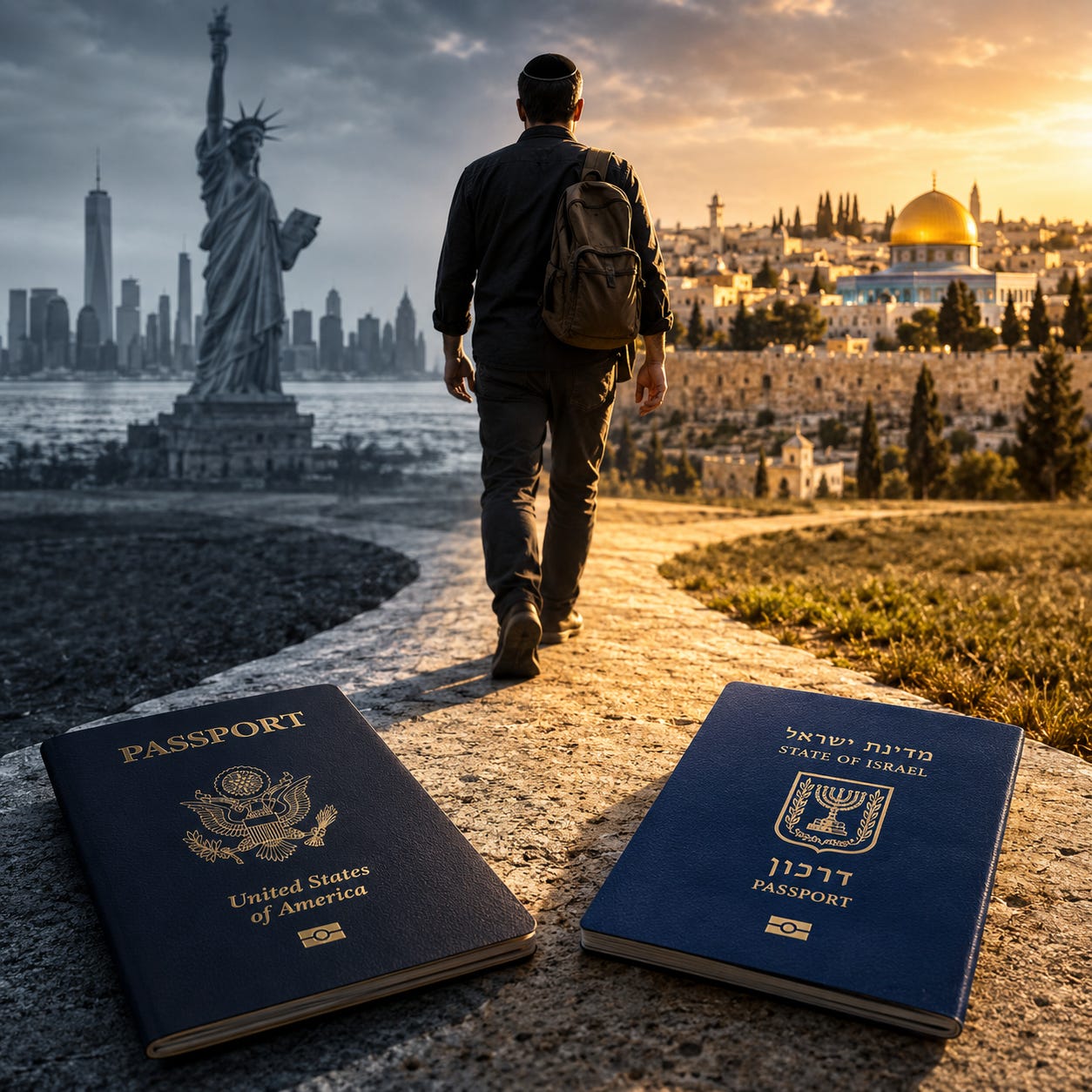
Hundreds of thousands of American citizens live in Israel today, a population on the scale of an entire U.S. congressional district. Some have made Aliyah and become Israeli citizens. Others have lived here for years while deliberately remaining Americans residing in Israel. Meanwhile, millions of Jews remain in America without having secured Israeli citizenship at all. These are three very different groups, facing three very different decisions, but perhaps all three should be asking the same fundamental question: Where is home?
Years ago, I was speaking with a South African banker in Ra’anana who made an observation that stayed with me. South African olim, he said, often describe themselves as “ex-South African.” You rarely hear an oleh call himself “ex-American” or “ex-British.” His explanation was simple: South Africans understood there was nothing to go back to, while Americans and Britons often retain another country somewhere in the back of their minds as home. Perhaps that generalization is unfair, but the question it raises is not: Have we made Aliyah, or have we merely relocated?
For Jews, even asking that question can be uncomfortable because the accusation of “dual loyalty” has an ugly history. Part of what makes that accusation antisemitic is its double standard. Irish-Americans can celebrate Ireland and Italian-Americans can proudly maintain connections to Italy without routinely being required to prove their loyalty to America, while Jewish attachment to Israel has repeatedly been treated as suspicious.
Jews are not entirely unique in confronting this issue. Before John F. Kennedy became America’s first Catholic president, he faced widespread concern that a Catholic president might ultimately answer to the Pope rather than the Constitution. The controversy seems antiquated today, but underneath it was a legitimate philosophical question: What happens when religious conviction and national allegiance genuinely collide?
I once asked precisely that question of one of my mentors, the late U.S. Supreme Court Justice Antonin Scalia. Justice Scalia was a devout Catholic, and I asked him what he would do if he encountered a direct contradiction between his obligations under the Constitution and the demands of his faith. He did not believe such a conflict would ever arise, but his answer has stayed with me ever since: “Josh, God before country!”
Those five words distinguish patriotism from idolatry. A country can deserve our loyalty, gratitude, service and sacrifice without becoming the highest object of our allegiance. For someone who truly believes in God, no flag, constitution, parliament, president, prime minister or supreme court can supersede the Creator. Loyalty to country does not require worship of country.
Interestingly, the current U.S. ambassador to Israel, Mike Huckabee, embodies much the same idea. He proudly represents the United States and its interests while openly identifying as a Christian pastor whose worldview and daily life are rooted in the Bible. His attachment to Israel is not merely political; he has repeatedly explained it in biblical terms. There is no contradiction between faithfully representing America and acknowledging that his deepest principles originate from a source above America.
I hope and pray that we live to see the day when Israel’s own leaders can proclaim the principle as clearly as Scalia did to me: “God before country.” Not Washington before Jerusalem, not party before principle, and not even state before God. The sovereign Jewish state should recognize the Sovereign above all sovereigns. We did not invent our relationship with Eretz Yisrael in 1948, and Zionism did not create it in Basel. Long before there was an American republic, Hashem entered into a covenant with Avraham and promised this land to his descendants. Jews prayed toward Jerusalem, mourned their exile and dreamed for millennia of returning. Israel is not merely another country competing for our affection; Eretz Yisrael stands at the center of our covenant with Hashem.
President Donald Trump touched this sensitive nerve during his 2025 address to the Knesset when he recalled asking Miriam Adelson which country she loved more: America or Israel. She declined to answer, and Trump joked that her silence might mean Israel. It was funny precisely because Jews have been conditioned to recoil from the question. But demanding that a Jew living loyally in America prove that he does not secretly serve a foreign power is very different from asking a Jew who voluntarily left America, made Aliyah, became Israeli and built his family’s future here where his primary national allegiance now lies. That is not the sinister “dual loyalty” imagined by antisemites. That is Aliyah.
This brings us to the first of our three groups: American Jews still living in America. For them, I would argue almost the opposite of what I am about to argue for American olim. If you are eligible for Israeli citizenship, why have you not seriously considered securing it?
Second passports have become coveted assets. An entire international industry advises wealthy families about additional citizenships and residencies as forms of geopolitical diversification. People diversify stocks, currencies, property and jurisdictions because they understand that circumstances change. What wealthy investors spend fortunes trying to acquire, millions of Jews already possess a legal pathway toward through Israel. The wealthy call it geopolitical diversification. Jews should call it their birthright.
The Law of Return represents one of the extraordinary achievements of restored Jewish sovereignty. For two thousand years, Jews depended upon foreign rulers to determine whether they could enter, remain or escape. Today there is finally a Jewish state whose doors are legally open to Jews and others eligible under its laws. Why wait for an emergency to begin documenting eligibility and navigating the process? The worst possible time to start looking for an escape route is when everybody else is looking for one too.
Many Jews learned a painful version of that lesson during COVID. At various points during the pandemic, Israel severely restricted the entry of non-citizens. Jews abroad who had always assumed that Israel would simply be there whenever they needed it encountered an uncomfortable distinction: being Jewish, being eligible for Aliyah and actually being an Israeli citizen are not always the same thing when borders close. Families were separated, regulations changed repeatedly, and people who regarded Israel as their ultimate refuge discovered that the right eventually to become Israeli was not necessarily equivalent to already holding an Israeli passport.
Emergencies are precisely when governments tighten borders, airlines cancel flights, bureaucracies become overwhelmed and rules change overnight. If Israel is your ultimate insurance policy, why wait for the fire to start before buying the insurance? For an eligible Jew who wants Israel available as his ultimate refuge, establishing that status while the world is relatively calm is not paranoia. It is preparedness.
The second group presents almost the reverse problem: Americans who already live in Israel but deliberately remain foreign residents rather than making Aliyah. There can certainly be legitimate family, financial and personal reasons for delaying citizenship, and not every long-term resident is avoiding responsibility. But there are also people who prefer the ambiguity itself. They want to live in Israel without becoming completely Israeli—to enjoy life in the Jewish state while preserving the ability to remain outside some of the obligations citizenship can bring, including, depending upon age and circumstances, military or national service. The fence itself can become comfortable.
At what point does keeping every option open become a refusal to choose? Eliyahu HaNavi confronted the Jewish people on Har Carmel with one of the most penetrating questions in Tanach: וַיִּגַּשׁ אֵלִיָּהוּ אֶל כָּל הָעָם וַיֹּאמֶר עַד מָתַי אַתֶּם פֹּסְחִים עַל שְׁתֵּי הַסְּעִפִּים אִם ה׳ הָאֱלֹהִים לְכוּ אַחֲרָיו וְאִם הַבַּעַל לְכוּ אַחֲרָיו וְלֹא עָנוּ הָעָם אֹתוֹ דָּבָר—“And Eliyahu approached all the people and said: ‘How long will you waver between two opinions? If Hashem is God, follow Him; and if Baal, follow him.’ And the people did not answer him a word.”
Obviously, Eliyahu was confronting idolatry, not immigration status. But his principle is extraordinarily relevant: there comes a moment when refusing to choose becomes a choice of its own. You can live here, own property here, raise children here and speak passionately about Israel while maintaining a legal and psychological escape hatch allowing you to say, when the obligations become inconvenient, “I am not completely part of this.” A sovereign Jewish society cannot be built entirely by people keeping one foot outside the door. Citizenship brings rights, but it also brings obligations. That is part of belonging.
Perhaps the most haunting words in Eliyahu’s challenge are actually the last ones: וְלֹא עָנוּ הָעָם אֹתוֹ דָּבָר—“And the people did not answer him a word.” They did not choose Baal. They did not choose Hashem. They remained silent on the fence. For Jews who have already chosen to build their lives in Eretz Yisrael while hesitating indefinitely to make that choice complete, Eliyahu’s opening words still demand an answer: עַד מָתַי—“How long?”
Then there is the third group: American olim who have already become Israeli citizens but retain their American citizenship. Here the question becomes subtler, because there are perfectly legitimate reasons to keep it. American citizenship preserves the unrestricted right to return, work and vote in the United States. Families may have elderly parents, businesses, pensions, property or children abroad, and renunciation can carry serious tax, financial and legal consequences. I am certainly not suggesting that hundreds of thousands of American Israelis march tomorrow to surrender their passports.
But there is a question no accountant can answer: Is that passport serving a practical need, or is it also serving as an insurance policy? Somewhere beneath the practical explanations may lurk another thought: What if things do not work out here? What if there is another war, the economy deteriorates, our children struggle or Israeli politics becomes intolerable? The passport sitting in the drawer quietly whispers: You can always go back.
Former Knesset member Rabbi Dov Lipman encountered this question in tangible form when entering the Knesset. Israeli law requires Knesset members who possess another citizenship, where relinquishment is legally possible, to take the necessary steps to give it up before exercising their parliamentary rights. Lipman has described how difficult surrendering his American citizenship was. The principle is understandable: someone serving in Israel’s sovereign parliament should have his political allegiance here. But why should the underlying question be relevant only to members of Knesset?
There is a national parallel. Israel should remain America’s close friend and strategic ally, and we should be profoundly grateful for decades of American support. But friendship is not dependence. A sovereign Jewish state should aspire to manufacture what it needs, defend itself and make its own decisions without assuming another country will always provide the weapons, money, diplomatic protection or political approval necessary for its survival. Independence from America does not mean hostility toward America.
Perhaps American olim should apply the same principle personally. We can love America, appreciate what it gave our families and maintain close relationships there without treating it as our permanent escape hatch. If Israel should stop treating America as its national insurance policy, perhaps American olim should ask whether America is still functioning as their personal insurance policy.
The Torah’s conception of return was never merely geographical. Avraham was commanded, לֶךְ־לְךָ מֵאַרְצְךָ וּמִמּוֹלַדְתְּךָ וּמִבֵּית אָבִיךָ—“Go forth from your land, your birthplace and your father’s house.” Leaving a country can be easier than leaving its psychological security behind. Perhaps this is one of the final stages of קיבוץ גלויות, the Ingathering of the Exiles: first Hashem takes the Jew out of the exile, and then the Jew must take the exile out of himself.
None of this requires ingratitude. America provided extraordinary opportunities to generations of Jews, gave refuge to many of our families, allowed Torah institutions to flourish and has stood beside Israel at crucial moments. Gratitude is a Jewish obligation. But gratitude does not require us to pretend that we still belong somewhere after we have chosen to come home. Ex-American does not mean anti-American.
And that resolves what initially appears to be a contradiction between these three groups. To the Jew living permanently in America, I ask: Why isn’t Israel already your Plan B? To the American who has lived in Israel for years without making Aliyah, I ask: עד מתי—how long will you remain on the fence? And to the American oleh who has already made Israel his permanent home, I ask: Why do you still need America as Plan B?
The answer is not that everyone should possess one passport. The answer is that everyone should know where home is. For the Diaspora Jew, Israeli citizenship can preserve the option of coming home before an emergency makes doing so difficult. For the foreign resident already living here, citizenship can transform residence into commitment, with both rights and obligations. And for the oleh who has already made that commitment, the remaining challenge may simply be recognizing that Israel is no longer the backup plan. It is Plan A.
There is an irony in Jews investing considerable effort obtaining European citizenship through grandparents or great-grandparents who fled Europe while barely considering their legal connection to the Jewish state those ancestors dreamed of seeing. One passport looks backward; the other looks forward. My grandparents may have been European, my parents may have been American and I may have been born in America. I can appreciate everything those countries gave us while recognizing that my children’s home, army, capital, language, elections and future are here.
After generations of wandering, Hashem has brought us home. Jerusalem is no longer merely a destination whispered at the end of the Seder. It is where we raise families, argue about parking, pay mortgages and build lives. At some point, a people returning home must stop living as though the moving boxes are still packed.
Maybe the South Africans understood something before the rest of us did. Maybe there is nothing to “go back” to—not because America is collapsing or because the countries of our birth are terrible places, but because we already came home.
So to the Jew still in America: secure the option of coming home. To the American already living here: decide whether you are ready to become part of it. And to the oleh who has already come home: ask yourself why you still need the option of leaving.
An insurance policy is valuable until you reach the place you were insuring yourself to get to. If Israel really is home, perhaps the question is no longer why an Israeli Jew would ever give up his American citizenship. Perhaps the more uncomfortable question is: Why are so many of us still afraid to call ourselves ex-Americans?
So long, America—and thanks for all the fish.
This article and many others appeared on Rabbi Wander’s Substack