

BLACK ROCK CITY, Nev. — For ten days every year, tens of thousands of people gather in Nevada’s Black Rock Desert to build a temporary city on the founding promise that anyone may belong there. This week, Burning Man organizers proved that promise has limits — and a Christian missionary camp found exactly where those limits are.
On Tuesday, September 2, federal law enforcement and volunteer Black Rock Rangers ordered the camp Shift the Atmosphere to tear down and leave the playa, giving its members roughly three hours to dismantle a camp that had taken a full week to build. By Wednesday morning, the spot was empty ground in the middle of Black Rock City. Videos confirmed by witnesses showed tents collapsing in high winds as camp members worked through the night under police watch, after one structure had already blown loose and landed in the road.
Burning Man’s own literature calls this Radical Inclusion — one of the festival’s Ten Principles, defined by the organization as welcoming “the stranger” with “no prerequisites” for belonging. Shift the Atmosphere’s expulsion has now forced organizers to explain, in public, exactly what those prerequisites are.
It might be said that Burning Man’s “radical inclusion” principle is based in the Bible. In Vayikra, the book of Leviticus, God commands: “The strangers who reside with you shall be to you as your citizens; you shall love each one as yourself, for you were strangers in the land of Egypt: I am the LORD your God” (Leviticus 19:34). The Hebrew word for stranger here is ger — not merely a visitor passing through, but someone who has taken up residence among a people not originally his own. The Bible does not ask Israel to feel warmly toward the ger in the abstract. It commands a specific, active love, rooted in a specific memory: you were once strangers yourselves, so you know exactly what it costs to be excluded.
Burning Man’s “radical inclusion” borrows that same instinct — welcome the stranger, no exceptions — without the accountability built into the original command. The Bible’s version of inclusion comes bound to law: to conduct, to conscience, to a shared moral order that made the welcome sustainable rather than merely stated. Burning Man’s version, this week, revealed itself as conditional the moment a camp’s behavior tested it.
What actually happened
Burning Man’s official account does not describe a faith-based expulsion. Spokesperson Dominique Debucquoy-Dodley said the camp was repeatedly warned before its removal.
“Burning Man takes participants’ right to privacy seriously,” Debucquoy-Dodley said. “Seeking permission and consent before filming or engaging other participants in Black Rock City is a requirement and responsibility for anyone at the event. This camp received multiple warnings and opportunities to correct their behavior, yet continued to violate our policies and were therefore evicted.”
Burning Man enforces strict privacy rules on every attendee, including credentialed media: no one’s face may be filmed or photographed without direct consent. Witnesses told the Reno Gazette-Journal that Shift the Atmosphere filmed attendees, including children, while pressing them to accept Jesus as their savior. The camp sat directly across from Kidsville, the section of Black Rock City reserved for families — more than a thousand children are attending this year’s event. One twelve-year-old, a returning Burner, said he was offered free matcha and coffee but had to sit through prayer and accept a pamphlet reading “For God so loved the world” before he received either.
Camp organizer John Hinerman told a different story in a series of Instagram videos, insisting his group was targeted for its religion. “We are being kicked out of Burning Man for having faith in Jesus?! So much for radical inclusion,” he said in one post. In another, he was more pointed: “We have over 600 people who have given their lives to Jesus already, and Satan can’t do anything about it.” Hinerman called Burning Man’s privacy complaint a fabrication — even as his own earlier videos showed him insisting he had obtained permission from the people he filmed, an insistence that only makes sense if the rule he now calls “lies” was one he knew applied to him.
Neighboring campers gave a more measured account. Jenae Gerstmann, who serves food at a nearby camp, said Shift the Atmosphere’s Christian electronic dance music ran too loud until other campers asked them to turn it down, which they did. Julien Rabinow, who visited the camp to see its religious artwork, said he was asked directly if he was ready to submit his life to Jesus. He declined the invitation but agreed to let a member pray over him, and said the approach did not particularly bother him — a reaction that undercuts Hinerman’s framing of blanket hostility toward his group.
The 600 conversions Hinerman claimed came with a complication of their own. The camp conducted baptisms on the playa using small communal water tanks. Commenters on Reddit pointed out that shared water tanks in contact with human bodies fall under Nevada’s public health rules against unlicensed pools — a direct conflict with Civic Responsibility, the Burning Man principle requiring organizers to conduct their events “in accordance with local, state and federal laws.” Neighboring campers also said Shift the Atmosphere left gear behind when it left, a violation of Leaving No Trace, the principle committing the community to leave no physical trace of its activity. Even the filming complaint traces back to a specific principle: Radical Self-expression, which Burning Man’s founding text ties directly to consent, stating that “the giver should respect the rights and liberties of the recipient.” By the time the group departed, it had run up against three separate, named principles, not one.
Burning Man co-founder Larry Harvey wrote all ten of these principles in 2004, and by his own account, not as enforceable law. They were meant, in his words, as “a projection of the community’s ethos as it developed organically in the desert,” not “rules to govern how we should act.” Burning Man’s decision to evict an entire camp over violations of that unenforceable ethos was, by the festival’s own history, the exception — organizers typically remove individual attendees or bar a camp from returning the following year, not tear one down mid-event.
Idols welcome, baptism not
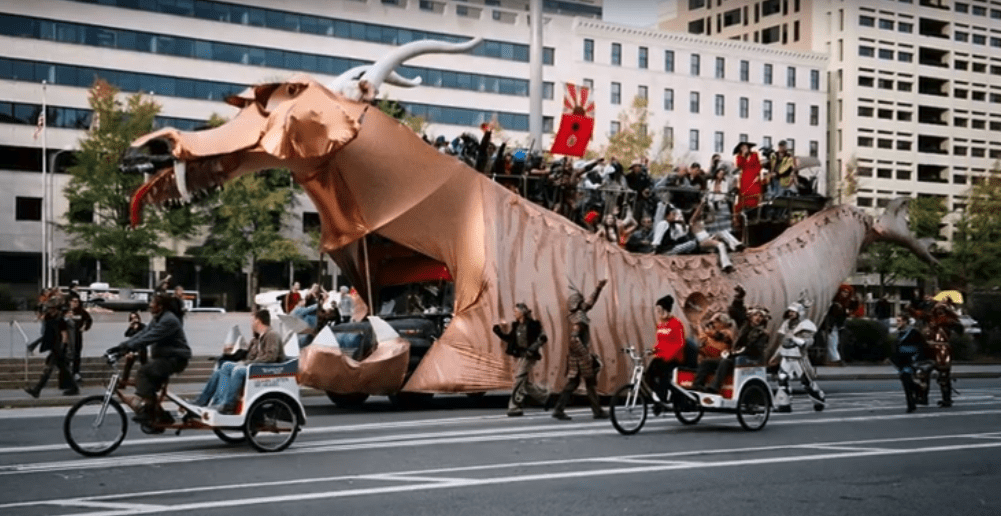
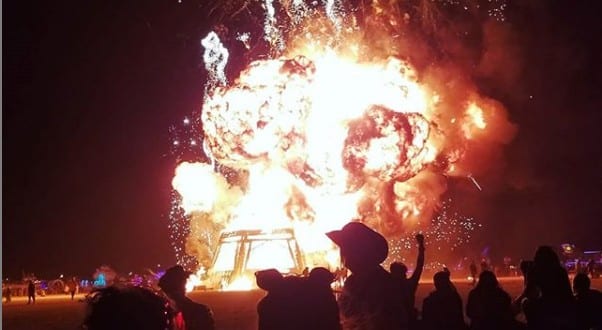
Burning Man’s tolerance has never been in question when the religious content leaned pagan rather than biblical. The festival’s camp is laid out as a five-sided pentagon, and past installments have featured a 70-foot, seven-headed metal dragon named for Abraxas — a figure widely understood to reference Satan as described in the Book of Revelation — alongside a papier-mâché sculpture of the Hindu god Shiva Nataraja and, in 2018, a spiral temple called Galaxia, dedicated to Gaia, the Greek earth goddess, built around a Buddhist meditation mandala. The signature ritual that gives the festival its name — the burning of a giant wooden effigy, a practice with clear roots in what anthropologists call the Druidic “wicker man,” an ancient stand-in for human sacrifice — has proceeded every year without official objection, even after attendees died running into the flames in successive festivals.

Jewish religious commentators who have covered the festival for years describe those elements in stark terms. Rabbi Yosef Berger, the rabbi of King David’s Tomb on Mount Zion, called a related Burning Man-affiliated event “a lightly disguised pagan feast” and warned that “Avodah Zarah is rising, make no mistake.” Rabbi Yoel Schwartz, a member of the nascent Sanhedrin, went further: “Even if the intention is secular and not for worshipping foreign gods, it is forbidden to take part in such acts. It imitates idol worship, and that is enough.” Avodah zarah, idol worship, is one of the seven Noahide laws — the prohibitions the Bible sets as binding on all of humanity, not on Jews alone.

None of that iconography got a camp evicted. A dragon modeled on Satan, a temple to a pagan earth goddess, and an effigy-burning ritual with sacrificial origins have coexisted with Burning Man’s Radical Inclusion for years without incident. What ended a camp’s participation within days was open Christian evangelism and baptism. Whatever the festival’s privacy rule required in this instance, the contrast tells its own story about which stranger Black Rock City is actually prepared to welcome.
A principle already tested before this week
Shift the Atmosphere is not the first group to expose a gap between Burning Man’s stated ideology and its practice. The organization runs its own Radical Inclusion, Diversity and Equity initiative specifically because its census data has shown white attendees far overrepresented relative to the general population, with fewer than two percent of surveyed Burners identifying as Black, Middle Eastern or North African.
Burning Man’s principles have bent under public pressure before, and quickly. In 2024, the festival pulled a submitted art listing titled “From the River to the Sea” — an eight-by-14-foot fiberglass watermelon referencing the Palestinian protest slogan — days after a Change.org petition with more than 1,250 signatures called the phrase antisemitic. Spokesperson Dominique Debucquoy-Dodley, the same official who addressed Shift the Atmosphere’s eviction this week, said the listing was removed because it had been submitted anonymously in violation of festival policy and because it “contained language understood by some to be hate speech.” Burning Man itself judged the piece, submitted by an untraceable account calling itself “Decolonize Now,” was “likely not an actual art piece coming to Black Rock City” at all — a rendering meant to provoke a reaction rather than a real installation — yet the listing came down anyway. Pro-Palestinian commenters accused the festival of censorship. Two years later, the same spokesperson reached for the same justification, a policy violation rather than the content itself, to explain why an entire camp had to leave the playa.
Other visitors describe a festival less willing to intervene when the target was a Jewish attendee rather than a piece of art. In a Reddit post from two years ago, a user identifying as Roie99 described walking into a camp called Threat Camp and being asked where his accent was from. When he said he was born in Israel, he wrote, a camp worker demanded he say “Free Palestine” or leave. He refused, calling himself an American under no obligation to declare a position on a foreign conflict. According to his account, a man then physically pushed him out of the camp; when he objected that force was not the worker’s right to use, the man allegedly replied, “it is our camp, you came to our camp and I can make you go away.” Roie99 wrote that he told the man he was being removed for being a Jew, and that the man answered, “exactly! You fucking Jew.” The account, which could not be independently verified and drew no on-the-record response from Burning Man or the camp in question, ends with Roie99 arguing that because Burning Man leases its site from the federal government, federal civil rights protections should apply to conduct inside Black Rock City.
The festival’s own numbers point to a narrowing crowd on several other fronts as well. Attendance has fallen from a 2019 peak near 80,000 to roughly 70,000 last year, and the burners still showing up skew older, wealthier, and male. Attendees under 30 made up 30 percent of Black Rock City in 2014; by 2025 that share had fallen to 14 percent. Men outnumbered women 56 percent to 44 percent last year. Half of last year’s attendees reported household incomes above $100,000, compared with a quarter in 2015, a shift that tracks a festival that now costs far more to attend than it once did: a general ticket runs $775, on top of roughly $1,000 in gear and supplies most burners budget separately, plus a fee to bring a vehicle onto the playa. One attendee who paid $215 for his first ticket in 2005 said online that rising costs are “pricing out so many of the younger, less financially-established burners.”
Burning Man’s leadership has acknowledged for years that “radical inclusion,” as written, has never functioned as an unconditional guarantee. A festival that is aging, wealthier, whiter than the country around it, and now less tolerant of an expelled camp’s faith is not radically inclusive by any definition beyond its own marketing. This week simply made the boundary visible to a much larger audience.
The wind had its own opinion
The National Weather Service forecast gusts up to 45 mph across the Black Rock Desert through Thursday evening, with blowing dust reducing visibility across the playa — arriving the same night Shift the Atmosphere’s tents came down in the wind and one blew into the road. Burning Man runs through September 7. Whether the timing means anything divine is a question the festival’s own principles are not equipped to answer.
The stranger the Bible commands you to love
Burning Man can revise its Ten Principles as often as it likes. It cannot claim ownership of the idea behind them. The command to welcome the stranger, unconditionally and without prerequisite, was written into the Bible long before Black Rock City existed, and it was written with a discipline Burning Man’s version lacks: a God who defines what love of the stranger actually requires, rather than leaving the definition to whichever community happens to be offended that week.
Shift the Atmosphere may have broken real rules — the record on privacy, on baptism, on cleanup, supports that conclusion. But the festival that evicted them did so while still calling itself radically inclusive, and that is the part worth remembering. A principle that bends the moment it is tested was never a principle. It was a slogan waiting for its exception.