


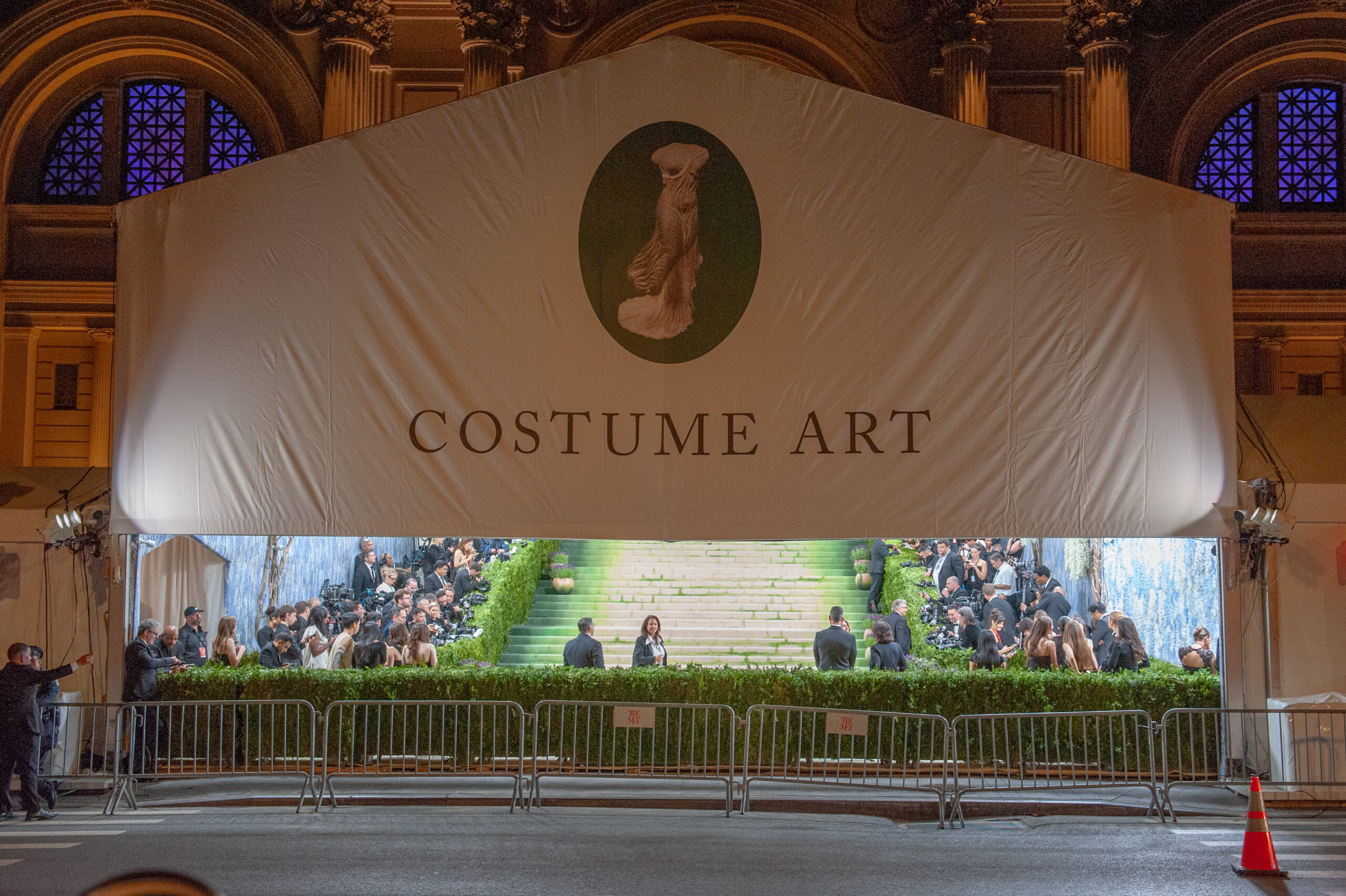
The Metropolitan Museum of Art has canceled its planned solo exhibition honoring British designer John Galliano, ending months of escalating backlash from the Jewish community over the museum’s decision to build its 2027 Met Gala around a designer with a history of antisemitic and racist statements.
“John Galliano: Horizons,” which was set to launch with the annual Met Gala next May and run through January 2028, will be replaced by a different exhibition, the museum announced Monday. The show would have made Galliano only the third living designer to receive a solo exhibition at the Costume Institute, following Yves Saint Laurent in 1983 and Rei Kawakubo of Comme des Garçons in 2017.
“Following thoughtful discussions with John Galliano, we have together decided not to proceed with the exhibition,” Max Hollein, the Met’s director and CEO, said in a statement. Galliano joined the museum’s announcement with his own statement: “After much reflection and discussion with The Met and all those involved, I have decided, with great sadness, that it is best for the exhibition not to take place at this time. I remain fully accountable for the pain caused by my words in the past, particularly the hurt I caused to the Jewish and Asian communities, and I remain deeply sorry for it.”
Anna Wintour, Vogue’s global editorial director and a longtime supporter of Galliano who oversees the Met Gala, called the decision “courageous” in her own statement. “John’s decision that the exhibition devoted to his work should not take place at this time is very courageous and a measure of the man he is,” Wintour said. “I believe this is the right decision, and both he and the Museum have my full support.” Andrew Bolton, the Costume Institute’s longtime curator, said he agreed with the decision as well, citing “the pain and concern this exhibition has caused.”
The cancellation carried additional weight because the gala, by tradition held on the first Monday in May, was set to fall in 2027 on Yom HaShoah, Israel’s Holocaust Remembrance Day. The collision between that date and a designer whose public disgrace began with praising the man responsible for the genocide the day commemorates had drawn pointed criticism as the controversy grew, and there had been speculation the museum might move the date rather than cancel the show outright.
A Decade-Long Fall and a Partial Comeback
Galliano built his reputation as one of the most influential designers of his era at Givenchy starting in 1995 and then at Dior beginning the following year, where his runway shows helped define the house for a generation and became closely associated with Nicole Kidman, Kate Moss, Naomi Campbell and Princess Diana. That run ended in 2011, when video surfaced of Galliano, drunk at a Paris bar, telling other patrons he loved Hitler. Dior fired him immediately, and a Paris court later convicted him on two separate hate crime charges tied to antisemitic and racist remarks, imposing a suspended fine. Galliano testified he had no memory of the incidents due to a combined addiction to alcohol, Valium and sleeping pills, and entered rehabilitation shortly after, returning to the industry in 2014 as creative director of Maison Margiela. He was separately accused in 2019 of yelling “Merry Christmas!” repeatedly at fashion publicist Lauren London while she spoke to her daughter in Hebrew over the phone at an alcohol-free spa; a spokesperson for Galliano denied the allegation to the New York Times.
Here’s the clip of John Galliano, who the Met planned to honor with a major 2027 exhibition, telling people in a Paris café that he “loves Hitler” and that their families would have been gassed.
— Yehuda Teitelbaum (@chalavyishmael) September 1, 2026
The Met finally canceled the exhibition today after weeks of backlash. pic.twitter.com/LH7v3z2sRu
Growing Donor Opposition
The pressure that led to Monday’s cancellation had been building for weeks. The New York Times reported that Jewish opposition to honoring Galliano intensified through August, with some donors threatening to pull their contributions. Among the senior officials the donors contacted were Wintour, Bolton and Hollein. Art dealer Arne Glimcher emailed Hollein and Met curator David Breslin, saying he and his family were “seriously reconsidering other works that have been earmarked from our collection to the Met in our wills,” according to the Times.
New York City Council Speaker Julie Menin, who is Jewish and the daughter of a Holocaust survivor, had been among the most vocal critics of the planned exhibition. In a letter to the Met addressed to Wintour, Hollein and Bolton, reported by the New York Post, Menin called the decision to build the gala’s theme around Galliano a “serious mistake.” “In a time of rampant anti-Semitism in our city, I believe honoring John Galliano is a serious mistake. I urge the Met to reconsider this decision as choosing to bestow the highest honor the museum has to someone who has a history of anti-Semitic and anti-Asian slurs only serves to fan the flames of hate and sends the message of a normalization of this type of conduct,” Menin wrote. “I am also deeply troubled by reports that there is a more recent 2019 incident that was never investigated. As the daughter of a Holocaust survivor and the first Jewish speaker of the New York City Council, I strongly urge the Met to reconsider honoring Galliano.” Following Monday’s cancellation, Menin said: “From the beginning, I have told them that I strongly disagreed with this decision, and at this rising time of antisemitism, it had served as a gut punch to the Jewish community. This is the correct decision, as the harm and pain this was causing was simply unacceptable.”
Rabbi David Ingber, senior director for Jewish life at the Bronfman Center at 92NY, who met with Galliano and Met leadership separately from a larger rabbinic meeting, had told the Times he remained unconvinced of the show’s worth. “By centering Galliano, the Met has put the Jewish community in a no-win position. Either we are blamed for being overly sensitive and not allowing him to be honored, or we are complicit. The question is not whether they can do this, but whether they should have,” he said, adding that while he “believes in the arc of redemption,” that was not the same as “repentance and forgiveness and an enormous public honor.” Ingber, who was not included in the museum’s earlier outreach to Jewish community leaders, praised Galliano’s decision to withdraw after the cancellation was announced but drew a sharp distinction between personal redemption and institutional celebration. “Redemption doesn’t entitle someone to every honor that we have,” he said. “It wasn’t that the Met was merely studying Galliano’s work. It was a solo exhibition that would be launched at the gala, and that would be an act of institutional celebration of his work. Galliano hasn’t been erased — the question was whether the Met should build its most glamorous annual gala celebration around him.”
Activists and Patrons React
Antisemitism activists condemned the museum’s original decision, according to the Post. Brooke Goldstein, founder of End Jew Hatred, an organization that combats antisemitism, said: “Anna Wintour must be awfully comfortable embracing a Nazi-loving antisemite to put the prestige of the Met behind his rehabilitation.” Eitan Guttenmacher, executive director of the Jewish artists group Havura, added: “The Met took the risk because they thought they could get away with it, I don’t think they would book a figure who was convicted of other forms of discrimination; it’s in vogue to overlook antisemitism in this industry.”
Museum patrons interviewed by the Post reacted with similar frustration. Brooklyn artist Richmond Jeffrey, 39, said Galliano should “just go away, you know? Just go do something else with your time or with your money.” Pratt University Critical and Visual Studies major Garland Kirtz, 18, called the decision “incredibly frustrating,” adding: “It doesn’t affect his popularity. In a time of such unrest, I feel like it is [a] very telling choice to make that decision to honor him.”
BREAKING — The Met cancels John Galliano exhibit at the Costume Institute following the designer's Jew-hatred comments
— End Jew Hatred (@EndJewHatred) August 31, 2026
"John Galliano: Horizons," the Met’s Spring 2027 Costume Institute Exhibition, Will Not Proceed as Planned". (Vogue)
Max Hollein, Director and CEO of The… pic.twitter.com/2HF1jxIdbo
What the Museum Said Before It Reversed Course
Hollein had initially defended the exhibition against the criticism, saying “the Met has no tolerance for antisemitism, racism or prejudice of any kind. We are in close consultation with Jewish leaders and other stakeholders, and we take the concerns we’ve heard very seriously,” and that the museum’s leadership was “developing a thoughtful plan for next year’s exhibition and gala that meets the moral and ethical standards set by the museum.” Bolton had said “no critical assessment” of Galliano “can be complete without a direct account of his failings,” but that whether he “can be forgiven is not a question the exhibition seeks to answer.” He told the Times the museum’s obligation was to “establish the record honestly, provide context, and create the conditions for visitors to make an informed judgment,” with an opening “orientation gallery” meant to directly address what he called “the rupture” in Galliano’s career. Wintour had said: “From the beginning, Andrew has approached the exhibition collaboratively, and with sensitivity and rigorous scholarship. As always, I am very appreciative and supportive of him, Max and the Met.” She told Vogue separately that “the exhibition won’t shy away from any of the darkness in John’s past. It’s part of what has shaped him. The show will take in the full arc of his career and grapple with all of it.”
That defense had come despite, not instead of, the museum’s earlier efforts to head off exactly this outcome. Galliano held a face-to-face meeting with a number of prominent rabbis earlier this year, and Wintour and museum officials met separately with several Jewish communal leaders, who the Post reported ultimately gave Wintour their blessing and said Galliano deserved a second chance. Rabbi Rick Jacobs, president of the Union for Reform Judaism, was among those who met with Galliano and described his demeanor as sincere. “He was open. He looked right at us and spoke in a clear way, not as if he had memorized talking points,” Jacobs told the Times. Jonathan Greenblatt, CEO of the Anti-Defamation League, had offered a formal endorsement of Galliano’s rehabilitation over the summer, saying the ADL had “long since accepted his apology” and that his efforts to learn from the incident “should be applauded.” By Monday, Greenblatt’s position had shifted. “With antisemitism at crisis levels, the Met honoring John Galliano at this moment was misguided, and even Galliano ultimately recognized what the Met should have done at the start,” he wrote, calling the planned exhibit “the wrong move at the wrong moment.” He had met with Hollein weeks earlier, along with a Met board member, urging the museum to cancel.
A Gala With a History of Contradicting Itself
The Galliano controversy is not the first time the Met Gala has collided with its own image. The event has struggled for years with the gap between the political messaging of its progressive attendees and the extreme exclusivity of the room delivering it, with tickets running roughly $30,000 to $35,000 apiece.
The clearest earlier example came at the 2021 Met Gala, held under the theme “In America: A Lexicon of Fashion,” when Rep. Alexandria Ocasio-Cortez arrived in a white gown designed by Brother Vellies founder Aurora James, with “Tax the Rich” printed across the back in red lettering, using the moment to argue for higher marginal tax rates on the wealthy. Critics called out the contradiction of delivering that message inside a room filled with the wealth she was proposing to tax more heavily. Erielle Davidson, a senior policy analyst at the Jewish Institute for National Security of America, wrote at the time: “Nothing captures the hypocrisy of our ruling class more than wearing a dress that says ‘tax the rich’ at a gala whose ticket price is $35K for the uninvited.” Donald Trump Jr. called her a “fraud,” and actor Michael Rapaport said a sitting member of Congress was “hobnobbing with the glitterati” instead of focusing on public service. Ocasio-Cortez’s defenders noted she attended on a complimentary ticket and did not personally pay for the dress, and that delivering the message directly in front of the donor class the policy would affect was the point, not a contradiction of it.
The Galliano exhibition presented a different version of the same tension: an institution that has increasingly foregrounded social conscience in its programming was prepared to devote its single biggest platform of the year to a designer whose career was destroyed by an antisemitic outburst, betting that a managed process of rabbinic meetings and an ADL endorsement could hold the same goodwill a single dress nearly cost the event four years earlier. In the end, donor pressure, an unbroken run of critical statements from Menin, Ingber and antisemitism watchdog groups, and Greenblatt’s own reversal proved too much. The bet did not survive the season.

