




The United Nations Human Rights Office accused Israel of threatening an “outrageous” response to what it characterized as harmless children’s play, after Prime Minister Benjamin Netanyahu and Defense Minister Israel Katz ordered the IDF to strike anyone responsible for launching kites from Gaza toward Israeli border communities. UN spokeswoman Ravina Shamdasani told reporters, “On the threat of expulsion due to children’s kite flying, I hope we can all agree that this is outrageous.” Her statement made no mention of the fact that Gaza kites have been used as incendiary weapons before, with consequences that took years to undo.
The criticism followed a weekend in which at least four kites were flown from Gaza toward Kibbutz Nahal Oz. The IDF said no explosives were found on the kites and that the public faced no immediate danger, but Hebrew media reported that the military believes Hamas launched them deliberately to test Israel’s response. Hamas spokesman Hazem Qassem denied any military purpose, calling the kites “children’s toys” from Gaza’s refugee camps and accusing Israel of inventing “fabricated pretexts” to continue its campaign against the territory.
Netanyahu rejected that framing entirely. “My directive to the defense establishment and the IDF is to do everything against this lethal weapon — to strike it, to strike those operating it, to strike the place from which it was launched,” he said. Katz was equally direct, stating that Israel now treats every launch from Gaza as an act of war. “A balloon is treated like a kite, and a kite is treated like a drone — with or without explosives,” he said. “Anyone who organizes, launches, or enables the launches will be dealt with immediately and with the utmost severity.” The two ministers issued a joint statement warning that continued launches would bring intensified strikes and the evacuation of the areas used for them.
The UN’s dismissal of that warning ignores a well-documented record. During the 2018 Gaza “March of Return” protests, a Hamas-linked unit calling itself the “Sons of Zouari” — named for Mohamed Zouari, the Tunisian engineer who ran Hamas’s drone program until his assassination in Sfax in December 2016 — openly organized incendiary kite launches into Israel. A masked activist from the unit told Al-Jazeera, “Not dozens but hundreds of kites will be flown toward the enemies, burning their crops, and causing them confusion and panic.” Another masked operative, interviewed by the Wattan News Agency, described kites “just like the ones kids fly on the beach,” repurposed “as a Molotov cocktail.” Footage from the period shows one such kite spinning out of control and crashing among the very protesters who had launched it.
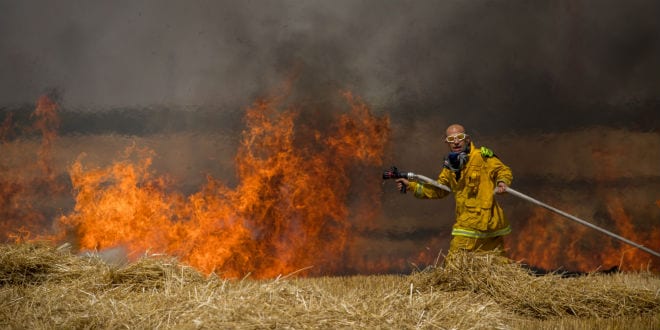
The devices were not toys. More than 800 incendiary kites and balloons were sent from Gaza into Israel that year, igniting over 1,000 fires and destroying as much as 7,500 acres of farmland and forest across the western Negev. While cropland recovered within a season, the wildlife caught in the blazes did not. The Israel Nature and Parks Authority reported that roughly 10 square kilometers of conservation land were affected, including the Be’eri Badlands, Karmia Sands, and Besor Stream nature reserves. Foxes, porcupines, jackals, rodents, snakes, and insects were killed in significant numbers. Because the reserves bordering Gaza are small, the damage to their ecosystems was disproportionately severe, and conservationists warned that the destruction of native flora left the land exposed to invasive species during recovery. The fires also released toxic smoke, worsened by tires burned at the border protests, adding to the environmental toll well beyond the acres actually consumed.
That history is precisely what makes the UN’s language so misleading. Calling the current kite launches “children’s kite flying” erases the fact that Hamas built an entire unit around weaponizing this exact tactic, named it after one of its drone engineers, and used it to burn a swath of Israeli land the size of a small city. Israel’s warning to strike those responsible and evacuate the launch areas is not a disproportionate reaction to an imaginary threat. It is a response shaped by a terror group that has already shown, in detail and on camera, exactly what it does with kites once no one is watching.

