


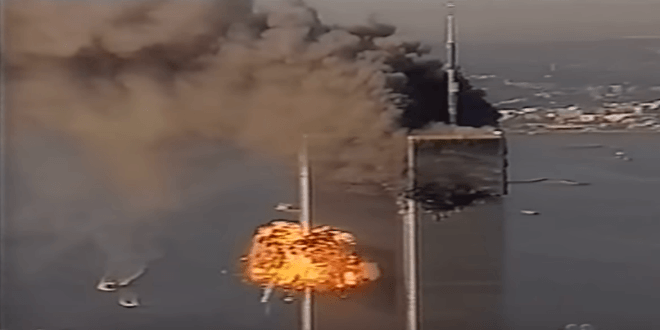
Twenty-five years after nineteen al-Qaeda hijackers murdered nearly 3,000 people in the deadliest terrorist attack in American history, a new false narrative of that day has taken hold across American and Western institutions. It does not deny the attacks happened. It strips them of the one fact that explains them.
The pattern is appearing among broadcasters, institutions, educators, media organizations, and public figures who discuss September 11 while avoiding the words “terrorism,” “terrorist,” and “Islamist extremism,” or who decline to name al-Qaeda’s ideological motivation directly, and who apply that same linguistic avoidance to Hamas and to Hezbollah.
In Pennsylvania and Delaware, the Philadelphia chapter of the Council on American-Islamic Relations distributed a guide this year instructing teachers to “avoid using language that validates the claims of the 9/11 attackers by associating their acts of mass murder with Islam and Muslims,” specifically naming “Islamic terrorists,” “jihadists,” and “radical Islamic terrorists” as forbidden terms. The guide’s own prose obeys its own rule. It never once uses the word “terrorism,” choosing “the 9/11 attacks,” “this tragic day,” and “acts of mass murder” instead. An organization willing to write the phrase “acts of mass murder” is plainly capable of writing “terrorism.” It chose not to.
CAIR National‘s own 2026-2027 back-to-school guide, extending what the organization calls its “Unhostile Campus Campaign” down into kindergarten classrooms, formally endorses a single 9/11 curriculum for nationwide use, developed by CAIR-New Jersey and a group called Teaching While Muslim, according to reporting by Jewish Onliner. That curriculum describes the September 11 hijackers as “a group self-identifying as AlQaeda hailing from the mountains of Afghanistan,” never uses the word terrorist, and tells students the attackers acted in response to “America’s support of Israel, their involvement in the Persian Gulf War, and the vast presence of the US military in the Middle East,” with support for Israel listed first. Osama bin Laden is introduced to students as “a man named Osama bin Laden,” and the curriculum recommends his own “Letter to America” as high school reading material. What was, in Pennsylvania, one chapter’s guidance has become, in CAIR’s own national materials, a single endorsed curriculum built for every grade from kindergarten through college.
Much of the curricular material built around September 11 over the past decade approaches the day primarily through its aftermath, the surge in Islamophobia, the wars in Afghanistan and Iraq, the erosion of civil liberties under new surveillance laws, rather than through the ideology and the organization that carried the attacks out. Teaching the bigotry that followed 9/11 is legitimate history and deserves a place in any honest curriculum. But a lesson plan that spends its time on what came after the attack while treating its cause as a subject too sensitive to name in plain language has not balanced the story. It has replaced it.
At Canada’s national public broadcaster, an internal memo authored by CBC News senior director of journalistic standards and public trust Basem Boshra told staff, in his own words, “Do not refer to the Sept. 11 attacks as terrorist attacks.” CBC’s public affairs director, Kerry Kelly, confirmed the memo reflected “the longstanding practice that favours the use of these terms with attribution in our reporting.” That same longstanding practice, CBC acknowledged, had already governed its coverage of Hamas’s October 7 massacre, in which staff were told not to call Hamas gunmen “terrorists” without attributing the word to someone else. CBC reversed the specific 9/11 policy after public backlash. It kept the underlying rule in place for everything else, including Gaza.
The BBC did not wait for a memo to leak before adopting the same posture. In 2023, the British government explicitly criticized the broadcaster for refusing to describe Hamas as “terrorists” and the October 7 atrocities as “terrorism,” even though Hamas is a proscribed terrorist organization under UK law. The government stated that accurately labeling the acts and the perpetrators helped audiences understand what had happened, and noted specifically that the BBC’s own editorial standards did not prevent it from using the terminology. An earlier BBC Trust report had already examined the same question and reached a telling conclusion: the BBC should generally avoid labeling organizations as “terrorist” in its own voice except through attribution, while acknowledging that “terrorism” could nonetheless be the most accurate word available for acts of ideological violence deliberately targeting civilians. That same report flagged inconsistency in how the BBC referred to Hamas specifically. A policy built to avoid the appearance of taking a side on the word “terrorist” produced, in practice, headlines and broadcasts in which an organization formally designated as a terrorist group by the broadcaster’s own government was described instead as a “militant group,” even after its gunmen burned families alive and dragged more than 250 hostages into Gaza.
Hezbollah has received the same treatment for far longer, with far less controversy attached. Designated a terrorist organization by the United States since 1997 and, in its entirety, by the United Kingdom since 2019, Hezbollah is nonetheless routinely described in mainstream reporting as a “militant group” or a “political and paramilitary organization,” language that omits both the word terrorism and the group’s own stated commitment to an Islamist ideology directed at Israel’s destruction. The avoidance did not begin with October 7 or with the CBC memo. It is the same house style, applied consistently across three different terrorist organizations spanning three different decades, and it survives precisely because no single instance of it draws the scrutiny that a leaked memo does.
The list of outlets that have adopted some version of the same policy is longer than any one broadcaster. Reuters set the template two decades before the CBC memo surfaced: its editor-in-chief at the time, Stephen Jukes, was widely reported to have told staff after September 11 that Reuters would not call the hijackers “terrorists,” preferring “attackers” or “hijackers” instead, on the reasoning that “one man’s terrorist is another man’s freedom fighter.” The Associated Press has generally followed the same attribution-based approach in its own voice, favoring “militant” over “terrorist.” Al Jazeera has been widely noted for describing Hamas fighters as “resistance fighters” rather than terrorists in its own reporting. NPR has faced repeated internal and public criticism, including from its own ombudsman, over guidance discouraging reporters from calling Hamas a terrorist organization without attribution. None of these four cases carries the documentary paper trail of a leaked memo or a government inquiry, but together they describe an industry-wide default, not an isolated lapse at one Canadian broadcaster.
The same avoidance has surfaced in American political speech directly. In 2019, Representative Ilhan Omar, addressing a CAIR event, said the organization was founded because “some people did something” and Muslim Americans began losing their civil liberties afterward. The phrase reduced a coordinated attack, planned and executed by a named terrorist organization, to an anonymous and almost accidental occurrence, with no attacker, no ideology, and no group attached to it at all. Representative Rashida Tlaib defended Omar publicly against the resulting criticism, arguing the remark had been taken out of context. Whatever the intended context, the words chosen were not incidental. They were the linguistic avoidance this piece has traced through curricula and newsrooms, spoken instead from the floor of American public life.
The habit runs in both directions at once, backward into 2001 and forward into 2023, because the underlying instinct is identical: soften the word, and the act it describes softens with it. A Cook County Teacher of the Year, Dr. Sawsan Jaber, is scheduled to speak at the Palestine Convention, hosted by American Muslims for Palestine, an organization currently under a Virginia Attorney General investigation for alleged terror financing and recently referred by the chairman of the House Ways and Means Committee for allegedly inciting riots after October 7. The Substack newsletter NAVI K-12 Extremism Tracker has reported that Jaber shared social media content arguing Palestinians should resist “normalizing the perception” that Hamas is a terrorist group rather than “legitimate resistance.” That specific characterization rests on one outlet’s account of her social media activity rather than a verified primary quote, and it should be weighed accordingly. What is not in dispute is the platform itself, and the fact that a sitting Illinois department chair has been booked to speak there at all.
Commentator Candace Owens has carried the same instinct to its furthest point, telling Prime Minister Benjamin Netanyahu directly, “You murdered 3,000 Americans on 9/11. For starters.” Owens is not alone in that claim, and the theory did not begin with her. Christopher Bollyn has spent nearly two decades building an entire career around the argument that Israel and Mossad orchestrated the attacks, publishing it at length in a book titled Solving 9-11: The Deception That Changed the World. Political commentator Nick Fuentes has promoted the same theory to his own online audience as part of a broader pattern of antisemitic conspiracy content. All three claims are false. Nineteen al-Qaeda hijackers carried out the attack as a deliberate operation directed by al-Qaeda’s own leadership, a fact established by the FBI, the 9/11 Commission, and Canada’s own government listing of al-Qaeda as a terrorist entity. But the theory did not arise from nothing. It arose from twenty-five years of institutions training the public to treat the word “terrorism” as negotiable, until a conspiracy theory calling Israel the true culprit found an audience already accustomed to doubting the plainest facts of the day.
Calling the September 11 attacks and the October 7 massacre terrorism is not Islamophobic. Calling al-Qaeda and Hamas Islamist terrorist organizations is not Islamophobic either. Those are factual descriptions. September 11 was terrorism by official designation: the body that investigated it was named, formally, the National Commission on Terrorist Attacks Upon the United States, and its report identifies al-Qaeda as the organization responsible while explicitly naming “the threat posed by Islamist terrorism, especially the al Qaeda network, its affiliates, and its ideology.” October 7 was terrorism by definition and by conduct: Hamas deliberately murdered civilians, including women and children, and took hostages as part of a planned, coordinated attack. Al-Qaeda and Hamas are Islamist organizations, and “Islamist” is not a synonym for “Muslim.” It describes political movements that seek to organize government and society according to their own interpretation of Islam, a description that applies with precision to both groups and to neither of the world’s billion-plus ordinary Muslims who hold no such political program. Islamophobia means prejudice, hostility, or discrimination against Muslims as Muslims. It is not a blanket immunity from criticism for individuals, movements, or organizations that invoke Islam to justify political violence. Precision is not prejudice, and the institutions named above have spent twenty-five years confusing the two.
Teaching honestly about the bigotry Muslim Americans faced after 2001 remains necessary and right. But a quarter-century after the attacks, the institutions responsible for teaching what happened that day have spent the anniversary proving that the hardest part of remembering is not the passage of time. It is the willingness to still call the thing by its name.