
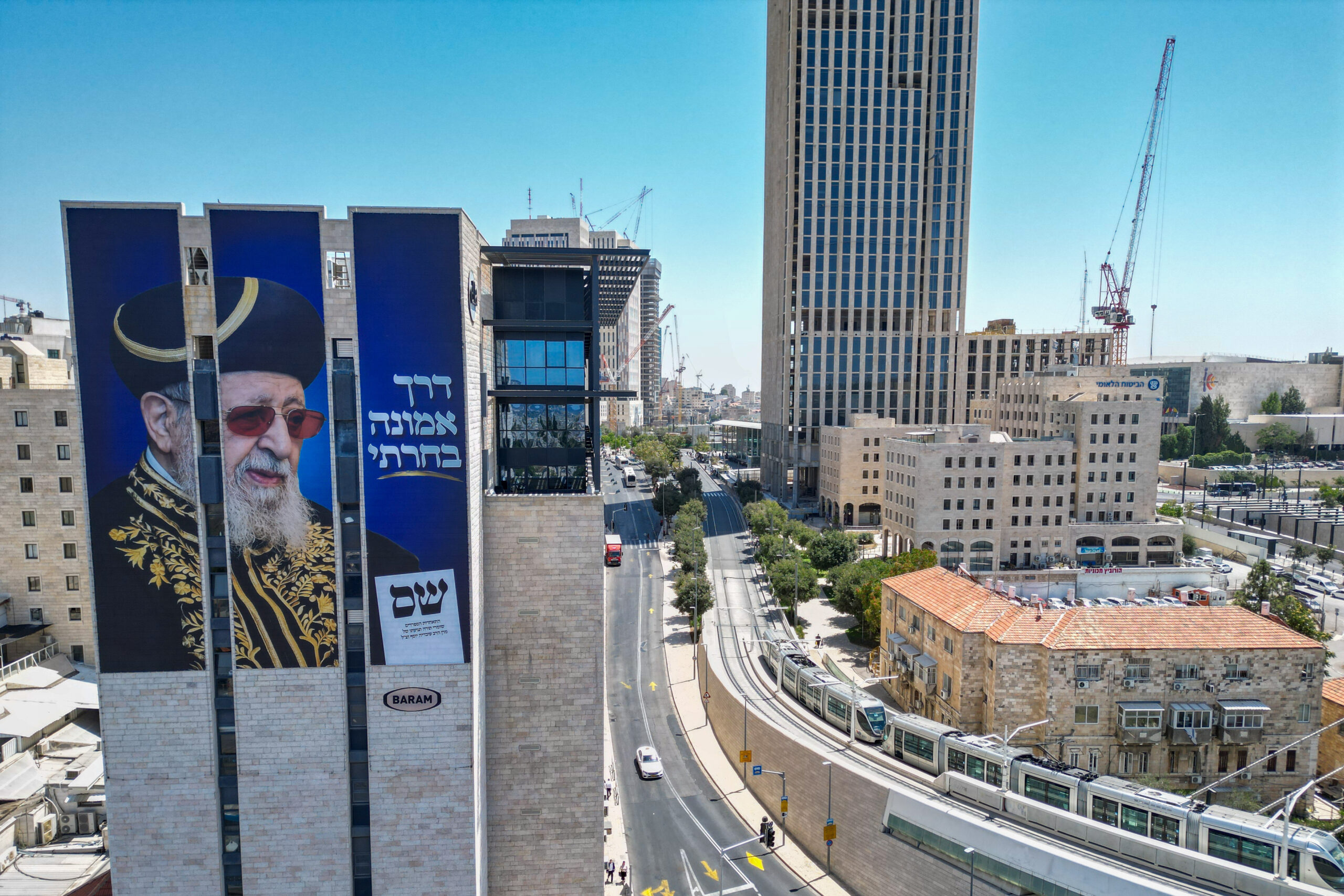
The Central Elections Committee ordered the ultra-Orthodox Shas party on Sunday to remove a campaign video featuring an apparent IDF soldier, ruling that the ad likely violated the ban on using images of security forces in election propaganda. Shas chairman Aryeh Deri was given two days to respond to the petition after Committee chairman Justice Noam Sohlberg issued the interim order.
The video at the center of Sunday’s order shows a religious family waiting for a soldier son to come home for Shabbat dinner. The young man runs in wearing army green and carrying a military rifle; his father and his brother, a full-time yeshiva student, embrace him. Text on screen claims that “more than 30,000 conscripts and career soldiers voted for Shas in the last election.”
That figure is unsubstantiated. It rests on a count of “double envelope” ballots, cast by voters unable to reach their home polling station, which are tallied separately after the general vote. Double envelopes are used not only by soldiers but by other security personnel, hospital patients and staff, diplomats stationed abroad, prisoners and detainees, and voters with disabilities using accessible polling stations.
Shas was one of the principal forces behind the passage of the Basic Law draft exemption, legislation that grants sweeping military service exemptions to yeshiva students and that polling has consistently shown to be deeply unpopular with the Israeli public. The party pushed the measure through three years of wartime debate over who serves in uniform and who remains in the study hall, even as casualties mounted on the battlefield. Israel’s coalition system gave Shas outsized leverage to do so: with governing majorities typically resting on a handful of seats, a single mid-sized party holding the balance of power can extract legislation that would otherwise struggle to pass, regardless of how the broader public views it.
The question of who serves in the IDF and who is exempted has become one of the most divisive social issues in Israel, cutting across the war years in ways few other domestic debates have. Bereaved families, reservists pulled from civilian life for repeated tours, and much of the general public have voiced growing resentment toward a system that exempts tens of thousands of yeshiva students while soldiers are killed and wounded on multiple fronts. Haredi leaders, in turn, have defended Torah study as an equally vital form of service to the nation, framing conscription efforts as an assault on religious life. The result has been a widening rift between secular and religious Israelis, one that has spilled from the Knesset floor into street protests, courtroom battles, and now into the campaign videos political parties are fighting over ahead of the coming election.
The complaint that triggered the order came from Gadi Eisenkot’s Yashar party. In a letter to Shas, an attorney for Yashar wrote that the video “is not merely election propaganda made in a manner ‘likely to create the impression that the Israel Defense Forces identifies with a party,’ but the claim is made explicitly.” The letter called it “deeply outrageous that Shas chose to launch its campaign with an advertisement featuring IDF soldiers after working for three years of war to pass a draft evasion law and fully prioritizing those who chose not to serve.” Yashar also alleged the video displayed the party’s Knesset ballot letters, in violation of Section 7 of the Propaganda Law, which bars such display within 42 days of an election, and demanded removal by 11:00 a.m. on August 23.
Shas initially refused, insisting “no IDF symbols were used whatsoever” and describing the video as depicting “a family member returning home from base in civilian clothes to refute false propaganda, including from Eisenkot and his party, suggesting that Shas supports draft evasion.” The soldier in the video wears no standard-issue uniform, but is dressed in army green and carries a military rifle.
By Sunday afternoon, Shas had taken the video down, while issuing a statement attacking Sohlberg’s ruling. “It is unsurprising that Judge Sohlberg rushed to comply with the left-wing party led by Eisenkot and disqualified a Shas video that contains no IDF symbols or elements,” the party said. “The left constantly spreads propaganda against Shas on the draft issue, but when Shas presents the truth, there is immediate intervention.” The statement added: “The legal persecution against the right, traditionalists, and the religiously observant is no longer surprising. You can delete a video, but you cannot delete the hundreds of thousands of families who support Shas.”
The Central Elections Committee has recently issued similar orders against Naftali Bennett’s B’Yachad party and against Eisenkot’s own party for featuring soldiers in campaign videos.
Shas represents mainly ultra-Orthodox Jews of Middle Eastern and North African background alongside traditional Mizrahi voters, and the party is reportedly worried that its hardline draft stance will push some of those voters toward Yashar. The tension came into view last Thursday when Shas spiritual leader and former chief rabbi Yitzhak Yosef, seeking to patch up a public rift with Deri, blessed IDF troops as “messengers of the Holy One, Blessed be He” in a video released by a party spokesman. Yosef has otherwise spent years calling on yeshiva students to flush draft orders down the toilet, warning of a mass Haredi exodus from Israel should the government arrest draft evaders, blaming IDF combat deaths in Gaza on insufficient Torah study among yeshiva students, and branding June’s US-Iran deal as divine punishment for Attorney General Gali Baharav-Miara’s crackdown on draft dodgers.
The Charedi Public Party, HaTzibur HaCharedi, formally launched its campaign for the 26th Knesset on Sunday night at an event in Beit Shemesh, drawing hundreds of activists, rabbis and public figures.
Speaking at the official launch, Charedi Public Party Chairman Moti Leitner talked about the importance of the community taking responsibility.
“Responsibility has been a supreme value for Charedi Jews throughout the generations. Sadly, the longstanding political leadership has forgotten what responsibility means,” said Leitner. “For the past three years, the State of Israel has been fighting a war on multiple fronts against enemies seeking our destruction. It began with a horrific massacre that reminded every one of us what responsibility truly means.”
The party’s electoral list will include representatives from the Ashkenazi, Sephardi, and Chasidic communities, including a representative from the English-speaking community in Israel, reflecting the breadth and diversity of Israel’s Charedi population. Leitner pointed to the response of ordinary Charedim following the October 7 massacre as evidence of the community’s commitment to the country and its people.
“Thousands of Charedim stepped forward. They enlisted, volunteered and helped in every way they could. Yet the terrible tragedies experienced by the people of Israel appear to have passed over the heads of a detached political leadership,” Leitner continued. “When a party leader danced to the words, ‘We do not believe in the rule of heretics,’ at the very moment the people of Israel were learning that brave and holy soldiers had fallen in battle, it was not merely a mistake. It reflected a policy, one that has transformed detachment and foolishness into a political path.”
Under the slogan “This Time, We Take Responsibility,” the party’s campaign will focus on protecting the Torah world while advancing practical solutions to the major challenges confronting Charedi society.
The Charedi Public Party accused the established Charedi parties of allowing extremist elements to shape their policies, abandoning the interests of the broader Charedi public in the process.