

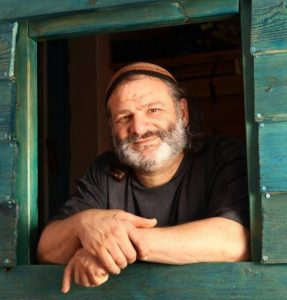
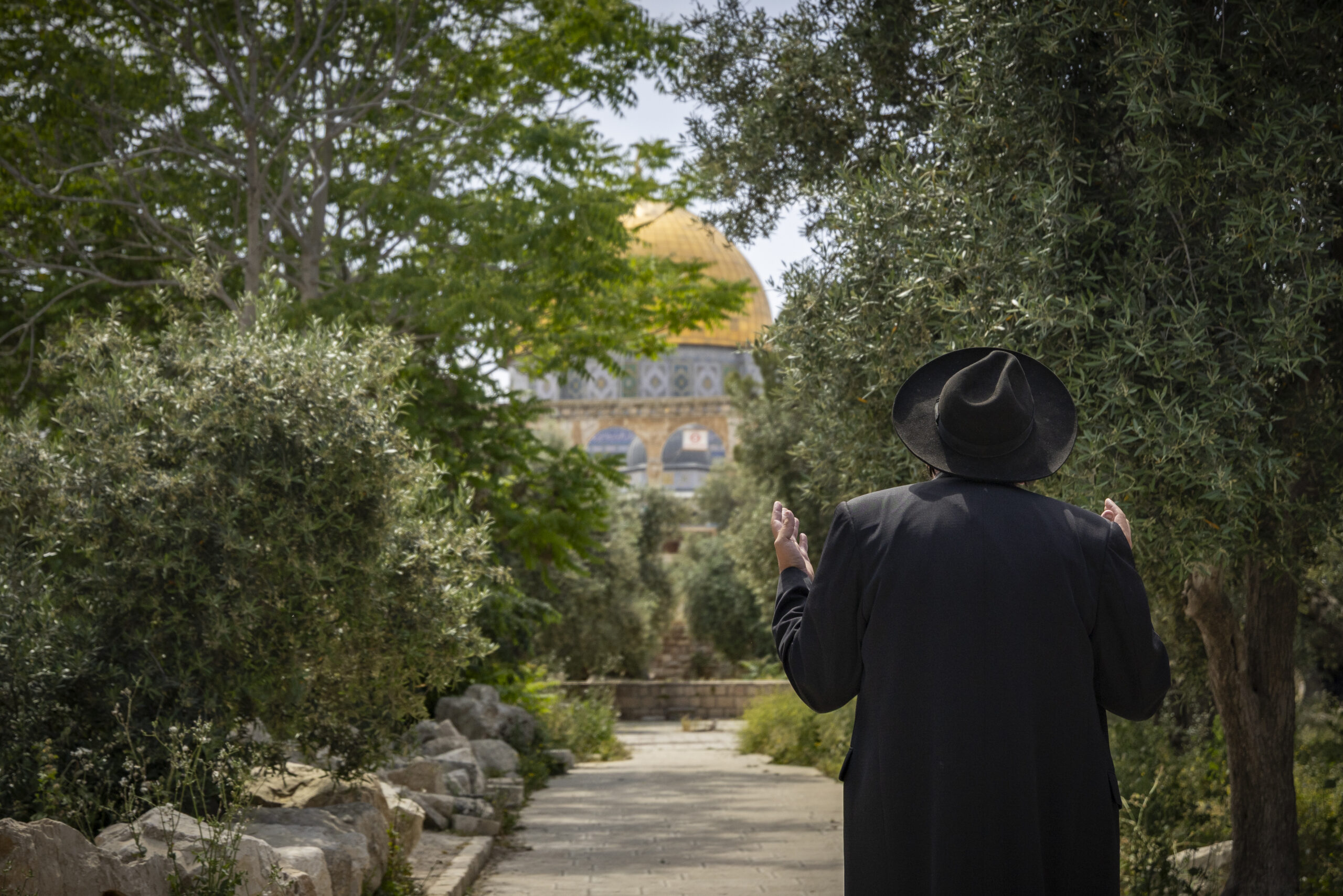
Assaf Fried has spent years documenting something most Israelis never think about: the Temple Mount, the holiest site in Judaism, is closed to Jewish visitors every single Shabbat (the Sabbath). Not for security reasons or because of an active threat. It is closed because the day is holy to Jews, and the government has decided that holiness itself is the reason to keep the gates shut. On Thursday evening, Fried is bringing that argument to a public rally in Jerusalem, demanding that a government led by the political right finally reverse a policy no left-wing government invented and no right-wing government has fixed.
“There is no operational reason, no security reason,” Fried said in an interview with Israel365 News. “The holiest place for Jews is open to Muslims on the day they call their day of rest, even though they do not observe Shabbat. And the holiest place for Jews is closed on the day that is holy to us.”
“It’s not only closed to Jews on Shabbat,” Fried said. “It’s also closed to Christians on Shabbat. Also closed to tourists on Shabbat, absolutely.” The distinction matters: this is not a grievance that belongs to one religious community. It is a blanket closure of the Temple Mount to non-Muslims of every background, one day a week, with no security rationale offered.
A Policy Born From Violence, Never From Law
Jewish access to the Temple Mount on Shabbat was not always restricted. Fried, who has interviewed dozens of witnesses and reviewed the historical record, said Jews prayed and visited the site on Shabbat under British Mandate rule and continued to do so after the Six-Day War in 1967, when the Mount came under Israeli control. “I personally went up to the Temple Mount for the first time in 1991,” Fried said. “Not many Jews went up to the Mount then, but it was open on Shabbat. I have taken testimonies from many people who told me they went up on Shabbat, because there was much less scrutiny back then.”
That access ended in September 2000, after then-opposition leader Ariel Sharon visited the Temple Mount and the Second Intifada erupted. The Mount was sealed to Jews entirely for nearly three years. “We were much weaker then than we are today, both numerically and in terms of political power,” Fried said, noting that former Knesset member Moshe Feiglin staged one of the only public protests over the closure, in 2001, at the Mount of Olives.
The Mount reopened to Jewish visitors in late 2003, after then-Public Security Minister Tzachi Hanegbi overruled the objections of the Jerusalem District Police Commander and ordered it done. But the reopening came with a permanent asterisk: access on Shabbat was not restored. “We asked ourselves, there is no demand; once there is demand, we will open it,” Fried said. “But we were not significant enough at the time to push for it. And a status quo formed.”
That status quo has never been reversed. Today, Fried said, the Temple Mount is closed to Jews on Fridays, the Muslim holy day, and on Shabbat, the Jewish holy day, a double closure with no equivalent anywhere else in the Old City. “The Old City is full of tourists,” Fried said. “They go everywhere, every place in the Old City, except the Temple Mount. There is no reason for it. If you want to say it is the danger of Palestinian violence, that danger exists against Christians and gentiles too. But the Temple Mount has been the quietest place in the country for the last three years.”
The Legal Basis for Jewish Prayer at the Site
Israeli law does not bar Jewish prayer on the Temple Mount; it guarantees the opposite. The Protection of Holy Places Law of 1967, passed by the Knesset weeks after the Six-Day War, obligates the state to keep holy sites accessible to members of every faith for worship and to prevent anything that would violate that access. The law makes no exception for Jews at the Temple Mount.
What restricts Jewish prayer at the site in practice is not legislation but police policy, and Israel’s Supreme Court, sitting as the High Court of Justice, has repeatedly upheld the distinction between the two. In its ruling on the petition brought by the Temple Mount Faithful movement in the early 1990s, the court affirmed that Jews possess a right to pray at the Temple Mount in principle, while granting the police broad discretion to limit or suspend that right whenever they determine that allowing it would risk public disorder. The result is a legal framework in which the right exists on paper, while a police commander’s judgment about Muslim reaction determines whether it exists in practice on any given day, including Shabbat.
A parliamentary body reached a similar conclusion. In 2013 and 2014, then-Knesset Interior Committee chairwoman Miri Regev established a committee of inquiry, chaired by Knesset member David Tzur and including Orit Struck of Habayit Hayehudi and Nachman Shai of the Labor Party, to examine the changing status quo on the Mount. “It was a balanced committee: right, left, and center,” Fried said. The panel’s report documented that the Temple Mount had, in the past, been open to Jews on Shabbat and had, at times, been reopened on Shabbat since. The finding sits in an official Knesset document, but it has changed nothing.
The Numbers Behind the Campaign
Fried’s organization, the Committee for Opening the Temple Mount on Shabbatot, has built its campaign around figures it says the public has never been shown. Out of the 168 hours in an average week, the group calculates, the Temple Mount is open to Jews for only 32.5 hours, which is less than 20 percent of the time. Materials distributed ahead of Thursday’s rally put the number of Sabbaths on which the site has been closed to Jews since the status quo shifted in 2000 at more than 1,350, with roughly 190 of those closures occurring during the current government’s four years in office alone.
The group’s data goes further than a running total. In the past Hebrew year alone, the committee counted eleven separate occasions on which the Temple Mount was closed to Jews: both days of Shavuot, closed on a Friday and Shabbat; both days of Hanukkah, again closed on a Friday and Shabbat; the 25th of Tevet, closed for a Muslim holiday; Purim and Passover, both closed because they coincided with Ramadan; the second day of Passover, closed on a Friday; Jerusalem Day and Shavuot, each closed on a Friday; the Ten Days of Repentance, closed for a Muslim holiday; Rosh Chodesh Tammuz, closed for a Muslim holiday; and Rosh Chodesh Elul, closed on a Friday. Eleven closures in a single year, on a site that observant Jews are otherwise free to visit six days out of seven.
Fried’s committee frames the current record as a specifically political failure, not a historical inevitability. Access on Shabbat was maintained under Israeli governments led by the political left. It is the present government, in office for four years, that has presided over 190 Shabbat closures without reversing the policy; it is a government whose own coalition includes ministers who keep Shabbat themselves. “We must not accept this,” the group’s campaign material states bluntly, noting that the Tzur Committee already called for restoring Shabbat access years ago and that National Security Minister Itamar Ben-Gvir now has the authority to open the Mount on Shabbat if he chooses to do so.
This year compounds the problem in a way Fried said has no recent precedent. Rosh Hashanah, the first day of Sukkot, and Simchat Torah all fall on Shabbat in the coming Hebrew year, meaning three of Judaism’s most significant pilgrimage-linked observances will each coincide with a day the Mount is already closed. Rosh Hashanah marked the start of the Temple’s own calendar year, when the service of the Kohanim (priests) began anew. Sukkot was the festival on which, according to the Sages, seventy sacrifices were offered in the Temple on behalf of the seventy nations of the world, making it the one holiday explicitly tied to the well-being of all humanity. Simchat Torah follows immediately after Shemini Atzeret, which the Bible describes as a day set apart from Sukkot specifically for Israel to remain in the Temple courts alone with God, with no distinct commandments of its own beyond that closeness. Each of these observances was built around presence at the Temple. This year, the presence at the site of the Temple will be exactly what is denied.
“That means that on the day after Simchat Torah, which falls in October on our calendar, we are surrendering to Palestinian violence,” Fried said, referring to the closure landing on the Hebrew-calendar anniversary of the October 7 massacre. Shemini Atzeret and Simchat Torah fall this year on the same dates in the Hebrew calendar as the day Hamas terrorists launched their assault, an operation the terrorist organization itself named “Al-Aqsa Flood” after the mosque compound on the Temple Mount. The attackers invoked the site by name to justify mass murder. On the Hebrew anniversary of that assault, the Temple Mount will be closed to the Jews it was named against. It is the precise moment, Fried’s campaign argues, when a sovereign Jewish state should be asserting its presence at the site rather than withdrawing from it.
Fried pointed to a counterexample that directly undercuts the security rationale. Seven years ago, the fast of Tisha B’Av fell on Eid al-Adha, a major Muslim holiday. “Even though it was a Muslim holiday, they opened the Temple Mount,” Fried said. “Access was somewhat limited, but they opened it, and thousands of Jews went up on Tisha B’Av, which fell on Eid al-Adha. So if a Jewish holiday falls on a Muslim holiday, it can be opened. But if a Jewish holiday falls on Shabbat — no, it cannot.” The double standard, Fried argued, exposes the policy as a matter of institutional habit rather than genuine security calculation.
Ministers Who Did Not Know
Fried said he has raised the issue directly with sitting members of the government, with mixed results. Energy Minister Eli Cohen, he said, was unaware the policy existed. “He told me, ‘Wow, I had no idea about this,'” Fried said. National Security Minister Itamar Ben-Gvir has voiced support for opening the Mount on Shabbat, according to Fried, while Prime Minister Benjamin Netanyahu has not. Fried also said he met on Tisha B’Av with Jerusalem District Police Commander Avshalom Peled and sent him a formal letter laying out the case for change. The response, Fried said, was brief and noncommittal.
A Growing Christian Audience
Fried said the Shabbat closure increasingly affects a constituency few discussions of the Temple Mount account for. “There is a strong rise in interest in the Temple Mount, both among Jews and among Christian readers,” Fried said, describing souvenir shops throughout the Old City market that now sell replicas of the Ark of the Covenant to tourists. He pointed to organizations such as those led by Doron Kedar and the Yovel movement, which bring Christians to the Temple Mount as part of a broader wave of interest in the site. Many of those visitors arrive in Israel with Shabbat as their only open day on the itinerary, Fried said, and find the site off-limits precisely then. “That could open up an entire tourism industry,” he said, “the Temple Mount on Shabbat.”
The Rally
The campaign moves from documentation to public pressure on Thursday, August 27, the 14th of Elul, at 7:00 p.m., in the Yitzchak Hall on Rabbi Kosovsky Street in Jerusalem’s Kiryat Moshe neighborhood. Organizers say the event will draw rabbis, yeshiva heads, Knesset members, and ministers, and will formally call on the government to end what the group’s promotional material bluntly labels a surrender to Palestinian violence embedded into the Israeli calendar itself.
Fried does not frame the campaign as a request for a favor. He frames it as the correction of an absurdity that has outlived every political justification originally offered for it. “It is absurd from every direction,” he said.
The Temple was destroyed twice, and the site has stood closed to a rebuilt sanctuary for nearly two thousand years. What Fried is asking for is smaller than that: for a sovereign Jewish state to let Jews stand on the Temple Mount on the one day the Bible names for universal worship, rather than the one day the government has chosen to keep it shut.

