


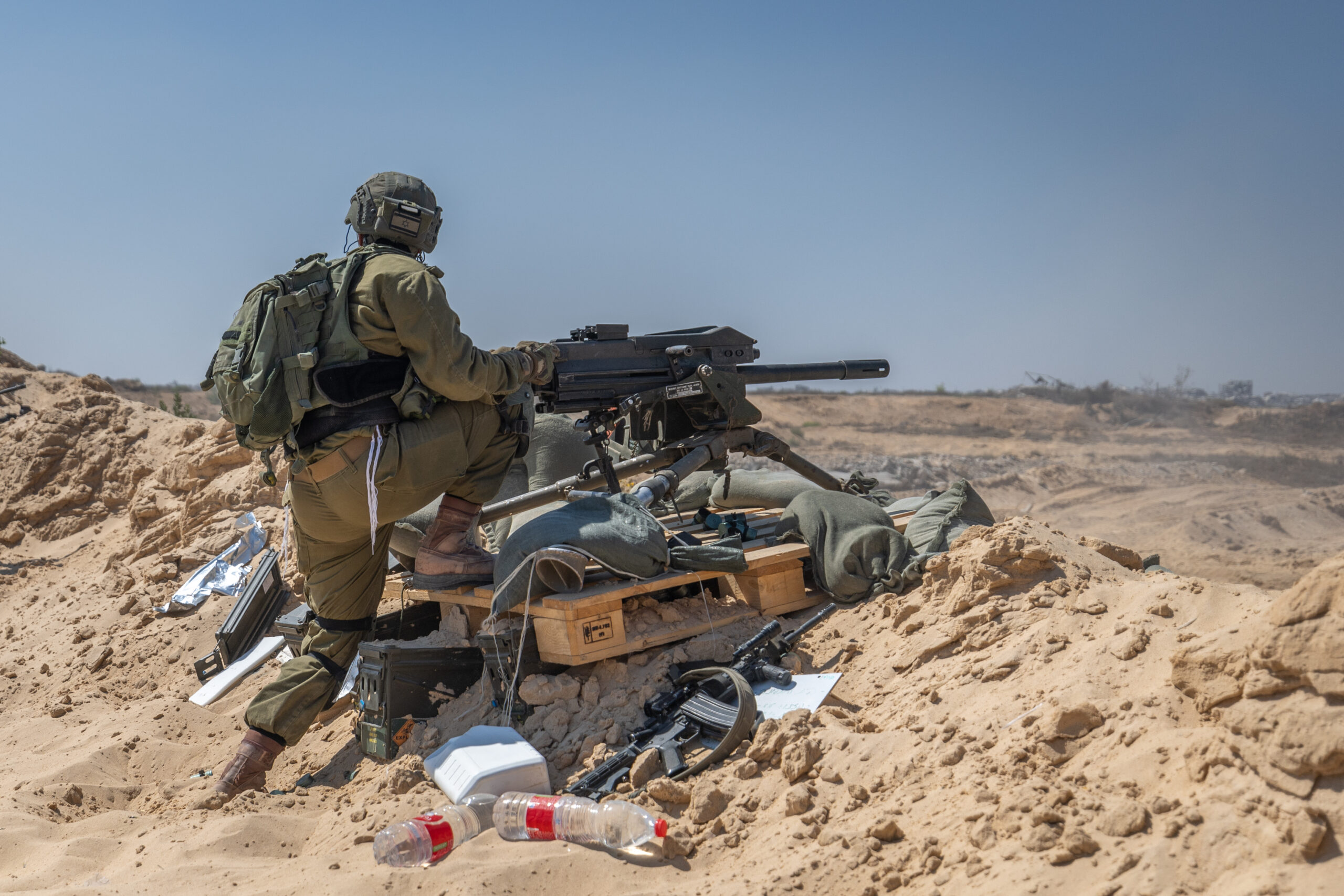
By 2025, a religious man serving in Israel’s military reserves was more than twice as likely to still be in uniform each month than his secular counterpart. Three years into a war that has demanded more from Israeli society than any conflict since 1973, the burden of defending the country has shifted decisively onto the shoulders of the National-Religious community, while participation from every other sector of Jewish Israeli society has fallen.
A study released by the Israel Democracy Institute, conducted by researchers Dr. Ariel Finkelstein and Roe Kenneth Portal, tracked reserve service among Jewish Israeli men from the final months of 2023 through 2025, using Central Bureau of Statistics Labor Force Survey data. In the immediate aftermath of the October 7 massacre, reserve participation was still relatively broad-based: 15.2% of religious men served in the reserves during an average month, alongside 11.2% of secular and traditional men. By 2025, overall mobilization had dropped sharply across the board, but the drop was far from even. An average of 4.3% of religious men were still serving each month, compared with 2.6% of traditional men, 1.7% of secular men, and just 0.3% of Haredi men. Among National-Religious men specifically, 31% had served in the reserves over the course of the war, more than double their 15% share of the population. The gap widened most among men in their late thirties and early forties: in 2025, religious men aged 35-44 made up just 13.1% of the relevant population but 28.7% of reservists in that age bracket.
The researchers framed their findings as structural rather than moral, citing higher rates of combat service among graduates of religious state schools and stronger community support for extended service as likely contributing factors. But the disparity raises a question the data alone cannot answer. The growing trend runs through a decade-old argument over whether the IDF can be called an army of God at all.
The letter that started the argument
In the summer of 2014, as Operation Protective Edge began, the commander of the Givati Brigade sent his officers into Gaza with a letter that framed their mission in the starkest religious terms available. Col. Ofer Winter wrote: “I lift my eyes up to the heavens and call out, together with you: ‘Hear O Israel, the Lord is our God, the Lord is One.’ Lord, the God of Israel, grant success to the path on which we are setting out to do battle on behalf of Your nation Israel against an enemy that blasphemes Your name.” He described the mission as a war against a “terrorist enemy” that “curses, reviles, and defames the God of the battles of Israel.”
The case against
The letter drew serious rebuttals from the Israel Democracy Institute. Prof. Yedidia Stern argued in the Jewish Week that the letter violated mamlachtiyut, the supremacy of the state over any sectoral or religious claim on the military, writing that “the uniform of a senior officer, like the robe of a judge, is a symbol that the officer is acting on behalf of the national interest, as defined by the democratic system as a whole.” Prof. Mordechai Kremnitzer went further in a lengthy IDI analysis, warning that an army accountable to God rather than to the Knesset “is a threat to democracy and a real existential threat.” He argued there is no difference in principle between an Israeli commander invoking God’s name in battle and the theology of Hamas and Al-Qaeda, cited Rabbi Yitzhak Shapira’s The King’s Torah as evidence of where unchecked religious military doctrine can lead, and warned that religious rhetoric imposed on a captive audience of soldiers, including non-Jewish and non-religious soldiers, violates their freedom of conscience. His conclusion was unambiguous: “An army that is an army of God cannot be an army of the people.”
The biblical case
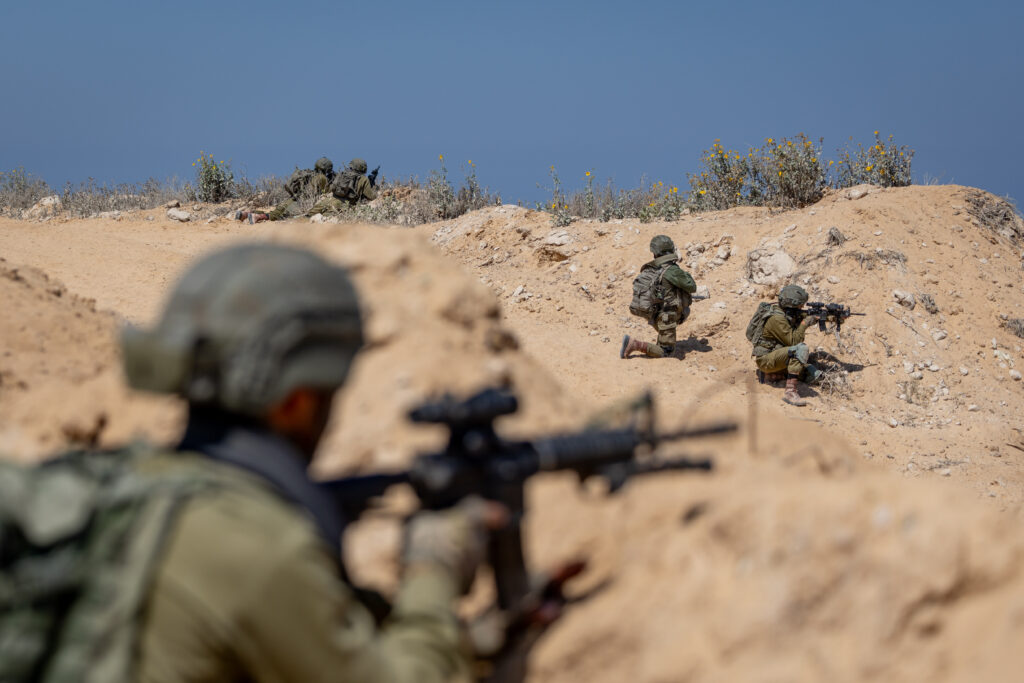
The Bible answers through the story of Gideon. Before he ever led an army, Gideon proved his own faith at personal risk, tearing down his town’s altar to Baal and the Asherah beside it on God’s command, an act that earned him the name Jerubbaal, “let Baal contend with him” (Judges 6:32). When Midian and Amalek crossed the Jordan and threatened Israel, Gideon summoned men from Manasseh, Asher, Zebulun, and Naphtali, and thirty-two thousand answered the call. God told him it was too large. “The people that are with thee are too many for Me to give the Midianites into their hand, lest Israel vaunt themselves against Me, saying, Mine own hand hath saved me” (Judges 7:2).
The reduction that followed was not a headcount exercise. It was a filter for faith and character. God’s first instruction was to send home every man who was afraid, and twenty-two thousand left, leaving ten thousand behind. God said this was still too many, and gave Gideon a second test: bring the men to the water, and separate those who lapped water from their hands like a dog from those who knelt down to drink. The distinction was not physical. It was a test of readiness, of the small number of men who stayed alert and watchful even in the mundane act of drinking, rather than lowering their guard completely. Three hundred men passed that test. With three hundred men, torches, and empty pitchers, Gideon routed the entire Midianite camp. God did not merely shrink Gideon’s army. He refined it twice, first for courage and then for vigilance and discipline, until what remained was not a smaller army but a better one, so that Israel could never credit the victory to its own strength.
This is the model the Bible sets for what an army of Israel is. Kremnitzer’s fear is that a commander who frames the enemy as God’s enemy releases his soldiers from moral constraint and rational limits on conduct in war. But Winter’s letter does not say this. It calls the enemy a terrorist enemy and commits explicitly to using “all means at our disposal” to bring the soldiers home safely while completing the mission. Framing the mission as a fight on God’s behalf is not a suspension of law and morality. It is the biblical framework in which Israel has always fought, from Gideon’s three hundred to Deborah’s army at Mount Tabor to the Maccabees. None of those armies fought less carefully because they understood their victories as coming from Heaven. They fought understanding that the outcome, win or lose, would testify to whose hand was actually at work.
The Sages read every Israelite victory this way, crediting none of them to superior numbers or tactics. Kremnitzer’s objection ultimately rests on a fear that religious language, once permitted in an official military document, cannot be contained and will inevitably slide toward the extremism of fringe rulings like those in The King’s Torah. That is a slippery-slope argument, not one based on what Winter’s letter actually said. The letter invoked God’s name and called for victory. It did not authorize a single act beyond what any secular commander’s letter authorizes. The claim that religious motivation is inherently indistinguishable from Hamas’s theology collapses the distinction between an army that fights while believing God is with it and an army that murders civilians in God’s name. Gideon’s three hundred were the former. They were never mistaken for the latter.
Testimony from outside Israel
That recognition has not stayed confined to Israel’s internal debate over Winter’s letter. It has come, more recently, from outside witnesses with no stake in Israeli domestic politics and every reason to know the difference between a state fighting for its own interests and an army fighting a battle larger than itself. Marziyeh Amirizadeh, an Iranian Christian who was imprisoned in Iran’s Evin Prison and sentenced to death for her faith, wrote an open letter to the Israeli Air Force after its strikes on the Islamic Republic’s nuclear facilities, military bases, and the very prison where she had been held. She described watching her cellmate and best friend, Shirin Alamhooli, tortured and executed, and thanked the IAF by name for destroying the gate of the prison where that happened. “You are God’s army,” she wrote, “bringing justice against Iran’s evil rulers, as foretold in Jeremiah 49:38-39, which promises judgment on Elam (modern Iran) and the restoration of its people. Your courage is fulfilling this divine promise.”
Amirizadeh is a torture survivor from the enemy’s own country, writing in the language of biblical prophecy because it was the only language adequate to what she had witnessed. Her letter makes, from personal experience, exactly the case Kremnitzer’s essay set out to foreclose: that people who have suffered most directly under the regimes the IDF fights recognize its actions as answering to something beyond the Knesset’s authorization, without that recognition making the army lawless, indiscriminate, or theocratic. She thanked Israeli pilots for precision, not brutality. The prophecy she invoked promises judgment on a specific nation for specific crimes, not permission for unrestrained war.
The IDI’s numbers and Amirizadeh’s letter are answering the same question from opposite directions. One measures, in percentages and age brackets, which community has kept showing up. The other explains, from inside an Iranian prison cell, why that showing up matters beyond Israel’s borders. The soldiers filling the growing gap in Israel’s reserve rosters are disproportionately the ones raised on the belief that Israel’s wars are not discretionary state business but a mission commanded from Sinai. Gideon did not lead a national army with a religious contingent attached to it, nor did he lead the largest army available to him. He led the smallest army that had survived two rounds of selection for faith, courage, and vigilance, three hundred men out of thirty-two thousand. The State of Israel did not invent that model of an army. It inherited it.
