

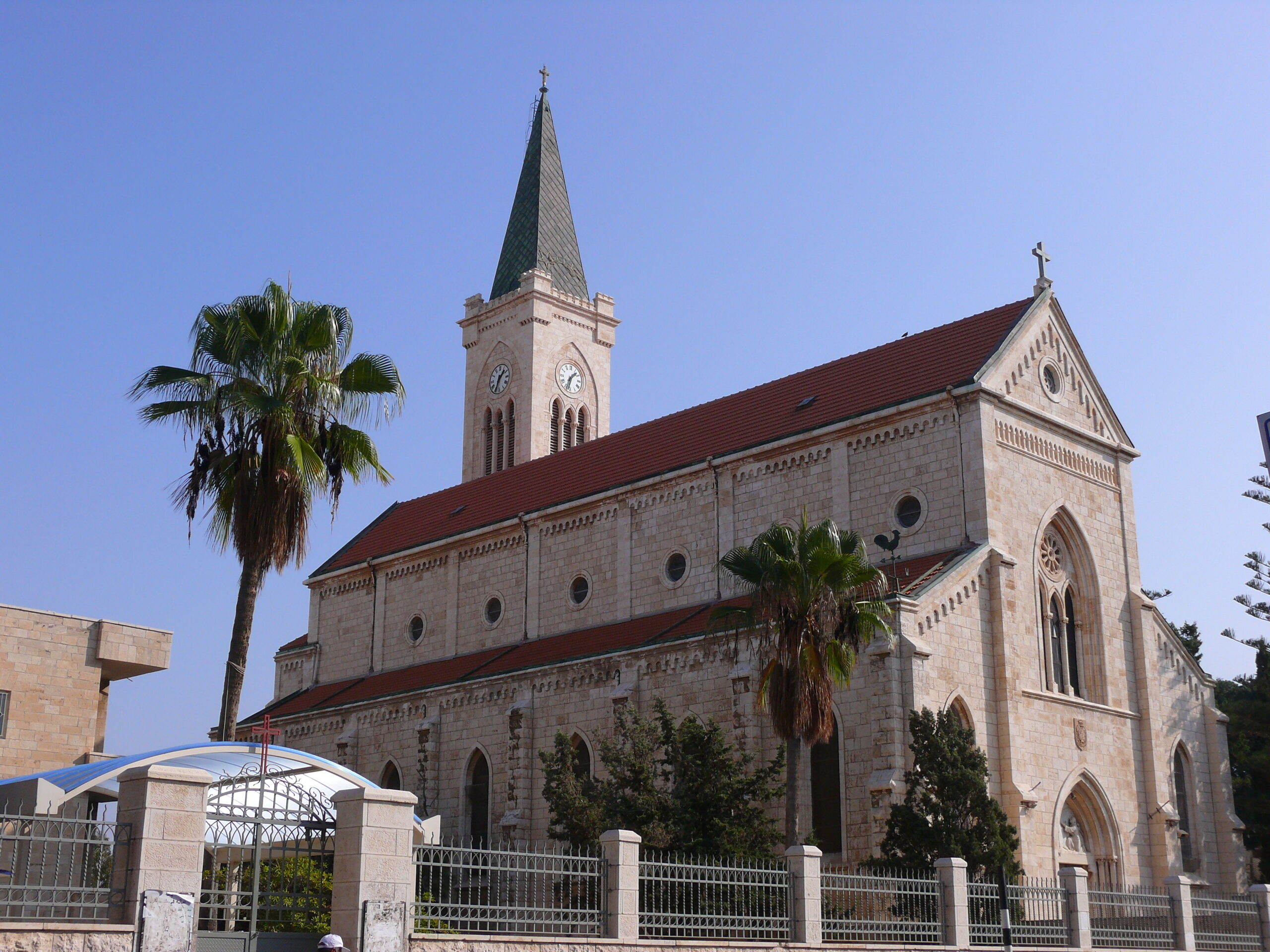
A church in Jaffa was vandalized last week, and within hours the story had been folded into a familiar accusation: that Jews are waging a campaign of violence against Christians in Israel. But what the media didn’t report was that the suspect arrested for that crime was a Muslim Arab. Almost no one reported that. Major Israeli outlets paired the arrest with unrelated cases of Jewish-perpetrated harassment, Catholic media built an entire narrative of Jewish persecution of Christians in Israel around the suspect’s unstated identity, and American commentators with millions of followers carried the same libel forward, as they had done in several previous cases. The pattern is neither new nor accidental.
A man in his twenties was arrested Sunday on suspicion of vandalizing St. Anthony of Padua Church, a Catholic parish in the Jaffa neighborhood of Tel Aviv. Police said several statues had been smashed and a number of crosses broken. Officers identified a suspect and took him into custody shortly thereafter. St. Anthony of Padua belongs to the Latin Patriarchate of Jerusalem. Police have not released the suspect’s name, and no formal charges have been announced.
Of the major Israeli outlets, only ILTV reported that the suspect was a Muslim Arab. The Times of Israel, The Jerusalem Post, and other major media instead placed the arrest against a backdrop of “growing levels of harassment against Christians in Israel by extremists.” JPost paired the Jaffa story with an unrelated case from earlier in the month: six suspects, five of them minors, arrested for throwing rocks and spitting at the Armenian Cathedral of St. James in Jerusalem’s Old City. That case is real, and the suspects were Jewish. But nothing connects it to Jaffa except that a church was involved in both. Placing them side by side folded an act of vandalism by a Muslim Arab suspect into a running count of Jewish attacks on Christians.
The record deserves to be set straight. No Jewish extremist smashed the statues or broke the crosses at St. Anthony of Padua. That does not mean the broader pattern is fabricated. A violent attack on a French religious sister near the Cenacle in Jerusalem made headlines in April. The Religious Freedom Data Center documented 88 incidents by early June, on pace to exceed 2025’s total of 181, concentrated mostly in Jerusalem’s Old City. Those cases are real and documented. Jaffa is not one of them.
Catholic outlets Sign of the Cross and LifeSiteNews ran the story under the headline “Catholic church in Tel Aviv vandalized as attacks on Christians surge across Israel,” built entirely around the same omission. It cited Cardinal Pierbattista Pizzaballa linking the pattern to Israel’s political climate, listed prior incidents attributed to Jewish extremists, and pivoted to an attack on Christian farmland in Taybeh, never returning to say who was actually arrested in Jaffa.
🚨 MUSLIM MAN VANDALIZES CATHOLIC CHURCH IN JAFFA
— Traci D Thompson (@RedElephantEtsy) August 22, 2026
Where’s the outrage @TuckerCarlson?
“A Muslim man vandalized St. Anthony of Padua Catholic Church in Jaffa, smashing several religious statues and breaking multiple crosses.” https://t.co/fdu3HRiGsf
Igor Sabino, a scholar of antisemitism at StandWithUs Brasil, named this pattern directly in a Times of Israel blog. He does not dispute that troubling incidents occur: “These incidents are reprehensible, but they neither represent Israeli society nor reflect a policy of the State of Israel.” He traces the broader narrative to the deicide charge, writing that portraying Jews as people who “hate Christians” revives “an antisemitic imaginary with nearly two thousand years of history.” On Jaffa itself: “Immediately after the incident, speculation emerged that this was yet another attack by a Jewish extremist against Christians. According to information subsequently reported by Arabic-language media outlets, however, the suspect was a Muslim Arab citizen of Israel. Suddenly, the incident no longer attracted the same level of interest.” His conclusion: “For certain actors, the persecution of Christians seems to matter primarily when it can be used against Israel and, in some cases, against Jews themselves.”
Jaffa is not the first such case to unravel. In July 2025, a brushfire that reached a cemetery in the Christian Arab village of Taybeh was widely condemned as Jewish arson, with church leaders and diplomats screening footage at a press conference. The church itself was untouched by the fire, and the accusation relied partly on deceptively edited images. Evidence gathered by Israel365 News showed Arabs had set the fire targeting a Jewish farmer’s grazing land, and that the farm owner’s team worked to extinguish it and filed three police reports. “No evidence has been provided linking Israelis to the fire,” said Naomi Kahn of Regavim. “Yet this is the narrative being reported.” Kahn tied the timing to a Christian-Zionist conference in Texas canceled that month under threat: “They had to create this Taybeh narrative as a weapon… to drive apart American Christian Zionists and Israel.”
Tucker Carlson gave the narrative a platform twice. In April 2024, he interviewed Rev. Dr. Munther Isaac of Bethlehem, which CAMERA called “a manipulative attempt to shame American officials and Christian leaders… for their support of Israel.” In August 2025, he hosted Mother Agapia Stephanopoulos, who claimed on air that Israelis “attacked” the Taybeh church and burned the surrounding brush. CAMERA’s review found both claims false: the church was undamaged, and the only documented footage showed Jewish residents extinguishing the fire. Carlson did not challenge the claim. Candace Owens has promoted the same narrative to her own audience.
A separate incident in Binyamin days before the Taybeh fire underwent the same reversal: what was reported as a Jewish-Palestinian clash was, per a senior security official, a staged Arab ambush designed to be reported as “settler violence.” A Regavim report, “False Flags and Real Agendas,” found that roughly 90 percent of incidents attributed to Jewish residents of Judea and Samaria by the United Nations could not be substantiated.
Not every response to this pattern was rushed. On August 17, one day after the Jaffa arrest, the American Jewish Committee published a statement on Christians in Israel. It acknowledged the problem without minimizing it: “Christians have faced a small number of incidents involving harassment and attacks by Jewish extremists in recent years,” attacks that “do not reflect Israel’s commitment to religious freedom or the values of the overwhelming majority of Israelis.” It noted Israel’s roughly 185,000 Christians, most of them Arab citizens serving as judges, diplomats, and Knesset members, and Israel’s April 2026 appointment of George Deek, an Arab Christian from Jaffa, as the country’s first Special Envoy to the Christian World. It contrasted those incidents with the broader region, where the Islamic State devastated Christian communities in Iraq and Syria, Egypt’s Copts have faced terrorist attacks, and Hamas has intimidated Palestinian Christians in Gaza, while Israel’s Christian population has continued to grow.
The statement closed with the standard the rest of this coverage failed to meet: “Understanding the situation means holding two things at once: the attacks are real and demand a real response, and Israel remains one of the Middle East’s strongest protectors of religious freedom, and home to one of its oldest, most vibrant Christian communities.”
