

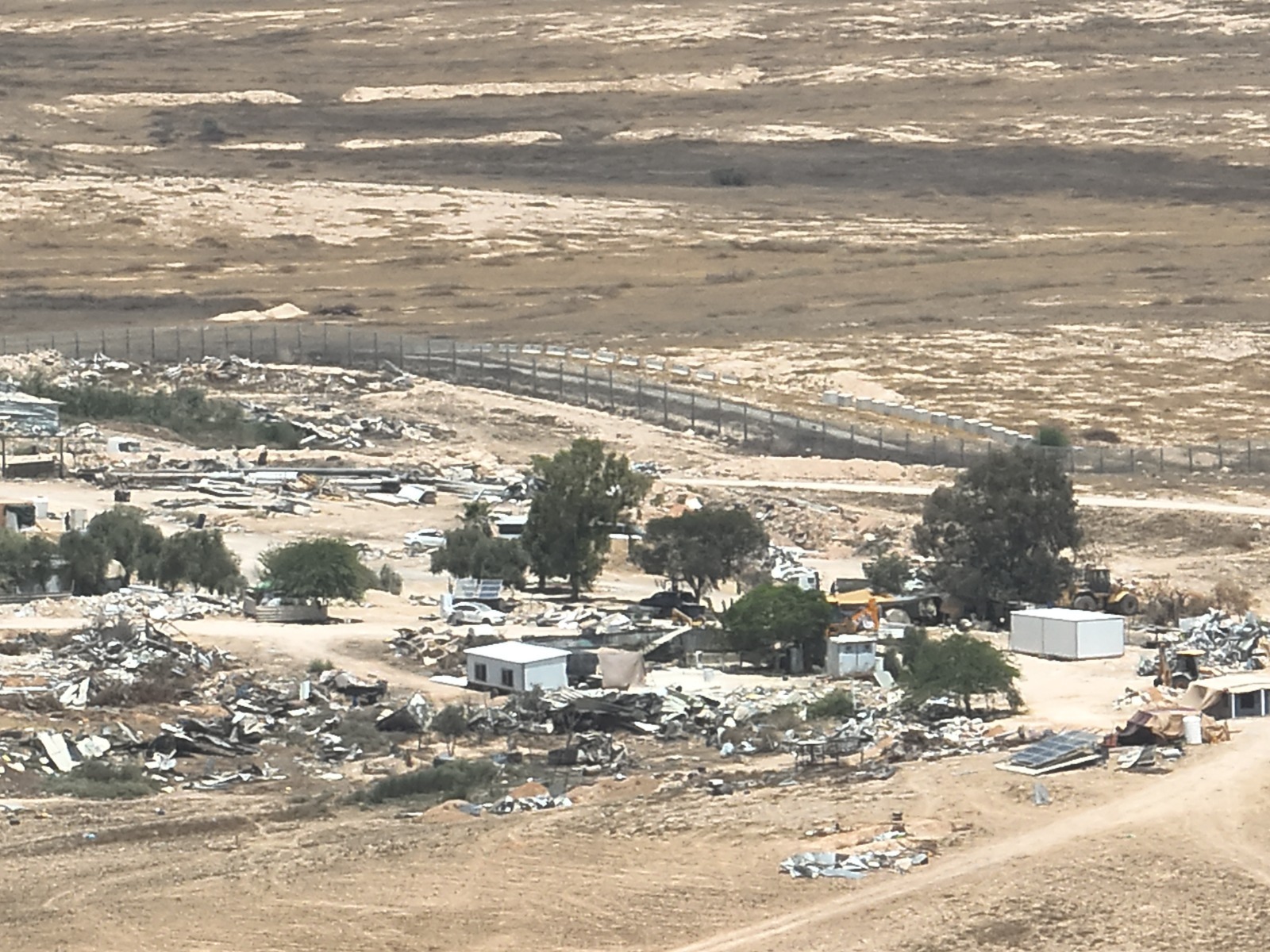
In the closest line of contact, within just 100 meters of the Nevatim Airforce Base, Regavim has documented 117 illegal Bedouin structures, where squatters are using the perimeter fence of one of Israel’s most sensitive military installations to hang laundry and tether animals.
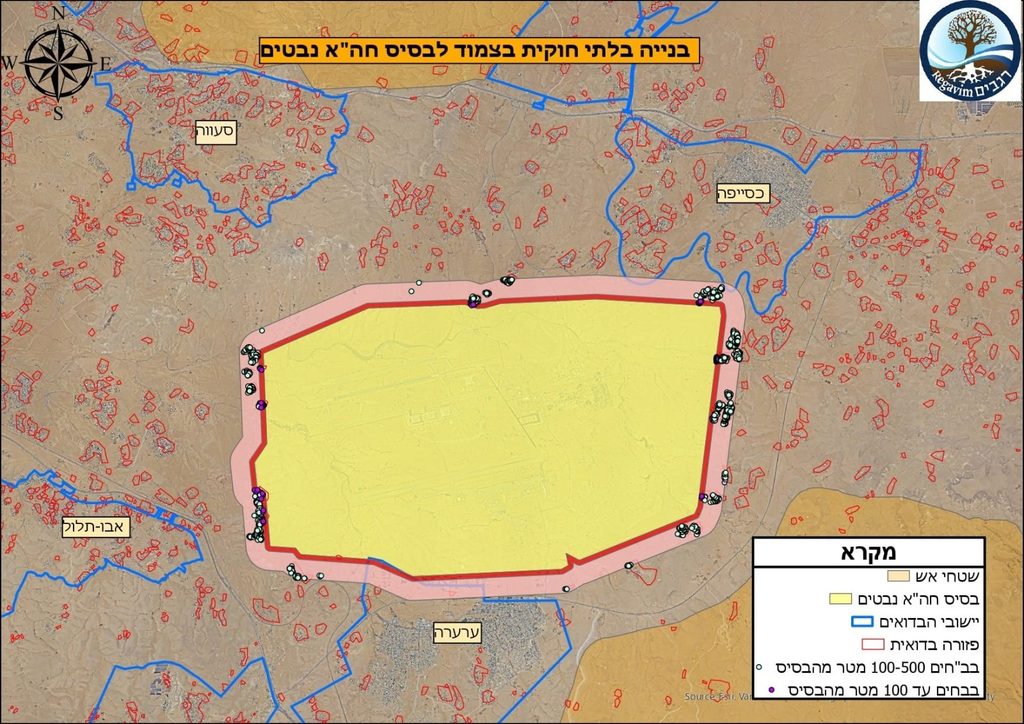
More than 1,000 illegally constructed Bedouin structures have formed clusters around Nevatim Airbase, one of Israel’s most strategically important military installations, according to new research released by the Regavim Movement.
Regavim’s research department identified 1,038 illegal structures, clustered in Bedouin squatters camps within 500 meters of the base perimeter. Of those, 117 stand within just 100 meters of the fence, while another 921 are located between 100 and 500 meters away.
Regavim sent an urgent letter detailing these findings to Israel’s Minister of Defense, the Commander of the Israeli Air Force, and enforcement authorities in southern Israel, demanding that enforcement around the base be given immediate priority.
“Significant progress has been made in law enforcement against illegal construction in the Negev, and we applaud this important and determined action,” Regavim said in a statement. “We call on the State to place the security of IDF bases at the very top of its list of enforcement priorities.”
Regavim described the illegal Bedouin construction as a “choke-hold” around the base, warning that its extraordinary proximity creates a series of direct security threats.
“The structures form a stranglehold around a base that is a key strategic asset of the State of Israel,” Regavim explained. “These clusters of illegal construction present a severe threat to national security and create numerous security risks.”
Regavim’s urgent correspondence cited a State Comptroller report published in April 2026 that documented a sharp rise in shooting incidents near Nevatim, including gunfire into the base itself. In one case, an aircraft wing was struck.
According to Regavim, some of the Bedouin construction is so close to the military installation that residents routinely make use of the base perimeter fence itself.
“The proximity to the base fence has reached the point where residents of the illegal structures hang laundry from it and tether animals to it,” Regavim noted. This repeatedly triggers false security alerts, wears down the base’s defensive systems and personnel, and can impair their ability to distinguish routine incidents from a genuine security breach.
Regavim also warned of serious operational security and intelligence concerns created by the illegal Bedouin construction overlooking the base. The close proximity provides opportunities to observe aircraft takeoffs and landings, track operational patterns, and receive advance indications of military activity.
Regavim pointed to a case from July 2025, when Israeli prosecutors filed a serious indictment against a Bedouin woman from the Negev who allegedly operated on behalf of Iranian intelligence. According to the indictment, the intelligence she collected included documentation of Israeli fighter jets taking off during Operation Rising Lion.
Regavim stressed that recent developments also demonstrate a significant shift in state enforcement in the Negev. Over the past several months, the movement’s southern field coordinator has documented Bedouin residents independently demolishing illegal structures in clusters around Nevatim following demolition orders and mounting enforcement pressure. Regavim welcomed these developments as evidence that sustained enforcement is producing results.
At the same time, its field team documented what it described as a renewed illegal land seizure by members of the al-Na’ami Abu Jamada clan, who rebuilt their squatters camp in an area from which they had only recently been removed. According to Yehuda Kapach, Director of Regavim’s Southern Region, the two developments demonstrate both a new determination by Israeli authorities and continued resistance by those occupying land illegally.
“After years of lawlessness in the Negev, the change in enforcement and regulation over the past three years has been dramatic,” Kapach said. “That change must be felt most strongly around IDF bases, which under no circumstances can be allowed to remain exposed and vulnerable.”
“The lessons of October 7 demonstrated clearly that where the rule of law is absent, criminal elements, and frequently terrorist elements, are able to penetrate. They also taught us that the gap between warning time and response time can be critical and can save lives. Bedouin squatters can – and have – obstructed access to IDF bases. Maintaining sterile buffer zones ensures that pilots can access the base unimpeded – a crucial factor in Israel’s defense system.”
Regavim’s spokesperson summed up the present call for action: “The long-overdue enforcement push currently underway in the Negev must continue, and illegal Bedouin construction surrounding IDF installations must be at the top of the enforcement agenda.”