




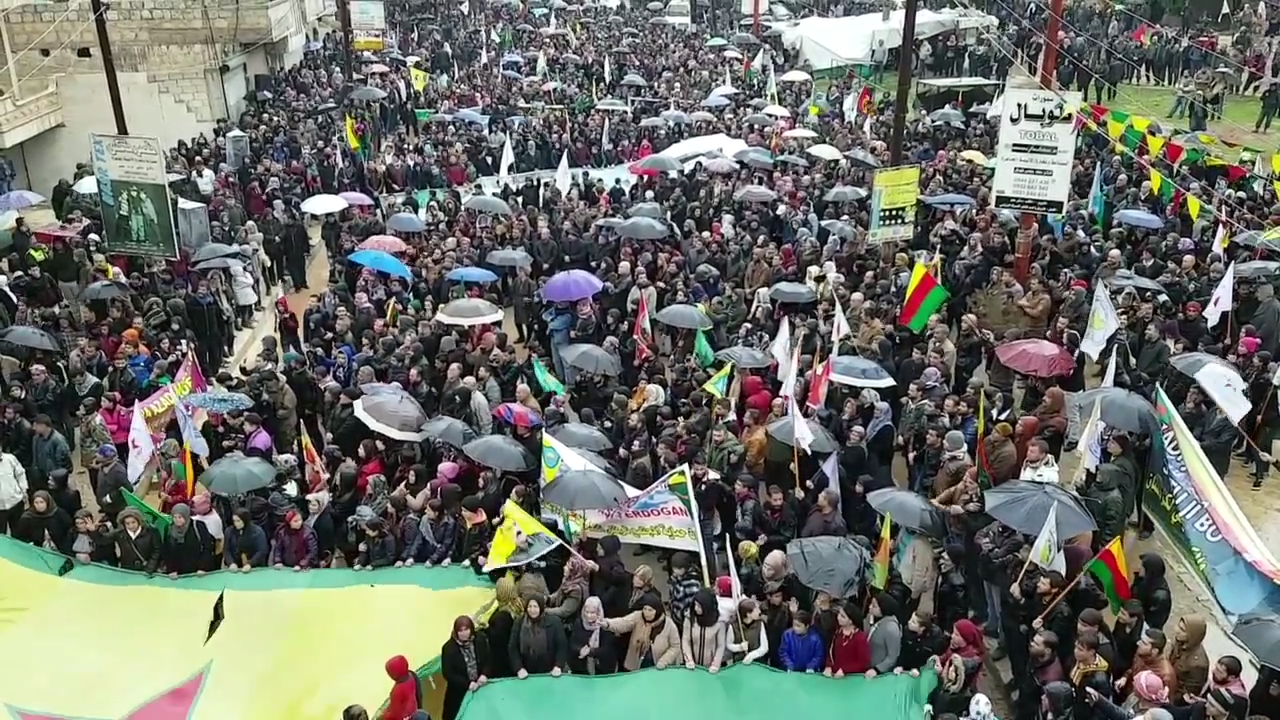
For years now, Turkey and a network of Palestinian organizations have been doing precisely what the anti-Israel crowd has been (wrongly) accusing us of doing: demographically ethnic cleansing and appropriating the homes of indigenous people for resettling settler colonial populations. The anti-Israel crowd’s claims are counter to truth and reality. The Israeli government forcibly uprooted Gush Katif in 2005, removing all of the Jews, living and dead, and destroying all of the homes.
Despite this recent historical fact, the accusations of ethnic cleansing and settler colonialism by Israel dominate the media. In the same space, actual ethnic cleansing and settler colonialism targeting an indigenous population are being carried out by the Palestinians.
This program is being carried out by Turkey and targets the displaced Kurds in northern Syria, on land cleared by force of its original inhabitants.
Implementation of Demographic Engineering
In March 2018, veteran war correspondent Patrick Cockburn described what Turkish forces and their Syrian proxies did to the Kurdish enclave of Afrin as they closed in on it: militiamen shouting “PKK pigs” while marching captured Kurdish civilians away with their hands raised, a burned-out car with a driver’s corpse still inside, houses shelled and bombed. Cockburn, writing in The Independent, noted that identical images from Eastern Ghouta led every newscast that week. Afrin, 200 miles away, barely registered. Reuters reported that more than 200,000 people fled Afrin as Turkish-backed forces took the town on March 18, many with nowhere to go. “The people with cars are sleeping in the cars, the people without are sleeping under the trees with their children,” Hevi Mustafa, a Kurdish civil authority official, told Reuters at the time.
Hassan Hassan, a Kurd whose family lost their home in the Afrin district, put it to journalists more simply years later: “We’ll have to leave again, that’s our only certainty.”
The Word Nobody Uses
Strip away the geography and the pattern is unmistakable: a foreign military crosses an international border, seizes territory, drives out the overwhelming majority of the people who live there, and settles a different population in their place. When this is alleged of Israel, the words “occupation” and “ethnic cleansing” appear immediately, treated as self-evident by international media and human rights bodies alike. Syrians for Truth and Justice, a French-based NGO that has documented Turkish conduct in Afrin since the occupation began, uses the same language in its own 2022 report: “demographic change.” The NGO draws a comparison not to Israel but to Indonesia’s occupation of East Timor after 1975. The comparison to Israel is one that almost nobody makes, though the pattern it describes fits far more precisely than the one usually invoked.
Erdogan’s Own Words
The clearest evidence of intent in this entire file comes not from a human rights report but from the man who ordered the operation. The day after Turkish forces launched Operation Olive Branch, President Recep Tayyip Erdogan told reporters that Afrin was already “55 percent Arab, 35 percent Kurds,” and that Turkey’s goal was “to give Afrin back to its rightful owners,” Cockburn reported. The claim was false when Erdogan made it. Every independent source on Afrin’s pre-invasion demographics, including the Afrin-based Human Rights Organization cited by Rudaw, places the district at 95 to 97 percent Kurdish before 2018. A stated intention to reverse a population’s demographic majority is treated as proof of ethnic cleansing when the accused party is Israel. When the party is Turkey, a NATO member, it drew no comparable response from any Western government.
Turkey’s actions violate a number of international laws, including, but not limited to the following:
Fourth Geneva Convention, Article 49 — Article 49 prohibits an occupying power from deporting or transferring parts of the occupied population, and separately prohibits the occupying power from transferring parts of its own civilian population into the territory it occupies. Both halves are arguably implicated here: the forced displacement of Kurds (and Yazidis, per Qamber’s testimony) is the first violation; the settlement of Arab, Turkmen, and Palestinian-linked populations into the vacated land is the same provision that is incorrectly invoked in the Israeli-Palestinian context regarding West Bank settlements.
Rome Statute of the International Criminal Court — population transfer and deportation of a civilian population are listed as crimes against humanity and, in the context of occupation, potentially war crimes under Article 8.
The Numbers
What followed bears out Turkey’s stated intention. Rudaw reported in 2020 that Afrin’s Kurdish population share had collapsed from 97 percent to 34.8 percent in under two years, citing the same Afrin-based Human Rights Organization: roughly 298,700 Kurds remaining against 458,000 people resettled from Arab-majority Idlib, Ghouta, Homs, and Deir ez-Zor. Spanish journalist David M. Mañá, who specializes in Kurdish affairs, gave an independent, lower estimate to the reporting outlet IPS in 2023: barely 20 percent of the original Kurdish population remains. The two figures, arrived at separately, describe the same collapse. More than 20 new settlements have been built in Afrin alone, part of roughly 100 across the Turkish-occupied areas of northern Syria, according to data from North Press Agency cited in that same IPS report.
The transformation reached even Kurdish national symbols. Militiamen toppled a statue of Kawa the Blacksmith, the central figure of Kurdish national mythology, and photographs of the demolition circulated soon after the occupation began.
Named Witnesses
Ibrahim Sheikho, a lawyer and president of the Afrin Human Rights Organization who was displaced to the Shahba refugee camp, has described the aftermath in detail in two separate interviews, one for a 2024 Lund University thesis and one for IPS in 2023. He recounted roughly 300,000 people originally displaced, 10,000 homes and 7,000 shops destroyed or confiscated, Afrin’s currency switched to the Turkish lira, and a corridor built specifically to route Afrin’s olive oil into Turkey under Turkish producer labeling.
Shekh Qamber, a Yazidi farmer who fled the village of Qastel Jindo, told The Independent in 2018 that Islamist fighters allied with Turkey forced Yazidis to convert to Islam under threat of death and destroyed Yazidi temples and places of worship. He recalled being interrogated by a militant who told him his village would no longer be called Qastel Jindo. It would be called al-Quds, Jerusalem, because “these areas were occupied by the infidels and now it is going back to their original owners.” Multiple accounts, including Cockburn’s, report that many of the Turkish-backed fighters in these operations are former ISIS and al-Qaeda members.
The Palestinian Exemption: Settlers Who Call Others Settlers
The deepest irony in this story belongs to the funders. According to IPS reporting, a Palestinian organization called Living with Dignity, also known as Alaysh 48, meaning “People of 48,” has financed settlement construction in Afrin, raising money through Hapoalim Bank, an Israeli bank that also finances settlement construction in the West Bank, with a branch in Ariel. Ajnadin, a Palestinian NGO headquartered in Beit Hanina in eastern Jerusalem, has funded and named its own project, the Ajnadin Palestine settlement. A third organization, Albairaq, admitted through its executive member Rashad Wattad that it built settlements in Afrin in partnership with Living with Dignity. Asked whether he saw a contradiction in supporting a resettlement program for displaced Syrian Arabs that mirrors what he considers Palestinians endure under Israeli settlement, Wattad told IPS he saw none: “We just want to help the people.”
Sheikho’s answer to that was direct: “I cannot understand that there are Palestinians who are able to forget the injustice they suffer at the hands of the Israeli authorities and wish the same to us.”
The Palestinian Authority itself has rejected these projects. Nazmi Hazouri, the PA’s consul in Iraqi Kurdistan, told Kurdish journalists in 2019 that “the word ‘settlement’ horrifies us, and we categorically reject the construction of any in our name.” One further claim in the file, reported by Medya News in 2023 and citing the Kurdish-aligned Hawar News Agency, alleges an organized effort to relocate roughly 250,000 Gazans, some Hamas-linked, into camps in Afrin and Al-Bab as part of a coordinated arrangement between Turkey, Qatar, and Hamas. That claim rests on a single Kurdish-sourced report and should be read as such, distinct from the independently corroborated funding activity described above.
A Palestinian who insists on the right to self-determination while financing the erasure of Kurdish self-determination in Afrin is not applying a principle. He is claiming an exemption from it.
A Cause the World Forgot
The United Nations has passed a staggering number of resolutions on Palestinian self-determination. Not one Kurdish self-determination proposal has ever reached even subcommittee level, let alone the General Assembly or Security Council, according to a 2025 analysis published by Geopolitical Monitor. The sole UN Security Council reference to Kurds at all, Resolution 688 in 1991, addressed Iraqi repression, not self-determination. The Arab League and the Organisation of Islamic Cooperation have never condemned Iraq’s 1988 chemical attack on Halabja, which killed roughly 5,000 Kurdish civilians in under an hour. A 2018 piece published by the Washington Institute made the underlying argument plainly: solidarity with the Palestinian cause while ignoring Kurdish suffering under Arab and Muslim governments is not a principled stance on self-determination. It is a double standard.
Anyone who believes a people with a shared language, a national identity, and a documented history of persecution has a right to a state of their own has already conceded the Kurdish case. The Kurds meet every criterion regularly invoked for Palestinian statehood, and they meet it with a far longer and more thoroughly documented record of dispossession, across four different states. The question is not whether the principle applies to the Kurds. It is why so few of the people who invoke that principle for Palestinians ever mention them.
A Difficult Ally
Turkey’s conduct in Syria sits uneasily with its NATO membership. A 2024 piece by scholar Loqman Radpey, published in ECPR’s The Loop, draws the direct comparison to Turkey’s 1974 invasion of Northern Cyprus, an illegal occupation under international law that produced an unrecognized state, sustained by Turkish troops for fifty years and tolerated throughout by the same NATO and EU institutions currently silent on Syria. Turkey has also hosted Hamas political leadership in Istanbul for years, a fact that sits oddly beside Ankara’s frequent public denunciations of Israel. A NATO member conducting demographic engineering against a Western ally’s own Kurdish partners, while sheltering a US-designated terrorist organization’s leadership, draws remarkably little scrutiny from the alliance it belongs to.
A Natural Alliance, Deferred
Israel’s relationship with the Kurds predates the state’s founding controversies by decades and rests on more than convenience. Under Prime Minister David Ben-Gurion’s “periphery doctrine,” Israel sought alliances with non-Arab peoples on the region’s edges. Between 1968 and 1975, Israeli intelligence and military personnel trained and armed Kurdish Peshmerga forces under Mustafa Barzani and helped establish the Kurdish intelligence service, Parastin, according to Washington Institute scholar Bilal Wahab. The relationship ran in both directions. Kurds helped protect and facilitate the emigration of Iraq’s remaining Jewish population to Israel during the same period.
The charge that Kurdish nationalism is a Zionist plot is not new. Iraq’s own defense minister accused Kurdish nationalists of building a “second Israel” in 1966, a phrase Iraq’s Nouri al-Maliki repeated against the 2017 Kurdish independence referendum, and one Turkish ultranationalists have used against their own Kurdish population as well. In September 2017, Israel stood alone among regional governments in publicly endorsing that referendum. Kurdish flags flew at rallies in Jerusalem; Israeli flags flew at rallies in Erbil. Israeli Foreign Minister Gideon Sa’ar has called the Kurds a “natural ally,” explaining that in a region where Israel will always be a minority, its natural alliances lie with other minorities. A 2009 poll found 71 percent of Iraqi Kurds favored establishing diplomatic ties with Israel, according to Wahab.
The relationship is not without its complications, and stating them plainly matters more than smoothing them over. Israel has historically treated the PKK as a terrorist organization and has kept its posture toward Syrian Kurdish forces ambiguous. Most Kurds are Muslim, and many feel genuine sympathy for Palestinians, not only on religious grounds but on the grounds of shared statelessness, as Wahab has noted. Kurdish Regional Government leadership has, in fact, shown considerable diplomatic grace on this question. President Nechirvan Barzani affirmed support for a two-state solution at the outset of the Gaza war, and the Kurdistan Region Presidency formally endorsed the international initiative to recognize Palestinian statehood at the UN, according to a December 2025 report in the Jerusalem Strategic Tribune. Kurdish leaders have managed to hold sympathy for the Palestinian cause without erasing their own people’s claim in the process. That is a generosity rarely returned.
A Debt Still Unpaid
The United States owes the Kurds a reckoning of its own, one that runs back fifty years and through both parties. In 1975, the Nixon and Ford administrations, working through Secretary of State Henry Kissinger, abandoned Iraqi Kurdish rebels the moment Iran and Iraq struck their own bilateral deal, cutting off a rebellion the CIA had been arming, according to reporting by Dexter Filkins cited in a 2019 New Republic piece by Adam Weinstein. The Kurdish leader at the time wrote to President Carter afterward: “I could have prevented this calamity which befell my people, had I not fully believed in the promise of America.” Kissinger’s own justification to Congress was blunter still: “Covert action should not be confused with missionary work.”
In 1988, as Saddam Hussein’s regime carried out the Anfal campaign against Iraqi Kurds, killing roughly 100,000 people, and gassed Halabja, killing some 5,000, the United States had long known about Iraq’s use of chemical weapons and largely tolerated it because Baghdad served as a check on Tehran, even supplying targeting intelligence that Iraqi forces used against Iran. In 1991, President George H.W. Bush urged Iraqi Kurds to rise up against Saddam, then declined to back the uprising once Kuwait had been liberated. Saddam’s forces killed thousands and displaced roughly a million Kurds in the reprisals that followed. In 2003, President Bush invoked Halabja directly to justify the invasion of Iraq, without acknowledging his own government’s earlier tolerance of the same atrocity.
The most recent chapter came in October 2019, when President Trump, days after telling reporters “they fought with us, they died for us and with us,” ordered a withdrawal of US troops from northern Syria following a phone call with Erdogan, clearing the way for a Turkish offensive against America’s Kurdish allies. According to Politico’s March 2026 reporting, that pattern has not been forgotten. Iranian Kurdish militia leaders considering whether to move against Tehran are now weighing, in the words of Sussex University academic Kamran Matin, whether America is “a dependable ally, or would it just see them again as a dispensable proxy.” Washington raised no objection as post-Assad Syrian government forces retook Kurdish-held territory in Aleppo, Deir ez-Zor, Raqqa, and Hasakah earlier this year. Three generations of American administrations, both parties, four different Kurdish theaters, one consistent pattern.
The Proposal, Rejected
The case for relocating Palestinians to Syria could be made plainly enough: the machinery already exists, Turkey has already normalized it, and Palestinian organizations are, by their own admission, already engaged in exactly this kind of resettlement.
But that case should be rejected outright. What this file documents, across a dozen independent sources, is not a model of humanitarian resettlement. It is a population transfer carried out by force, backed by falsified demographic claims, and financed in part by the very people who reject the same treatment when it is applied to them. Extending that model to Palestinians would not solve anything. It would simply extend the crime documented in this piece to a new population.
A standard that applies only when convenient is not a standard. It is a license. If the world, and Palestinian advocates in particular, believe a stateless people with a coherent national identity and a documented history of persecution deserves a homeland, that belief has to extend to the Kurds, a nation that has waited a century longer than most, been betrayed by nearly every power that ever claimed to champion it, and asked, through people like Ibrahim Sheikho and Shekh Qamber, for nothing more than the right to go home.


