


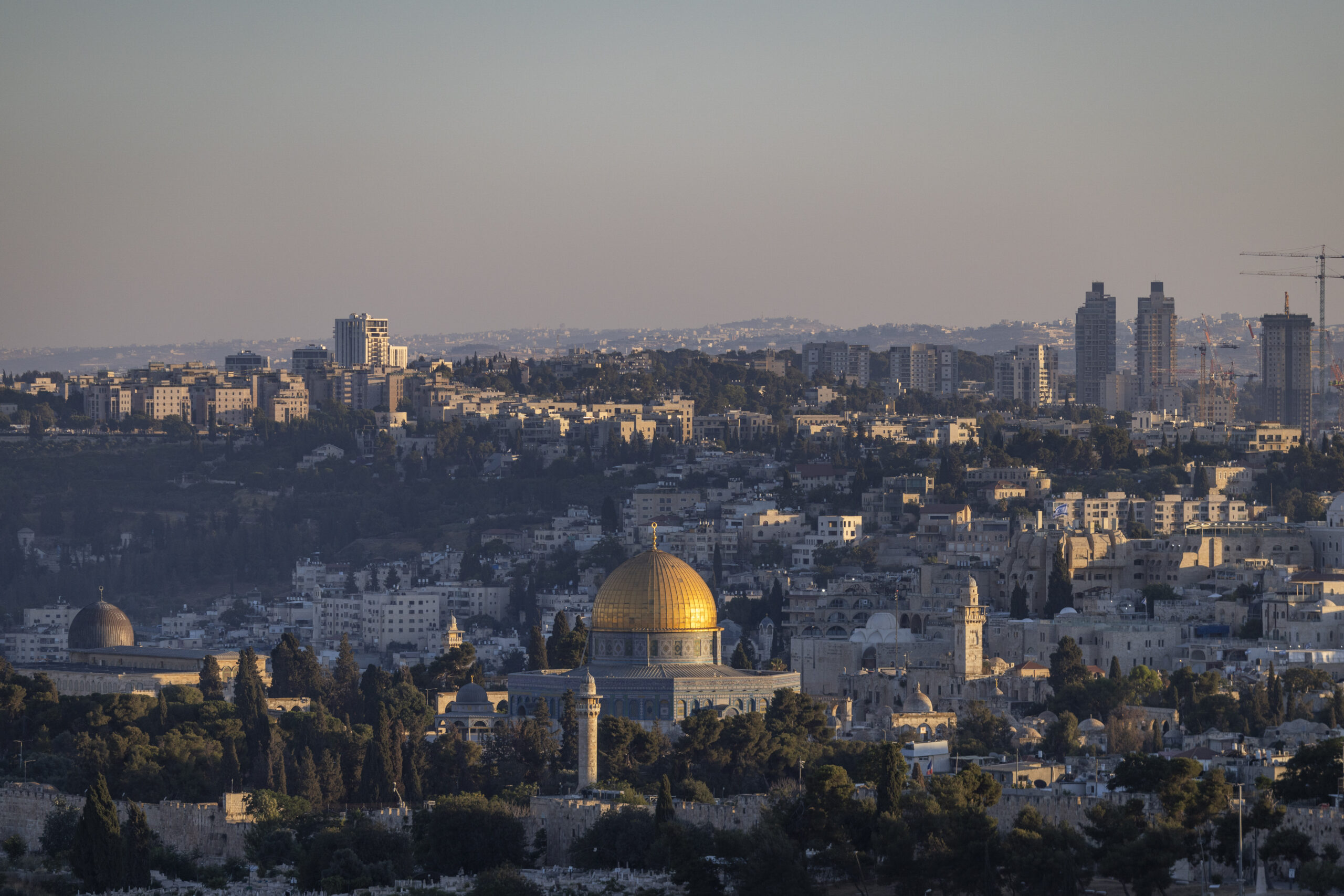
The Ark of the Covenant remains one of the oldest open questions in Jewish tradition, and one with real stakes: Jewish sources tie the Ark’s return directly to the Third Temple and to the return of prophecy itself. In a recent class, Talmudic scholar and Torah educator Efraim Palvanov worked through the question methodically, moving from the original construction of the Mishkan (Tabernacle) through a largely unknown history of multiple ancient Jewish temples, a reexamination of what the cherubim actually were, and evidence that the Ark itself may have functioned as something closer to a piece of advanced, otherworldly technology than a decorated wooden box.
Palvanov’s class opened by tracing a history of Jewish temples far broader than the First and Second Temples most people learn about. The Northern Kingdom’s King Jeroboam built two rival temples at Dan and Bethel, complete with golden calves, specifically to keep his subjects from pilgrimaging south to Jerusalem. The Samaritans, whom Palvanov describes as descendants of populations resettled in the land who later adopted a modified version of the Torah, built their own temple on Mount Gerizim, one the Hasmoneans eventually destroyed. Centuries later, in Ptolemaic Egypt, a priest named Onias built a functioning Jewish temple at Leontopolis, near Alexandria, that operated for roughly two hundred years until the Romans destroyed it in 73 CE, three years after the fall of Jerusalem’s own Temple. An even older Jewish temple, according to archaeological evidence Palvanov cites, stood on the island of Elephantine in the Nile, likely built by Jewish soldiers stationed there, until the Persians destroyed it around 410 BCE. “There’s so much more to the history of Jewish temples than we know,” Palvanov said. “It’s not just the First and Second Temple, and that’s it.”
He devoted significant attention to the cherubim, the two golden figures mounted on the Ark’s cover, arguing that centuries of religious art depicting them as chubby winged infants gets the description wrong. “That baby idea comes from the Greeks, because the Greeks had cherubs that were like Cupid,” Palvanov said, tracing the image to Greek iconography rather than the Torah itself. He pointed instead to how cherubim are actually described throughout the Hebrew Bible: “Throughout Tanakh, the cherubim are described as warriors with swords… they’re not cute babies with bird wings,” he said, citing the composite lion, eagle, ox, and human features Ezekiel assigns them in his vision of the divine chariot. He noted the striking resemblance to armored guardian figures found across the ancient Near East, including Babylonian and Assyrian temple sculptures known as lamassu and shedu.
The most provocative section addressed the Ark’s apparent electrical properties. Palvanov pointed to the death of Uzzah in the Book of Samuel, killed instantly after touching the Ark to steady it as it nearly fell. “He touched it to try to prevent it from falling, but when he touched it, he got electrocuted,” Palvanov said. “So we know that the ark had some kind of electrical power.” He connected the episode to a teaching from the Baal HaTurim linking the Ark’s construction to the Hebrew word for electricity, chashmal, the same term Ezekiel uses to describe the divine chariot. He also cited the Talmudic claim that the Ark occupied no measurable space within the Holy of Holies, an idea that Rashi himself struggled to explain. “Was it even something from this world?” Palvanov asked. “The ark seemed to be like in another dimension, as if it didn’t take up any space at all.” He briefly connected this to the Zohar’s description of both the Ark and Noah’s own ark as vessels that operated outside the normal rules of physical space, functioning almost as if they existed partly outside conventional dimensions. “It’s super advanced divine technology,” he said. “That’s what it is.”
With that broad picture established, Palvanov turned directly to the central question: what actually happened to the Ark, and where might it be now?
What the Talmud Says Happened
Jewish tradition splits on this from the outset. Palvanov noted that the Mishnah’s own wording, describing the Ark as having been “taken” rather than “hidden,” has led some Sages to conclude that it was seized and destroyed by the Babylonians when the First Temple fell, and that its fate thereafter remained unknown. The competing position, codified by the Rambam, holds that King Solomon foresaw the Temple’s eventual destruction and had a hidden chamber built beneath the Temple Mount to conceal the Ark during times of crisis. Palvanov pointed to a passage in Divrei HaYamim describing King Josiah, one of the last kings before the First Temple’s destruction, instructing the Levites to “bring the Ark” back to its place. In Maimonides’ reading, this is evidence that the Ark was still on-site centuries after Solomon, simply hidden rather than gone.
Historical Confirmation of the Backdrop
Palvanov offered one clearly documented historical anchor for the broader story: the Egyptian pharaoh Shishak’s invasion of Jerusalem, recorded in the Bible as stripping the Temple of its treasures during the reign of Solomon’s son, Rehoboam. Palvanov noted that this event is independently confirmed by an inscription at the Bubastite Portal in Karnak, Egypt, describing Pharaoh Sheshonq’s campaign against Jerusalem in terms that match the biblical account and, he said, constituting the oldest known archaeological reference to the kingdom of Judah.
The Legends That Don’t Hold Up
Palvanov worked through several popular theories and found each wanting. The claim that the Ark resides in a church in Ethiopia, which is among the most widely circulated Ark theories online, was directly investigated in 1941 by a British scholar of Ethiopian studies who was granted rare access to the site. He found no ark at all, only a wooden replica no older than five or six hundred years. Palvanov also cited the researcher Tudor Parfitt, who spent years searching for the Ark across multiple continents, from tribal communities in southern Africa to traditions placing it near Baghdad or Mecca to a final search in Papua New Guinea, and came away without finding it. A separate claim that the Ark ended up in Rome, based on the Arch of Titus’s depiction of looted Temple treasures, collapses on its own logic, Palvanov noted, since the Second Temple never contained the Ark to begin with. Even a personal account from Rabbi Harry Moskoff, who was granted access to the Vatican’s archives and vaults, turned up other artifacts but not the Ark.
The Two Claims Palvanov Treated Seriously
Two theories stood out as more substantive. The first is a declassified 1988 CIA document from a remote-viewing program called Project Sun Streak, in which government-employed psychics attempted to locate the Ark. The unclassified report describes viewers concluding the Ark exists and sits hidden underground somewhere in the Middle East, near structures suggesting mosque domes, with Arabic-speaking figures nearby.
The second is a long-standing account involving Rabbi Shlomo Goren, the IDF’s chief rabbi who blew the shofar at the Western Wall in 1967, and Rabbi Yehuda Getz, longtime rabbi of the Western Wall. According to the account Palvanov relayed, the two rabbis, digging in tunnels beneath the Temple Mount around 1981, located a hidden chamber and reported seeing the Ark itself inside it. Palvanov was careful to frame this as an unverified legend rather than confirmed fact. “Whether that’s true or not, I don’t know,” he said. “I don’t know it from a firsthand account. That’s what people say.” He noted that when word of the excavation spread at the time, it triggered riots, and that the tunnel has remained inaccessible to further investigation since.
Ending on Joel’s Prophecy
Palvanov closed by connecting the Ark’s disappearance to a broader pattern in Jewish tradition: that open prophecy largely ceased after the First Temple’s destruction, a period Jewish sources tie directly to the loss of the Ark itself, since the Torah describes Hashem speaking to the Jewish people from between the cherubim atop it. He pointed to the prophet Joel’s promise that this will not remain permanent, that in the Messianic era, Hashem will pour out His spirit on all people, so that sons and daughters, elders and even servants will all become prophets and visionaries. Palvanov ended the shiur on that note directly. “In these forthcoming days, we’ll have the spirit of God, and we’ll see prophecy returned, the Ark returned, the Temple returned, God willing, very soon,” he said. For Palvanov, that promise is the real endpoint of the search: not simply locating a lost artifact, but the expectation that the Ark’s return will coincide with the Third Temple, restoring both the vessel and the direct divine communication that accompanied it.
