


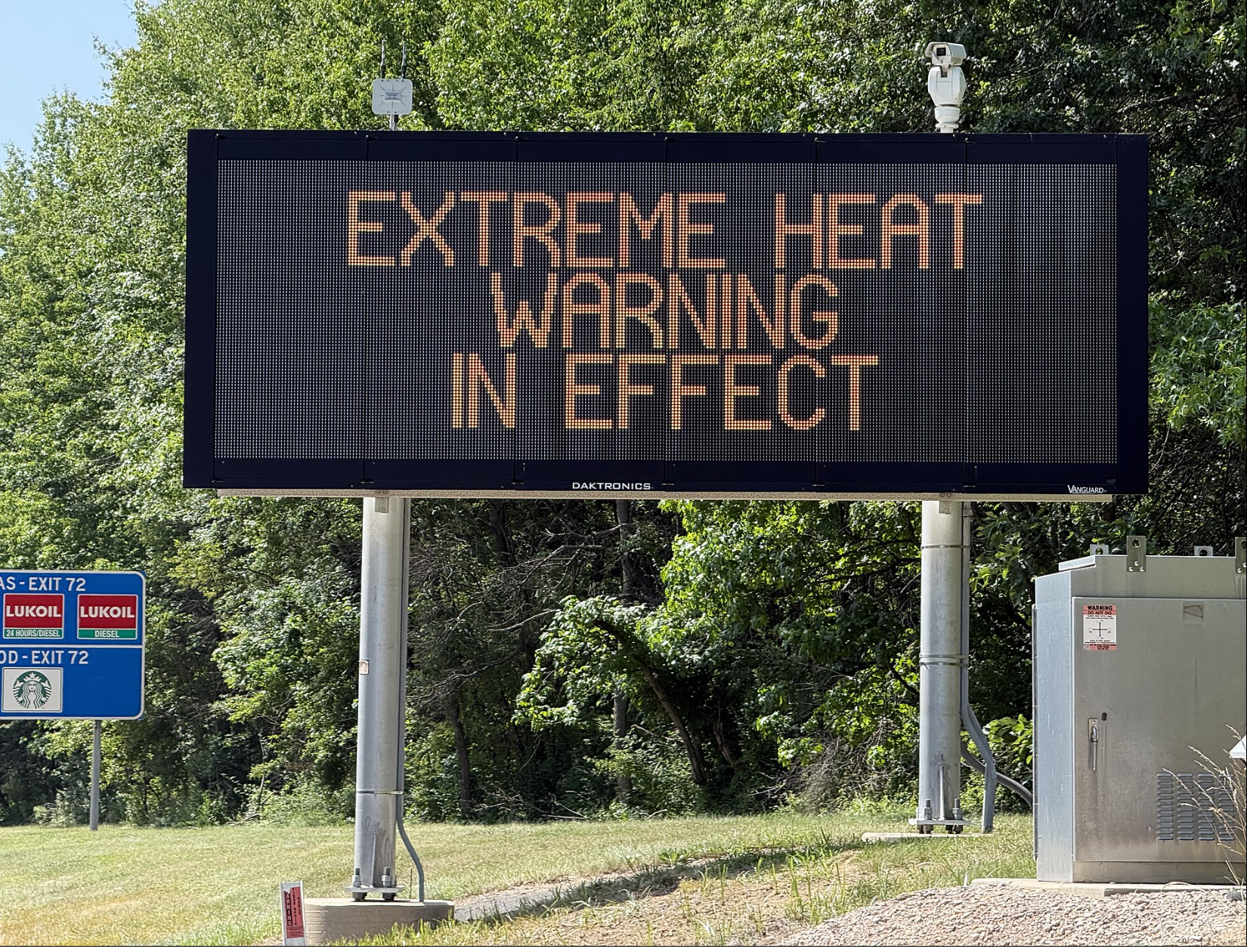
The United States just recorded its hottest month in 132 years of measurement, and the scientific establishment is calling it a milestone of the climate crisis. The Hebrew Bible called it something else three thousand years ago: the predictable result of a nation’s relationship with Heaven, described in language so specific it reads less like ancient poetry and more like a weather report.
According to the National Oceanic and Atmospheric Administration, the average temperature across the contiguous United States in July reached 76.9 degrees Fahrenheit, roughly 0.1 to 0.2 degrees above the previous records set in July 1936 and July 2012, in data stretching back to 1895. Daytime highs averaged 89.5 degrees, the sixth-warmest on record for that measure alone, but the more striking number came at night. Overnight lows averaged 64.2 degrees, nearly four degrees above the historical average and the highest overnight reading of any month ever recorded, surpassing even the previous mark set in July 2022.
Thirteen states posted one of their five warmest Julys on record, and Wyoming set an outright record, coming in 0.9 degrees above its previous hottest month. Nearly half the country, roughly 48.5 percent of the mainland states and Washington, D.C., sat in drought conditions as of early August, alongside more than two-thirds of Puerto Rico. The country endured three separate heat dome events during the month, periods when a slow-moving zone of high pressure traps soaring temperatures over a region for days at a stretch, while wildfire smoke from Canada and the Pacific Northwest blanketed large sections of the country in haze.
Polling released by AP-NORC found that roughly two-thirds of respondents said the extreme temperatures had disrupted their families’ outdoor activities, about half reported their exercise routines had been affected, and nearly half described the hit to their electricity bills as major. Climate scientist Michael Mann of the University of Pennsylvania noted that record heat tends to arrive alongside major El Niño events, and this year’s is unusually strong, with some researchers projecting it could push global temperatures to a new high before the current record, set only in 2024, has even had time to age.
What Deuteronomy Already Said
Scientists and politicians are calling this climate change. The Bible described the same condition three thousand years ago, in a passage so specific it names the exact atmospheric failure now showing up in NOAA’s data: rain that will not fall.
The warning appears in the Torah’s catalog of consequences for a nation that turns from Hashem: “V’hayu shamecha asher al roshcha nechoshet, v’ha’aretz asher tachtecha barzel,” “And your skies above your head shall be copper, and the earth beneath you shall be iron” (Deuteronomy 28:23). Copper skies. Iron ground. No rain, no relief, the sky sealed shut like a lid clamped over a pot already boiling.
In Jewish thought, the divine name Elohim is the name through which Hashem governs the natural order, the God of seasons, harvests, and climate, and it is simultaneously the name associated with judgment. Weather, in this framework, is never merely mechanical. It is language. This was established as far back as the story of Noah, and it appeared again unmistakably in the ten plagues that struck Egypt. It runs as an unbroken thread through the entire Hebrew Bible.
The prophet Malachi removes any doubt about where extreme heat fits into that framework. “For behold, the day is coming, burning like a furnace, and all the arrogant and every evildoer will be chaff, and the day that is coming will set them ablaze, says the LORD of hosts, so that it will leave them neither root nor branch” (Malachi 3:19). Malachi is describing the geulah, the final redemption, and the heat that arrives with it as an instrument of divine separation between the righteous and the wicked.
The Talmud takes the idea further still. In Nedarim 8b, Reish Lakish teaches that in the Messianic era there will be no Gehinnom: instead, Hashem will remove the sun from its sheath, and the same sun that judges the wicked will heal the righteous. One sun, two outcomes, determined entirely by where a person stands. Isaiah describes the healing side of that same intensified light directly: “And the light of the moon shall become like the light of the sun, and the light of the sun shall become sevenfold, like the light of the seven days, when the LORD binds up His people’s wounds and heals the injuries it has suffered” (Isaiah 30:26). Heat, in the prophetic framework, is never only punishment. It is also preparation.
Haggai’s Diagnosis
Nowhere is the mechanism spelled out more directly than in the Book of Haggai, addressed to Jews who had returned from Babylonian exile, rebuilt their own homes, and left the Beit HaMikdash, the Holy Temple, in ruins. Hashem’s response came through the climate itself: “Therefore, the heavens above you have withheld the dew, and the earth has withheld its produce. And I called for a drought on the land, on the mountains, on the grain, on the new wine, on the oil, on what the ground produces, on man, on beast, and on all their labors” (Haggai 1:10-11).
The equation Haggai lays out has two directions. A people living in the Land of Israel while neglecting the Temple invites climatic consequence. Building the Temple invites the opposite.
The Bible’s Answer to a Question Science Cannot Solve
Secular climate science offers only mechanical fixes for a mechanical problem as it understands it: carbon taxes, emissions targets, and, in some of the more extreme proposals now circulating, deliberately dimming the sun through atmospheric intervention, engineering less of the very sunlight Isaiah described as the instrument of future healing. The Bible’s framework runs in the opposite direction entirely. The shamayim, the heavens, were never a closed physical system indifferent to human behavior. They are a mirror held up to the covenant between Hashem and the Jewish people, and when they turn to copper, that is not noise in the data. It is a message.
The Jewish people have now lived back in their land for nearly eighty years. The Temple Mount, Har HaBayit, sits under Israeli sovereignty, and yet the Beit HaMikdash remains unbuilt. For generations, its reconstruction was treated as a distant aspiration rather than an active project, deferred indefinitely by political caution and security concerns. That began changing after October 7, 2023.
The signs of that shift are no longer confined to the realm of prayer. This month alone, the National Institute for Red Heifer Research announced the birth of a third red heifer candidate in Israel, born in the Jordan Valley and joining two others already being raised in the Galilee and the Golan Heights, each examined by rabbinic scholars for the specific unblemished status the Torah requires for the purification ashes described in Numbers 19. Separately, ongoing research into the ketoret, the sacred incense burned in the Temple service, has continued to build on the discovery Vendyl Jones made in a cave near Qumran in 1992, where he recovered a reddish substance later subjected to chemical analysis matching the incense composition described in rabbinic sources, a project that scholars continue to refine and defend decades later.
None of this, on its own, rebuilds the Temple. But taken together, a rare red heifer herd being raised across three regions of the country at once and a decades-old chemical trail leading back to the actual formula of the incense that once burned inside the sanctuary mean the pieces long treated as permanently missing are, one at a time, being found. Haggai told a generation that neglecting the Temple brought drought. The generation alive today is watching the mercury climb past every record on the books, while the ingredients for the Temple’s service reassemble themselves in laboratories and barns across the same land on which Haggai stood when he said it.


