What exactly is a Zionist? It sounds like a simple question, but today it has become one of the most loaded questions in Jewish life. People are harassed and targeted for being “Zionists,” while others walk proudly through the streets declaring that they are Zionists. Our enemies increasingly insist that they are not antisemitic, merely “anti-Zionist.” Yet before we argue about Zionism, perhaps we should first decide what the word actually means.
The conventional historical answer begins with Theodor Herzl and modern political Zionism. Herzl’s Der Judenstaat, The Jewish State, gave political expression to the idea that the Jewish people required national sovereignty in their ancestral homeland. That movement produced the Zionist Congresses, successive waves of Aliyah and ultimately the State of Israel in 1948. In a modern political-science textbook, that is a reasonable place to begin. But it is certainly not where Zionism began for the Jewish people.
I would argue that the first Zionist was Avraham Avinu. Hashem tells him, “Lech lecha me’artzecha… el ha’aretz asher areka” — “Go forth from your land… to the land that I will show you.” The Jewish story begins with a Jew being commanded to leave his birthplace and journey to Eretz Yisrael. Long before Herzl, Basel or the word “Zionism,” the Torah connected the destiny of the Jewish people with a particular Land.
From there, the theme never disappears. The prophets describe the Jewish people being scattered and ultimately gathered home. King David made Jerusalem the center of Jewish national life. Ezra and Nechemiah called Jews back from exile. For nearly two thousand years Jews prayed facing Jerusalem three times every day, begging Hashem to gather the dispersed of Israel and rebuild Jerusalem. Every Pesach Seder and Yom Kippur ends with “L’Shanah Haba’ah B’Yerushalayim” — “Next year in Jerusalem.”
Nor did physical return begin with Herzl. The expulsion from Spain in 1492 helped bring Jews toward Eretz Yisrael and contributed to the extraordinary flowering of Jewish life in Tzfat. Centuries later came the students of the Baal Shem Tov and the disciples of the Vilna Gaon. They did not need Herzl to teach them about Zion. Their Zionism, if we apply that modern word retroactively, came directly from Torah, prayer and Jewish destiny.
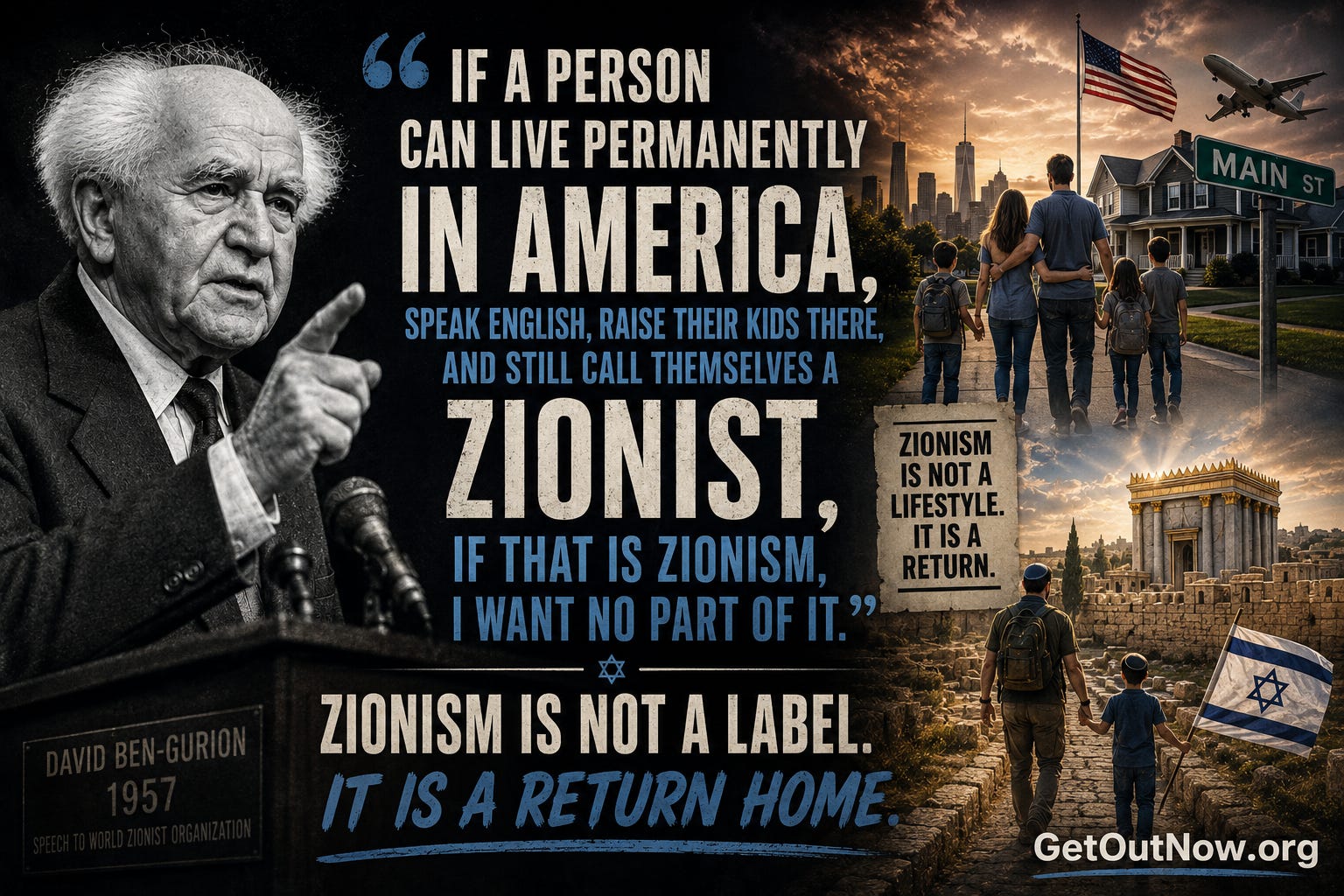
This is why the definition becomes particularly interesting after 1948. David Ben-Gurion himself questioned what it meant to continue calling oneself a Zionist once the State had been created. Zionism was not supposed to become an identity badge. Its goal was the return of the Jewish people to sovereign national life in their Land. Ben-Gurion could therefore describe himself not as a Zionist but as an Israeli Jew: the aspiration had become reality.
His challenge to American Jews was even more uncomfortable. What does it mean to call yourself a Zionist while permanently living in America, speaking English and raising your children there? If Zionism means returning the Jewish people to their homeland, eventually somebody has to return. Donating to Israel, marching for Israel, buying Israeli products and displaying an Israeli flag are all admirable, but are they Zionism itself or support for Zionism? Perhaps Zionism was never supposed to remain a label. It was supposed to be a return.
This exposes the problem with the increasingly fashionable declaration, “I am not antisemitic; I am only anti-Zionist.” Criticism of an Israeli government or policy is obviously not inherently antisemitic; Israelis themselves do it constantly. But rejecting the very concept of Jewish return and sovereignty in Eretz Yisrael is something fundamentally different. Once Zionism is understood not merely as a nineteenth-century ideology but as the ancient Jewish attachment to Zion, separating Judaism from Zion becomes extraordinarily difficult.
Martin Luther King Jr. reportedly recognized this more than half a century ago. Harvard sociologist Seymour Martin Lipset recalled a gathering with King in Cambridge on October 27, 1967, where a student made an anti-Zionist remark. King sharply interrupted: “Don’t talk like that! When people criticize Zionists, they mean Jews. You’re talking anti-Semitism!” King understood the distinction that is so often blurred today: criticizing Israel is one thing; declaring the national movement of the Jewish people uniquely illegitimate is another.
The early Reform movement understood Zion’s centrality from the opposite direction. The 1885 Pittsburgh Platform declared, “We consider ourselves no longer a nation, but a religious community,” rejecting the expectation of a return to Palestine and restoration of the sacrificial service. Reform congregations even adopted the designation “Temple,” reflecting a Judaism that no longer regarded rebuilding the Temple in Jerusalem as its aspiration. To construct a Judaism without Zion required fundamentally redefining Judaism itself.
Open a traditional siddur and try removing Jerusalem, Zion, Eretz Yisrael, the ingathering of the exiles, the rebuilding of Jerusalem, the Davidic kingdom and the return of the Divine Presence to Zion. You would need a very thick black marker. These concepts permeate our prayers, holidays, prophets, mourning and celebrations. Israel is not an appendix to Judaism. It is embedded in its very structure. Herzl did something enormously important, but he did not invent our relationship with the Land. Political Zionism was new. Zion was not.
A Zionist, therefore, is not simply someone who supports the Israeli government, nor is Zionism inherently Left, Right, secular or religious. At its most fundamental level, Zionism recognizes that Jews are not merely adherents of a religion scattered randomly throughout the nations. We are a people with a homeland and a national destiny. King David captured it beautifully: “ומי כעמך ישראל גוי אחד בארץ” — “And who is like Your people Israel, one nation in the Land” (Shmuel II 7:23). We are not described merely as goy echad, one nation, but goy echad ba’aretz, one nation in the Land. Jewish peoplehood and Eretz Yisrael are intertwined.
Perhaps this is why Zionism remains so fiercely contested. Its realization seems to defy the normal rules of history. Nations are conquered, dispersed, assimilated and eventually disappear. Languages die and ancient civilizations become museum exhibits. Yet after thousands of years of exile and persecution, the Jewish people did not disappear. Mark Twain famously marveled at Jewish survival, asking, “What is the secret of his immortality?” Twain wrote those words before the State of Israel existed. Imagine what he might ask today.
For centuries, the wandering and stateless Jew was used in Christian polemics as evidence that Judaism had been superseded. Within strands of traditional Islamic thought, Judaism after Islam could likewise be regarded as a superseded or invalid religious path, sometimes expressed through concepts such as dīn al-bāṭil — a false or invalid religion. Jewish political weakness therefore fit comfortably within certain theological understandings of history. Christianity and Islam are vast and diverse traditions, but the historical theological challenge is nevertheless real.
Then something happened that was not supposed to happen. The Jews did not disappear. They returned to the Land from which they had been exiled, revived Hebrew, rebuilt ancient cities and restored Jewish sovereignty. A people portrayed for centuries as a theological fossil suddenly walked back onto the stage of history carrying an Israeli passport. The return of the Jewish people therefore raises an uncomfortable question for theological systems that regarded Jewish exile and subordination as religiously meaningful: What if the Jews were not rejected after all?
There is another contradiction hiding inside the declaration, “We have no problem with Jews; we only oppose Zionists.” Historically, Jews could often be tolerated so long as they accepted exile and political subordination. Under various Muslim regimes, Jews lived as dhimmis: protected non-Muslim subjects, but subordinate to Muslim political rule. The Jew living as a minority under somebody else’s sovereignty could be accommodated. The Jew who returns home and becomes sovereign is apparently another matter.
That is what makes “From the river to the sea, Palestine will be free” so revealing when it is used to demand the elimination of Jewish sovereignty throughout the entire Land. Free of what? The Jewish state. Jewish sovereignty. Jewish national independence. Put provocatively: Judenrein. Not necessarily a land physically emptied of every individual Jew, but a land cleansed of Jewish sovereignty and Jewish self-determination. Jews might perhaps be permitted to remain as a minority under somebody else’s rule—but never again as masters of their own national destiny.
“We don’t have a problem with Jews; only Zionists” can therefore become a modernized version of an ancient arrangement. We have no problem with the Jew who remains in exile, accepts minority status and prays toward Jerusalem from New York, London or Paris. We have a problem when that Jew gets on an airplane, comes home, speaks Hebrew and insists that after two thousand years he will never again live at the mercy of somebody else’s sovereign. For centuries the world was comfortable with the Jew praying for Zion. What has proven harder to accept is the Jew actually returning to Zion. The problem was never simply the Jew. It was the Jew who came home.
Rabbi Meir Kahane HY”D captured that transformation in a characteristically provocative line attributed to him: “I prefer a powerful and proud Jewish State that is hated by the entire world than an Auschwitz that is loved by one and all.” Whatever one thinks of Kahane or his politics, the point is unmistakable. Jewish acceptance purchased through Jewish powerlessness is not a prize worth having. Zionism means that after centuries of depending upon others for our survival, Jews once again take responsibility for their national destiny.
And this may explain why the controversy intensifies as we move from Israel to Jerusalem, and from Jerusalem to Har HaBayit, the Temple Mount. Jerusalem is not simply another Israeli city. It was the capital of the Jewish kingdom, the city of David and the location of the Beit HaMikdash, the Temple. If the Jewish people have returned not merely to their homeland but to their ancient capital, the historical reversal becomes much harder to ignore.
Perhaps we have overlooked the most obvious clue of all: what is Zionism without Zion? Tzion is not an abstract nineteenth-century political concept invented in Basel. “For Hashem has chosen Zion; He has desired it for His dwelling place” (Tehillim 132:13). And “For out of Zion shall go forth Torah, and the word of Hashem from Jerusalem” (Yeshayahu 2:3). We endlessly debate who qualifies as a Zionist while sometimes stripping Zion itself out of Zionism. Zionism divorced entirely from Jerusalem and our holiest place risks becoming a word separated from its own root.
This helps explain why the Temple Mount remains one of the most contested pieces of real estate on earth. For Muslims, the site carries enormous religious significance as al-Haram al-Sharif and contains the Al-Aqsa Mosque and Dome of the Rock. For Jews, Har HaBayit is the site of the First and Second Temples and Judaism’s holiest location. The great poet Uri Zvi Greenberg captured its significance with the famous maxim: “He who controls the Mount, controls the Land.” Har HaBayit is about far more than strategic geography. It represents sovereignty, identity and whether the Jewish people see themselves as temporary guests in their own history or as a nation finally restored to it.
Jerusalem has similarly occupied a unique place in Christian diplomacy and theology. Historically, important Christian and international actors supported proposals to remove Jerusalem from exclusive Jewish or Arab sovereignty. The 1947 UN partition proposal envisioned Jerusalem as a corpus separatum, an internationally administered territory. Political considerations certainly played a major role, but the recurring international obsession with Jerusalem demonstrates that everyone understands that sovereignty there means something far greater than possession of another city.
This may also explain something uncomfortable within the Jewish world. For the Jew still carrying an exile mentality—and for the non-Jew accustomed to seeing Judaism as a religion of exile—there is something comfortable about Jews praying at the Western Wall. The Jew stands below, mourning what was destroyed and begging for what might someday return. It is the familiar image of Judaism the world has known for centuries. The Kotel is unquestionably holy and precious, but its significance ultimately derives from what stands beyond it. It is a retaining wall of the Temple Mount, not the final destination of Jewish history.
History changed almost sixty years ago. In 1967, Jewish soldiers entered the Old City and reached Har HaBayit. Yet psychologically, much of the Jewish world remained standing below at the Wall. We returned physically without necessarily allowing our consciousness to catch up. For generations we prayed because we could not return. Now that we have returned, the question is whether our thinking has returned with us.
The progression is striking. If the Jews survived, that was remarkable. If they returned to their Land, that was extraordinary. If they restored sovereignty, revived Hebrew and rebuilt Jerusalem as their capital, the reversal became harder to ignore. And if Jewish history continues toward the restoration of Jewish spiritual life at the place where the Beit HaMikdash once stood, then the question becomes theological as much as political. Zionism challenges the assumption that Jewish exile is permanent. Jerusalem challenges the assumption that Jewish sovereignty belongs only to antiquity. Har HaBayit confronts us with the possibility that Jewish history itself has begun moving forward again.
From a Jewish perspective, none of this should be surprising. We spent thousands of years reading prophetic promises that the scattered children of Israel would return. We prayed for it three times a day. We faced Jerusalem, mourned Jerusalem, broke a glass under the chuppah to remember Jerusalem and ended our holiest days declaring that next year we would be there. Generation after generation died insisting that one day their descendants would return. And now millions of those descendants are actually living here.
Perhaps, then, the question Jews should be asking is no longer simply, “Am I a Zionist?” The more uncomfortable question is what our Zionism requires of us. If we truly mean “L’Shanah Haba’ah B’Yerushalayim” — “Next year in Jerusalem,” it cannot remain merely the ceremonial closing line of the Seder. If we believe in Kibbutz Galuyot — the Ingathering of the Exiles — then someone actually has to be gathered.
Zionism cannot forever remain an Israeli flag hanging outside a home in New York, London or Paris. It cannot merely be an annual donation, an Israel Day parade or a declaration of solidarity from thousands of miles away. Those things may support Zionism, but the fulfillment of Zionism is considerably more demanding. At some point the dream of return must become the act of returning, and our return to Zion must force us to confront Zion itself. Zionism is not merely believing that the Jewish people have a homeland. It is recognizing that a homeland is a place to come home to. And if Zionism means anything, shouldn’t it eventually lead us back to Zion?