

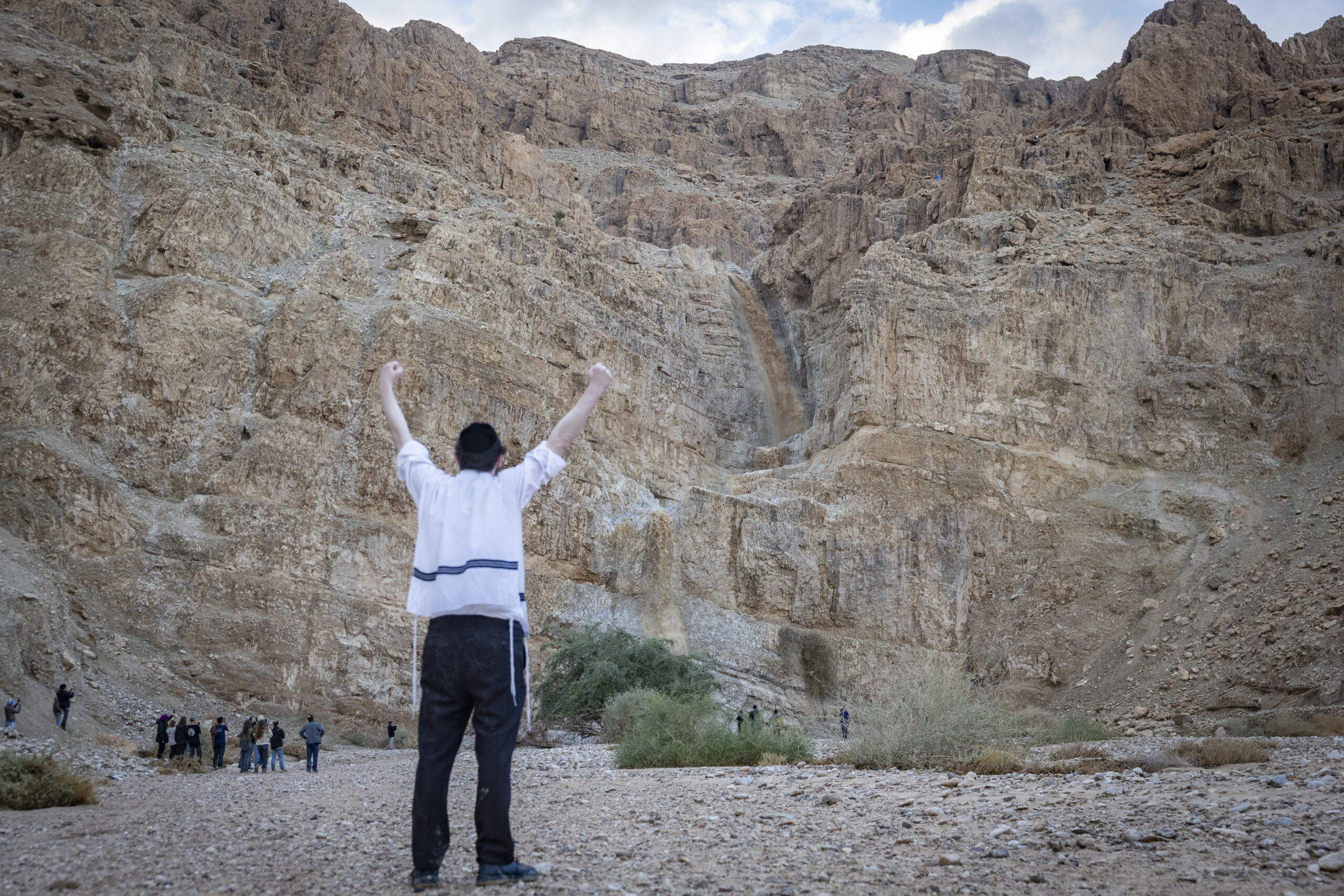
Rain fell across Jerusalem, the Judean Desert, and the Golan Heights on Saturday in amounts that have not been recorded at this time of year in over a century, breaking multiple all-time August records and sending flash floods through desert streambeds that had never flooded in August before.
Ma’ale Adumim recorded 26 millimeters of rain over the course of the day, including 11 millimeters in a single hour, the most rain the region has ever measured in the month of August. According to the Meteorological Service, it was only the fourth time on record that more than 20 millimeters of rain fell anywhere in Israel during August, joining previous events in the Golan Heights in 2012, Kfar Blum in 1971, and Zichron Yaakov in 1920.
Jerusalem itself received roughly 5 millimeters in a downpour lasting several hours, but the significance was cumulative rather than singular. The Meteorological Service reported that total July-August precipitation in Jerusalem this year was the highest recorded in approximately 170 years.
אזור מעלה אדומים pic.twitter.com/vpPnbVbrLs
— 02ws ירושמיים (@YERU02WS) August 15, 2026
Flooding in the Desert
Rain began falling in northern Israel around 3 p.m. Saturday before moving south into Jerusalem and the surrounding hills within the hour. The storm continued for several hours over the Jerusalem Hills, flooding parts of Ma’ale Adumim and prompting rescue crews to assist affected residents.
Nahal Og, a streambed north of the Dead Sea, flooded for what the Meteorological Service said was the first time on record at this point in the summer calendar. Route 90 near the Dead Sea was temporarily closed as a precaution. The Israel Nature and Parks Authority urged the public to stay clear of flowing streams and riverbanks until water levels fully receded, and additional rain was expected Sunday afternoon in the Jordan Valley, the Judean Desert, and the Dead Sea region, with officials warning of further flooding and advising against nonessential travel to those areas.
Meteorologists are linking the storm to the developing “Super El Niño,” a Pacific Ocean climate event expected to peak in December that is already disrupting weather patterns on nearly every continent. Summer drizzle is not unusual along Israel’s coastal plain, occurring roughly once every two years, but rainfall in the 5-to-10-millimeter range is far rarer inland, happening on average only once every five to ten years. Rain in double digits as far south as Jerusalem and the Dead Sea basin is considered an extremely rare or unprecedented event. Israel is an arid country by design of its calendar as much as its climate: roughly 70 percent of its average annual rainfall falls between November and March, and June through August are ordinarily dry months entirely.
Rain as Covenant, Not Coincidence
That ordinary dryness is not incidental to Jewish practice. It is built directly into the liturgy: the request for rain is inserted into the daily prayers only at the end of Sukkot in the autumn and continues until Passover in the spring, when the request shifts to dew instead. The practice traces back to the Bible’s own description of rainfall not as a weather pattern but as a direct response to the covenant between the Jewish people and Hashem. “If, then, you obey the commandments that I enjoin upon you this day, loving Hashem your God and serving Him with all your heart and soul, I will grant the rain for your land in season, the early rain and the late, and you shall gather in your new grain, wine, and oil” (Deuteronomy 11:13-14).
Jewish tradition treats rainfall as one of the clearest visible points of contact between the physical world and divine providence. The Talmud states plainly that “the day on which rain falls is as great as the day on which heaven and earth were created” (Taanit 8b), and the blessing recited over rain in the Amidah, the Standing Prayer said three times daily, is grouped together with the blessing praising Hashem’s power to resurrect the dead. The connection is not accidental. Watching dry hillsides covered in yellow, brittle grass suddenly break into green after rain falls is, in traditional Jewish thought, treated as a small, seasonal image of the same principle that governs resurrection: dormant matter restored to life by the same divine will that first assigned it life. Even the mechanics of rainfall are, according to the Tanach and later liturgical poetry, entrusted to a specific angelic force, Af-Bri, mentioned in the Book of Job and later in the Sukkot rain prayer composed by the liturgical poet Eleazar Kallir over a thousand years ago: “From the breath of God He gives forth ice, and the breadth of waters in a flood. Af-Bri burdens the cloud; he scatters His rain cloud, and he turns around in circuits by His guidance for their work, whatever He commands them upon the face of the habitable world, whether for the rod, whether for His land, or for kindness that He cause it to come” (Job 37:10-14).
Rain in the Month the King Comes to the Field
This storm fell during Elul, the Hebrew month that immediately precedes Rosh Hashanah and the Yamim Noraim (the Days of Awe), and Chassidic teaching describes this specific month in strikingly intimate terms. Elul is the month, the teaching holds, when “the King goes out to the field to meet with His people, greeting them with kindness and tenderness, displaying a joyous face to all.” Unlike the rest of the year, when approaching a king requires formal audience through the throne room, Elul is described as the one stretch of the calendar when the King leaves the palace entirely and stands out in the open field among His people, approachable by anyone, regardless of standing, simply for having shown up. The appropriate response, in the same teaching, is that we in turn “open our hearts to Hashem.”
Unseasonal rain during this exact window carries weight in Jewish thought precisely because rainfall itself is treated as a direct communication from that same King, not background weather. A storm this rare, landing in the very month tradition holds open for that meeting, arriving as a resurrection-linked blessing normally withheld from the land for months at a stretch, reads in traditional terms less like an anomaly and more like a gesture. The Sages already tied rainfall to the day of creation and to the resurrection of the dead. Both concepts, creation and resurrection, sit at the center of the redemption Jewish tradition awaits at the End of Days, when the dead are returned to life, and the physical order of the world is renewed entirely. A record-breaking, out-of-season rain arriving in the month the King comes out to meet His people, days before the world stands in judgment on Rosh Hashanah, is not proof of anything in itself. But in a tradition that has spent thousands of years reading rainfall as a direct message rather than a random event, it is not the kind of week that goes unnoticed either.