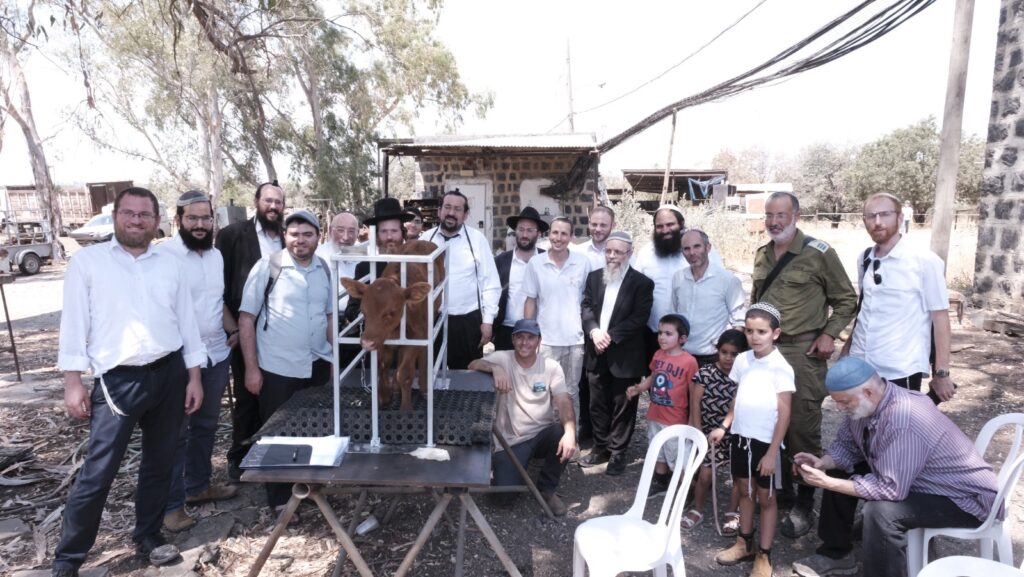
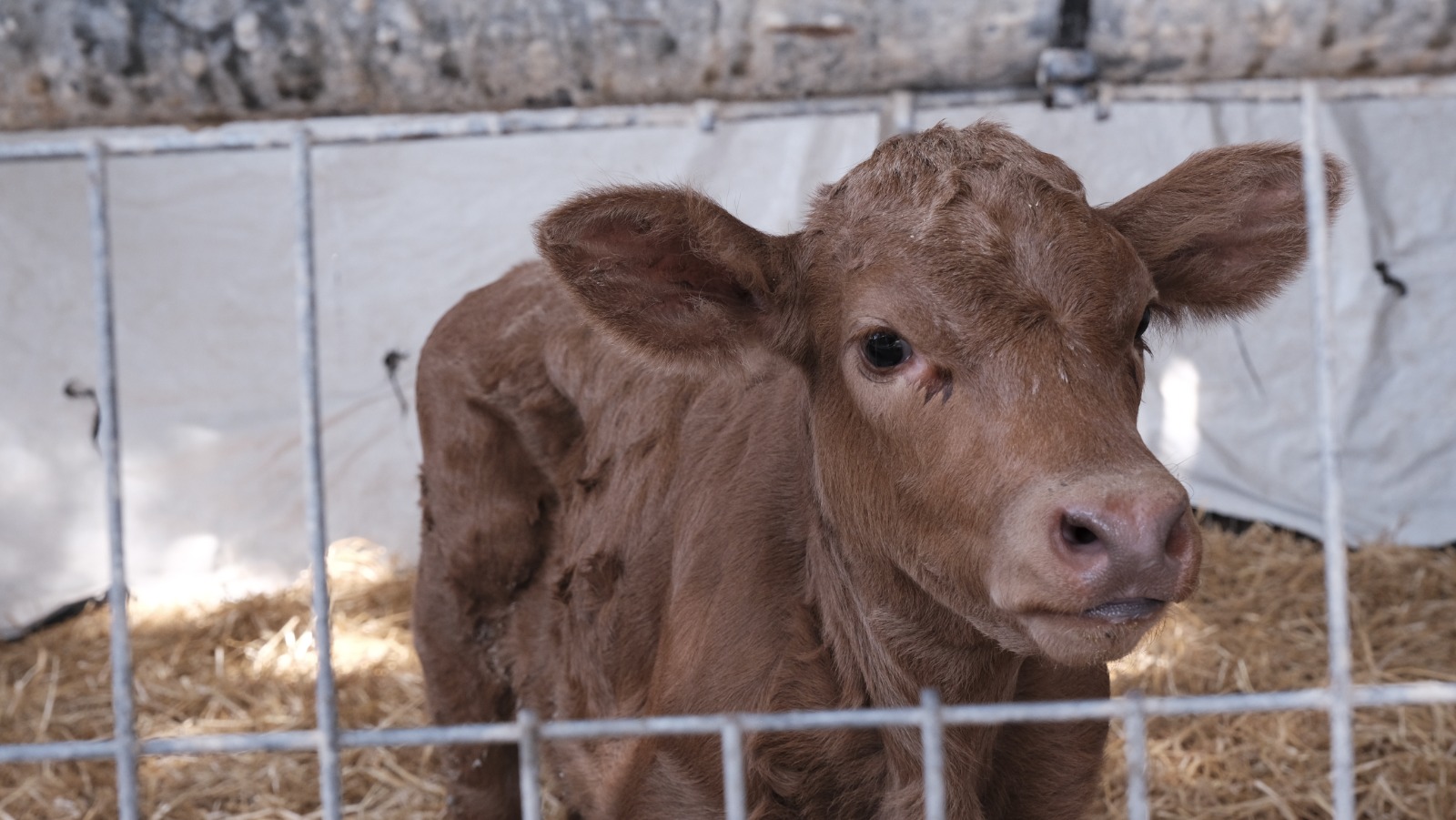
A calf was born in a dairy barn in the Jordan Valley last week, and on Rosh Chodesh Elul, a delegation of rabbis stood over her, running their hands through her coat. She was the third heifer of her kind to be born in Israel this season, joining two others already under watch in the Galilee and the Golan Heights. Together, the three calves represent the most concrete progress yet toward a goal Jewish tradition has pursued since the destruction of the Second Temple: raising a red heifer whose ashes can restore ritual purity to the Jewish people.
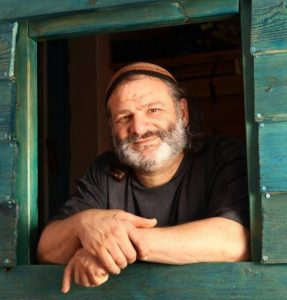
The examinations were carried out by the Beit Midrash, the rabbinic study hall, of the National Institute for Red Heifer Research, a body that unites religious Zionist, Litvish, and Hasidic rabbis around a single national mission. Members of the Institute traveled to all three farms in a single sweep, checking the calves from tail to head for the disqualifying flaws that have derailed nearly every red heifer candidate in living memory.
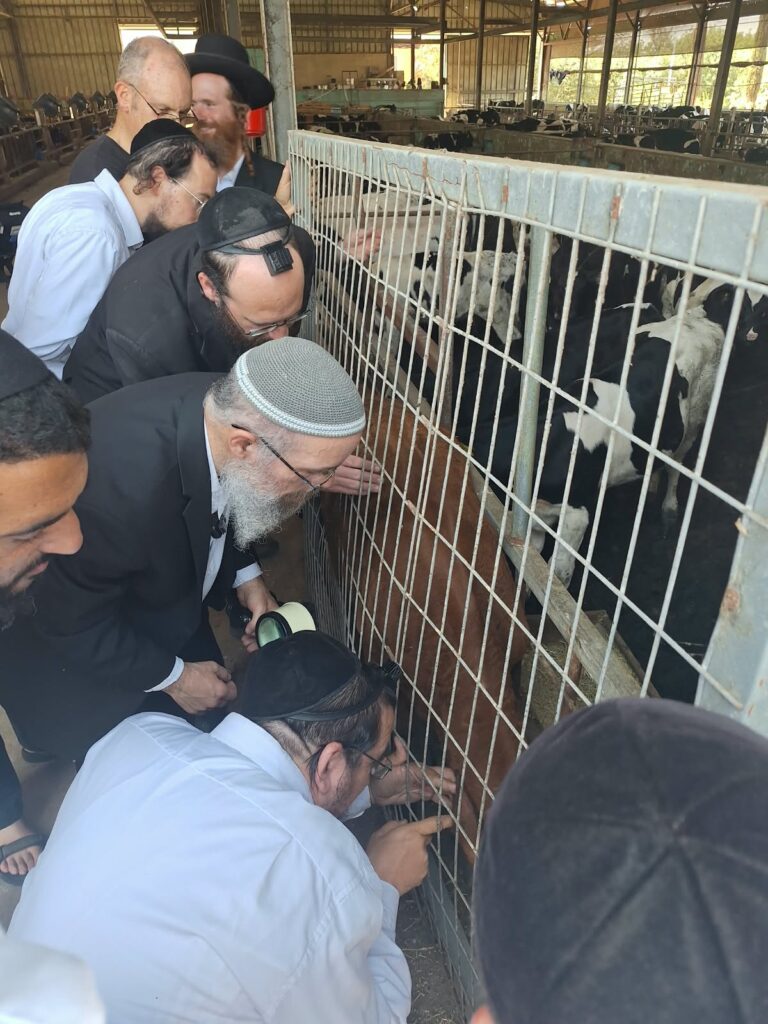
The requirements come directly from the Hebrew Bible. “This is the ritual law that Hashem has commanded: Instruct the Israelites to bring you a red cow without blemish, in which there is no defect and on which no yoke has been laid” (Numbers 19:2). Since the Second Temple’s destruction nearly two thousand years ago, the ashes of such a cow have been unavailable, leaving every Jew in a state of ritual impurity from contact with the dead, a status the Bible calls tumat met. Without those ashes, the purification described in the Torah cannot take place, and full Temple service cannot resume. That is why a light hair on a newborn calf is not a minor veterinary detail. It is the difference between a heifer that can eventually serve the nation and one that cannot.
Beit Rimon: Temimah’s Ear Begins to Heal
The first stop was Beit Rimon in the Galilee, where the heifer given the name Temimah, meaning “unblemished” or “whole,” was examined three months after her birth. Temimah’s case has been the most closely watched of the three, because a farmhand attached an identification tag to her ear shortly after birth, before anyone recognized what she might become. The tag raised concern that it may have caused a disqualifying blemish.
The examination was conducted in the presence of the local rabbi, Rabbi Yechiel Tzur, with the Institute’s team checking Temimah from tail to head, a process the Institute has said requires exceptional expertise in the relevant halachic laws. The verdict was encouraging. The team reported that she is indeed temimah, unblemished, both in the redness of her hair and in the physical integrity of her body. The hole in her ear is healing well and appears to be moving toward classification as a temporary blemish, which, according to the ruling of the Institute’s Beit Midrash, does not disqualify her.
Yehudiya: A Question the Sages Never Had to Answer
The second stop was the Golan Heights herd of Shai Givon, the artificial insemination specialist whose work for the company Piryon has now produced two red heifer candidates from his own barns. This calf, born just before Tisha B’Av, has no ear tag. Aware of what a single puncture had already cost Temimah’s case, the Institute chose not to tag her.
Her complications are internal rather than visible. She was born a twin to a male calf, and cattle are one of the few species in which twin fetuses in the womb can share a connected blood supply between their placentas. When that happens, the male twin’s hormones can cross into the female twin and permanently affect her reproductive organs, leaving her what veterinarians call a freemartin and Jewish law would recognize as an aylonit, a female incapable of ever conceiving. The examination at Yehudiya also turned up several lighter-colored hairs on her coat, a detail that drew Rabbi Aharon Eisental into the discussion alongside the Beit Midrash’s own scholars. Rabbi Azaria Ariel, head of the Institute’s Beit Midrash, offered a measured assessment: “In any event, it is reasonable to assume that these hairs will darken in the future, enabling us to approve their color according to all halachic opinions.” On the question of her uterus, Rabbi Azaria said his latest research has left him confident that the calf can still be rendered a potential red heifer, a question the Sages of the Talmud never had occasion to confront, since freemartinism was not a concept available to them.
Givon has described the pace of these births as more than coincidence. Following the birth of the calf in his herd, he said he has fielded questions from across the Jewish spectrum, from Hasidim and Litvaks to secular and religious Jews alike, and called it a sign that the Jewish people are “more attuned than ever to the Temple and to restoring purity to Israel.”
The Jordan Valley: A Calf Born Without a Single Flaw
The third and newest heifer was born only last week in a dairy barn in the Jordan Valley, at Shadmot Mechola, an agricultural community founded in 1984 on the northern stretch of the valley. Her birth is, on its face, the most improbable of the three. She was born to a light-colored cow sired by a black bull, a combination that would ordinarily not be expected to produce a solid red calf.
Yakir, who manages the calf department at Shadmot Mechola, described the delivery himself. “Usually, the cows give birth on their own, but in this case I had to assist her,” he said. “During the delivery, I suddenly saw a calf with a reddish color. It was remarkable, since she was born to a light-colored cow and a black bull. I immediately called the supervising rabbi to receive instructions.”
Yehuda Ben-Tzvi, coordinator of the Mikdash Educational Center, led the rabbinic tour of all three farms. He explained to Israel365 News that the calf is not considered a candidate for the mitzvah of a red heifer until it has been inspected and certified by rabbinic authorities. The inspection requires going through an exhaustive list of potential blemishes that may be present.
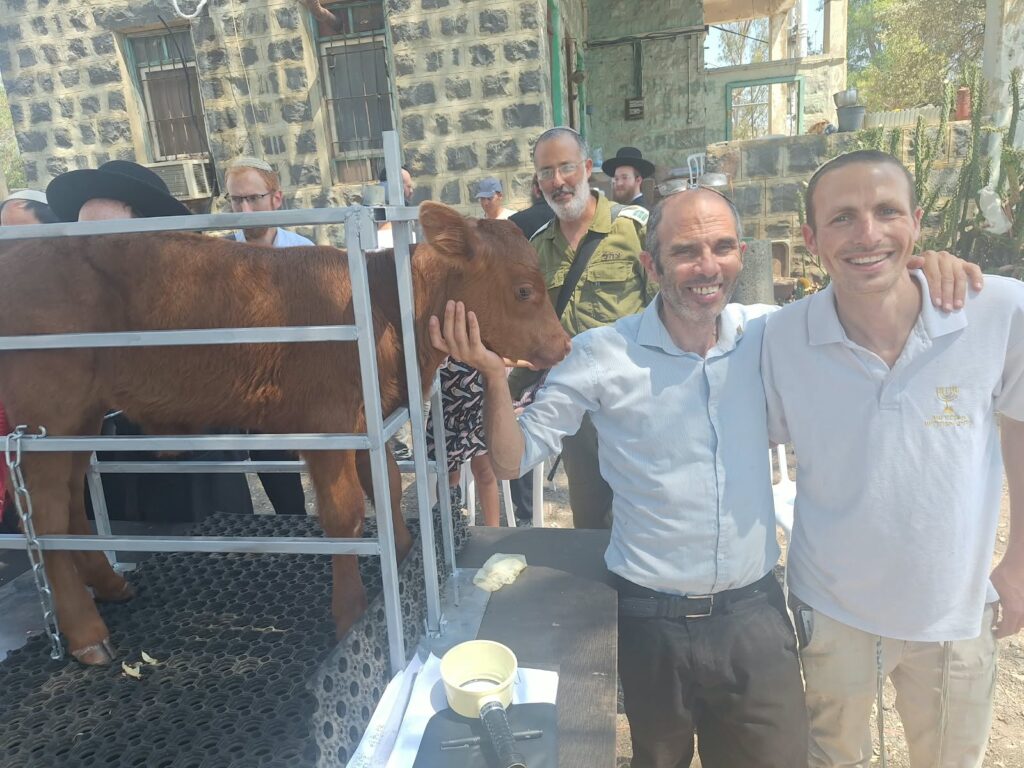
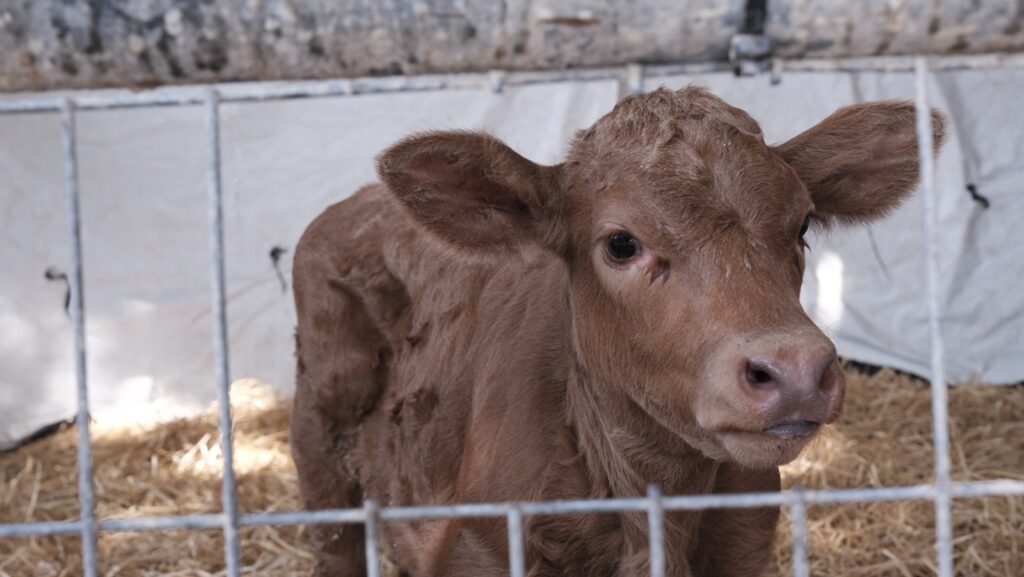
The comprehensive examination that followed turned up no visible blemishes. No off-color hairs, no injuries, no irregularities of any kind were recorded. Of the three calves inspected that week, she is currently the closest to the Bible’s description of an animal “without blemish, in which there is no defect.”
“Redeemed Even While It Is Upon Its Pyre”
Rabbi Azaria Ariel described a moment of recognition standing in the Jordan Valley barn. “Today, for the first time, I understood the words of Rabbi Shimon regarding the red heifer,” he said, “that if a more suitable one is found, the cow may be redeemed even while it is upon its pyre. This describes a reality in which a suitable red heifer has already been found, and yet another, even better one, may be found within a very short period of time. Indeed, we have now merited to see three heifers born within a relatively short span of time, with the latest one appearing even more promising than the previous ones.”
“There is still a long road ahead of us,” he said. “Nevertheless, as we approach the year 5787, we can announce that the people of Israel are indeed moving toward raising a herd of red heifers and advancing the process of restoring ritual purity to Israel after 2,000 years of exile. With God’s help, in the near future we hope to announce where the heifers will be displayed and raised until they grow from calves into two-year-old cows.”
The National Institute’s leadership has framed the three births as part of a coordinated national undertaking rather than a series of isolated events. The Institute’s Beit Midrash is still required to rule on approximately ten complex halachic questions that demand in-depth study, and intends to consult with leading Torah authorities in order to build the broad halachic support needed to restore ritual purity to the people of Israel in the coming years, in a historic national event in Jerusalem.
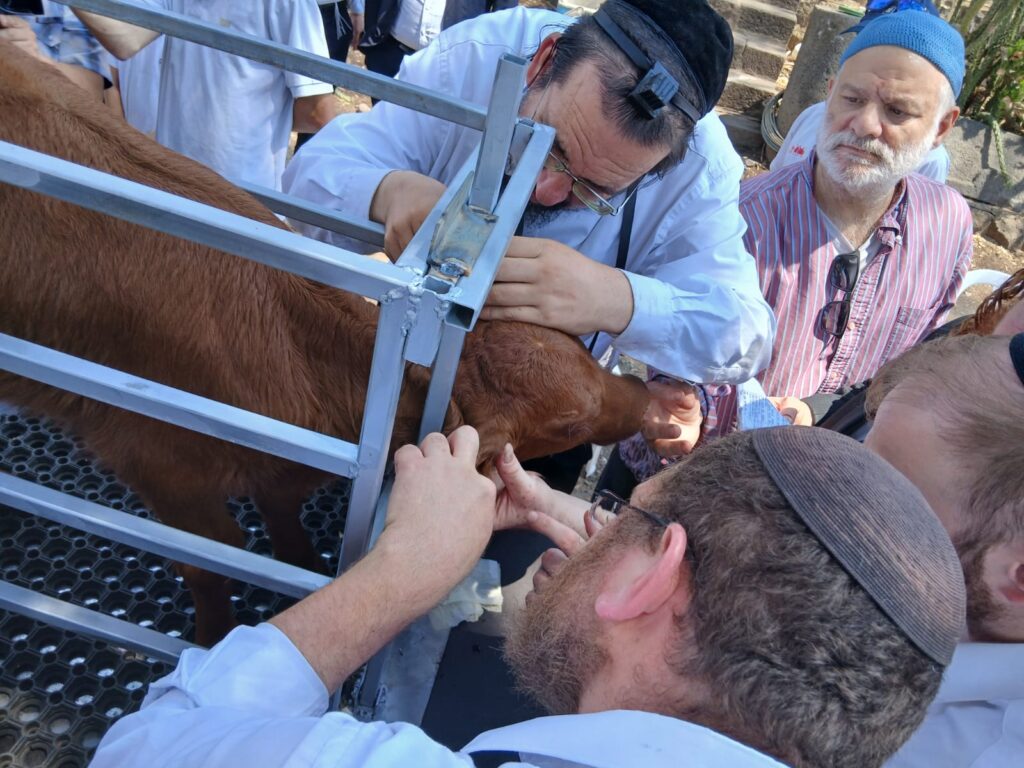
None of the three calves born this season are yet old enough to serve their purpose. Jewish law requires a red heifer to be at least two years old before her ashes can be prepared, and each animal must maintain her unblemished status without interruption until that day arrives. What changed this season is not that the requirement became easier to meet. It is that, for the first time in living memory, three candidates are being raised toward that requirement at once, on three different farms, in three different regions of the same land their ancestors were exiled from two thousand years ago.