

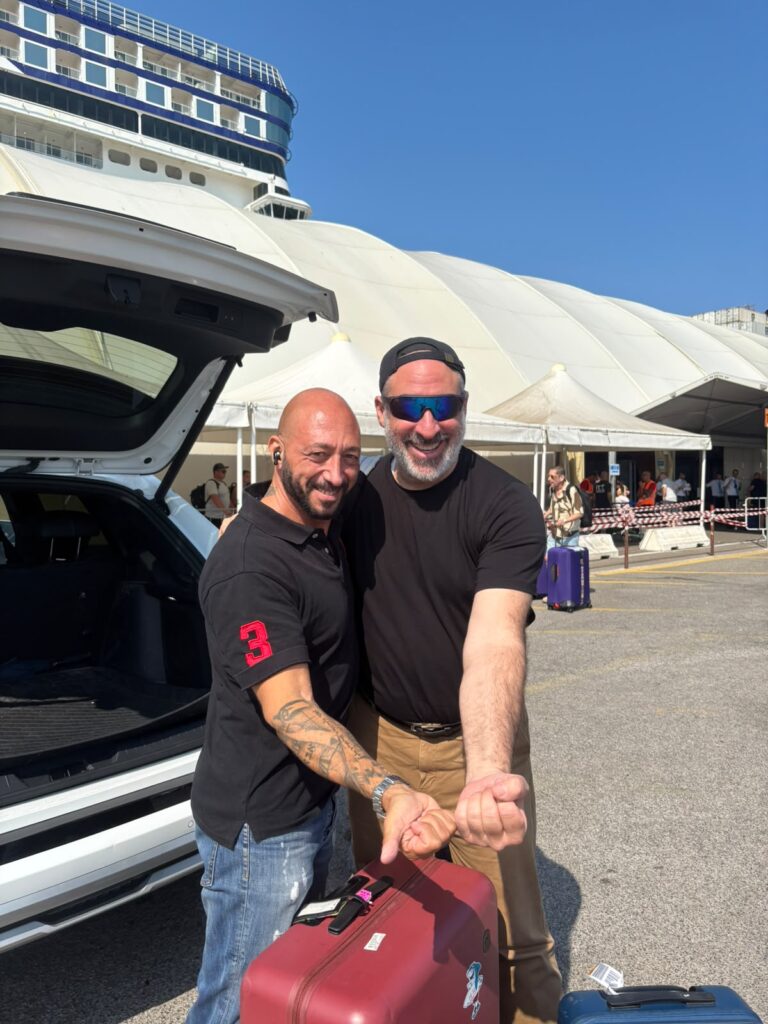
A taxi pulled up outside a hotel in Rome last week to pick up Goel Jasper and his wife. The driver stepped out to help with the bags, glanced at Jasper’s baseball cap, then looked at his wife’s mitpachat (the scarf head covering worn by married Orthodox women in Israel). “Where are you guys from?” he asked. When they answered Israel, he said, “I knew it,” and rolled up his sleeve to reveal a tattoo running the length of his arm: Hebrew words wrapped around a map of Israel. The driver was Jewish by birth. He was an Italian man in his fifties who, somewhere along the way, had connected so deeply with the Jewish people that he etched the language and land into his skin.
For Jasper, the newly appointed global head of communications for the Yael Foundation, the encounter was not a curiosity. It was proof of the argument his organization has staked its entire mission on: Jewish identity is not primarily a matter of religious observance, and it is not primarily a defense against antisemitism. It is a peoplehood, and it can be planted, nurtured, and carried by anyone who has ever been given the chance to feel it.
The foundation takes this imperative directly from the Hebrew Bible. In the words of the Shema, the declaration observant Jews recite twice daily, Moses commands the nation: “And you shall teach them diligently to your children, and shall talk of them when you sit in your house, and when you walk by the way, and when you lie down, and when you rise up” (Deuteronomy 6:7). The verse commands transmission, in the home, on the road, at the beginning and end of the day, from one generation directly into the next. Jewish continuity was meant to survive because it is taught, deliberately and repeatedly, to children.
From Communications to a Cause
Jasper grew up in Philadelphia and attended university in Washington, D.C., expecting, in his words, “a very nice American sports fan life.” That changed during the Second Intifada, when he traveled to Israel with his rabbi on a solidarity mission. “I realized that I was wasting my time living outside of Israel, and needed to move to Israel ASAP,” he said. His wife had already reached that conclusion a decade earlier. The family made aliyah in 2004.
His career, however, stayed rooted in the corporate world for another two decades. Starting in 1993, Jasper worked in public relations for high-tech and telecom companies, representing clients that included Dunkin’ Donuts. He calls his younger self “a selfish capitalist.” On the side, he sat on the board of Ptil Tekhelet, the organization credited with restoring the tekhelet, the blue thread commanded in the tzitzit, and hosted a program about aliyah on Israel National News for seven years. Those causes stayed on the side of his life, not at its center, until October 7.
“This is like enough is enough,” Jasper said. “I need to devote my life to this, and not just the time when I’m away from work, but I have to figure out a way to have this be my work.” He needed an organization whose mission matched that shift. He found it at the Yael Foundation.
What the Yael Foundation Actually Does
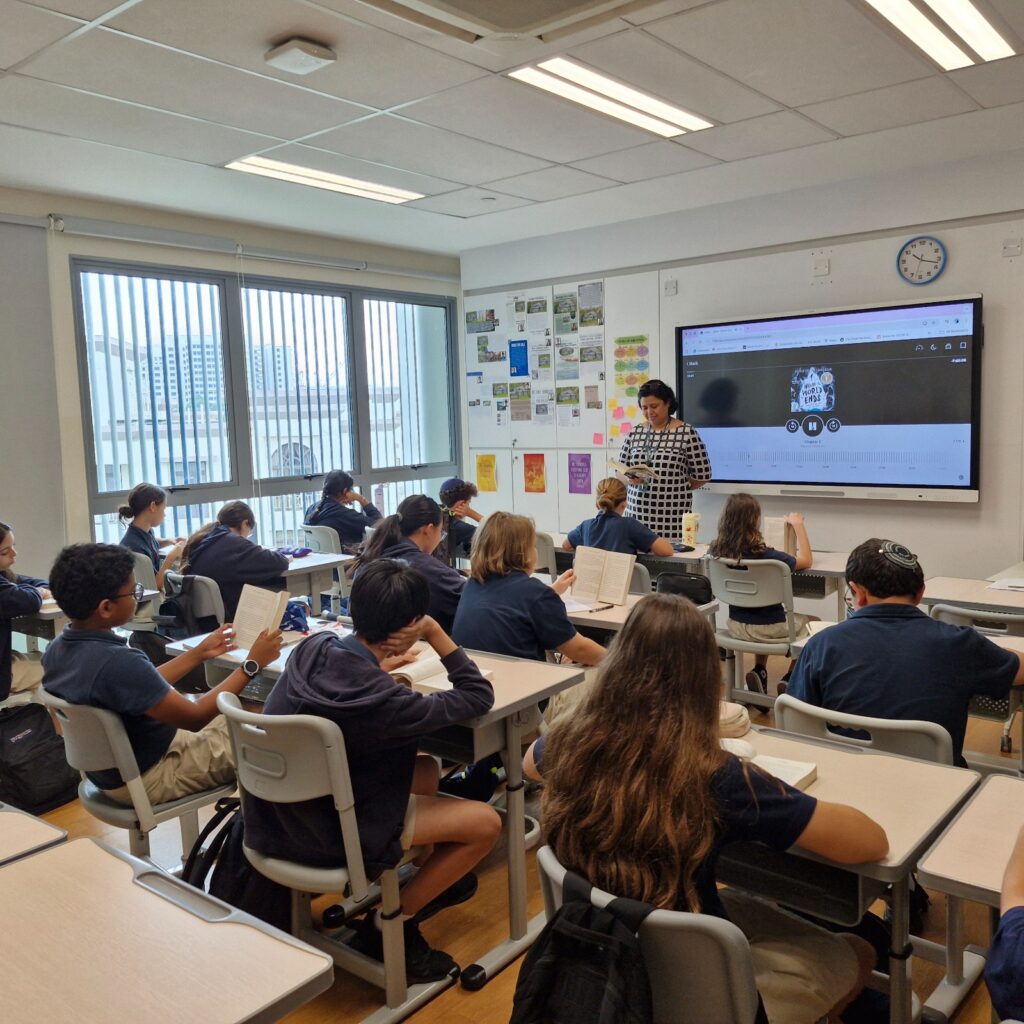
The Yael Foundation was founded in 2020 by Uri and Yael Poliavich. Uri Poliavich, born in Ukraine, did not learn about Judaism until his family made aliyah when he was thirteen. He built his fortune as founder of the iGaming company Soft2Bet before turning to philanthropy. By early 2026, the foundation was funding 64 day schools, 20 Sunday schools, 18 kindergartens, and 11 after-school programs across nearly 40 countries, including Turkey, Kyrgyzstan, and Gibraltar, and had distributed roughly $47.5 million in grants over the previous year to some 130 schools, educators, and programs.
Jasper described the foundation’s philosophy in blunt terms. “The philosophy of our founders is Jewish parents are going to send their kids to the best school available to them,” he said. “So we need to make sure that the Jewish schools are the best schools. The Jewish school in Bulgaria is the best in the country. The Jewish school in Finland is the best school in Helsinki.” The strategy is not to prop up struggling institutions but to make Jewish schools the obvious first choice for any family in the city, Jewish or otherwise.
That approach does not require religious uniformity. “They are not necessarily religious schools,” Jasper said, though many are philosophically Orthodox even while drawing students “from all different backgrounds.” He pointed to the Jewish school in Istanbul, which the foundation supports and which is not Orthodox, as an example of the network’s range. Poliavich has framed the underlying conviction in similarly direct language, saying the foundation aims not merely to be the largest Jewish educational organization in the world but “to create the future of the Jewish people and the people of Israel.”
Investing in Children, Not Real Estate
Jasper recalled a line Poliavich gave in an interview roughly six months earlier, when a reporter asked why the foundation was investing in small, shrinking Jewish communities rather than letting them fade. “I’m not investing in the real estate of the Jewish communities,” Poliavich said, according to Jasper’s account. “I’m investing in the children, and each of these children can be one of our leaders in the future, but not if they don’t have a chance to understand what it means to be Jewish.”
Understanding what it means to be Jewish, in Jasper’s telling, is exactly the outcome the Yael Foundation is built to produce. “Your education early in your life plants some seeds of positivity in your mind about what it means to be Jewish, and when you need to access those files, so to speak, you access them,” Jasper said.
Jasper was equally direct about what the foundation is not trying to do. “The issue is, can Jewish kids receive the kind of education so that they feel confident in their Jewishness, that they feel proud to be Jewish, that they feel connected to Jews everywhere else in the world,” he said, adding that the goal has little to do with teaching children how to respond to antisemitism. He pushed the point further: “If antisemitism hadn’t been coined as a phrase to mean those who are against Jews, antisemitism could very easily have been the phrase used for Jews who don’t have an understanding of what it means to be Jewish.” The foundation, he said, is fighting for something closer to “pro-Semitism,” a confident Jewish identity built on pride rather than fear.
The Case for Children Over Adults
Jasper argued that the foundation’s focus on young children, rather than adults, is not incidental but strategic. He paraphrased a rabbi he once heard speak in Baltimore about aliyah, who told a room full of adults in their thirties, forties, and fifties: “None of this really matters because I don’t care about you. I want your children.” Jasper called the framing “the perspective we have to have,” explaining that persuading a forty-six-year-old of anything is rarely an efficient use of limited resources, while “helping a four-year-old feel happy about being Jewish” can shape an entire life.
He was careful to draw a distinction. “I’m not talking about Jewish ritual, keeping kosher, keeping Shabbat,” he said. “Just happy about being Jewish.” He described Judaism itself as something to be marketed on its own merits to children who do not yet carry any resistance to it. “Judaism is a great product,” he said. “It has everything you need.” A jelly doughnut on Hanukkah, chocolate coins, a Purim costume: for a child, he said, these are simply enjoyable, and the enjoyment becomes the doorway to something deeper. Many of the children the foundation reaches, he added, come from families that have never held a Passover seder, making the first goal something as basic as offering a child matzah for the first time.
The foundation does not treat secular education as secondary to Jewish content. “It’s no less important to educate them on technology,” Jasper said. “We need to make sure that Jewish kids are educated in secular subjects as well, so that they know that they have the capabilities necessary for living a good, positive life in this world.”
Rebuilding After October 7
Jasper was blunt about what October 7 meant to his own family. His son deployed that day; a future son-in-law was sheltering in a besieged yeshiva in the south two days before he was scheduled to marry Jasper’s daughter. “I could talk about October 7 for a very long time,” Jasper said, “but October 7 happened. And our job, as always as Jews, is: where do we go from here.”
He described the massacre as a chilul Hashem, a desecration of God’s name, on a scale unseen “probably since the Holocaust,” and said the devastation extended to Jews around the world who were already only loosely connected to their own identity. “We’ve got to repair how Jews around the world feel about being Jewish,” he said. “We’ll leave the battles to people like my son and my sons-in-law. But there’s another battle, and that is to make sure that Jews feel good about their Jewishness, and it starts with the kids. It always starts with the kids.”
He offered a specific example: a boy from Germany, raised in a secular home, who attended a fully funded Yael Foundation summer camp serving 600 children at no cost to their families. He came home and told his parents he wanted to have his bar mitzvah at the Western Wall and asked to begin putting on tefillin. His parents, according to Jasper, had no framework for the request. “That’s where we need to be focusing our energies,” Jasper said. “Let the soldiers deal with the soldiers. They’ve got it under control.”
Jasper called the foundation’s response to October 7 “the most Jewish response,” describing an unbroken line of transmission running from Mount Sinai to the present. “Even in the darkest periods, even in the worst of times, we were teaching our kids,” he said. “We never lost that.”
The Living Chain
Jasper’s closing argument returned to the same idea that opened the conversation: identity, once planted, does not disappear, even when it lies dormant for decades. The tattooed taxi driver in Rome, the German boy who now wants tefillin, the college dropout who found his way back through a Hebrew school he attended as a child, are all the same story told at different ages. None of them needed to be taught to fear antisemitism. They needed, at some point in their lives, someone to teach them what there was to be proud of.
That is the wager the Yael Foundation has made: that the Jewish people’s future will not be secured primarily by better security or louder advocacy, but by four-year-olds who grow up already knowing, without having to be convinced, that they belong to something old, something global, and something worth carrying forward.

