


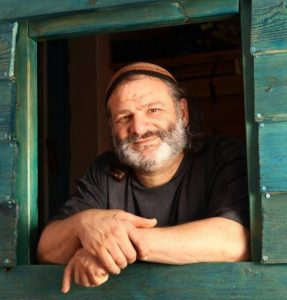

Rabbi Pinchas Winston sat down with host Aaron Sol on the Parsha Inspired podcast on August 10 to explain why the Third Temple isn’t simply a more magnificent version of the first two, and why he thinks artificial intelligence, of all things, offers one of the clearest windows into what the Temple actually was.
“The Third Temple will dwarf the other two,” Winston said. “It’ll be a whole different level of experience.” The problem, he explained, is that human beings can only understand something new by comparing it to something they’ve already lived through, “and we haven’t had anything in our lifetime, in the last couple thousand years, that compares to what the Temple reality actually was. It’s hard to describe because it is outside of our experience. But you have to build the picture, because that’s what’s going to happen.”
Even the Second Temple, for all its physical beauty, fell well short of the first. “The Talmud speaks about five things that were missing,” Winston said. “It was a beautiful building — anyone who didn’t see the building that Herod finished off never saw a beautiful building their entire life. But spiritually, we didn’t have the level of miracles, the level of connection to God, that we had in the First Temple.” And the Third Temple, he stressed, isn’t simply a bigger, more famous upgrade of that beauty. Israel today already builds gorgeous synagogues, he noted, “beautiful woodwork and lighting and everything.” The Third Temple “is not like that at all. It’s a whole different reality.”
The Tablets Moshe Broke on Purpose
Winston’s central image for explaining the gap between the temples is the two sets of tablets Moshe brought down from Sinai. “He broke the first set of tablets,” Winston said, “not because he was sloppy, not because he was careless, because he was making a point. In fact, I go so far as to say that when he broke the first set of tablets, he actually broke spirituality.”
The difference, he explained, comes down to how knowledge itself functions. Had the first tablets survived intact, “if you learn something, it automatically would have become” part of you — no effort required. “That was the reality of it. That was what we call Torat Mashiach, messianic Torah. It was a Torah that we’re going to see in the future once Mashiach comes.” The second tablets, which Moshe himself carved even though God wrote upon them, work differently: “That already tells you it was a lesser level of Torah… You can read it front to back and it won’t automatically change you. That’s the work that you have to put in to get to it.” Winston ties the distinction directly to the Temples themselves. “The first tablets actually correspond to the First Temple, and the second tablets correspond to the Second Temple,” he said. “And you don’t need the third set of tablets, because the Third Temple is forever. It’s going to last forever, God willing.”
He pointed to a striking statement in the Talmud, in Tractate Berachot, that anyone who possesses da’at, true internalized knowledge, is considered as though the Temple had been built in their generation. “How is it possible that somebody, even if they’re a genius and they know all of Torah — how is that comparable to building a physical altar, going up on the Temple Mount, rebuilding the Temple?” Winston asked. The answer, he said, lies in what da’at represented at the level of the First Temple: a return to the state of Adam before the sin, “when you learned something you only had to be aware of it, and it automatically changed you as a person. That was the First Temple. It was this reality of God that you were enveloped by.”
To illustrate what that lost, effortless connection actually felt like, Winston pointed to the Sinai revelation itself, where the Israelites reportedly died and were revived twice simply from hearing God speak the first two commandments. “It was sensory overload. The body couldn’t handle it,” he said. “The nicest way to die, according to the Gemara, is called neshikah, which means kiss. It’s a divine kiss… an exposure of God that’s so overwhelming for the body and the soul that the soul gets sucked out of the body like a vacuum cleaner pulling out dust with a carpet, and the body can’t hold the soul anymore, and it dies, but with the greatest pleasure. It’s saved for righteous people” — Moshe, Aharon, Miriam, Yaakov, and Sarah among them. After the second near-death experience, the people asked Moshe to receive the rest of the Torah on their behalf, telling him, “this living, dying, living, dying thing is a little bit much for us.” The Midrash, Winston noted, says they could still hear God speaking after that, “but it wasn’t so directly anymore, and therefore they didn’t die.”
Eve, the First User of Artificial Intelligence
Winston’s most provocative claim in the conversation is that artificial intelligence isn’t a modern invention at all. “If I were to ask you, who do you think was the first person to use artificial intelligence, who would you say?” he asked Sol, who guessed the 1956 Dartmouth conference where the term was coined. “They’re not the first ones to use artificial intelligence,” Winston said. “Who was the first one to use artificial intelligence? Eve. She was the one, right? She didn’t have a computer.”
The point, he explained, is definitional. Real wisdom, in his framework, moves through stages named in the first blessing of da’at in the Shemoneh Esrei: chochmah, binah, and da’at, sometimes rendered as discernment or integration. “The first one is simply factual information. Binah is understanding,” Winston said. “But this third category, that’s the tricky one.”
The three terms build on each other rather than sitting as three separate types of the same thing. Chochmah is the raw spark of an idea as it first arrives, often described in this tradition as sudden and intuitive rather than reasoned toward, closer to a flash of insight than a conclusion worked out step by step. Binah is what happens once that spark gets developed, analyzed, and built into a structure you can examine and follow the implications of, closer to what people usually mean by understanding in the ordinary sense. Da’at, which Winston used interchangeably with haskel, is the step most people skip: not a third piece of information alongside the first two, but the internalization of chochmah and binah to the point where knowledge stops being something merely possessed and becomes something a person actually is, knowledge moved, in Winston’s own phrase, “from the head to the heart.” The same word is used elsewhere in the Bible for intimate connection, which the tradition treats as no coincidence: real knowledge, on this reading, is closer to a bond than a fact on file.
He traced the distinction back to the two central trees in the Garden of Eden, the Tree of Life and the Etz HaDa’at Tov V’Ra, the Tree of Knowledge of Good and Evil. Eve’s mistake, he said, wasn’t wanting understanding. “She’s not interested in the physical taste of it. She wants to understand. That’s the word haskel.” Her error, according to the Zohar, was skipping the process entirely. “The tree was never meant to be forbidden forever. God didn’t make a tree that should exist as a forbidden tree forever,” Winston said. “She should have eaten from the Tree of Life at the same time… and then not only would the knowledge not have damaged her, it would have brought her closer to God. The snake knew that, and that’s why he pushed her away from it and into the Tree of Knowledge instead.” Her real error, Winston said, “was taking a shortcut. She wasn’t going from da’at to haskel like you’re supposed to, because there are no shortcuts to wisdom.”
That framework, Winston argued, is exactly how to think about AI today. “In order to become a wise person… there are no shortcuts to wisdom. You could become a knowledgeable person easily today. You just sit in front of the computer for hours a day, going from website to website to website. Does it make you a better person in the end? Does it make you closer to God in the end? No, not necessarily, and unlikely. On the contrary, it results in a lot of scams in the end.” From the Torah’s perspective, he said, “anytime a person tries to shortcut the system, tries to get wisdom without going through the process of da’at to haskel — you literally work on yourself, you investigate, you get an understanding of the material, but not just that, you become one with it — you can call it artificial intelligence. It’s not the real thing.”
He drew the same contrast through the biblical figure of Bilaam versus Moshe. “Everything that Moses learned went from his head down to his heart. It stopped here on Bilaam,” Winston said.
“He talks about God like he knows Him… he says, ‘I can’t say anything that God will not let me speak.’ He literally sounds like a tzaddik, and then he goes ahead and does exactly the opposite. How’s that happen?” The answer, he said, usually isn’t hypocrisy. “A lot of times it’s because people don’t feel in their bones, in their life, ideas that are so part and parcel of who we are that if you violate the idea, it feels like a violation of the self.” He illustrated the point with a story he read decades ago about a man who accidentally killed someone, escaped detection entirely, and turned himself in anyway. “He said the pain of living free, but knowing that I did something wrong and not paying for it, was overwhelming, and he’d rather go to jail.” Winston compared this to Talmudic cases of people commanded to kill or be killed themselves, who choose death. “That’s what we call the love of haskel,” he said. “That’s what’s supposed to be going on inside the yeshivas when people learn Torah. Unfortunately, we’re not taught this. People don’t realize it, and they think it’s enough just to know the material backwards and forwards, and then we wonder why there are so many inconsistencies between what people know and how they behave.”
Winston isn’t opposed to the technology itself. “I’ve used it for editing lately,” he said, “and part of the fun of it has been how it takes something that I write intuitively and sends back to me what I’ve accomplished with it, what I said, how this works. And I didn’t have that in mind.” Sol added a line from Rabbi Tuvia Singer on the same subject: “AI never gets insulted. If you tell it you’re absolutely wrong, it says, ‘I’m sorry,’ and that’s the end of the conversation. It doesn’t hold a grudge.” Winston’s concern is purely about substitution, using AI or any shortcut to bypass the internal work wisdom actually requires, not the tool itself.
A Recurring Pattern: Given, Withdrawn, and Earned Back
Winston framed the entire structure of the conversation, from Eden to Sinai to the Temples, as one repeating pattern. “There’s always a pattern in Judaism that we’re given something for free. We’re shown what it could be like, and then we’re taken away, and then say, okay, now try to get to it,” he said. “This happens countless times. It’s just a pattern that happens, even through the Nevi’im.” The Garden of Eden was the first instance; the giving and breaking of the tablets was the next. He cited a numerical detail from a commentator on a recent parsha: the gematria of a key word came to 172, matching the letter-count difference between the first and second sets of tablets, “to tell us that even though Moshe broke the first set of tablets, you can still access them through the second set, but you have to work on it.”
He connected this directly to the Three Weeks the Jewish people had just observed at the time of the interview. “The whole point of the Three Weeks is that we’re supposed to focus on what it means to have the Temple, so that we’ll mourn for it once again, and only then does God see that we’re ready for it.” He tied the same pattern to where history is heading now. “We talk about the War of Gog and Magog, we talk about Armageddon, end of days scenarios… we’re being brought up to speed, whether we realize it or not, and specifically the Jewish people. The transformation from this stage of history to the messianic stage of history is like going to space, and even more so — it’s going to be such a transformation of the fabric of reality that people will drop dead in the shock.”
Every Person Is a Potential Temple
The conversation’s throughline connects directly to Winston’s book, “House of God,” which argues the phrase is meant literally rather than as a figure of speech. The Temple, he said, “wasn’t just a synagogue that God happened to visit, and he was the chief rabbi of the synagogue there. That wasn’t what it was. He imbued it with Himself. The stones themselves.” He illustrated the point with the Talmudic account of Nebuzaradan’s destruction of the First Temple, where a heavenly voice reportedly dismissed the general’s triumph as no real feat at all: “No big deal. You’re grinding already ground flour, and you’re killing already killed people.” As Winston explained it, the Temple could never actually have fallen while God’s presence remained within it. “What happened was the Jewish people, by not using it properly, compelled Me to leave those stones and leave it as a stone building. Now it’s just another building.” He noted that something once used for holiness retains a lesser, residual holiness, “but not the same level. Now it can be destroyed.”
Winston also retold the Talmudic story of Herod and the blind sage Bava ben Buta as an explanation for why the Second Temple was built so magnificently despite the spiritual level being lower than the first. Herod, paranoid about his illegitimate claim to the throne after seizing it from the Hasmonean line, had ordered nearly all the leading rabbis of his generation killed, sparing only a few, including Bava ben Buta, whom he had blinded. Still suspicious, Herod disguised himself and questioned Bava ben Buta at length, testing whether he still harbored resentment. “He answered correctly the entire time. He was so good at it that Herod was impressed,” Winston said, and Herod admitted that had he known the rabbis were so careful in what they said, he wouldn’t have killed them. Asked how he could make amends, Bava ben Buta told him: “You extinguished the light of the world by killing off all these rabbis. Put some of that light back in by building the Temple.” Herod agreed and did so. “This building wasn’t just built from marble, fancy colors of marble matching the sky,” Winston said. “It was built in place of the rabbis who died for the sake of God and Torah. That’s what this building is.”
But the book’s real argument, Winston said, is that the same principle of indwelling applies to individual people, grounded in God’s instruction in the book of Exodus: And let them make Me a sanctuary, that I may dwell among them. (Exodus 25:8) “The literal reading of the verse is that God is simply saying, I can be amongst you, the nation. Let’s build the Tabernacle, I’ll be there, you go there, and we’ll all be one big happy family,” Winston said. “But the rabbis go ahead and say, no, it’s literal. It means amongst them — within you.” He pointed to prophetic depictions of the Third Temple’s layout, which resemble a human figure, with the altar positioned where a heart would be and the Holy of Holies where the brain would sit. “It literally looks like a human being, because it is a human being,” he said. “We were always meant, there’s always meant to be a Temple… but more than that, we are always supposed to be the Temple.”
That thesis echoes a classical idea with its own biblical anchor, one Winston didn’t cite directly but that runs through the same tradition: the concept of a mikdash me’at, a “diminished sanctuary,” drawn from God’s promise to the exiled people through the prophet Ezekiel: Yet I have been to them a diminished sanctuary in the countries where they have come. (Ezekiel 11:16) The Talmud identifies that diminished sanctuary with the synagogues and study halls Jews built in exile, places carrying a fragment of the Temple’s holiness even in its physical absence. Winston’s argument in “House of God” pushes that same principle one step further inward, from a building that stands in for the Temple to a person who does.
Winston connected this back to why the Torah is famously silent about the Temple’s location in the text itself, referring only to “the place I will cause My name to dwell,” despite the site atop Mount Moriah having been known since Abraham bound Isaac there. “Why does God act mysteriously about the whole thing?” Winston asked, noting the same pattern applies to the land promised to Abraham, and to the Torah’s use of the name “Canaan,” after the morally corrupt nation that lived there, rather than “Israel.” His answer: “Israel is not a geographic location. It happens to have a location. It’s what you make it by living up to a standard of life… You want it to be Israel, you have to make Israel, by going into the land, elevating the sparks out of the impurities, by living by Torah on the land. You transform it into Israel.” The same principle, he said, governs the Temple site itself. “I cannot call it the place of the Temple until you get to the level where you’re fitting for a Temple. Then that will make it the place, finally.”
Believing Leads to Seeing
Sol connected Winston’s argument to his own memory of his late rebbi, Rav Asher Zelig Rubinstein, whose certainty in God, he said, “wasn’t that he believed in God, he knew God was there.” Sol also raised a teaching from Rabbi Moshe Dovid Valle, the Ramdu, an eighteenth-century Italian kabbalist and close disciple of the Ramchal, on why a Jewish body carries unusually high impurity after death: “because its potential is so high.” Sol connected this to the physical stones of the land itself, citing the prophet’s description of the gemstones the future Jerusalem will be built from: Isaiah 54:12.
Winston closed the conversation by returning to the difference between vertical and horizontal learning, an idea he said he once heard from a rebbi of his own. “Before you marry, your learning is vertical. You’re adding and you’re adding, always getting more and more,” Winston recalled being told. “When you get married, your learning becomes horizontal… reality has this incredible way of educating us about what we don’t know, because we fall short, and we find out that we didn’t have that strength that we thought we had.” That, he said, is what the Mishkan itself was ultimately about. “If I could sum it up in one line, it made reality real.”
He pushed the point further into questions of perception itself, noting that even physicists now entertain simulation theory, the idea that reality may not be what it appears to be. “Unlike what the Greeks taught us, seeing can lead to believing, but often doesn’t,” Winston said. “If anything, believing leads to seeing.” He tied this back to the verse from Psalms that opened the conversation, “that which is wondrous in our eyes is from God,” and flipped it. “If you don’t see God in everyday life, in the miracles happening to you, it’s because you stopped making life wondrous,” he said, invoking the Rambam’s teaching that people take health for granted until illness reminds them what it was worth. “Rather than wait for crisis… use your brain. That’s what it’s given for.”
Winston closed with a story he attributed to Rabbi Berman, about a man whose friend was struck by a car, thrown into the air, and walked away unhurt, yet showed no visible shift in his relationship with God afterward. Asked why, the friend said simply, “It happened to my friend. It didn’t happen to me.” For Winston, that story captures the challenge of the present moment precisely. “We can witness redemption stare us in the face,” he said, “and we still say, God, is this really happening? Is this really the whole change, the whole world?”
“House of God” is available on Amazon in paperback, hardcover, and Kindle editions, and as a PDF through Winston’s website, thirtysix.org.