


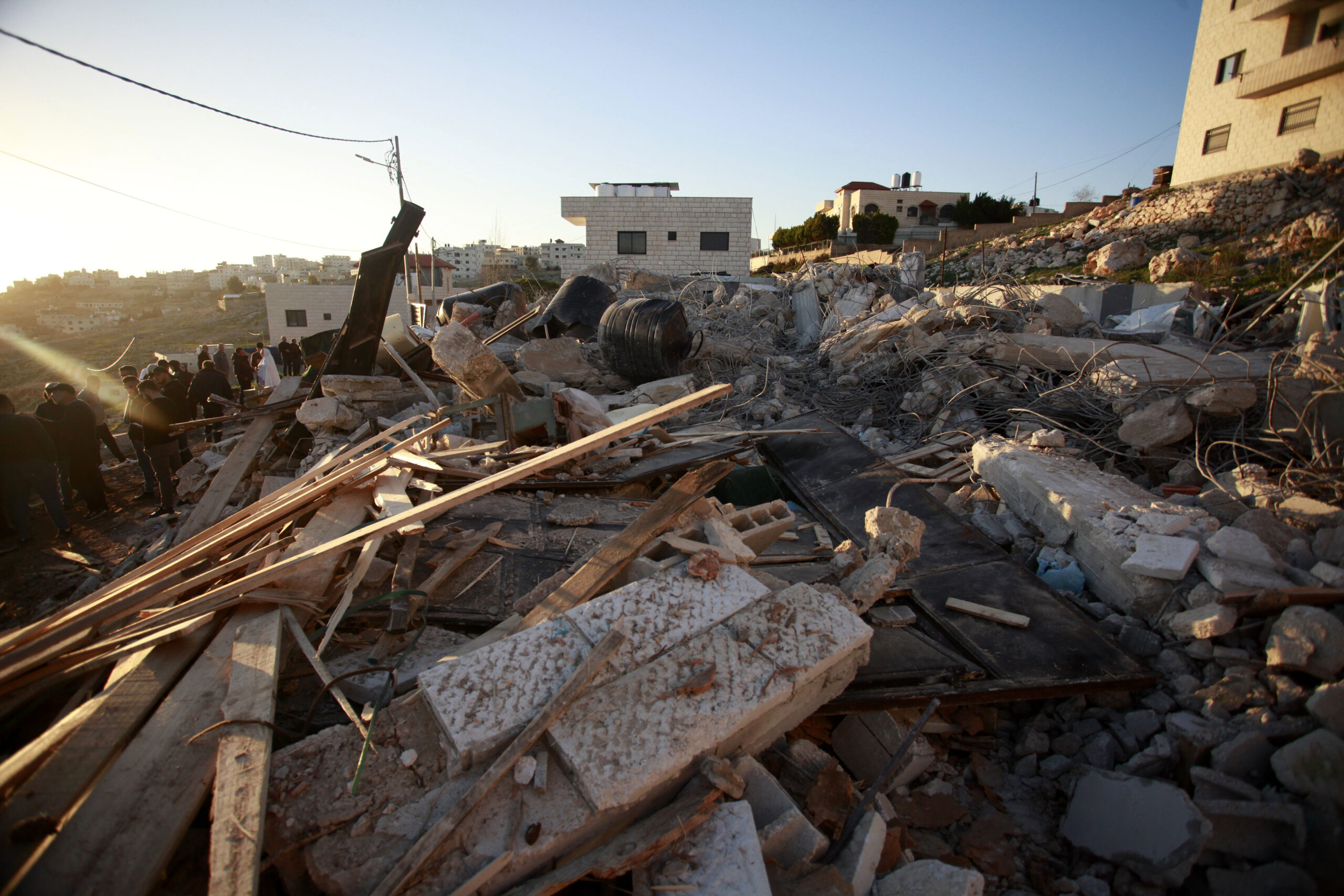
A newly released Civil Administration report shows Israel demolished 956 illegal Palestinian structures in 913 separate enforcement actions across Area C in 2025, the highest level of enforcement recorded in four decades. The Regavim Movement, which has spent years tracking what it calls a systematic Palestinian campaign to seize control of the territory, says the numbers mark a genuine break from a long pattern of official neglect. “We are witnessing a dramatic change on the ground, and now the numbers prove it,” the organization said.
The report’s most significant finding may be a simple comparison: 2025 was the first year on record in which the number of illegal structures demolished actually exceeded the number newly built. Roughly 75% of the structures addressed during the year had already existed before 2025 began, meaning enforcement is finally working through a backlog rather than only keeping pace with new construction. Overall, the Civil Administration recorded 1,258 cases of illegal Palestinian construction during the year and issued 1,005 demolition orders. The report also credits the sustained enforcement of the past two years with creating real deterrence, pointing to a measurable slowdown in illegal building in the Jordan Valley, in military firing zones, along major transportation corridors, and in areas adjacent to Israeli communities.
Regavim credited the shift directly to political leadership. “We commend Minister Bezalel Smotrich and the Settlement Directorate for leading the determined policy that produced these results,” the organization said, framing the moment in stark terms: “Israel is at a critical and historic turning point. We are committed to demanding that this trend continue and that Israel’s national interests be protected.”
A Campaign With a Name and a Blueprint
What the Civil Administration report calls the “battle for Area C” is not, in Regavim’s telling, a series of scattered violations. It is the visible surface of a deliberate strategy that has a name, a founding date, and a funding source. The report itself documents hundreds of Palestinian Authority and internationally funded projects spanning construction, agriculture, infrastructure, roads, and water systems, all aimed at establishing a permanent Palestinian presence in Area C, the roughly 60% of Judea and Samaria that remains under full Israeli civil and security control per the Oslo Accords. Among the projects tracked over the years, 465 were funded directly by the European Union.
The strategy traces back to 2009, when then-Palestinian Authority Prime Minister Salam Fayyad laid out what has become known as the Fayyad Plan, a methodical program for building the physical and institutional infrastructure of a Palestinian state inside Area C specifically, without waiting for or requiring a negotiated agreement with Israel. An article in the Palestine-Israel Journal of Politics, Economics and Culture, describing the plan’s early implementation, noted that Fayyad, “with the help of the Barack Obama administration and the European Union, has been quietly building national institutions and physical infrastructure” across the territory since August 2009. The approach was designed explicitly to bypass negotiations altogether and instead create irreversible facts on the ground, homes, schools, roads, and public buildings that would make any future Palestinian claim to the land harder to unwind regardless of what any peace process eventually produced.
The European Union’s role in that strategy goes beyond the individual projects Regavim tracks, and the scale of it is worth stating plainly. The EU maintains a standing program, the European Joint Development Programme for Area C, carrying an annual budget of roughly €300 million specifically earmarked for construction in the same Israeli-controlled territory the Fayyad Plan targets, and a separate government report found the EU had invested some $500 million cumulatively in illegal PA construction across Area C. That funding stream is precisely why 465 of the projects the Civil Administration has tracked over the years carry EU financing specifically, out of the hundreds of Palestinian Authority and internationally backed projects the report catalogs.
What makes the funding pattern harder to explain as ordinary humanitarian assistance is where the money does not go. The EU runs no comparable donor-funded construction program in Area A, the roughly 18% of Judea and Samaria under full Palestinian Authority civil and security control, where Palestinians can build without any Israeli permit at all. The program’s own stated rationale is that Palestinians living in Area C face “serious limitations” on development that Palestinians elsewhere do not, since construction in Area A requires no outside funding push to begin with, there being no Israeli permitting process to work around in the first place. In practice, that reasoning means EU money flows specifically and exclusively toward building inside the one part of Judea and Samaria still under Israeli control, and not toward the much larger area already under full Palestinian administration, a funding pattern that lines up precisely with the Fayyad Plan’s original goal of establishing facts on the ground inside Area C specifically, rather than with any broader effort to address Palestinian housing or development needs across the territory as a whole.
The scale of the resulting land loss, before the current enforcement surge, was substantial. Regavim data presented to the Knesset’s Land of Israel Lobby found that between 2019 and 2021 alone, Palestinians built 5,097 new illegal structures in Area C, roughly seven new illegal buildings added every single day, bringing the total illegal Arab structures in the zone to 72,274. Over the same two-year window, a parallel Palestinian Authority-guided agricultural takeover added 7,125 dunams of land under Israeli control to a running total of 93,071 dunams. Meir Deutsch, CEO of Regavim, described the pattern in blunt terms at the time: “The PA is shaping the borders of the Palestinian state with its own hands and setting facts for Israel on the ground. This is a failure on the scale of the Yom Kippur War.”
Why Enforcement Lagged, and Why That May Be Changing
Israeli officials have been aware of the scope of the problem for years without matching it with enforcement at scale. Naftali Bennett, while serving as defense minister in 2019, told European ambassadors directly that illegal construction they financed would be destroyed by Israel regardless of its funding source, and the Defense Ministry acknowledged at the time that the phenomenon was one of Bennett’s central priorities. But researchers examining COGAT’s practices found that the coordination body responsible for enforcement was, for years, choosing not to exercise its full legal mandate, holding back specifically under sustained EU diplomatic pressure. COGAT officers routinely negotiated informal arrangements with Palestinian Authority officials to leave infrastructure built under the Fayyad Plan’s master blueprint standing, reserving actual demolitions for the rare cases involving direct security concerns, structures near IDF firing zones, major roads, or sites tied to terrorist activity. These demolitions reliably drew heavy international media coverage and condemnation whenever they did occur.
Finance Minister Smotrich, whose Settlement Directorate now oversees the enforcement effort Regavim is crediting, has described the underlying dynamic directly: “Arab illegal construction has become systematic and serves as a tool to promote the Fayyad Plan… that aims to establish a de facto Palestinian state.” He has framed the Civil Administration’s more recent work as a direct countermeasure, describing an “organized and strategic work plan” specifically built to halt the progress of agricultural infiltrations and illegal building before they can become permanent facts on the ground.
The 2025 numbers suggest that a shift in strategy is now showing up in the data rather than just in rhetoric. A demolition total exceeding new construction for the first time in the enforcement report’s history is precisely the kind of reversal Regavim has been pressing Israeli governments to produce for more than a decade, and the organization’s own framing of the moment, a “critical and historic turning point,” reflects an expectation that the coming year will show whether 2025 was the start of a sustained reversal or a single strong year against a campaign that has had a fifteen-year head start.
