

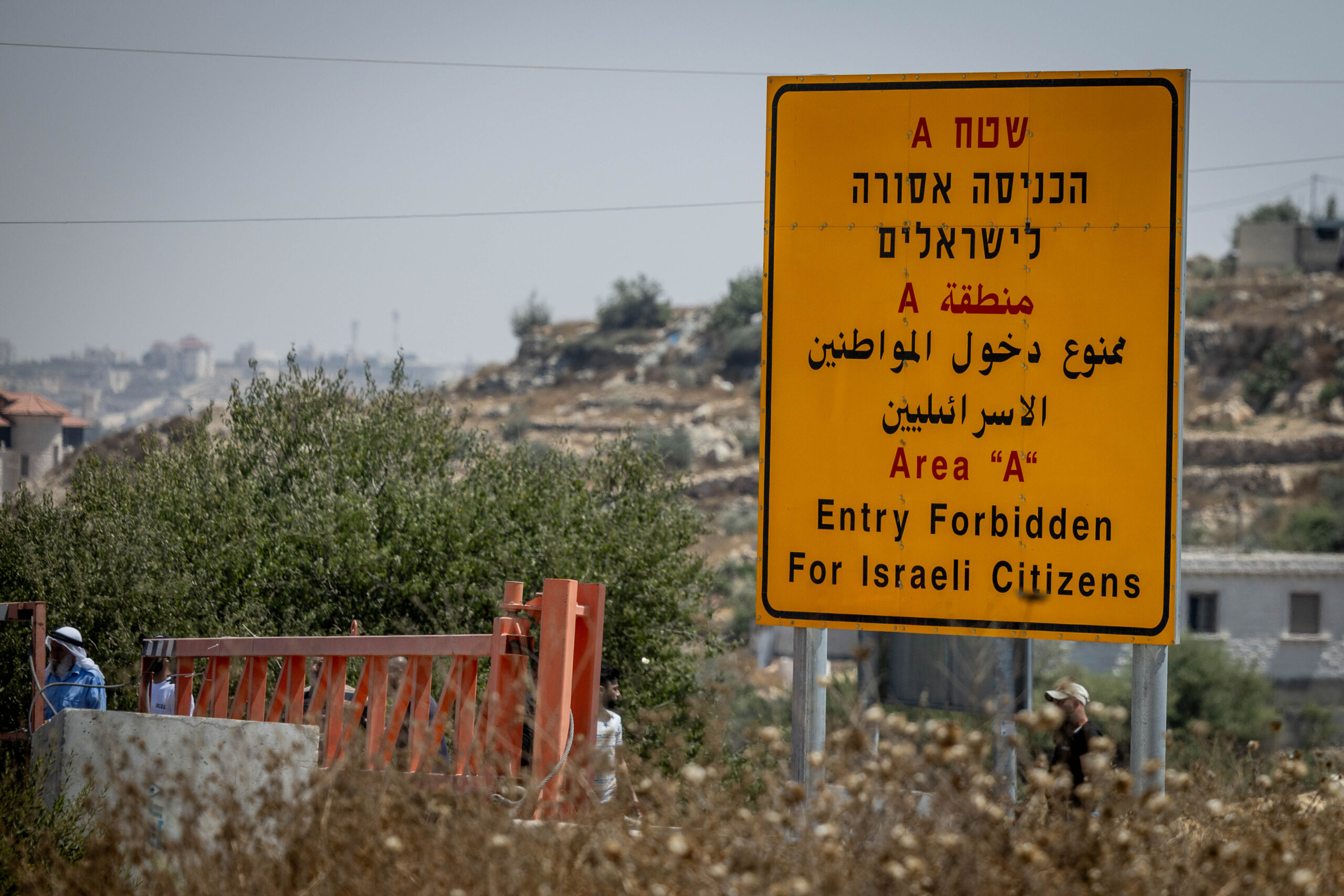
A mother and her son, residents of Samaria, survived an attempted lynching last Thursday after accidentally driving into Jenin while on their way to meet friends in Afula. The mother told Israeli media that she only realized they had been routed into the city when dozens of Arabs surrounded their vehicle, tried to force the doors open, and hurled stones at the car. She managed to break free and kept driving until she reached an IDF force; neither she nor her son was injured, though their car was damaged. The IDF confirmed the two civilians had mistakenly entered the urban area of Jenin and were attacked by terrorists throwing stones, and that forces subsequently entered the city to arrest wanted suspects. The military repeated a warning it has issued many times before: entry into Area A is prohibited, dangerous for Israelis, and a violation of Israeli law.
The Religious Zionist Party responded within days by installing new directional signage on major roads across northern Samaria, aimed specifically at preventing the kind of navigation error that put the mother and son in danger. “Northern Samaria is a flourishing region, renewing itself through settlement. The entire Israeli public is welcome to come, travel and visit without fear,” the party said, adding that “terror is not allowed to control the roads.” The party framed the signage as serving a dual purpose: reducing wrong turns into Area A cities and strengthening the broader Israeli public’s familiarity with and connection to Jewish communities across northern Samaria.
A Pattern With a Long, Documented History
The Jenin incident fits a pattern stretching back a quarter century, one grim enough that it has its own name in Israeli public memory: the Ramallah lynching.
On October 12, 2000, at the outset of the Second Intifada, IDF reservists Vadim Nurzhitz and Yosef Avrahami missed a checkpoint and drove into Ramallah, an Area A city, where Palestinian Authority police took them into custody at a local station rather than turning them back. A rumor spread that undercover Israeli agents were being held inside, and a mob of more than a thousand people, drawn partly from a nearby funeral procession, stormed the station. Nurzhitz and Avrahami were beaten, stabbed, and mutilated; one was thrown from a second-story window. A Palestinian man named Aziz Salha appeared at the window afterward, displaying his blood-soaked hands to the cheering crowd below, an image that became one of the defining photographs of the conflict. Salha was eventually sentenced to life in prison, then released in 2011 as part of the prisoner exchange for Gilad Shalit; Israel confirmed he was killed in a 2024 airstrike in Gaza. Other participants have continued to be released in the years since, including Raed Sheikh, a Palestinian police officer who took part in the killings, freed as part of a Gaza-related deal in 2025, and Hatam Faiz Khalil Magari, whose sentence was reduced on evidentiary grounds before he was deported to Gaza. According to Palestinian Media Watch, PA officials still honor participants in the lynching to this day, more than a quarter century later.
The pattern has continued well past 2000. In March 2023, two German tourists, Gerald Hetzel and a friend, drove an Israeli rental car with Tel Aviv municipality branding into Nablus. A crowd surrounded the vehicle within minutes, banging on the windows, hurling stones and a traffic sign, and stabbing the tires before pulling a knife on one of the men. “It was a very, very dangerous situation, and we really thought they wanted to kill us,” Hetzel told Israeli television afterward. A PA spokesman said the crowd believed the two men were undercover IDF soldiers, a claim consistent with the same “undercover agent” rumor that triggered the Ramallah lynching twenty-three years earlier. The two Germans escaped on foot through side streets.
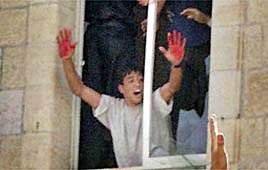
By Italian TV crew of Mediaset channel via Wikipedia
Fatalities have continued, not just near-misses. In June 2024, Amnon Muchtar, a 67-year-old Israeli from Petah Tikva, was shot and killed while buying produce for his vegetable stall in Kalkilya, another Area A city. Two months later, a second Jewish Israeli was shot and seriously wounded near a car repair shop in the same city. Israeli media have documented a steady stream of additional close calls in recent years: a family of five who got lost near Nablus in 2016 and were handed over by Palestinian security forces directly to the IDF rather than to a crowd, an off-duty IDF servicewoman extracted from Jericho by Israeli security forces this past July, and Israelis pulled out of Nablus by the Civil Administration in May. Israeli police have repeatedly acknowledged that many of these incidents begin exactly the way last week’s did in Jenin: with a wrong turn rather than a deliberate crossing.
A Symbol That Traveled to Hollywood
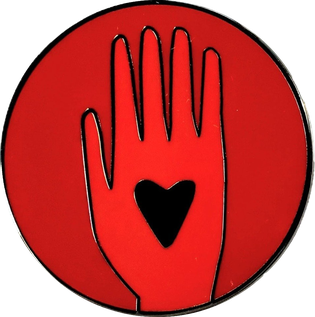
The imagery from that Ramallah police station window has resurfaced in a setting far removed from Area A. At the 2024 Academy Awards, and again the following awards season, a coalition called Artists4Ceasefire distributed red pins, a hand in front of a red background, and encouraged Hollywood figures to wear them on the red carpet. Billie Eilish, Finneas O’Connell, Mark Ruffalo, Ramy Youssef, Ava DuVernay, and Mahershala Ali were among those photographed wearing them. To many Israelis, the resemblance to Aziz Salha’s blood-soaked hands at the Ramallah police station window was immediate and unmistakable, not a coincidence of design but the same image repackaged as a red-carpet accessory. Noa Tishby, who briefly served as Israel’s antisemitism envoy, called the display “tantamount to a display of Jew-hatred.” The Brigade, a coalition of roughly 700 pro-Israel producers, agents, and executives, put the comparison even more bluntly the following year, after the campaign’s organizers sent their pin request out on the same day the bodies of murdered Israeli children Kfir and Ariel Bibas were returned from Gaza: “In 2000, Palestinian terrorists in Ramallah lynched two innocent Israelis, ripped them apart limb by limb, and held up their blood-soaked hands to a cheering mob. That infamous image is now your ‘ceasefire’ badge. Is this ignorance? Or is this deliberate, calculated malice?”
Whether or not any individual celebrity wearing the pin knew the history behind the image, the horror of the coincidence is hard to overstate. A gesture built and marketed as a plea for peace happened to reproduce, almost exactly, the single most infamous act of anti-Jewish mob violence to come out of Area A, an image Israelis have spent twenty-five years unable to unsee, now applauded on a red carpet rather than condemned outside a police station window.
The Sign Says “Forbidden.” It Doesn’t Say to Whom.
Buried inside this pattern is an irony worth stating plainly. Bright red warning signs are posted at the entrances to Area A cities, in Hebrew, Arabic, and English, reading: “This road leads to Area ‘A’ under the Palestinian Authority. The entrance for Israeli citizens is forbidden, dangerous to your lives, and is against Israeli law.” The prohibition, as written, applies to every Israeli citizen regardless of ethnicity or religion. In practice, it is enforced almost exclusively against Jews. Arab Israelis cross into Kalkilya, Jenin, Nablus, and other Area A cities routinely, for family visits, cheaper shopping, car repairs, and religious holidays, and Israeli security forces generally do not attempt to stop them or penalize the crossings. An Israeli army spokesperson confirmed the law technically applies to all Israelis, not just Jews, when directly pressed on the disparity by a columnist in the Jerusalem Post, who asked plainly why Arab Israeli citizens are effectively exempt from a law that, on its face, binds them just as much as any Jewish citizen. The army’s own answer, relayed to that columnist, was that barring Arab Israelis from visiting family in Area A would be inhumane, and that a camera-and-fine enforcement system aimed only at Jewish drivers would itself be legally impermissible discrimination.
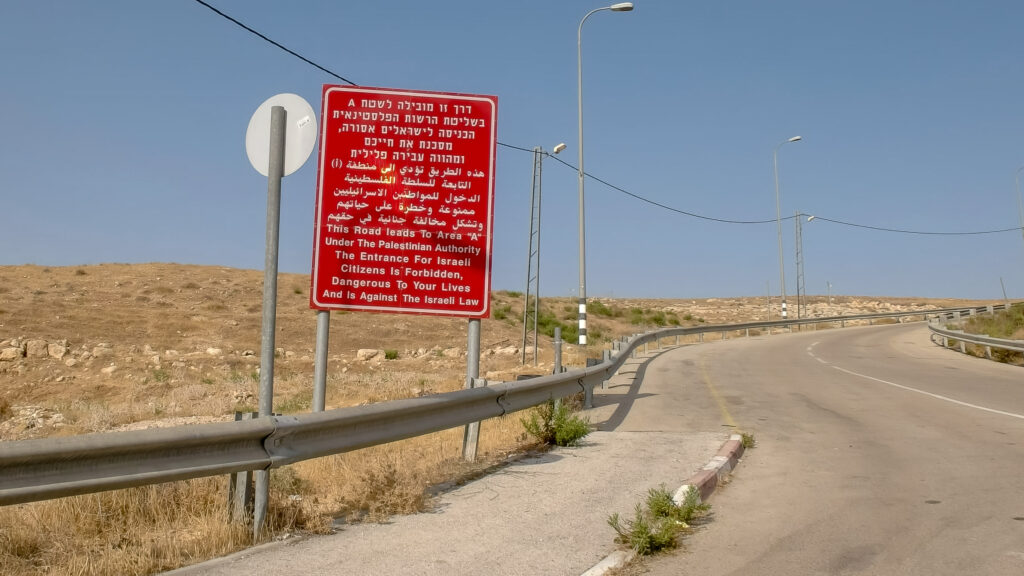
The result is a strange and rarely discussed asymmetry. The territory in question is governed entirely by the Palestinian Authority, with its own police, courts, and civil administration, not by Israel. And within that Palestinian-governed territory, Jewish Israelis face a real and repeatedly demonstrated risk of being surrounded, stoned, and in the worst cases killed, simply for driving through, while Arab Israeli citizens move across the same boundary lines each week without incident. Critics of Israel have spent decades applying the word “apartheid” to Israeli policy toward Palestinians. The pattern documented here runs in the opposite direction entirely: a governing authority, and a surrounding population, in which one ethnic and religious group can move freely and another cannot safely enter at all, where the danger is not theoretical but has produced a body count stretching from Vadim Nurzhitz and Yosef Avrahami in 2000 to Amnon Muchtar in 2024 to a mother and her son who simply missed a turn last week. Whatever term applies to a line that only Jews die for crossing, it is not the term usually used to describe the country on the other side of it.
