



Dinesh D’Souza, the bestselling author and filmmaker best known for political documentaries like “2000 Mules,” is turning his attention to a very different kind of evidence gathering. His new book, “The Stones Cry Out: Biblical Archaeology, Prophecy and the Last Days,” arrives October 13 from Charisma House, and it applies the same evidence-first instinct that drives his political work to a question of a different order entirely: whether the events of the Bible actually happened.
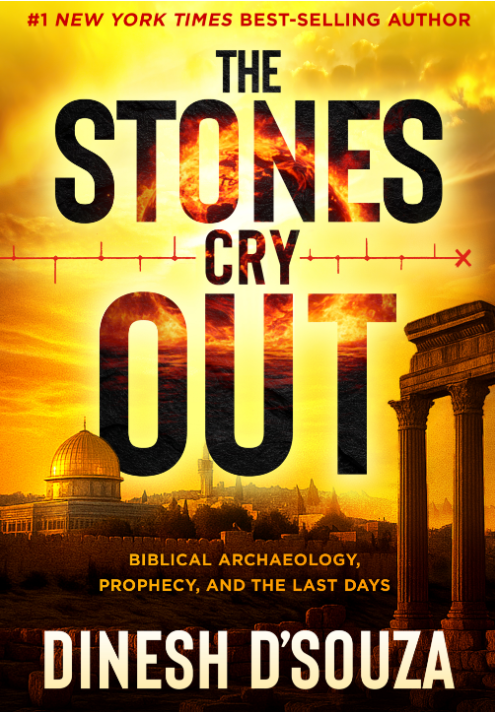
The project traces back to a 2022 trip D’Souza took to Israel, after which he spent three years visiting excavation sites across the biblical world. “I have come away from reading, reflecting and studying with the exhilarating recognition that the events and people of the Bible are real,” D’Souza said in the announcement. “It’s all true. What I previously accepted on faith is now supported and corroborated by scientific fact.” The book walks through the archaeological record and ongoing scholarly debate around King Solomon’s Temple, the destruction of Sodom and Gomorrah, the Exodus and ancient Egypt, the walls of Jericho, and the crucifixion, burial, and resurrection of Jesus. Each chapter includes video access that places readers at the excavation sites, and D’Souza extends the project beyond history into prophecy, connecting the archaeological record to the end-times material in the book of Revelation and what he argues it signals about the present moment.
D’Souza has been named one of America’s most influential conservative thinkers by The New York Times Magazine and one of the nation’s leading authorities on international affairs by the World Affairs Council, credentials that travel with him from the political documentary world into this new project.
The Case He Makes for the Exodus
D’Souza laid out a preview of his argument in a Substack post built around the Exodus, and it is a useful window into how the book actually argues its case rather than simply asserting it. His starting point is Psalm 114:1: When Israel came out of Egypt, the house of Jacob from a people of strange language.
He leans heavily on two scholars in particular, the archaeologist Kenneth Kitchen and the Egyptologist James Hoffmeier, both of whom have spent much of their careers testing the biblical narrative against the Egyptian archaeological record. The details D’Souza cites are specific rather than general. Genesis 37:28 prices Joseph’s sale into slavery at 20 shekels, a figure that matches the documented slave price in Mari and the laws of Hammurabi specifically for the eighteenth and nineteenth centuries BCE, a price that both rose and fell in other eras, meaning a later writer inventing the detail would have had no obvious way to get it right. The Beni Hasan tomb painting, dated to the mid-nineteenth century BCE, depicts a procession of Semitic men, women, and children arriving in Egypt in the brightly colored clothing the Bible associates with Jacob’s family. A separate scene from the tomb of Rekhmire, vizier under Pharaoh Thutmose III, shows foreign laborers making mud bricks under Egyptian overseers, an image D’Souza ties directly to Pharaoh’s order in Exodus: Ye shall no more give the people straw to make brick, as heretofore: let them go and gather straw for themselves. And the tale of the bricks, which they did make heretofore, ye shall lay upon them; ye shall not diminish ought thereof. (Exodus 5:7-8) Archaeological work in Egyptian cities, including Pi-Ramesses, has separately confirmed that straw was a standard component of brickmaking in exactly this period.
D’Souza also draws on linguistic evidence: the Exodus narrative uses vocabulary distinctive to Egypt’s New Kingdom period that appears nowhere else in the Bible, the name Moses mirrors the common Egyptian royal element “mose” seen in names like Thutmose and Ramesses, and the text’s habit of never naming a specific pharaoh matches standard Egyptian royal record-keeping conventions of the era rather than reading as a later fabrication. The centerpiece of the argument is the Merneptah Stele, discovered in 1896 by Flinders Petrie and dated to 1207 BCE, which records that “Israel is laid waste, his seed is no more,” the earliest known reference to Israel as a people outside the Bible itself, and proof that whatever the exact date of the Exodus, it had to precede that inscription by enough time for the Israelites to have become a recognizable political entity.
Where the Book Fits Among Others in the Field
D’Souza’s title carries an unusual amount of history. Nearly three decades before D’Souza’s book, biblical scholar and archaeologist Randall Price published his own book under the identical title, “The Stones Cry Out: What Archaeology Reveals About the Truth of the Bible,” in 1997. Price’s book covers strikingly similar ground, Sodom and Gomorrah, the fall of Jericho’s walls, the kings of Israel, and the archaeology surrounding Jesus, and was built on interviews with practicing archaeologists rather than D’Souza’s site-visit approach. Price, who has directed excavations at Qumran and holds a doctorate in Middle Eastern studies, wrote explicitly as a rebuttal to what he called the “minimalist” school of biblical archaeology. Whether D’Souza’s publisher chose the title deliberately or arrived at it independently, readers searching for “The Stones Cry Out” will now find two different books making largely the same case nearly thirty years apart.
The scholarly foundation D’Souza builds on is well established in its own right. Kenneth Kitchen’s “On the Reliability of the Old Testament” remains the most comprehensive academic defense of the Bible’s historical accuracy, running past 600 pages of Egyptological and Near Eastern comparative evidence. James Hoffmeier, the Egyptologist D’Souza cites directly, authored two book-length studies on the same territory, “Israel in Egypt” and “Ancient Israel in Sinai,” both of which make the specific case that the biblical writers show a level of Egyptian cultural and geographic detail that would be difficult to fabricate from a distance. More recently, Titus Kennedy’s “Unearthing the Bible: 101 Archaeological Discoveries That Bring the Bible to Life” covers similar ground in a more popular, catalog-style format aimed at general readers rather than specialists.
All of this scholarship exists in direct tension with the opposing camp in biblical archaeology, sometimes called the “minimalist” school, represented most prominently by Israel Finkelstein and Neil Asher Silberman’s “The Bible Unearthed,” which argues that archaeological evidence contradicts or fails to support major portions of the biblical narrative, including large parts of the Exodus and conquest accounts. D’Souza’s book, like Price’s before it and Kitchen’s and Hoffmeier’s scholarly work underlying it, positions itself explicitly against that reading, arguing that the accumulating weight of specific, hard-to-fabricate details points the other way. Whether general readers find that case persuasive will likely depend less on any single discovery than on which side of that broader scholarly divide they were already inclined to trust.

