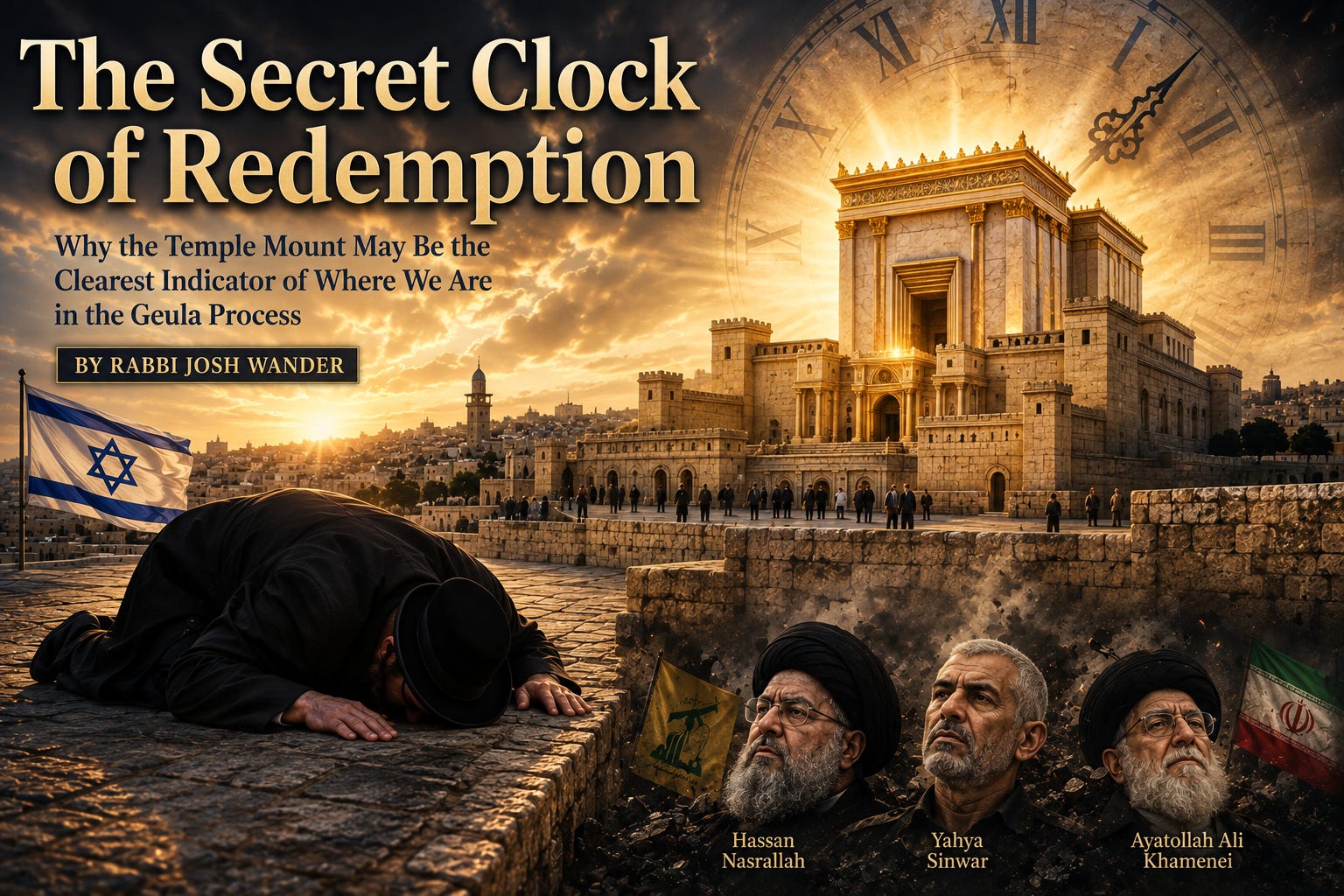
Everyone wants to know where we are holding in the process of Geula, the final redemption. We look at wars and peace agreements, antisemitism and Aliyah, political upheaval and events throughout the Middle East. We search the words of our prophets and Sages, trying to match ancient descriptions with today’s headlines. But perhaps we are watching too many clocks. There may be one gauge more sensitive than all the others, sitting precisely where Jewish tradition tells us the center of the world has always been: the Temple Mount.
The Temple Mount is not simply another holy site. Jewish tradition describes the place of the Beit HaMikdash, the Holy Temple, as the spiritual center of creation, the point connecting heaven and earth, the spiritual and physical worlds. It is the place Hashem chose for His Presence to be uniquely manifest in this world. Jewish prayer itself converges upon this point. Jews throughout the world turn toward Jerusalem; Jews in Jerusalem turn toward the Temple Mount; and on the Mount everything ultimately points toward the place of the Holy of Holies. If this is truly the spiritual center of the world, then even seemingly tiny developments there may reverberate far beyond the few meters upon which they occur.
For nearly two thousand years, the Jewish people had virtually no control over their holiest site. Then, in 1967, something almost unimaginable happened. Jewish soldiers returned to the Mount and declared, “Har HaBayit b’yadeinu”—“The Temple Mount is in our hands.” After almost two thousand years, Jewish sovereignty had returned to the heart of Jerusalem. Yet almost immediately we stepped backward. Israel retained overall sovereignty and security responsibility, while administration of the Mount’s Muslim holy places remained with the Islamic Waqf. We had returned physically, but psychologically we were still carrying the mentality of exile.
For almost sixty years, that contradiction largely defined the situation. But in just the past few years, quietly and almost beneath the radar of the broader Jewish world, a revolution has been taking place. Changes that would have been unimaginable only a few years ago are becoming increasingly commonplace. A prayer here, a bow there, another minyan, another group ascending—each can appear trivial. But if the Temple Mount really is what our tradition says it is, these changes are anything but trivial. They are earth-shattering.
Anyone who remembers ascending years ago remembers a radically different atmosphere. Jewish visitors could be subjected to intense harassment. Groups of Muslims would surround Jews, sometimes in large numbers, shouting “Allahu Akbar.” Jews were watched for the slightest indication of prayer, and even moving one’s lips could lead to intervention. The Jew had physically returned to Har HaBayit, the Temple Mount, but was still expected to behave there like a Jew in exile.
Then something changed. Jewish prayer became increasingly open. Minyanim formed. Torah was taught. Tallitot and siddurim, prayer books, appeared. A yeshiva and kollel framework developed, and Jews began performing hishtachavaya—full prostration—in prayer. At the same time, the scenes of large Muslim groups surrounding and intimidating Jewish visitors largely faded. Today, organized Muslim groups may even be brought to the Mount to maintain a conspicuous daily Muslim presence. Whatever explanation one gives, the symbolism is difficult to miss: when Jews were afraid to behave as Jews on Har HaBayit, others dominated the space. As Jewish religious confidence grew, the atmosphere itself changed.
Perhaps nothing illustrates this more powerfully than hishtachavaya. Jewish law generally prohibits full prostration upon stone outside the Mikdash, yet because of the unique status of the Temple area, prostration there belongs to an entirely different religious category. An act associated with the Mikdash and its avodah, its service, is returning to the mountain upon which it belongs. A Jew falls upon the ground before Hashem on Har HaBayit. The act takes seconds; in the sweep of Jewish history it is enormous.
And then comes an observation I find impossible to ignore. As Jewish prostration became increasingly visible on the Temple Mount, we simultaneously began watching some of Israel’s most formidable enemies literally fall. Hassan Nasrallah fell. Yahya Sinwar fell. Ayatollah Ali Khamenei fell. Other senior leaders and commanders followed. I am not claiming that we possess Hashem’s heavenly accounting books or can scientifically demonstrate that one caused the other. But Judaism has never taught that spiritual actions are disconnected from physical reality. The image is astonishing: Jews falling before Hashem at the place of His Mikdash while those seeking their destruction fall around them. We see the Jew bow and stand back up; what we cannot see are the ripples.
Yet perhaps the greatest indication of how much Galut consciousness remains within us is that most Jews are satisfied stopping at the Kotel, the Western Wall. Jews travel from around the world to kiss its stones, cry against them and frequently describe the Kotel—incorrectly—as “Judaism’s holiest site.” The Kotel is unquestionably sacred and has absorbed the tears of generations, but it is fundamentally a retaining wall of the Temple Mount. Its extraordinary significance comes precisely from what lies behind and above it. The destination was never supposed to be the wall; the destination is the place the wall was built to support.
For generations the Kotel represented the closest we could come. There was something entirely appropriate about that in Galut. We stood outside, looked toward what we had lost and cried over what we could not reach. But history has changed, and our national psychology must change with it. We have returned to Eretz Yisrael, restored Jewish sovereignty, gathered millions of Jews from the four corners of the earth and returned to Jerusalem. Yet it is possible to leave Galut physically while continuing to carry Galut inside our heads.
That may be precisely the psychological evolution we are witnessing today. Galut taught us how to survive without sovereignty, how to remember, mourn, yearn and pray. Those instincts preserved us for two thousand years. Geula demands something additional: responsibility, confidence, initiative and recognition that when Hashem returns opportunities to our hands, our role cannot remain limited to crying about what is missing. The movement from the Kotel to Har HaBayit therefore represents far more than walking a few hundred meters. It is a journey from standing outside to beginning to return inside, from mourning the past to preparing for the future. The physical distance traveled may be measured in meters; the psychological distance traveled is two thousand years.
Perhaps this transition is even hinted at in Tehillim: “כי רצו עבדיך את אבניה ואת עפרה יחוננו”—“For Your servants cherish her stones and favor her dust.” I see in these words two stages of our return. There are Jews who have rediscovered Jerusalem through אבניה—“her stones.” They embrace the stones of the Kotel, kiss them and pour out their hearts beside them. That itself represents an extraordinary return after generations in which even those stones were beyond our reach.
But then comes “ואת עפרה יחוננו”—“and they favor her dust.” Some Jews take the next step. They ascend Har HaBayit and literally lower themselves onto its earth in hishtachavaya before Hashem. They move from the stones of the retaining wall to the ground of the place toward which those stones point: אבניה—her stones; עפרה—her earth. The physical movement is tiny, but spiritually and psychologically it represents an enormous next step.
What makes this interpretation particularly striking is the very next verse: “אתה תקום תרחם ציון כי עת לחננה כי בא מועד”—“You will arise and have mercy upon Zion, for it is time to favor her; the appointed time has come.” The sequence is remarkable. Hashem’s servants cherish her stones, then favor her earth, and immediately afterward comes the declaration: כי עת לחננה כי בא מועד—“For it is time to favor her; the appointed time has come.” I would not suggest that this is the simple meaning of the verse or that it provides a prophetic timetable, but as an image of what we are witnessing it is extraordinary. For generations we embraced the stones. Today Jews are once again placing their faces upon the earth of Har HaBayit, and the next words speak of עת—time—and מועד—appointed time.
There may be another hand on this secret clock. A remarkable tradition is attributed to the Vilna Gaon that if the Jewish people succeed in properly bringing even one korban, one sacrifice, at the place of the Mikdash, it would open the way to the final Geula. Consider how radically different such an idea sounds today compared with only a few generations ago. For almost two thousand years, bringing a korban on Har HaBayit seemed impossibly remote. Today Jews control Jerusalem, Kohanim study the avodah, Temple vessels and garments have been researched and prepared, and practical halachic discussions surrounding korbanot have moved from what once seemed purely theoretical into contemporary debate. Enormous obstacles remain, but something that sounded like fantasy to our grandparents is no longer geographically or technically unimaginable. We are getting extremely close to circumstances previous generations could scarcely have imagined.
Look at the progression. Jews returned to the Mount. Prayer returned. Torah learning returned. Tallitot and siddurim returned. Hishtachavaya returned. Practices once considered unimaginable moved from impossible, to controversial, to tolerated, and finally to reality. What happens when the next seemingly impossible step becomes possible? If the tradition attributed to the Vilna Gaon is correct, the next tiny movement of this clock may not be tiny at all.
Yet if something so extraordinary is happening, why do so few Jews seem to recognize it? Here another teaching of the Vilna Gaon may provide the answer. The Torah describes Yosef standing before his brothers with the words “ויכר יוסף את אחיו והם לא הכירוהו”—“Yosef recognized his brothers, but they did not recognize him.” The Gra explains this as a model for redemption: just as Yosef stood directly before his brothers while they remained unaware of who he was, so too the Geula can unfold directly before the Jewish people while they remain oblivious to what they are witnessing.
What an extraordinary description of our generation. Jews have returned from the four corners of the earth. Eretz Yisrael has blossomed. Jewish sovereignty has returned after nearly two thousand years. Jerusalem is again the capital of a Jewish state. Har HaBayit is under Jewish sovereignty, while Jews ascend, pray, learn Torah and prostrate themselves at the place of the Mikdash. And yet millions of Jews can look directly at all of this and see nothing particularly extraordinary. “והם לא הכירוהו”—“but they did not recognize him.” Perhaps the danger is not that Geula is not happening, but that it can be standing directly before us and we fail to recognize it.
This fits perfectly with the tradition that Geula unfolds kima kima—little by little. Dawn does not begin with a blazing sun suddenly appearing overhead. It begins with an almost imperceptible change in the darkness. Yesterday’s impossibility becomes today’s controversy, then tomorrow’s normality, and we become accustomed to each development before the next one arrives. Someone sleeping notices nothing, while someone watching the eastern horizon sees everything. Perhaps Har HaBayit is that horizon.
Strangely enough, the nations sometimes seem more sensitive to what is happening there than we are. A Jewish prayer, a politician’s visit or a seemingly minor change on the Mount can trigger diplomatic reactions across the globe. Governments thousands of kilometers away monitor what happens on these few acres in Jerusalem. The world seems to understand that this place is not ordinary, while many Jews remain oblivious to the transformation occurring before their eyes.
This does not mean that every incident on the Mount is a prophetic sign or that we can calculate the arrival of Moshiach by counting visitors, minyanim or acts of prostration. Geula is not a mathematical formula we possess. But there is an enormous difference between predicting the future and recognizing direction. Someone watching a sunrise may not know the exact second the sun will clear the horizon, but he certainly knows that the darkness is receding.
That is why I believe the Temple Mount may be the secret clock of Geula. Watch what was impossible yesterday become normal today. Watch Jewish consciousness change. Watch a nation slowly shed the psychology of exile and rediscover what it means to live in an era of return. For two thousand years we prayed toward this mountain. Then we returned to the Land, then to Jerusalem, then to sovereignty over the Mount, and now another stage appears to be unfolding as the Jewish people begin to relate to Har HaBayit not merely as a distant symbol of something destroyed long ago, but as a living part of our national and spiritual future.
The casual observer sees a few Jews walking on a mountain. Someone attuned to Jewish history sees something else entirely: he sees the gears of history moving. Perhaps the greatest danger at this stage is not that nothing is happening, but that everything is happening and we fail to recognize it. So if you want to know where we are holding, keep one eye on the headlines, but keep the other on Har HaBayit. The headlines tell us what happened today; the Mount may be telling us what time it is.
This appeared in Rabbi Wander’s Substack. Click here to subscribe.