




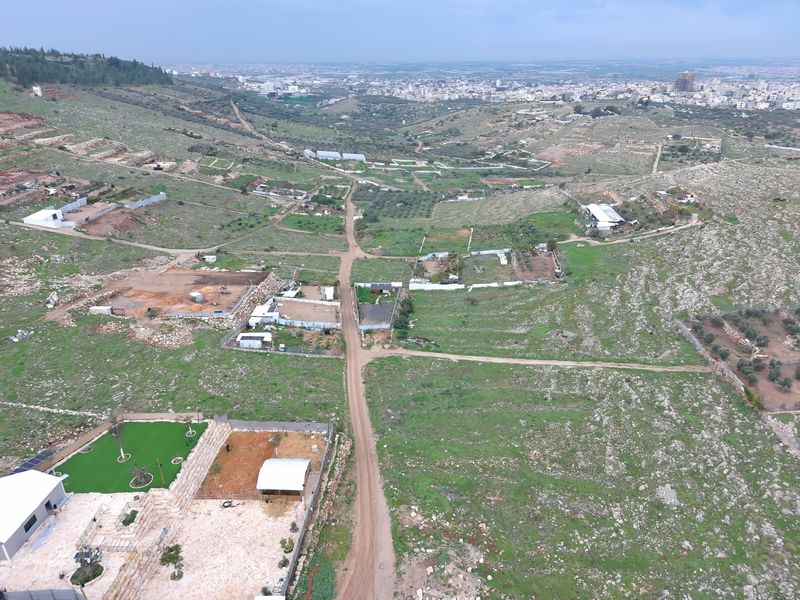
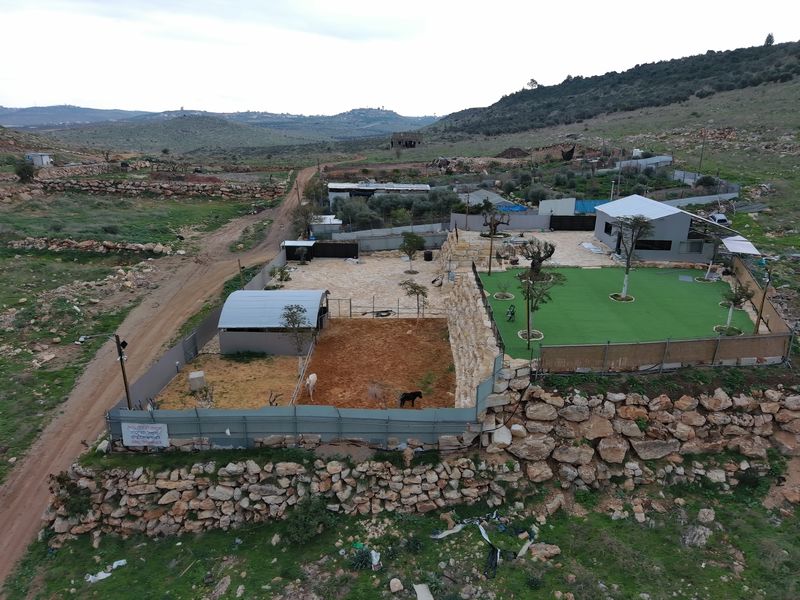
The Regavim Movement and the Samaria Regional Council have petitioned the Jerusalem District Court to demand the demolition of an illegal residential compound built inside an enclave between the Green Line and the security barrier in western Samaria, near the town of Sal’it.
It is important to note that the Taybeh at the center of this case is not the Christian town of the same name located northeast of Ramallah, a small community sometimes identified by tradition with the biblical Ephraim of the Gospel of John. The Taybeh in the Regavim petition is a different place entirely: an Arab-Israeli city in the Triangle region of central Israel, roughly four kilometers north of Kfar Saba and directly on the Green Line. No verifiable biblical identification exists for this Taybeh.
This Taybeh has produced a documented series of terrorists in recent years. In June 2026, a Taybeh resident carried out a shooting attack in the Sharon area near the seam line, murdering a retired IDF sergeant major from Tzur Natan and wounding five others before being killed by security forces following a manhunt. In August 2025, a Taybeh resident was indicted for a car-ramming attack on soldiers and civilians near Kfar Yona that wounded nine people, allegedly carried out in response to the Gaza war. Shin Bet reporting has also named Taybeh residents recruited into ISIS-linked and Hamas-linked terror cells, including a man who swore allegiance to ISIS and passed intelligence to Hamas operatives in Tulkarem, and another who supplied the weapon used in a shooting attack near Tzur Yitzhak. In 2008, Taybeh men were convicted of plotting to plant explosives on Israel Railways tracks in Netanya on behalf of the al-Aqsa Martyrs’ Brigades. In 2000, a Hamas cell based in Taybeh planned coordinated bombings in Tel Aviv, Netanya, Holon, and Kfar Saba; several of its operatives were killed when security forces raided a house in the town.
Regavim and the Samaria Regional Council filed an urgent administrative petition against the defense minister, the minister in the Defense Ministry, and enforcement authorities in Judea and Samaria, demanding immediate action against development and construction on an illegal residential compound and a new horse farm east of Taybeh near Sal’it. The petition states that construction at the site is ongoing: since Regavim’s first appeal against the compound, additional lots have been fenced off, and new mobile structures have been placed there in recent months.
According to Regavim, the case reflects the exploitation of a geographic “no-man’s land.” The compound sits in Area C, under full Israeli control, but lies west of the separation barrier, adjacent to Taybeh. The route of the security fence diverges from the diplomatic seam line at this point, creating a large enclave that enforcement authorities on both sides of the Green Line have left unaddressed for years. Beyond the compound named in the petition, other illegal structures and agricultural projects have taken root in the same area. The petition describes the situation as “a failure that creates a real vacuum in the seam-line area and provides fertile ground for construction offenses and, no less, a security risk.”
Regavim sharply criticized what it called prolonged foot-dragging by enforcement authorities, who did not respond to any of its appeals over the past year. The petition notes that this negligence has cost Israel the ability to use fast-track enforcement tools, such as an order to remove new structures, because people have since taken up residence in the illegal buildings. The petition argues that this amounts to an unreasonable abdication of law enforcement, and asks the court to order the respondents to exercise their authority, carry out the demolition orders, open a criminal investigation against the offenders, and disclose their identities so that full legal proceedings can follow.
Roi Drucker, Regavim’s Judea and Samaria Regional Coordinator, said: “Over the past two years, we have witnessed a dramatic change in Judea and Samaria and a significant assumption of responsibility by the State of Israel after years of lawlessness. However, there are still many areas that remain ‘out of sight, out of mind,’ and the time has come to enforce the law there as well.”
Yossi Dagan, head of the Samaria Regional Council, said: “This petition is an expression of our responsibility, of genuine concern for the security of our residents. This enclave along the seam line has become a no-man’s land, and while the enforcement authorities turn a blind eye and do not even respond to appeals, the offenders are enjoying a frenzy of illegal construction in the very heart of Area C, which is under full Israeli control.”
Dagan continued: “One of the important lessons of October 7 is that ‘innocent civilian activity’ along the seam line is an ideal launching pad for terrorism. We cannot allow illegal construction along the seam line in Samaria — this is a real and immediate security threat to residents and security forces, and fertile ground for crime and terrorism that impacts the entire State of Israel. We must not turn a blind eye to these weak links in the chain.”

